
航运

Search documents
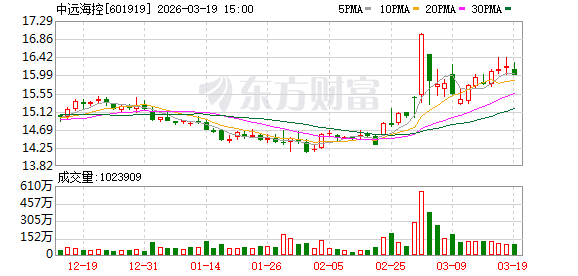
中远海控:2025年净利润308.68亿元 同比下降37.13%
Di Yi Cai Jing· 2026-03-19 12:57
中远海控公告,2025年营业收入2195.04亿元,同比下降6.14%;归属于上市公司股东的净利润308.68亿 元,同比下降37.13%。公司拟向全体股东每股派发现金红利人民币0.44元(含税)。 (文章来源:第一财经) ...


PA联盟价格较低,关注4月份高运力下的需求成色
Hua Tai Qi Huo· 2026-03-19 08:17
Report Industry Investment Rating - Not provided Report's Core View - The PA Alliance has relatively low prices, and attention should be paid to the demand in April under high capacity. The EC2604 contract is approaching delivery, and investors are advised to closely follow the spot market and operate flexibly. The contracts for the relatively peak seasons of June, July, and August are expected to be strong, but there are uncertainties. The strategy is to go long on EC2606 and short on EC2610 [1][6][8] Summary by Relevant Catalog 1. Futures Price - As of March 18, 2026, the total open interest of all contracts of the container shipping index European line futures was 49,092.00 lots, and the single - day trading volume was 42,436.00 lots. The closing prices of EC2604, EC2605, EC2606, EC2607, EC2608, EC2609, EC2610, and EC2512 contracts were 1905.30, 2137.00, 2342.00, 2475.00, 2316.00, 1693.30, 1525.40, and 1718.80 respectively [7] 2. Spot Price - On March 13, the SCFI (Shanghai - Europe route) price was $1618/TEU, the SCFI (Shanghai - US West route) was $2249/FEU, and the SCFI (Shanghai - US East) was $3111/FEU. On March 16, the SCFIS (Shanghai - Europe) was 1556.49 points, and the SCFIS (Shanghai - US West) was 1109.11 points [7] 3. Container Ship Capacity Supply - **Static Supply**: As of February 28, 2026, 27 container ships with a total capacity of 174,232 TEU were delivered in 2026. From 2026 to 2029, there are clear delivery plans for ships of 12,000 - 16,999 TEU and over 17,000 TEU. The delivery pressure of ultra - large ships in 2026 is relatively small, while in 2027, 2028, and 2029, the annual delivery volume of over 17,000 TEU ships exceeds 40 [4] - **Dynamic Supply**: The average weekly capacity of the China - European base port in the remaining 3 weeks of March was 308,200 TEU, and the weekly capacities in weeks 12, 13, and 14 were 310,600, 282,100, and 331,800 TEU respectively. In April, the average weekly capacity was 326,200 TEU. In May, the average monthly capacity was 311,800 TEU. There were 8 blank sailings in March and some TBNs in March, April, and May [5] 4. Supply Chain - The US government is considering sending thousands of additional US troops to the Middle East while Trump weighs the next move against Iran. After the Israel - Iran conflict, shipping companies try to support prices in the off - season. Some large ships are transferred from the Middle East route to the Asia - Europe route, increasing supply - side pressure and potentially affecting European line freight rates [4][5] 5. Demand and European Economy - The year - on - year growth rate of the demand side of the Asia - Europe route has been relatively high, with the container trade volume in most months having a year - on - year growth rate of over 10%. The peak - season contracts in June, July, and August are expected to be strong, mainly because the probability of the Suez Canal's resumption in the first half of 2026 is relatively low, the delivery pressure of ultra - large container ships in the first half of 2026 is small, and the demand side has a high growth rate. However, it is also necessary to pay attention to the impact of oil price fluctuations on the economy and demand [6]
美联储对关税通胀更谨慎:环球市场动态2026年3月19日
citic securities· 2026-03-19 05:17
Market Overview - U.S. stock indices fell over 1% due to inflation concerns and geopolitical uncertainties, with the Dow Jones down 1.63% to 46,225.2 points, S&P 500 down 1.36% to 6,624.7 points, and Nasdaq down 1.46% to 22,152.4 points[3][11]. - Brent crude oil futures rose nearly 4% to $110 per barrel, driven by escalating tensions in the Middle East and a hawkish stance from the Federal Reserve[4][28]. Federal Reserve Insights - The Federal Reserve maintained the policy interest rate at 3.50%-3.75%, aligning with market expectations, while raising inflation and economic growth forecasts slightly[6][11]. - The February PPI exceeded expectations at 3.4% year-on-year, increasing concerns about inflation and potential rate hikes[11][32]. Asian Market Performance - The Hong Kong Hang Seng Index rose 0.61% to 26,025.42 points, driven by AI computing and power equipment sectors, while real estate and automotive sectors lagged[13][16]. - A-shares saw a collective increase, with the Shanghai Composite Index up 0.32% to 4,062.98 points, led by the computing industry[16]. Commodity and Currency Movements - Gold prices fell 3.74% to $4,818.5 per ounce, marking the sixth consecutive day of decline due to rising oil prices and a stronger dollar[4][28]. - The U.S. dollar index increased by 0.5% to 100.09, reflecting the impact of higher oil prices and inflation concerns[27]. Bond Market Trends - U.S. Treasury yields rose by 4-10 basis points, with the 2-year yield at 3.77% and the 10-year yield at 4.27%[5][32]. - The Asian bond market remained stable, with spreads narrowing by 2-4 basis points, indicating a preference for buying[32].
集运指数(欧线):宽幅震荡,关注地缘情绪扰动
Guo Tai Jun An Qi Huo· 2026-03-19 05:15
2026 年 3 月 19 日 集运指数(欧线):宽幅震荡,关注地缘情绪扰动 郑玉洁 投资咨询从业资格号:Z0021502 zhengyujie@gtht.com 黄柳楠 投资咨询从业资格号:Z0015892 huangliunan@gtht.com 【基本面跟踪】 表 1:集运指数(欧线)基本面数据 | 期货 | 合约 | 昨日收盘价 | 日涨跌 | 昨日成交 | 昨日持仓 | | 持仓变动 昨日成交/持仓 | 前日成交/持仓 | | --- | --- | --- | --- | --- | --- | --- | --- | --- | | | EC2604 | 1,905.3 | -1.71% | 27,129 | 21,187 | -2,265 | 1.28 | 1.24 | | | EC2606 | 2,342.0 | -2.15% | 10,169 | 13,686 | -462 | 0.74 | 0.64 | | | EC2608 | 2,316.0 | -1.84% | 1,094 | 2,770 | -6 | 0.39 | 0.22 | | | EC2610 | 1,525.4 | -2. ...
永安期货集运早报-20260319
Yong An Qi Huo· 2026-03-19 05:12
1. Report Industry Investment Rating - No information provided in the given content 2. Core View of the Report - It is recommended to mainly adopt a wait - and - see approach. Contract 04 is gradually entering the delivery logic, and it is necessary to observe whether there are opportunities for basis repair. Although historically, the reverse spreads of 6 - 7 and 6 - 8 are reasonably valued, it still depends on the duration of the geopolitical situation. If the issue is resolved in May, the current structure is also reasonable [2] 3. Summary by Relevant Catalogs Futures Contract Information - **Contract Prices and Changes**: EC2604 closed at 1905.3 yesterday, down 4.95%; EC2605 at 2137.0, down 4.64%; EC2606 at 2342.0, down 4.53%; EC2607 at 2475.0, down 2.93%; EC2608 at 2316.0, down 3.54%; EC2609 at 1693.3, down 3.34%; EC2610 at 1525.4, down 3.46%; EC2612 at 1718.8, down 4.56% [2] - **Trading Volume and Open Interest**: The trading volume and open interest of each contract vary, with some contracts showing a decrease in open interest, such as EC2604 with an open - interest change of - 2265, and EC2605 with a change of - 81 [2] - **Monthly Spread**: The monthly spreads of different contract combinations have changed. For example, the spread of EC2604 - 2606 was - 436.7, with a day - on - day increase of 11.8 and a week - on - week decrease of 19.9 [2] Spot Market Information - **Spot Price and Index**: The spot price (in points) was 1545.46 on March 9, 2026, up 5.61% from the previous period. The SCFI (European Line) was 1618 US dollars/TEU on March 13, 2026, up 11.43% from the previous period [2] - **European Line Spot Price Increase**: In March, OA and PA alliances, and MSC announced price increases to around 4000 US dollars. In Week 12, the average price was 2450 US dollars, equivalent to about 1715 points on the futures market. In Week 13, MSK kept the price flat at 2250 US dollars, and other shipping companies quoted around 2700 - 3000 US dollars. On Tuesday, Maersk opened the cabin for the first week of April (Week 14) at 2650 US dollars (up 400 US dollars from the previous period) [3] News - **Fuel Surcharge Increase**: On March 18, CMA CGM raised the emergency fuel surcharge from 150 to 265 US dollars/TEU [4] - **Geopolitical Events**: On March 18, Iran's National Television reported that parts of the South Pars Gas Field and the Asaluyeh Petroleum Industry Facilities were attacked. On March 19, the US Senate rejected the resolution to limit the use of force against Iran again. Trump is considering sending thousands of troops to the Middle East and evaluating ground - action options. Iran warned that if the attacks continue, it will expand the scope of strikes to all energy infrastructure of US and Israeli allies [4][5]
集运欧线数据日报-20260319
Shen Yin Wan Guo Qi Huo· 2026-03-19 02:53
Report Summary 1. Report Industry Investment Rating - Not provided in the given content 2. Core View of the Report - The European container shipping line (EC) has declined by 1.71%. Maersk (MSK) has opened new bookings for the first week of April, with a large container quote to Rotterdam at $2,600, a $400 increase from the previous period, and the quote is basically on par with the online average price of shipping companies at the end of March. The European line has passed the first stage after the US - Iran conflict, where freight rates soared due to supply - chain uncertainties. With the increase in fuel costs caused by the conflict, most shipping companies have implemented emergency fuel surcharges. The main logic of the European line is gradually returning to supply - demand pricing, but sentiment is still affected by geopolitical changes. Referring to past seasonality, cargo volume is expected to gradually increase in April as the resumption of work is completed, but there may be pressure due to the end of the rush - export of products like photovoltaic. If the geopolitical conflict does not subside, shipping companies will be more inclined to raise and maintain prices. Attention should be paid to the quotes of other shipping companies in the future [1] 3. Summary According to Relevant Catalogs EC Contract Volume and Price | Contract | Latest Transaction Price (Points) | Latest Percentage Change (%) | Trading Volume (Change) | Open Interest (Change) | Long Positions (Top 20 Members) | Short Positions (Top 20 Members) | Net Long Positions (Top 20 Members) | | --- | --- | --- | --- | --- | --- | --- | --- | | EC2604 | 1905.3 | -1.71 | 27129 (-1988) | 21187 (-2265) | 12188 | 14266 | -2078 | | EC2606 | 2342 | -2.15 | 10169 (1057) | 13686 (-462) | | | | | EC2608 | 2316 | -1.84 | 1094 (489) | 2770 (-6) | | | | | EC2610 | 1525.4 | -2.41 | 2351 (-52) | 7808 (-147) | | | | | EC2612 | 1718.8 | -4.52 | 113 (42) | 411 (6) | | | | | Total | - | - | 40856 | 45862 | 12188 | 14266 | -2078 | [2] Latest Spot Freight Rates - European Routes | Spot Index | Indicator | Latest Period | Percentage Change | Previous Period | Percentage Change | Two Periods Ago | Percentage Change | | --- | --- | --- | --- | --- | --- | --- | --- | | (Weekly) | SCFIS - Points | 1556.49 | 0.7% | 1545.46 | 5.6% | 1463.4 | -7.0% | | | SCFI - $/TEU | 1618 | 11.4% | 1452 | 2.3% | 1420 | 4.3% | | | TCI(20GP) | 1869 | -5.3% | 1975 | 11.8% | 1767 | 0.0% | | Spot Freight Rates (Daily) | $/TEU | | | | | | | | | TCI(40GP) $/FEU | 3133 | -4.1% | 3266 | 13.5% | 2877 | 0.0% | [4] Basis Spread (Points) - The basis spread of the previous trading day was -348.81, and that of the day before the previous trading day was -448.01, with a change of 99.2 [6]
交运月度会-交易-运价弹性-与-供应链重塑
2026-03-19 02:39
Summary of Conference Call Notes Industry Overview - **Industry Focus**: Transportation and logistics sectors, including shipping, rail, air travel, and express delivery services - **Geopolitical Context**: The situation in the Strait of Hormuz is impacting shipping, rail, and hazardous materials logistics positively, while high oil prices are increasing operational costs across various transport sectors Key Points and Arguments Shipping and Logistics - **Shipping Industry**: The daily passage through the Strait of Hormuz has decreased significantly, affecting 31% of global oil shipping exports and 5% of container shipping, leading to a re-evaluation of shipping rates and a potential restructuring of shipping networks [1][2] - **Rail Transport**: High oil prices are increasing road transport costs, making rail transport more attractive. The Daqin Railway is expected to benefit from increased coal transport demand due to rising coal prices linked to oil price increases [1][2] - **Hazardous Materials Logistics**: Companies with a high percentage of chemical and oil products in their storage are likely to benefit from increased demand for stockpiling, potentially raising warehouse rental rates [3] Air Travel - **Cost Pressures**: The aviation sector is facing significant cost pressures due to rising fuel prices, with fuel costs accounting for approximately 35% of total operating costs. The expected increase in fuel surcharges could reach 170-180 RMB per flight segment [6][17] - **Market Dynamics**: The geopolitical situation is creating opportunities for Chinese airlines as travelers seek alternatives to Middle Eastern hubs, potentially increasing international passenger volumes by 13% if 25% of transit passengers shift to Chinese carriers [18][19] Express Delivery - **Market Trends**: The express delivery sector is experiencing a "reverse involution" trend, with prices in key areas like Yiwu increasing. Major companies like YTO and ZTO are expected to gain competitive advantages [1][5] Investment Recommendations - **Stock Selection**: It is recommended to focus on stocks with low correlation to Middle Eastern geopolitical risks and those with defensive attributes, such as Anhui Expressway and Shenzhen International. SF Express is highlighted for its alignment with high-quality growth trends in the express delivery sector [7] - **Shipping vs. Oil Transport**: The recommendation is to prioritize container shipping over oil transport due to lower expected volatility and higher certainty in returns, even amidst geopolitical tensions [8] Market Conditions - **Current Market Sentiment**: The overall sentiment in the transportation sector is cautious, with a preference for rail over road transport due to the latter's vulnerability to rising fuel costs. The express delivery sector shows signs of recovery, while air travel is under pressure from fuel costs [15][20] Airport Operations - **White Cloud Airport**: A new duty-free agreement has been signed with a commission rate reduced to 21%, which is expected to positively impact profits, although the overall profit elasticity will depend on the recovery of duty-free sales [22][23] Future Outlook - **Long-term Adjustments**: The geopolitical situation is expected to lead to profound adjustments in global logistics networks, with potential shifts in trade routes and increased congestion at major ports [4][10] Risks and Challenges - **Cost Transferability**: The ability of the air, road, and express delivery sectors to pass on increased costs to consumers is limited due to weak supply-demand dynamics, which may suppress market demand if oil prices remain high [2][6] Additional Important Insights - **Rail Freight Benefits**: The closure of the Strait of Hormuz is driving up coal prices in the Asia-Pacific region, benefiting rail freight operations like the Daqin Railway [10] - **Container Transport Opportunities**: The potential shift from sea to rail transport for high-value goods due to increased shipping costs could benefit the China-Europe Railway Express [11] This summary encapsulates the key insights and trends discussed in the conference call, providing a comprehensive overview of the current state and future outlook of the transportation and logistics sectors.

集运早报-20260319
Yong An Qi Huo· 2026-03-19 02:16
Report Industry Investment Rating - The report suggests a wait - and - see approach [2] Core Viewpoints - The EC2604 contract is gradually entering the delivery logic, and it is necessary to observe whether there is an opportunity for basis repair. Although the historical seasonality shows that the 6 - 7 and 6 - 8 reverse spreads have appropriate valuations, it still depends on the duration of the geopolitical situation. If the issue is resolved in May, the current structure is also reasonable [2] Summary by Related Catalogs Futures Contract Information - For the EC2604 contract, the previous closing price was 1905.3, with a decline of 4.95%, a basis of - 359.8, a trading volume of 27129, an open interest of 21187, and an open interest change of - 2265 [2] - For the EC2605 contract, the price was 2137.0, with a decline of 4.64%, a basis of - 591.5, a trading volume of 1060, an open interest of 1847, and an open interest change of - 81 [2] - For the EC2606 contract, the price was 2342.0, with a decline of 4.53%, a basis of - 796.5, a trading volume of 10169, an open interest of 13686, and an open interest change of - 462 [2] - For the EC2607 contract, the price was 2475.0, with a decline of 2.93%, a basis of - 929.5, a trading volume of 393, an open interest of 841, and an open interest change of 60 [2] - For the EC2608 contract, the price was 2316.0, with a decline of 3.54%, a basis of - 770.5, a trading volume of 1094, an open interest of 2770, and an open interest change of - 6 [2] - For the EC2609 contract, the price was 1693.3, with a decline of 3.34%, a basis of - 147.8, a trading volume of 127, an open interest of 542, and an open interest change of 8 [2] - For the EC2610 contract, the price was 1525.4, with a decline of 3.46%, a basis of 20.1, a trading volume of 2351, an open interest of 7808, and an open interest change of - 147 [2] - For the EC2612 contract, the price was 1718.8, with a decline of 4.56%, a basis of - 173.3, a trading volume of 113, an open interest of 411, and an open interest change of 6 [2] Month - to - Month Spread Information - The EC2604 - 2606 spread was - 436.7, with a daily increase of 11.8 and a weekly decrease of 19.9 [2] - The EC2604 - 2605 spread was - 231.7, with a daily increase of 4.7 and a weekly decrease of 186.3 [2] - The EC2606 - 2610 spread was 816.6, with a daily decrease of 56.4 and a weekly decrease of 39.9 [2] Spot Market Information - The spot price of the European line (Tolar) was 1545.46 points on March 9, 2026, with a week - on - week increase of 5.61% [2] - The SCFI (European line) was 1618 dollars/TEU on March 13, 2026, with a week - on - week increase of 11.43% [2] European Line Spot Situation - In late March, OA and PA alliances and MSC announced price increases to around 4000 US dollars [3] - In Week 12, MSK offered 2250 US dollars (a week - on - week increase of 400), QA alliance offered 2700 - 2800 US dollars, PA alliance offered 2200 US dollars (a reduction of 200 for large - volume orders), and MSC offered 2740 US dollars (a reduction of 200 for large - volume orders). The average price was 2450 US dollars, equivalent to about 1715 points on the futures market [3] - In Week 13, MSK kept the price at 2250 US dollars, while other shipping companies offered around 2700 - 3000 US dollars [3] - On Tuesday, Maersk opened the booking for the first week of April (Week 14) at 2650 US dollars (a week - on - week increase of 400) [3] - On Wednesday, YML offered 2400 US dollars for the last week of March (2200 US dollars for 3 routes), and MSC offered 2840 US dollars (2640 US dollars for large - volume orders) [3] News - On March 18, CMA CGM raised the emergency fuel surcharge from 150 to 265 US dollars/TEU [4] - On March 18, Iran's national TV reported that parts of the South Pars gas field and the Asaluyeh oil industrial facilities were attacked [4] - On March 19, the US Senate rejected the resolution to limit the use of force against Iran again [4] - On March 19, foreign media reported that Trump was considering sending thousands of US troops to the Middle East and evaluating ground - operation options [4] - On March 19, Iran stated that if the attacks continued, it would expand the scope of strikes to all energy infrastructure of US and Israeli allies [5]
美联储维持利率不变!美伊冲突引爆不确定性
Dong Zheng Qi Huo· 2026-03-19 00:45
1. Report Industry Investment Rating No relevant content provided. 2. Core Views - The Fed maintained the federal funds rate target range at 3.50% - 3.75% in March, in line with market expectations, but the future interest rate path is unclear. The escalation of the geopolitical conflict in the Middle East has added complexity, and the Fed's concerns about inflation have increased, but it is not yet at the stage of needing to raise interest rates. The US dollar is expected to continue to strengthen in the short term [18]. - The situation between the US and Iran has escalated again, leading to a continuous decline in global stock markets. The A - share market showed a shrinking - volume V - shaped reversal, but in the short term, there are few opportunities in the market, and it is recommended to wait and see the navigation situation in the Strait of Hormuz [23]. - The central bank conducted 20.5 billion yuan of 7 - day reverse repurchase operations. Although the US dollar and oil prices weakened during the bond futures trading session, with stocks and bonds strengthening, the news that the US has started to attack Iranian oil facilities has caused oil prices to strengthen again, and there are still negative disturbances in the bond market [3]. - The price of imported thermal coal in the market remained stable on March 18. Although the short - term price is stable, there is still an upward risk in the previous period. It is necessary to wait for external situation changes [4]. - Due to the Israeli attack on Iranian energy facilities, the weak fundamentals of zinc and the resonance of capital risk - aversion have led to a short - term continuation of the weak and volatile trend of zinc prices, and it is advisable to wait for the full release of market sentiment [5]. - After the Israeli attack on the Iranian gas field and Iran's vow to retaliate, oil prices have risen significantly, and the safety risk of energy facilities in the Middle East has increased significantly [6]. 3. Summary According to the Directory 3.1 Financial News and Comments 3.1.1 Macro Strategy (Gold) - Powell stated that most people do not consider raising interest rates as the basic expectation. If there is no progress in inflation, the Fed will not cut interest rates. The Fed maintained the federal funds rate target range at 3.50% - 3.75% in March, in line with market expectations. The US PPI in February increased more than expected, which increased short - term inflation pressure and reduced the Fed's willingness to cut interest rates. In the short term, precious metals will continue the weak and volatile trend. It is recommended to wait for the callback to buy gold, and silver performs weaker than gold [11][13][14]. 3.1.2 Macro Strategy (Foreign Exchange Futures - US Dollar Index) - The US producer price in February increased more than expected. The Fed maintained the interest rate unchanged in March, but the future economic outlook is unclear. Due to the impact of the US - Iran war on the US economy being uncertain, the Fed tends to continue observing. Overall, the Fed's concerns about inflation have increased, but it is not yet at the stage of needing to raise interest rates. The US dollar is expected to continue to rise in the short term [15][18][19]. 3.1.3 Macro Strategy (US Stock Index Futures) - Iran launched a large - scale missile attack on US - related energy facilities. The Fed maintained the interest rate unchanged, and Powell's statement was significantly hawkish, emphasizing the risk of rising oil prices on inflation and even mentioning the possibility of raising interest rates. The market's expectation of interest rate cuts has cooled again. In the short term, the US stock market will still operate weakly, and it is recommended to take a risk - averse and wait - and - see approach [20][21][22]. 3.1.4 Macro Strategy (Stock Index Futures) - The A - share market showed a shrinking - volume V - shaped reversal. Due to the escalation of the US - Iran situation, global stock markets continued to decline, and risk - aversion trading dominated. In the short term, there are few opportunities in the market, and it is recommended to wait and see the navigation situation in the Strait of Hormuz. The stock index strategy should adopt a low - position risk - aversion approach [23][24]. 3.1.5 Macro Strategy (Treasury Bond Futures) - The central bank conducted 20.5 billion yuan of 7 - day reverse repurchase operations, with a net withdrawal of 6 billion yuan on the day. Although the US dollar and oil prices weakened during the bond futures trading session, with stocks and bonds strengthening, the news that the US has started to attack Iranian oil facilities has caused oil prices to strengthen again, and there are still negative disturbances in the bond market. In the short term, the cost - performance of short - selling is slightly higher than that of long - buying [25][26]. 3.2 Commodity News and Comments 3.2.1 Black Metal (Thermal Coal) - On March 18, the price of imported thermal coal in the market remained stable. Due to factors such as the Ramadan in Indonesia and the incomplete implementation of RKAB, the mines' price - holding sentiment continued. The supply of low - calorie coal was tight, and the international coal shipping cost continued to rise, resulting in a decrease in the circulation of market cargoes and high landed costs of imported coal. In the short term, the price of thermal coal is stable, but there is an upward risk in the previous period, and it is necessary to wait for external situation changes [27][28]. 3.2.2 Black Metal (Iron Ore) - BHP announced that Brandon Craig will replace Mike Henry as the CEO. The demand for iron ore started weakly after the Spring Festival, and the overseas demand under external conflicts is highly uncertain. The steel mills are still in the process of small - scale resumption of production, and the overall supply - demand fundamentals are weak. The cost of iron ore has increased by about $5 due to the increase in overseas energy prices. It is expected that the price of iron ore will continue to be in a volatile market [31]. 3.2.3 Black Metal (Rebar/Hot - Rolled Coil) - In February, China's automobile exports increased significantly, while the exports of steel plates and bars decreased. The steel price showed an obvious decline after rising during the day, indicating that the market lacks a trend - driving force. The inventory inflection point of finished steel products is approaching, but the subsequent inventory reduction speed is still uncertain. The demand for building materials is weak, and the terminal manufacturing demand for coils is differentiated. The Middle East situation has also had an impact on steel exports. In the short term, it is recommended to treat the market with a volatile mindset, and the upward space of steel prices is limited [33]. 3.2.4 Agricultural Products (Soybean Oil/Rapeseed Oil/Palm Oil) - Indonesia's palm oil inventory in December decreased significantly. The overall decline in the oil market yesterday was mainly due to the weakening of international crude oil prices. Brazil plans to raise the biodiesel blending ratio to 16%, and Indonesia is considering resuming B50, increasing the linkage between the oil market and the energy market. In the short term, the oil market is mainly dominated by crude oil trends and national biofuel policies. It is recommended to participate in long positions at low prices or wait and see [34][35]. 3.2.5 Agricultural Products (Corn) - As of March 13, the inventory of domestic and foreign - traded corn in Guangdong Port decreased, while the inventory of imported sorghum increased and that of imported barley decreased. The inventory of corn in the four northern ports increased, and the throughput also increased. The consumption of corn by deep - processing enterprises increased. The supply side is affected by factors such as farmers' reluctance to sell and the increase in grain sources. The downstream demand has rigid support, but there is no large - scale replenishment. In the short term, the market is in a state of multi - empty game. In the long term, the corn price is expected to stabilize and rebound, and it is necessary to pay attention to the rhythm of grassroots grain supply, reserve procurement policies, and wheat auction dynamics [36][39][40]. 3.2.6 Agricultural Products (Pigs) - Tangrenshen's sow production capacity utilization rate was basically at full - load production at the end of 2025. The pig - breeding industry is in a critical and painful period of "market - oriented deep - loss production reduction". In the short term, the supply peak and the pressure of passive inventory accumulation still dominate the market. It is recommended to short on rallies for near - month contracts and wait and see for far - month contracts [42][43]. 3.2.7 Non - ferrous Metals (Platinum) - The prices of platinum and palladium declined. The geopolitical conflict between the US and Iran has intensified, and the risk - aversion sentiment of funds has dominated the market, suppressing non - ferrous and precious metals. The fundamental driving force of platinum and palladium has weakened compared with the end of last year. In the short term, platinum and palladium may continue the weak and volatile performance, and platinum may perform better than palladium. It is recommended to wait and see in the short term and pay attention to the opportunity of long - platinum and short - palladium in the medium term [44][45][46]. 3.2.8 Non - ferrous Metals (Lead) - The price of lead was weak and volatile, mainly due to macro - level drag. The LME inventory remained unchanged, and the domestic social inventory increased, suppressing the lead price. There is cost support for lead, and the downstream purchasing power has increased, but the terminal consumption is still weak. It is recommended to pay attention to the opportunity of buying on dips in the medium term [48]. 3.2.9 Non - ferrous Metals (Zinc) - The price of zinc continued to decline, mainly due to the intensification of the US - Iran conflict and the risk - aversion sentiment of funds. The LME inventory decreased slightly, and the domestic social inventory reached a high level in the past five years, dragging down the zinc price. Although the downstream production has gradually returned to normal, most manufacturers are still waiting and seeing. In the short term, the zinc price may continue the weak and volatile trend, and it is recommended to wait and see in the short term and pay attention to the opportunity of buying on dips in the medium term [49][50]. 3.2.10 Non - ferrous Metals (Lithium Carbonate) - Core Lithium plans to restart the Finniss lithium mine, with an annual production capacity of 214,000 tons of lithium concentrate SC6. The supply of lithium ore is tight, and the demand for power batteries is still uncertain. In the short term, the direct demand for lithium carbonate is supported, but in the long term, the new energy substitution narrative provides support. It is recommended to pay attention to buying on significant dips [52][53][55]. 3.2.11 Non - ferrous Metals (Tin) - The LME tin inventory increased, and the domestic futures warehouse receipts decreased. The supply side has a strong expectation of repair, and the demand side is weak. It is expected that the tin price will fluctuate in the short term [56][57]. 3.2.12 Energy Chemicals (Crude Oil) - Iran attacked the US - exclusive area of the Riyadh refinery, and Israel attacked the Iranian gas field, causing Iran to vow to retaliate. Oil prices have risen significantly, and the safety risk of energy facilities in the Middle East has increased significantly, which will further boost the risk premium [57][58][59]. 3.2.13 Energy Chemicals (Asphalt) - The capacity utilization rate of domestic heavy - traffic asphalt has decreased. Due to the shortage of raw materials, the supply has decreased significantly, and the risk of asphalt supply interruption has increased. The geopolitical risk has further increased, and the asphalt price is still prone to rise and difficult to fall [60][61]. 3.2.14 Energy Chemicals (LLDPE) - As of March 18, the inventory of Chinese polyethylene production enterprises decreased, and the LLDPE inventory decreased significantly. The decrease in inventory is due to reduced supply and increased downstream purchasing. It is expected that the inventory will continue to decrease, and attention should be paid to the inventory reduction speed [62][63]. 3.2.15 Energy Chemicals (Urea) - The inventory of Chinese urea enterprises decreased. The urea futures price has been oscillating at a high level recently. With the continuation of the Iranian conflict, overseas urea prices have risen sharply. However, the policy guidance has been strengthened, and the upper limit of the urea 05 contract will be restricted. It is recommended that market participants replenish inventory based on rigid demand and reduce speculative operations [64][66]. 3.2.16 Shipping Index (Container Freight Rate) - The acquisition of ZIM by Hapag - Lloyd is facing strict review by Israeli regulatory authorities. The spot market quotes are showing a differentiated trend. Although the supply of shipping capacity in April is expected to be large, some shipping companies have raised their quotes, laying the foundation for the increase in freight rates in April. It is recommended to maintain a bullish and volatile mindset and pay attention to the impact of oil price fluctuations on the European - line market [67][68].
建材价格普遍反弹2026年3月第2周
SINOLINK SECURITIES· 2026-03-18 14:57
1. Report Industry Investment Rating No information provided in the content. 2. Core Viewpoints of the Report - The economy shows mixed signals with some production indicators weakening while demand in the building materials sector rebounds. Inflation presents a situation of increasing divergence between pork and oil prices [2][3]. 3. Summary by Relevant Catalogs 3.1 Economic Growth: General Rebound in Building Material Prices 3.1.1 Production: Power Plant Daily Consumption Weaker than the Past 3 Years - Power plant daily consumption is weaker than the past 3 years. On March 17, the average daily consumption of 6 major power - generating groups was 72.7 tons, a decrease of 8.2% from March 10. On March 12, the daily consumption of power plants in eight southern provinces was 188.7 tons, a decrease of 7.7% from March 5 [5][12]. - The blast furnace operating rate has partially recovered. On March 13, the national blast furnace operating rate was 78.4%, up 0.7 percentage points from March 6; the capacity utilization rate was 82.9%, down 2.4 percentage points from March 6. The blast furnace operating rate of Tangshan steel mills was 92.5%, up 8.4 percentage points from March 6 [5][18]. - The tire operating rate is slightly weaker than in the past two years. On March 12, the operating rate of truck all - steel tires was 70.2%, up 4.3 percentage points from March 5; the operating rate of car semi - steel tires was 77.7%, up 3.7 percentage points from March 5. The loom operating rate in the Jiangsu and Zhejiang regions has recovered slowly [5][21]. 3.1.2 Demand: General Rebound in Building Material Prices - The sales volume of commercial housing in 30 cities has strengthened month - on - month but remains weak year - on - year. From March 1 - 17, the average daily sales area of commercial housing in 30 large and medium - sized cities was 200,000 square meters, up 34.0% from February, down 8.8% from March last year, and up 0.4% from March 2024 [5][27]. - The retail growth of the auto market has strengthened. In February, retail sales increased by 54% year - on - year, and wholesale sales increased by 46% year - on - year [5][31]. - Steel prices have continued to be strong. On March 17, the prices of rebar, wire rod, hot - rolled coil, and cold - rolled coil increased by 0.9%, 0.8%, 2.2%, and 0.3% respectively compared to March 10 [5][38]. - Cement prices have started to rebound. On March 17, the national cement price index increased by 1.4% compared to March 10. The cement prices in the East China and Yangtze River regions increased by 3.2% and 4.1% respectively, outperforming the national average [5][41]. - Glass prices have risen moderately. On March 17, the active glass futures contract price was 1,096 yuan/ton, up 1.4% from March 10 [5][45]. - The growth rate of the container shipping freight index has continued to increase. On March 13, the CCFI index increased by 1.7% compared to March 6, and the SCFI index increased by 14.9% [5][49]. 3.2 Inflation: Increasing Divergence between Pork and Oil Prices 3.2.1 CPI: Deep Drop in Pork Prices at a Low Level - Pork prices have dropped deeply at a low level. On March 17, the average wholesale price of pork was 16.2 yuan/kg, a decrease of 4.1% from March 10. Since the winter solstice, pork prices have been on a downward trend. After the Spring Festival, the imbalance between production and sales has become more obvious, and the decline rate has accelerated [5][54]. - The agricultural product price index is stronger than last year. On March 17, the agricultural product wholesale price index decreased by 1.0% compared to March 10. By variety, mutton (up 0.1%) > eggs (down 0.1%) > beef (down 0.3%) > fruits (down 1.3%) > vegetables (down 2.6%) > chicken (down 2.8%) > pork (down 4.1%) [5][61]. 3.2.2 PPI: Continued Rise in Oil Prices - Oil prices have continued to rise. On March 17, the spot prices of Brent and WTI crude oil were $103.5 and $96.2 per barrel respectively, up 17.2% and 15.3% from March 10. The attacks on energy infrastructure in the Middle East and the increased risk in the Strait of Hormuz have tightened the global supply chain [5][66]. - Copper prices have dropped while aluminum prices have risen. On March 17, the LME 3 - month copper price decreased by 1.8% and the aluminum price increased by 0.7% compared to March 10. The domestic commodity index's month - on - month increase has expanded [5][71]. - Most industrial product prices have turned to an upward trend. Since March, most industrial product prices have risen month - on - month, and the year - on - year decline of most industrial product prices has converged [73].