航天

Search documents
每周回顾 马斯克团队走访中国多家光伏企业;1月港股IPO集资额同比增长555%
Sou Hu Cai Jing· 2026-02-06 10:41
Macro & Industry - China has banned the use of hidden door handles in vehicles, requiring mechanical door handles for all car doors except the tailgate, effective from January 1, 2027 [1] - NAND flash prices are expected to rise by over 40% in Q1 2026 due to reduced consumer-grade production and increased demand from AI servers [1] - The VAT rate for basic telecom services will increase from 6% to 9% starting January 1, 2026, impacting the revenue and profits of major telecom operators [2] Company News - Meituan announced the acquisition of Dingdong Maicai's China business for approximately 7.17 billion USD (about 49.75 billion RMB), enhancing its service offerings [4] - NIO is projected to achieve its first quarterly adjusted operating profit between 700 million RMB and 1.2 billion RMB in Q4 2025, marking a significant milestone in its 11-year history [4] - SpaceX has confirmed the acquisition of xAI, aiming to integrate AI with its existing technologies to create a highly ambitious innovation engine [8]






打造国际一流航天科技城
Hai Nan Ri Bao· 2026-02-06 07:38
Core Viewpoint - Wenchang City aims to build an internationally first-class aerospace technology city while strengthening the leadership of the Communist Party and enhancing local governance [1][2] Group 1: Governance and Leadership - In 2025, Wenchang City will firmly uphold and strengthen the comprehensive leadership of the Party, establishing a "department-grid" linkage system [2] - The city has conducted 1,031 educational exchange meetings, 1,109 party classes, and 922 promotional sessions across various levels of party organizations [2] - A total of 36 weak and scattered party organizations have been restructured, and 41 communities have achieved full coverage of the "three posts and eighteen levels" treatment [2] Group 2: Talent and Community Development - Wenchang City has introduced 6,988 various talents to enhance local capabilities [2] - The city emphasizes collaboration among the business development company, aerospace city management bureau, and Wenchang City to innovate in party-building initiatives [2] Group 3: Aerospace Development - Wenchang has successfully completed 21 launches and 2 tethered ignition support tasks, demonstrating its commitment to becoming a "Aerospace Tourism Capital" [2] - The city is focused on advancing key project land acquisition and demolition tasks while promoting red power [2] Group 4: Future Plans - Future initiatives include tiered and categorized implementation of party member education and training, aiming to enhance the youthfulness of the "two committees" team [2] - Wenchang City will build a comprehensive talent introduction, cultivation, and retention system while strengthening political supervision [2]

马斯克究竟想干什么?
Guan Cha Zhe Wang· 2026-02-06 05:20
Core Insights - The recent resurgence of interest in space photovoltaic concepts is linked to Elon Musk's activities, particularly his exploration of the Chinese photovoltaic industry and ambitious plans for solar energy in space [1][2][3]. Group 1: SpaceX and Solar Energy Ambitions - SpaceX aims to deploy solar-powered AI data centers in low Earth orbit and has set a target to build 200 GW of solar capacity in the U.S. within three years, which is ten times the current solar capacity [3]. - Musk's strategy is not merely about creating a company or technology but about establishing a new operational system for civilization that transcends Earth's physical limitations [3][5]. Group 2: Energy and AI Demand - The exponential growth of AI has led to a significant increase in power demand, with predictions that AI could require up to 100 terawatts of power in the next decade, while current global power generation capacity is only 3 terawatts [4][5]. - The current solutions to energy supply issues are insufficient, as they remain within the constraints of Earth's closed system, highlighting the need for innovative approaches like Musk's [5][6]. Group 3: Technological Innovations - Near-Earth orbit offers a solar energy intensity over 1.4 times that of the Earth's surface, allowing for nearly continuous power generation without the limitations of weather or day-night cycles [6]. - The Starship rocket is crucial for reducing launch costs to below $10 per kilogram, enabling the deployment of large-scale infrastructure in space at a lower cost than traditional data centers [7]. Group 4: Integration of xAI and SpaceX - The integration of xAI into SpaceX's framework is strategic, as xAI's goal is to explore universal intelligence, which requires stable and abundant power that can be achieved in space [9]. - The Gigafactory model used by Tesla is seen as a precursor to the space industry, where ground-based solar production can be adapted for orbital deployment [9]. Group 5: Challenges and Criticisms - There are significant challenges to the feasibility of space solar power, including low energy transmission efficiency and the complexities of deploying and maintaining solar arrays in orbit [10][11]. - Critics raise concerns about the potential for increased space debris and the implications of energy transmission methods, but Musk's approach focuses on creating a self-sufficient orbital ecosystem rather than a traditional power grid [11][12]. Group 6: Vision for the Future - Musk's long-term vision is to "liberate Earth" by moving high-energy computing tasks to space, allowing Earth to focus on life and ecological balance [14][15]. - This shift is seen as a historical precedent, akin to previous industrial and technological revolutions, with the potential for significant geopolitical implications regarding control over space-based energy and computing resources [18][20].
马斯克净资产达8520亿美元创历史纪录,距万亿仅一步之遥
Sou Hu Cai Jing· 2026-02-06 03:54
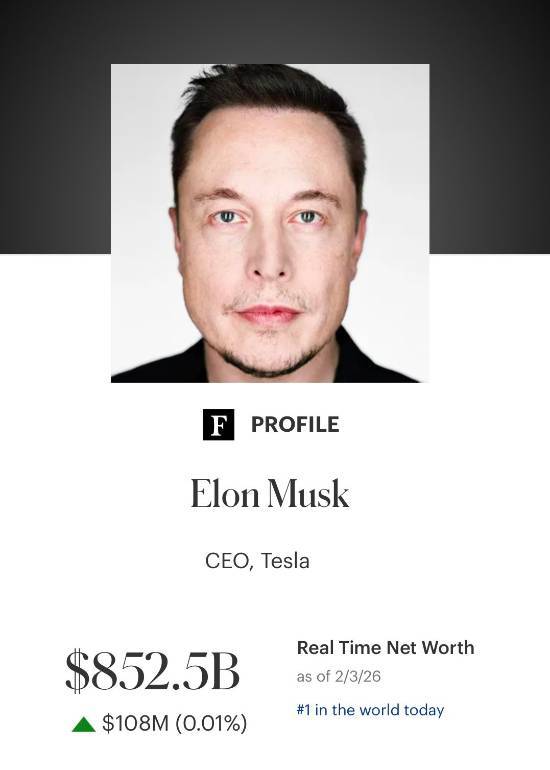
2026-02-05 02:00:48 作者:狼叫兽 截至2026年2月5日,埃隆·马斯克的个人净资产已达8520亿美元,持续位居全球富豪榜首。这一数字不 仅刷新人类财富积累的历史纪录,也使他成为迄今唯一净资产突破8000亿美元大关的个体。 其财富增长主要源于旗下核心企业的强劲表现:特斯拉股价保持稳健上行趋势,SpaceX估值持续攀 升,人工智能公司xAI亦展现出显著增长势头。多家权威财富评估机构及行业分析人士普遍预计,若当 前发展态势延续,马斯克有望在2026年内实现净资产突破1万亿美元,成为人类历史上首位达成此里程 碑的个人。 需要指出的是,该目标的最终实现仍受制于宏观经济环境、资本市场走势以及各业务板块估值变化等多 重因素影响。 对于这一现象,有人视其为创新价值与时代机遇共同作用下的自然结果;也有人关注由此折射出的财富 分配格局及其对社会结构的深层影响。 ...

格林大华期货早盘提示:股指-20260206
Ge Lin Qi Huo· 2026-02-06 02:39
更多精彩内容请关注格林大华期货官方微信 | 板块 | 品种 | 多(空) | 推荐理由 | | --- | --- | --- | --- | | | | | 【行情复盘】 受外盘影响,周四两市主要指数低开下行,下午有所反弹。主要指数呈现破位形态, 叠加纳指趋弱,后市不乐观。两市成交额 2.17 万亿元,继续缩量。沪深 300 指数 收 4670 点,跌 28 点,跌幅-0.60%;上证 50 指数收 3059 点,跌 10 点,跌幅-0.33%; 中证 500 指数收 8146 点,跌 152 点,跌幅-1.84%;中证 1000 指数收 8068 点,跌 | | | | | 139 点,跌幅-1.69%。行业与主题 ETF 中涨幅居前的是银行 ETF 天弘、影视 ETF、 食品 ETF 鹏华、旅游 ETF、消费 ETF 华夏,跌幅居前的是光伏 ETF 华夏、黄金股 ETF 工银、中韩半导体 ETF。两市板块指数中涨幅居前的是影视院线、日用化工、医疗 | | | | | 美容、酒店餐饮、中小银行指数,跌幅居前的是光伏设备、贵金属、工业金属、稀 | | | | IF (弱) | 有金属、风电设备指数。沪深 3 ...
商业航天概念回暖巨力索具13天7板
Cai Jing Wang· 2026-02-06 02:15
Group 1 - The commercial space industry is experiencing a partial recovery, with companies like Giant Lifting Equipment seeing significant stock performance, achieving 7 trading limits in 13 days [1] - Other companies in the sector, such as Zhonghuan Hailu, Tianma New Materials, Xinwei Communication, Shenjian Co., and Goldwind Technology, also saw stock increases, with Zhonghuan Hailu rising over 10% [1] - Elon Musk, during an appearance on the Dwarkesh Podcast, stated that running AI in space will be the most cost-effective option, potentially occurring within 30 to 36 months [1]


“怀疑通中”,美议员要求五角大楼审查SpaceX
Guan Cha Zhe Wang· 2026-02-06 00:53
Core Viewpoint - The U.S. Congress is raising concerns about potential national security risks associated with Chinese investments in SpaceX, led by Senators Elizabeth Warren and Andy Kim, who have requested an investigation by the Department of Defense [1][3]. Group 1: Investigation and Concerns - Senators Warren and Kim have expressed worries that Chinese investors may have secretly acquired shares in SpaceX, which could pose a national security threat [1][3]. - The senators have requested the Pentagon to disclose any Chinese ownership stakes in SpaceX and assess whether the company needs to implement measures in accordance with the Foreign Ownership, Control, or Influence (FOCI) rules [3][6]. - They have set a deadline for the Department of Defense to respond by February 20 [3]. Group 2: Financial and Operational Context - SpaceX has been involved in significant federal contracts since its inception in 2002, reportedly receiving billions of dollars while allegedly paying little to no federal income tax [6][7]. - The company is projected to generate $15.5 billion in revenue by 2025, with its commercial space revenue expected to surpass NASA's total budget for the following year [7]. - SpaceX's rapid revenue growth is largely attributed to its Starlink satellite internet service, which has approximately 6 million users [7].
神剑股份:与中科宇航、星河动力、北京蓝箭鸿擎等均有业务合作
Ge Long Hui· 2026-02-06 00:48
格隆汇2月6日丨神剑股份(002361.SZ)在投资者互动平台表示,公司与中科宇航、星河动力、北京蓝箭 鸿擎等均有业务合作。 ...

太空机房这件事,马斯克为什么认真了
3 6 Ke· 2026-02-06 00:42
Core Insights - The AI industry has experienced significant growth, but power supply remains a critical bottleneck for scaling operations [2][10] - Elon Musk predicts that within 36 months, deploying AI will be cheaper in space than on Earth due to various advantages [3][12] - The current challenges in the AI sector are not related to chip availability but rather to electricity supply and infrastructure [5][10] Group 1: Power Supply Challenges - The deployment of xAI's Colossus 2 cluster requires 1 gigawatt of power, which is a significant portion of the U.S. average electricity consumption [5][6] - The lengthy approval processes for power generation permits and equipment shortages hinder the timely scaling of AI operations [8][9] - Musk anticipates that by the end of the year, many AI chips will be stockpiled due to insufficient power supply [10] Group 2: Transition to Space - Musk argues that space offers a viable solution for AI deployment, as it eliminates ground-based obstacles such as permitting and equipment bottlenecks [12][13] - Solar power in space can be generated at a significantly lower cost compared to Earth, with estimates suggesting a tenfold reduction in electricity costs [13][14] - SpaceX and Tesla are already preparing for this transition by developing the necessary launch capabilities and solar technology [14][28] Group 3: Future Projections - Within five years, Musk predicts that AI computing power in space will exceed the cumulative total on Earth, marking a shift in the competitive landscape [16][17] - The projected annual increase in space-based AI capacity could reach hundreds of gigawatts, equivalent to adding a new U.S. power grid every two and a half years [17][18] - Musk envisions that the Moon could serve as a future launch point for even larger-scale AI operations, leveraging local resources for solar panel production [20][21] Group 4: Strategic Alignment of Companies - SpaceX, Tesla, and xAI are positioned to collaborate effectively, with SpaceX providing launch capacity, Tesla manufacturing solar panels, and xAI driving demand for AI capabilities [25][30] - This synergy allows for a streamlined approach to overcoming the limitations of terrestrial data centers, paving the way for scalable AI solutions in space [31]

心智观察所:马斯克究竟想干什么?
Xin Lang Cai Jing· 2026-02-06 00:22
Core Viewpoint - The article discusses Elon Musk's ambitious plans to revolutionize energy and computing through space-based solar power and AI, suggesting a shift towards a new civilization operating system that transcends Earth's physical limitations [3][20]. Group 1: Space Solar Power and AI Integration - Musk's SpaceX aims to deploy solar-powered AI data centers in low Earth orbit, with a goal of building 200 GW of solar capacity in the U.S. within three years, which is ten times the current solar capacity [3][4]. - The near-Earth solar intensity is over 1.4 times that of the ground, allowing for nearly continuous power generation without interruptions from weather or day-night cycles [6][9]. - The integration of xAI into SpaceX's framework is strategic, as it requires vast, stable computing power that can only be achieved in space, avoiding the limitations of terrestrial power grids [10][22]. Group 2: Challenges and Solutions - Current solutions to energy demands from AI are inadequate, as they focus on optimizing terrestrial systems rather than addressing the fundamental limitations of Earth's resources [5][11]. - The efficiency of energy transmission from space to Earth is currently below 15%, leading to significant energy loss, and the deployment of solar arrays in orbit presents substantial engineering challenges [11][12]. - Musk's strategy avoids the most challenging aspects of energy transmission by having space-based data centers consume power directly in orbit, thus bypassing the need for energy return to Earth [12][13]. Group 3: Long-term Vision and Implications - Musk's approach is not merely about escaping Earth but rather about liberating it from the burdens of high-energy computing tasks, allowing for a more sustainable and livable planet [15][16]. - The article posits that the competition for orbital computing power will become a new frontier in global power dynamics, with control over energy and computing resources in space being crucial for future civilizations [20][21]. - Musk's plans are seen as a step towards achieving a Type II civilization, capable of harnessing energy from its star, with the 200 GW solar initiative serving as a prototype for future energy collection systems in space [21][22].