
铝业

Search documents
中东电解铝产能面临能源断供风险
新华网财经· 2026-03-05 08:34
Core Viewpoint - The geopolitical situation in the Middle East is disrupting aluminum production and shipments, leading to potential price increases in aluminum due to supply chain vulnerabilities and energy shortages [2][6]. Group 1: Production Disruptions - Bahrain Aluminum announced on March 4 that it is facing force majeure, continuing production but unable to ship, with a global leading smelting capacity of 1.623 million tons of aluminum expected in 2025 [2]. - Qatar Aluminum, a joint venture of Norway's Hydro, has begun an orderly shutdown of its production lines due to a natural gas shortage, with a smelting capacity of 636,000 tons and a casting capacity of 664,000 tons [4]. - Hydro has issued a force majeure notice to its customers based on the shutdown situation at Qatar Aluminum [5]. Group 2: Energy Supply Risks - The Middle East's electrolytic aluminum production is entirely dependent on natural gas for power generation, and recent shutdowns of gas facilities have disrupted energy supply, which is a key factor in the shutdown of Qatar Aluminum [7]. - The average electricity consumption for aluminum production globally is about 13,500 kWh per ton, with electricity costs accounting for 30%-40% of production costs [7]. - Rising global oil and gas prices due to the tense situation in the Middle East could lead to increased aluminum prices through various channels, including higher coal and electricity costs [7]. Group 3: Raw Material Transportation Risks - The Middle East has a total electrolytic aluminum capacity of nearly 7 million tons, accounting for about 9% of global capacity, but relies heavily on imports for alumina, with a demand close to 9 million tons per year [9]. - The strategic value of the Strait of Hormuz is highlighted, as it handles about 30% of global oil trade and is crucial for the aluminum supply chain in the region [9]. - Current inventory levels of alumina at Middle Eastern aluminum plants are around one month, but if the Strait of Hormuz remains closed, concerns over raw material supply will increase, potentially leading to production cuts [9].

铝:中东铝厂减产,供应担忧发酵,氧化铝:反弹沽空;铸造铝合金:跟随电解铝
Guo Tai Jun An Qi Huo· 2026-03-05 07:00
2026 年 03 月 05 日 铝:中东铝厂减产,供应担忧发酵 氧化铝:反弹沽空 铸造铝合金:跟随电解铝 所 铝、氧化铝、铸造铝合金基本面数据更新 | | | | 70 | T-1 | T-5 | T-22 | T-66 | | --- | --- | --- | --- | --- | --- | --- | --- | | | | 沪铝主力合约收盘价 | 24795 | 890 | ૭૨૦ | 870 | 3070 | | | | 沪铝主力合约夜盘收盘价 | 25145 | ー | ー | l | l | | | | LME铝3M收盘价 | 3336 | 61 | 161 | 207 | 455 | | | | 沪铝主力合约成交量 | 612472 | 622 | 374122 | -48351 | 373863 | | | | 沪铝主力合约持仓量 | 263422 | 6048 | 15262 | -70477 | -119423 | | | 电解铝 | LME铝3M成交量 | 58259 | 1953 | 37352 | 29228 | 38087 | | | | LME注销仓单占比 | 18. 2 ...
广发早知道:汇总版-20260305
Guang Fa Qi Huo· 2026-03-05 05:47
Report Industry Investment Rating No relevant content provided. Core Viewpoints of the Report - The report analyzes various futures markets including financial derivatives, precious metals, non - ferrous metals, black metals, agricultural products, and energy chemicals. It takes into account factors such as geopolitical conflicts (especially the US - Iran conflict), supply - demand relationships, inventory levels, and macro - economic data to provide insights and trading suggestions for each market [2][6][15]. Summary by Directory Daily Selections - **Aluminum**: Affected by the supply crisis in the Middle East, the internal - external positive spread has widened. The short - term market is cautious due to macro - situation uncertainties, but the long - term bullish logic remains unchanged. The short - term operating range of the main contract is expected to be 24,000 - 26,000 yuan/ton [2][23]. - **Styrene**: Driven by geopolitical factors and cost, it is expected to be strong in the short term. Pay attention to the recovery of downstream开工 and the dynamics of Iranian styrene plants. Strategies include being cautious about the risk of a pull - back after a rise and narrowing the EB04 - BZ04 spread when it is high [3][105]. - **Silicon Ferrosilicon**: The supply - demand is in a tight balance. Pay attention to silicon ferrosilicon exports. Short - term price fluctuations may intensify, and there is pressure when the price rebounds to the FOB export cost [4][62]. - **Corn**: The spot price is firm, and the price is in a high - level shock. Pay attention to the change in grain - selling enthusiasm with rising temperatures and the release of policy grain sources [5][74]. Macro - finance - **Stock Index Futures**: Geopolitical risks are complex and changeable, and the stock index is slowly building a bottom. It is recommended to wait and see and keep a low position [6][9]. - **Precious Metals**: The US economy has slightly improved. Officials' statements have stabilized oil prices and supported interest rate cuts. The US dollar has fallen, and precious metals have stopped falling and rebounded slightly. Gold may fluctuate around historical highs, and silver and platinum - palladium have their own characteristics in terms of supply - demand and price trends [10][13][14]. Non - ferrous Metals - **Copper**: There is a short - term mismatch between supply and demand, and the market risk preference is under pressure. In the long term, the copper price is still optimistic. It is recommended to wait and see in the short term and go long at low prices in the long term [15][18]. - **Alumina**: The spot basis has recovered, and the futures price is under pressure. It is expected to fluctuate widely, and it is recommended to short at high prices [18][20]. - **Aluminum**: The supply crisis in the Middle East has spread, and the internal - external positive spread has widened. The short - term is cautious, and the long - term is bullish. It is recommended to go long on pull - backs [21][23]. - **Aluminum Alloy**: The futures and spot prices have risen together, and the short - term market trading is cold. It is expected to fluctuate in a range, and it is recommended to go long on pull - backs [24][27]. - **Zinc**: The social inventory accumulation trend continues, and the zinc price fluctuates narrowly. It is recommended to wait and see in the short term and go long at low prices in the long term [28][30]. - **Tin**: The market sentiment fluctuates greatly, and the tin price fluctuates widely. It is recommended to wait and see in the short term and go long after the sentiment stabilizes [31][34]. - **Nickel**: The war situation continues, and the macro - uncertainty increases. The price fluctuates strongly. It is expected to fluctuate in a range, and it is recommended to operate within the range [34][37]. - **Stainless Steel**: There is uncertainty in the policy window, and there is a game between raw materials and demand. It is expected to fluctuate strongly in the short term, and it is recommended to consider buying out - of - the - money call options [38][40]. - **Lithium Carbonate**: There is uncertainty in the macro and supply sides, and the futures price adjusts widely. It is not recommended to open new long positions, and use options to protect existing long positions [41][44]. - **Polysilicon**: The spot price has fallen, and the futures price fluctuates downward. It is recommended to wait and see [45][47]. - **Industrial Silicon**: Due to environmental inspections in Xinjiang, the futures price has risen. It is recommended to hold long positions cautiously at around 8,200 yuan/ton and pay attention to position reduction or liquidation [48][49]. Black Metals - **Steel**: The steel price fluctuates, waiting for the verification of post - holiday demand. Pay attention to the impact of the US - Iran conflict on steel exports and the "Two Sessions" on demand expectations [50][51]. - **Iron Ore**: The macro - disturbance intensifies, and the supply pressure still exists. The short - term price may fluctuate widely, and the reference range is 730 - 770 [52][53]. - **Coking Coal**: The spot price is weak, and the power coal price has peaked and fallen. It is recommended to view it with a shock perspective and operate cautiously, with a reference range of 1,050 - 1,200 [55][57]. - **Coke**: The steel mills have proposed to lower the coke price, and the futures price fluctuates with coking coal. It is recommended to view it with a shock perspective and operate cautiously, with a reference range of 1,600 - 1,800 [58][59]. - **Silicon Ferrosilicon**: The supply - demand is in a tight balance, and pay attention to silicon ferrosilicon exports. The short - term price may fluctuate strongly, and there is pressure when the price rebounds to the FOB export cost [60][62]. - **Manganese Silicon**: The manganese ore price continues to rise. Pay attention to the resumption of manganese silicon production. It is recommended to try short - term long positions or 5 - 9 positive spreads [64][66]. Agricultural Products - **Meal**: The domestic and foreign markets are in a high - level shock, and the domestic soybean meal basis has fallen. It is expected to maintain a high - level shock [67][69]. - **Hogs**: The hog slaughter pressure is large. Pay attention to the performance of secondary fattening. The short - term price may be weak, and the upward space is limited [70][71]. - **Corn**: The spot price is firm, and the price is in a high - level shock. Pay attention to the change in grain - selling enthusiasm with rising temperatures and the release of policy grain sources [72][74]. - **Sugar**: The raw sugar price is weak, and the domestic spot price is stable and weak. It is recommended to wait and see in the short term [75]. - **Cotton**: The cotton price continues to fluctuate, and the adjustment range of the futures price may be limited. Pay attention to downstream orders and weather conditions [77]. - **Eggs**: The market sales are slow, and the egg price is mainly falling. The short - term price is expected to be weak and fluctuate [80][81]. - **Oils and Fats**: The oils and fats show a stagnant and adjusted trend. Different oils have different supply - demand and price trends, and pay attention to relevant factors such as production, inventory, and demand [82][86]. - **Jujubes**: The consumption is weak, and the futures price is under pressure. It is recommended to operate in a light - position band and control risks [88][89]. - **Apples**: The price of high - quality apples is firm, and the futures price is strong. Pay attention to post - holiday inventory reduction, spot price, and delivery goods [90][91]. Energy Chemicals - **Crude Oil**: The geopolitical conflict continues. Pay close attention to the passage of the Strait of Hormuz and the safety of energy facilities in the Middle East. If the Strait of Hormuz is blocked, the oil price may rise; if it resumes passage, the oil price may fall. It is recommended to hold long positions cautiously [92][93]. - **PX**: The supply - demand is expected to improve, and the oil price is strong. The short - term PX trend is strong. It is recommended to be cautious about the risk of a pull - back after a rise and go long in a rolling manner [94][95]. - **PTA**: The supply - demand drive is limited, but the cost side is strong. The short - term PTA is driven by the cost. It is recommended to be cautious about the risk of a pull - back after a rise and go long in a rolling manner [96][97]. - **Short - fiber**: The supply - demand pattern is weak, and it follows the raw materials. It is recommended to follow the PTA strategy and pay attention to the low - level expansion of the processing fee [98]. - **Bottle Chips**: The raw materials are expected to be strong in the short term, and the supply of bottle chips is expected to increase. The processing fee may fall. It is recommended to follow the PTA strategy, pay attention to the high - level narrowing of the processing fee, and buy call options at low prices [99][100]. - **Ethylene Glycol**: The supply - demand in March is expected to improve, and the cost support is enhanced. It is recommended to go long on the EG5 - 9 spread at low prices [101]. - **Pure Benzene**: Driven by geopolitical factors, the cost side drives the pure benzene to be strong. It is recommended to be cautious about the risk of a pull - back after a rise and go long in a rolling manner, and narrow the EB - BZ spread when it is high [102][103]. - **Styrene**: Driven by geopolitical factors and cost, it is expected to be strong in the short term. Pay attention to the recovery of downstream开工 and the dynamics of Iranian styrene plants. Strategies include being cautious about the risk of a pull - back after a rise and narrowing the EB04 - BZ04 spread when it is high [104][105]. - **LLDPE**: The upstream sells at a loss, and the market trading is weak. The short - term market is strong under cost support and demand recovery expectations. It is recommended to wait and see [106]. - **PP**: The valuation is low, and the price rises strongly. Pay attention to the sustainability of cost support. It is recommended to take profits on the PL spread [107][108]. - **Methanol**: The geopolitical risk still exists, and the methanol price fluctuates widely at a high level. It is recommended to hold long positions [108]. - **Caustic Soda**: The supply - demand pattern is weak, and the caustic soda price may be adjusted weakly. Pay attention to downstream delivery volume and liquid chlorine price fluctuations [109][110]. - **PVC**: Geopolitical disturbances bring cost concerns, and the PVC price fluctuates emotionally. The supply - demand is deadlocked, and the price may be pushed up passively [111][112]. - **Urea**: The demand side improves marginally, and the urea price runs firmly. It is recommended to stop losses on short positions at low prices and follow the crude - oil - related varieties with a low - long idea [113][114]. - **Soda Ash**: The macro - situation boosts sentiment, but the fundamentals are weak. It is recommended to wait and see [115][117]. - **Glass**: The downstream resumption of work is less than expected. Pay attention to macro - policies and inventory changes. It is recommended to wait and see or short at high prices [115][119]. - **Natural Rubber**: The overseas geopolitical situation affects tire demand, and the rubber price is under pressure. It is recommended to wait and see [119][122]. - **Synthetic Rubber**: The fundamental support is limited, but the geopolitical conflict will drive the BR to rise in the short term. It is recommended to wait and see, and the short - term view is a wide - range shock [123][124][125]. Container Shipping to Europe - The MSK has opened a position at 2,200 US dollars (a 400 - dollar increase compared to the previous period). Pay attention to the actual implementation of the price increase in the off - season. The futures price is expected to fluctuate and run in an enlarged range. It is recommended to hold positive spreads [125][126].
巴林铝业再受影响
Hua Tai Qi Huo· 2026-03-05 05:44
Group 1: Report Industry Investment Ratings - Aluminum: Cautiously bullish; Alumina: Neutral; Aluminum alloy: Cautiously bullish [8] - Arbitrage strategy: Long aluminum and short aluminum alloy [8] Group 2: Core Views - After Qatar suspends aluminum production, Bahrain Aluminum announces supply contract performance affected by force majeure, with a combined impact on production capacity of over 2.2 million tons. Rising natural gas prices trigger concerns about an energy crisis. In China, there are no additional positive factors, consumption is in a slow recovery after the Spring Festival, and social inventories are in a rapid accumulation cycle. In the long term, macro - interest rate cuts and strong overseas consumption support a callback - buying hedging strategy [6] - Indian alumina is traded at FOB $308 per ton for 30,000 tons, and there are other potential deals. The Middle East crisis causes overseas alumina orders to be resold intensively, pressuring prices. In China, the supply surplus pressure eases due to production cuts by northern alumina plants, and the inventory accumulation rate slows [6] Group 3: Summary by Related Catalogs Aluminum Spot - East China A00 aluminum price is 24,390 yuan/ton, up 440 yuan/ton from the previous trading day, with a spot premium of - 150 yuan/ton, up 10 yuan/ton. Central China A00 aluminum price is 24,250 yuan/ton, with a spot premium of - 290 yuan/ton, unchanged from the previous trading day. Foshan A00 aluminum price is 24,360 yuan/ton, up 430 yuan/ton, with a spot premium of - 175 yuan/ton, up 5 yuan/ton [1] Aluminum Futures - On March 4, 2026, the main Shanghai aluminum futures contract opened at 24,210 yuan/ton, closed at 24,795 yuan/ton, up 560 yuan/ton. The highest price was 24,890 yuan/ton, and the lowest was 24,085 yuan/ton. The trading volume was 612,472 lots, and the open interest was 263,422 lots [2] Aluminum Inventory - As of March 4, 2026, the domestic electrolytic aluminum ingot social inventory was 1.229 million tons, up 72,000 tons from the previous period. The warehouse receipt inventory was 317,076 tons, up 923 tons from the previous trading day. The LME aluminum inventory was 461,125 tons, down 425 tons from the previous trading day [2] Alumina Spot Price - On March 4, 2026, the SMM alumina price in Shanxi was 2,650 yuan/ton, Shandong was 2,610 yuan/ton, Henan was 2,665 yuan/ton, Guangxi was 2,690 yuan/ton, Guizhou was 2,760 yuan/ton, and the Australian alumina FOB price was $312 per ton [2] Alumina Futures - On March 4, 2026, the main alumina futures contract opened at 2,800 yuan/ton, closed at 2,782 yuan/ton, down 13 yuan/ton or - 0.47%. The highest price was 2,828 yuan/ton, and the lowest was 2,773 yuan/ton. The trading volume was 383,264 lots, and the open interest was 307,900 lots [2] Aluminum Alloy Price - On March 4, 2026, the Baotai civil raw aluminum purchase price was 18,400 yuan/ton, and the mechanical raw aluminum purchase price was 18,800 yuan/ton, both up 300 yuan/ton from the previous day. The ADC12 Baotai quotation was 23,900 yuan/ton, up 300 yuan/ton from the previous day [3] Aluminum Alloy Inventory - The aluminum alloy social inventory was 67,000 tons, and the in - factory inventory was 94,800 tons [4] Aluminum Alloy Cost and Profit - The theoretical total cost was 22,631 yuan/ton, and the theoretical profit was 569 yuan/ton [5]
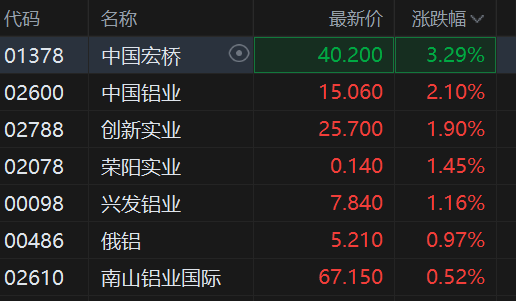
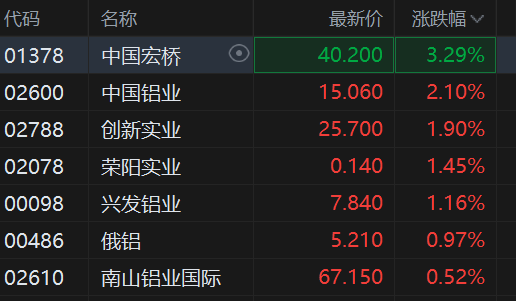
铝业股继续活跃 中国宏桥涨超3%逼近历史高位 中东局势推高铝价
Ge Long Hui· 2026-03-05 03:17
Group 1 - The core point of the news is the significant activity in the Hong Kong aluminum sector, with notable price increases for major companies like China Hongqiao and China Aluminum, driven by rising LME aluminum prices following a force majeure event at Alba [1] - LME aluminum prices reached their highest level since May 2022, with an intraday increase of over 4% [1] - By 2025, the Middle East is projected to have alumina production capacity of approximately 4.5 million tons per year, accounting for 2% of global capacity, and electrolytic aluminum capacity of about 6.92 million tons per year, representing 9% of global capacity [1] Group 2 - Iran's electrolytic aluminum production is expected to reach around 620,000 tons by 2025, which would be 0.8% of global production [1] - There is a potential risk of production cuts in the region due to possible attacks on energy infrastructure [1] - If the Strait of Hormuz remains blocked, oil and gas prices, as well as overseas electricity prices, may continue to rise significantly, leading to a potential secondary energy crisis [1] Group 3 - The aluminum industry is particularly sensitive to energy price changes due to its high electricity consumption [1] - China's energy import dependency is relatively low at 20%, providing a competitive advantage in energy pricing [1] - A renewed energy crisis could lead to cost-push aluminum price increases, significantly enhancing the profitability of Chinese aluminum companies [1]
格林铝业遇不可抗力价格获进一步提振,成材:重心下移偏弱运行
Hua Bao Qi Huo· 2026-03-05 02:58
Report Summary 1. Industry Investment Rating - Not provided in the content 2. Core Views -成材预计震荡整理运行,铝价预计短期偏强运行,需关注宏观情绪 [2][3][4] 3. Summary by Relevant Catalogs 3.1. Steel Products (Chengcai) -云贵区域短流程建筑 steel 生产企业春节停产检修时间多在 1 月中下旬,复产预计在正月十一至十六,停产预计影响总产量 74.1 万吨 [2] -安徽省 6 家短流程钢厂,1 家 1 月 5 日停产,多数 1 月中旬停产,个别 1 月 20 日后停产,停产日度影响产量 1.62 万吨 [3] -2024 年 12 月 30 日 - 2025 年 1 月 5 日,10 个重点城市新建商品房成交面积 223.4 万平方米,环比降 40.3%,同比增 43.2% [3] -成材震荡下行,价格创新低,供需双弱,市场情绪悲观,冬储低迷,对价格支撑不强 [3] 3.2. Aluminum Ingot -中东冲突使巴林铝业暂停发货,卡塔尔冶炼厂关闭,加剧供应担忧,铝价偏强运行 [2] -假期后国内氧化铝市场库存小幅去化,供需边际改善但过剩压力未根本缓解 [3] -美伊冲突使市场看涨,月差好,部分卖方惜售,下游开工备货,铝价接受度上行 [3] -2 月国内铝加工综合 PMI 为 34.8%,位于荣枯线下方,各细分行业 PMI 普遍低于荣枯线 [3] -3 月 2 日电解铝锭地区社会库存较上周四累库 7.2 万吨,较上周一累库 12.1 万吨,铝棒库存较上周四累库 0.55 万吨 [3] -地缘黑天鹅或致供应扰动和成本上升,铝价波动性或放大,基本面季节性压力突出 [4]
港股铝业股继续活跃 中国宏桥涨超3%逼近历史高位
Jin Rong Jie· 2026-03-05 02:55
Group 1 - The aluminum sector in the Hong Kong stock market is experiencing significant activity, with notable price increases among key companies [1] - China Hongqiao has seen its stock price rise over 3%, approaching historical highs [1] - China Aluminum's stock has increased by more than 2%, while other companies like Chuang Ke Industrial and Xingfa Aluminum have also shown positive movements, with increases of 1.9% and over 1%, respectively [1]

港股异动丨铝业股继续活跃 中国宏桥涨超3%逼近历史高位 中东局势推高铝价
Ge Long Hui· 2026-03-05 02:47
Group 1 - The aluminum sector in Hong Kong is experiencing significant activity, with China Hongqiao rising over 3%, China Aluminum increasing by more than 2%, and other companies like Chuangke Industrial and Xingfa Aluminum also seeing gains [1][1][1] - The LME aluminum price reached its highest level since May 2022, rising over 4% after a force majeure event at Alba [1][1][1] - By 2025, the Middle East is projected to have alumina production capacity of approximately 4.5 million tons per year, accounting for 2% of global capacity, and electrolytic aluminum capacity of about 6.92 million tons per year, representing 9% of global capacity [1][1][1] Group 2 - If the Strait of Hormuz remains blocked, oil and gas prices, as well as overseas electricity prices, may continue to rise significantly, leading to a potential secondary energy crisis [1][1][1] - The aluminum industry is particularly sensitive to energy price fluctuations due to its high electricity consumption [1][1][1] - China's energy import dependency is relatively low at 20%, and the country has competitive energy prices, which could enhance the profitability of domestic aluminum companies if an energy crisis occurs [1][1][1]
资讯早班车-2026-03-05-20260305
Bao Cheng Qi Huo· 2026-03-05 02:11
1. Report Industry Investment Rating No relevant content provided. 2. Core Viewpoints of the Report - The global economic situation is complex, affected by factors such as geopolitical conflicts, policy adjustments, and commodity price fluctuations. The Middle - East conflict has a significant impact on energy prices, and the economic data of various countries shows different trends. For example, China's manufacturing and non - manufacturing PMI have certain fluctuations, and the US economic expectations are generally optimistic but also face challenges [18][22]. - In the financial market, the bond market is affected by factors such as risk aversion and policy expectations, and the stock market shows different trends in different regions, with A - shares and Hong Kong stocks both experiencing declines [25][35]. - In the commodity market, different commodities have different price trends. For example, metals such as aluminum and platinum have supply - demand changes, and energy prices are affected by geopolitical factors [6][12]. 3. Summary by Directory 3.1 Macro Data - GDP: In Q4 2025, the year - on - year growth rate of GDP at constant prices was 4.5%, down from 4.8% in the previous quarter and 5.4% in the same period last year [1]. - PMI: In February 2026, China's official manufacturing PMI was 49.0%, down 0.3 percentage points from the previous month; non - manufacturing PMI was 49.5%, up 0.1 percentage points; the comprehensive PMI output index was 49.5%, down 0.3 percentage points. The S&P manufacturing PMI was 52.1, the service PMI was 56.7, and the comprehensive PMI was 55.4 [1][2]. - Social Financing and Money Supply: In January 2026, the monthly value of social financing scale was 7220.8 billion yuan, and the year - on - year growth rates of M0, M1, and M2 were 2.7%, 4.9%, and 9.0% respectively [1]. - CPI and PPI: In January 2026, the year - on - year growth rate of CPI was 0.2%, and the year - on - year growth rate of PPI was - 1.4% [1]. - Investment and Consumption: In December 2025, the cumulative year - on - year growth rate of fixed - asset investment was - 3.8%, and the cumulative year - on - year growth rate of total retail sales of social consumer goods was 3.7% [1]. - Foreign Trade: In December 2025, the year - on - year growth rates of export and import amounts were 6.60% and 5.70% respectively [1]. 3.2 Commodity Investment Reference 3.2.1 Comprehensive - Affected by the Spring Festival, China's February official manufacturing PMI decreased, non - manufacturing PMI increased slightly, and the comprehensive PMI output index decreased. The S&P manufacturing, service, and comprehensive PMIs all increased [2]. - Multiple futures exchanges adjusted the trading margin and price limit of some contracts, such as fuel oil, crude oil, and methanol futures [2][3]. - On March 4, 29 domestic commodity varieties had positive basis, and 40 had negative basis. The basis of Shanghai tin, Shanghai nickel, and Zhengzhou cotton was the largest, while that of butadiene rubber and apple was the smallest [4][5]. - The US imposed a maximum 143.3% temporary counter - subsidy tax on Indonesian photovoltaic cells and components, and Indonesia was preparing countermeasures [5]. - On March 4, the container shipping index (European line) futures on the Shanghai International Energy Exchange mostly rose, with the April contract having the largest increase [5]. 3.2.2 Metals - On March 3, Qatar Aluminum Company started an orderly shutdown, causing the London aluminum price to soar by more than 3.8% [6]. - The Thailand Futures Exchange suspended the online futures trading of silver and expanded the daily price limit [6]. - The global platinum market will have a supply shortage of 240,000 ounces in 2026, with total demand expected to decrease by 8% and total supply expected to increase by 2% [6]. - In January, the net gold purchase of global central banks was 5 tons, significantly less than the average of the past 12 months [7]. - As of March 4, the positions of the world's largest silver and gold ETFs decreased [8]. - On March 3, the copper and tin inventories in the London Metal Exchange reached new highs, while the nickel, zinc, aluminum, and lead inventories decreased [8]. 3.2.3 Coal, Coke, Steel, and Minerals - Indonesia reduced the nickel ore quota in 2026 by 30% compared with 2025, reformed the resource tax mechanism, and expected a domestic supply gap of 1.2 billion tons [9]. - Indonesia adjusted the nickel ore production plan to maintain supply - demand balance and support the nickel price [9]. - Indonesia's coal production target in 2026 is 733 million tons, and the coal output in January decreased year - on - year and month - on - month [9]. - A landslide occurred in a mining area in the Democratic Republic of the Congo on March 3, resulting in hundreds of people being buried [10]. - Vale expects the iron ore supply to slightly exceed demand by 2030, reaching 1.54 billion tons [11]. 3.2.4 Energy and Chemicals - Due to the Middle - East situation, the EU may restart discussions on the Russian natural gas import ban, and the European natural gas price has soared by 75% this week [12]. - Thailand is one of the most vulnerable economies in Asia due to high energy import dependence. State - owned enterprises are under pressure to stabilize prices [12]. - Iraq is shutting down the production of its largest oil field due to the approaching exhaustion of oil storage space and may cut production by about 3 million barrels per day if the Holmuze crisis continues [12]. - The French economic minister said there is no risk of oil and gas shortage in the next few weeks and will not tolerate excessive fuel price increases [12]. - In the week ending February 27, the EIA crude oil inventory in the US was 3.475 million barrels, higher than expected [13]. 3.2.5 Agricultural Products - In late February, most agricultural product prices in the circulation field rose, with cotton reaching a new high since June 2024, while most fertilizer and pesticide prices fell [14]. - US exporters sold 125,000 tons of corn to unknown buyers [15]. - Brazil's corn and soybean exports in March are expected to increase compared with the same period last year [15]. - Due to weather problems, Ukraine's rapeseed export price is expected to rise in 2026 [15]. 3.3 Financial News Compilation 3.3.1 Open Market - On March 4, the central bank conducted 40.5 billion yuan of 7 - day reverse repurchase operations, with an operating rate of 1.40%. The net withdrawal on the same day was 369 billion yuan [16]. 3.3.2 Important News - The Fourth Session of the 14th National People's Congress will be held from March 5 to 12, with a series of agendas and activities [17]. - The National Office of the State Council will hold a briefing on March 5 to interpret the Government Work Report [17]. - The spokesperson of the NPC said that the "15th Five - Year Plan" draft will be reviewed and approved, and policies such as expanding domestic demand and promoting the development of the private economy will be implemented [17]. - China's February official manufacturing and comprehensive PMIs decreased, while the non - manufacturing PMI increased slightly [18]. - China's February S&P manufacturing, service, and comprehensive PMIs all increased [19]. - The former deputy governor of the central bank said that China's macro - policies in 2026 will be more active and moderately loose [19]. - The Chinese Ministry of Foreign Affairs urged all parties to stop military operations in the Holmuze Strait [20]. - Three departments announced tax - exemption policies for the China International Fair for Trade in Services from 2026 to 2027 [21]. - The China Federation of Logistics and Purchasing announced that the February China Commodity Price Index decreased slightly month - on - month but increased by 10.9% year - on - year [21]. - The US - Iran conflict may last for 8 weeks or more, and China will send a special envoy to the Middle - East [21]. - The US Treasury Secretary said that the tariff rate will soon return to the level before the Supreme Court's veto of Trump's reciprocal tariffs, and the US will provide insurance for ships in the Persian Gulf [22]. - Trump nominated Kevin Warsh as the next Fed Chairman, but the nomination may face obstacles [22]. - The Fed's Beige Book shows that the economic outlook is generally optimistic, but some regions' economic activities are flat or declining [22]. - The OECD said that the developed countries' government bond issuance scale will reach a record high of $18 trillion in 2026, and the bond market faces challenges [23]. - There are bond - related events such as overdue debts and bond redemptions of some companies [23]. - Some companies' credit ratings were adjusted [24]. 3.3.3 Bond Market Summary - The inter - bank bond market in China was strong, with the yields of interest - rate bonds falling, and the bond futures of most contracts rising [25]. - The exchange bond market had different trends for different bonds, and the real - estate and high - yield urban investment bond indexes rose slightly [26]. - The CSI Convertible Bond Index and the Wind Convertible Bond Equal - Weighted Index fell [27]. - Most money - market interest rates showed different trends, with some rising and some falling [27][28]. - The yields of some financial bonds and treasury bonds were determined through bidding [29]. - European bond yields generally fell, while US bond yields rose [29][30]. 3.3.4 Foreign Exchange Market - On March 4, the on - shore RMB against the US dollar fell, and the RMB central parity rate was adjusted down [31]. - The US dollar index fell, and most non - US currencies rose [31]. 3.3.5 Research Report Highlights - CITIC Securities suggested pre - arranging South Korean government bonds as they will be included in the WGBI in April 2026, which is expected to bring $50 - 60 billion of passive funds [32]. - CITIC Securities analyzed the PPI cycle and pointed out that predicting PPI trends requires considering both domestic and foreign factors [32]. - Western Fixed - Income believes that the credit - bond market is likely to maintain a volatile pattern in March, and suggests controlling duration and using leverage strategies [33]. 3.3.6 Today's Reminders - On March 5, 207 bonds will be listed, 154 bonds will be issued, 58 bonds will be paid, and 140 bonds will pay principal and interest [34]. 3.4 Stock Market News - A - shares adjusted with reduced trading volume, with the Shanghai Composite Index, Shenzhen Component Index, and ChiNext Index all falling. The market focus shifted to food and fertilizer sectors, and the grid equipment and military equipment sectors rose [35]. - The Hong Kong Hang Seng Index, Hang Seng Technology Index, and Hang Seng China Enterprises Index all fell, with significant corrections in the oil and shipping sectors and general declines in technology stocks [35][36]. - FTSE Russell will adjust the FTSE China A50 Index, including China State Shipbuilding, Tianfu Communication, and Wanhua Chemical, with the adjustment taking effect on March 20, 2026 [36].
欧盟碳排放关税开征,钢铁铝业出口成本陡增
Zhong Xin Qi Huo· 2026-03-04 23:30
1. Report Industry Investment Rating No relevant content provided. 2. Core Viewpoints of the Report - The Carbon Border Adjustment Mechanism (CBAM) officially came into effect on January 1, 2026. Although the tariff is levied on importers by the EU, it will be passed on to exporting companies, impacting China's steel and aluminum product exports [2][5][76][77]. - High default values for determining embedded emissions in goods will weaken the export competitiveness of China's steel and aluminum products. The default carbon intensity values for most China steel and aluminum products are significantly higher than the CBAM benchmark values, leading to an increase in carbon tariffs [3][6]. - From the perspective of total exports, the impact of CBAM on the steel and aluminum industries in China is not yet significant. However, for specific enterprises with a large proportion of exports to the EU, the formal implementation of CBAM will lead to a significant increase in carbon tariff costs. Enterprises need to optimize carbon emission management and use financial instruments to hedge risks [4][6]. 3. Summary According to the Table of Contents 3.1 CBAM will be implemented on January 1, 2026 - **Historical Evolution of CBAM**: CBAM is part of the "Fit for 55" package announced by the EU in 2021. In 2023, the EU passed legislation for CBAM and initiated the transition period from October 1, 2023, to December 31, 2025. In 2025, the EU revised CBAM, including setting an import volume exemption threshold, revising deadlines, reducing the number of certificates required, and planning to publish annual default carbon prices starting from 2027 [12][13][14]. - **Impact on China's Steel and Aluminum Exports to the EU**: China's exports of CBAM products to the EU rank fifth in volume but first in implicit carbon emissions. The carbon emission costs will be passed on to Chinese export enterprises, impacting the export of steel and aluminum products [22][24]. 3.2 High default values will weaken the export competitiveness of China's steel and aluminum products - **Core of CBAM**: The core of CBAM is to define carbon intensity values. The EU proposes two methods: using actual carbon emission intensity (which needs third - party verification) and using default values published by the EU (which will result in higher carbon tariffs) [32][33][34]. - **China's Higher Default Value of Carbon Intensity**: The EU has set significantly higher default carbon emission intensity values for Chinese products than the CBAM benchmark values, with annual stepwise increases. China's steel and aluminum products exported to the EU face higher default carbon emission intensities in 2026 [39][40]. - **Underestimated Carbon Emission Cost**: The carbon emission costs paid for Chinese export products may have been underestimated. The EU may set a default carbon price for China significantly lower than the domestic carbon emission allowance price [41]. 3.3 The cost of exporting steel and aluminum products from China to the EU will rise sharply - **Carbon Tariff on Steel Products**: Chinese steel product exports to the EU face higher default carbon emission intensity values. If the carbon costs already paid by Chinese companies are not considered and the default values are used, Chinese steel products will face a carbon tariff ranging from CNY389 - CNY3,917 per tonne [42][46]. - **Carbon Tariff on Aluminum Products**: Default carbon intensities for Chinese aluminium products significantly exceed CBAM benchmarks. If the default values are used, Chinese aluminum and aluminum products will face a carbon tariff of CNY1399 - CNY3413 per tonne [53][57]. 3.4 Addressing the Challenges Posed by CBAM for Steel and Aluminum Exporters - **Limited Impact on Total Exports**: The implementation of CBAM has a relatively limited impact on China's total steel and aluminum exports. However, it has a more significant impact on the cost of Chinese steel and aluminum companies exporting to the EU [65][66]. - **Conduct CBAM Carbon Verification**: Some steel and aluminum enterprises in China have actual carbon emission intensities lower than the default values set by the EU. Companies should actively use actual carbon emission data and avoid using default values [67][68][69]. - **Reasonable Use of EUA Futures Hedging**: In the second half of 2025, EU carbon allowance prices rose significantly. The EUA supply and demand have been tight in the long term, which may drive carbon prices upward. Exporting companies can hedge through the EUA futures market to avoid the risk of rising carbon tariff costs [70][73].