空调

Search documents
小米强势杀入“前三”,7月线上销量超格力,空调格局变了吗?
Hua Er Jie Jian Wen· 2025-08-16 12:07
Core Insights - The Chinese air conditioning market is experiencing a significant shift, with Xiaomi surpassing Gree in online sales market share for the first time in July 2025, achieving 16.71% compared to Gree's 15.22% [2] - Xiaomi's annual growth rate reached 53.9%, positioning it as the third-largest player in the market, making it the only high-growth variable among the top three brands [2][6] - The competitive landscape is evolving, with Xiaomi's entry challenging the long-standing dominance of Midea and Gree, which have ruled the market for nearly two decades [6][19] Group 1: Xiaomi's Strategy - Xiaomi's approach leverages software to redefine hardware value, focusing on the smart home ecosystem, with over 70% of its air conditioning users connected online [7] - The company has established a significant partnership with Changhong, contributing approximately 60% of its revenue from air conditioning sales, but this has pressured Changhong's profit margins [10][11] - Despite its aggressive pricing strategy, Xiaomi faces limitations due to physical cost constraints, with a quality air conditioner priced no lower than 1900 yuan under ideal conditions [10][12] Group 2: Traditional Giants' Resilience - Midea and Gree maintain a strong defensive position through historical experience, scale, and control over the supply chain, which have proven effective against price wars in the past [12][13] - The market size of approximately 300 billion yuan allows these giants to leverage their scale, with Midea and Gree generating over 100 billion yuan in domestic sales, significantly outpacing their competitors [12][13] - The vertical integration in the compressor market, where Midea and Gree hold a combined 65% market share, further solidifies their control over the industry [13][16] Group 3: Future Competitive Landscape - The future competition is expected to shift from direct brand confrontations to a more nuanced "agent war" involving sub-brands, allowing giants to maintain their premium positioning while competing with Xiaomi [17][21] - Sub-brands like Midea's "Hualing" and Haier's "Tongshuai" have gained market share, indicating a strategic pivot to capture value in the price-sensitive segment without undermining the main brand [17][21] - The overall market dynamics are changing, with Xiaomi's entry prompting traditional players to adapt their strategies rather than engage in destructive price wars [19][20]





奥维云网、中怡康7月数据:空调市场TOP3格局稳固,美的格力海尔领跑
Huan Qiu Wang· 2025-08-16 06:47
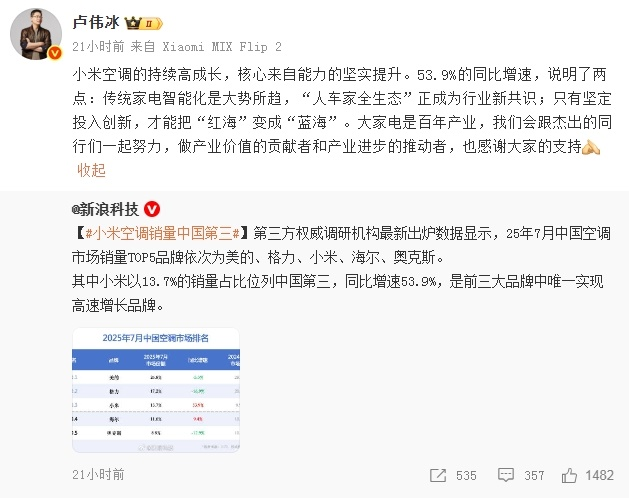
Core Insights - The air conditioning market in China remains dominated by three major brands: Midea, Gree, and Haier, according to the latest retail monitoring reports from AVC and CMM [1][2] - Midea holds the largest market share at 29%, followed by Gree at 17% and Haier at 15%, with Haier being the only brand among the top three to show a year-on-year net growth in market share [1][2] Group 1 - Midea's market share decreased from 30% in July 2024 to 29% in July 2025, reflecting a 1% decline [2] - Gree's market share also declined from 19% in July 2024 to 17% in July 2025, marking a 2% decrease [2] - Haier's market share increased from 11% in July 2024 to 15% in July 2025, indicating a 4% growth [2] Group 2 - Xiaomi's market share fell from 12% in July 2024 to 10% in July 2025, representing a 2% decline [2] - Aux maintained its market share at 8% from July 2024 to July 2025, showing no change [2] - The overall competitive landscape in the air conditioning market remains stable, with the top three brands consistently leading [1][2]
7月中国空调线上销量小米超格力,卢伟冰回应感谢支持
Xin Lang Ke Ji· 2025-08-16 03:47
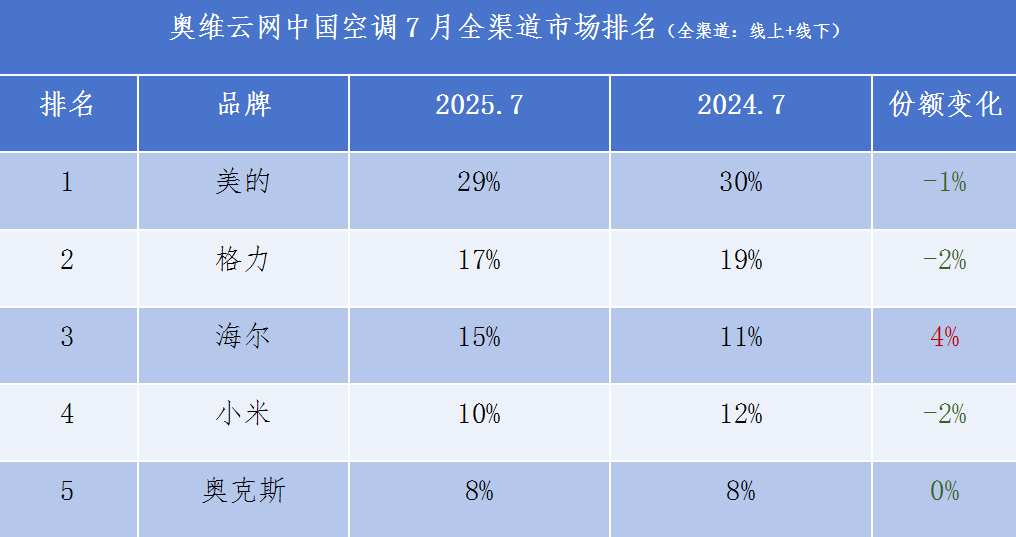
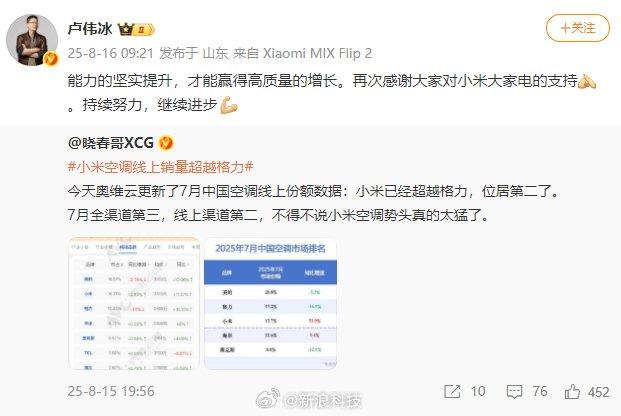
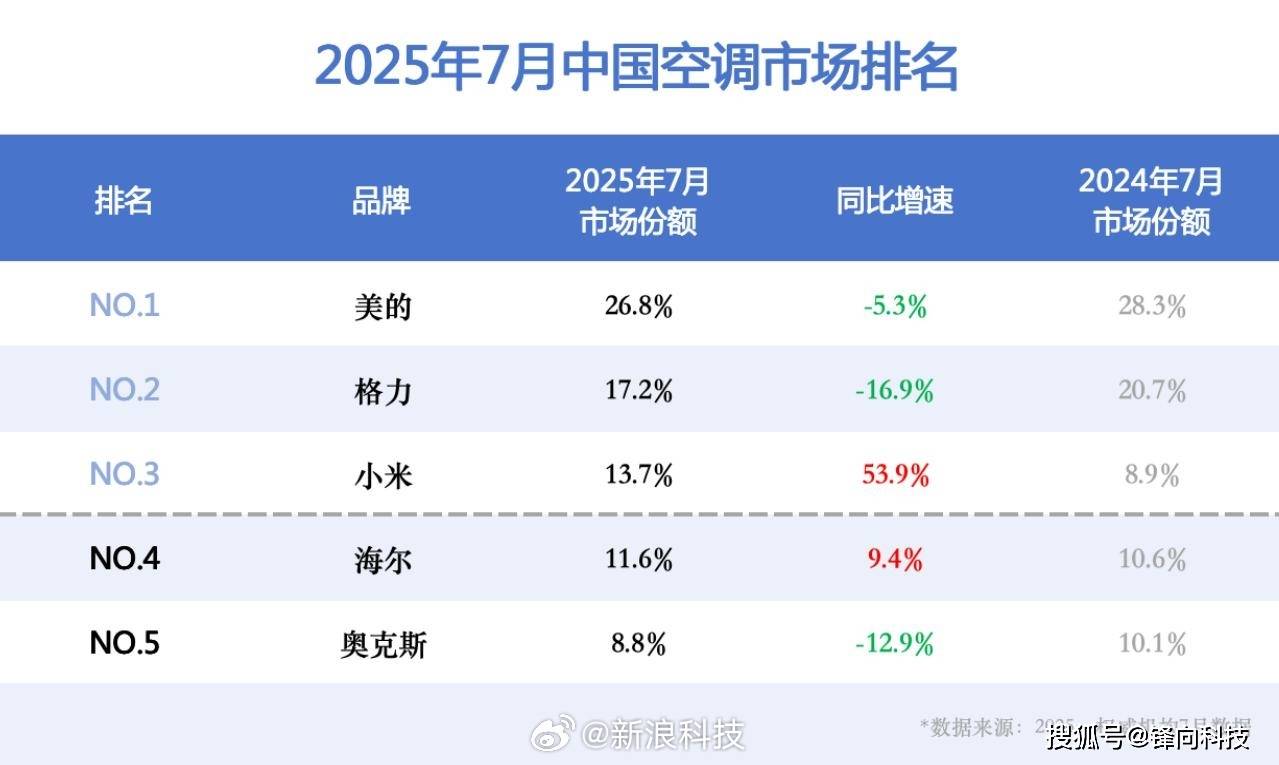
Group 1 - The core viewpoint of the article highlights that Xiaomi has surpassed Gree in online air conditioner sales, ranking second in the market, only behind Midea [1] - In July 2025, the top five air conditioner brands in China by sales volume were Midea, Gree, Xiaomi, Haier, and Aux [1] - Xiaomi achieved a market share of 13.7% in July, representing a year-on-year growth rate of 53.9%, making it the only brand among the top three to experience significant growth [1] Group 2 - According to data from Aowei Cloud Network, Xiaomi's online market share for air conditioners has exceeded that of Gree, positioning it as the second-largest online seller [1] - Xiaomi's president, Lu Weibing, emphasized the importance of solid capabilities for achieving high-quality growth and expressed gratitude for the support of Xiaomi's home appliance segment [1]
雷军开始打到董明珠老巢
Sou Hu Cai Jing· 2025-08-15 03:55
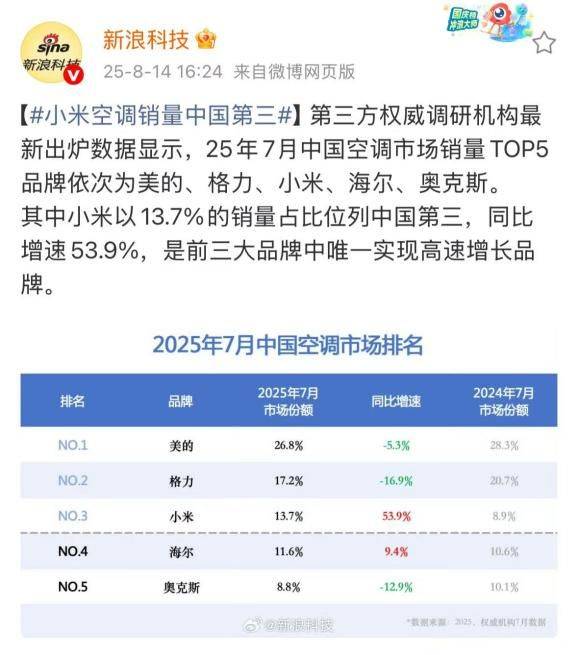
Core Insights - The air conditioning market in China is experiencing significant changes, with Midea, Gree, and Xiaomi leading in sales as of July 2025. Xiaomi stands out with a remarkable year-on-year growth rate of 53.9%, making it the only top brand to maintain positive growth [1][2]. Market Share and Growth - Midea holds the largest market share at 26.8%, but has seen a decline of 5.3% compared to the previous year [2]. - Gree ranks second with a market share of 17.2%, experiencing a substantial drop of 16.9% year-on-year [2]. - Xiaomi's market share has increased from 8.9% to 13.7%, narrowing the gap with Gree from 11.8% to just 3.5% [1][2]. Competitive Strategies - Xiaomi's success is attributed to its competitive pricing strategy, particularly with its "Giant Energy Saving Pro" series, which can be priced as low as 1500 yuan after government subsidies, offering significant savings compared to Gree's products [4]. - The energy efficiency of Xiaomi's products is highlighted, with an APF efficiency ratio of 5.65, allowing users to save approximately 30% on monthly electricity bills [4]. Technological Advancements - Xiaomi's air conditioners support remote control via the Mi Home app and voice control through Xiao Ai, contrasting with Gree's traditional remote control approach [5]. - The innovative "Pro Air Outlet" model utilizes advanced millimeter-wave radar technology for human sensing, enhancing user comfort by intelligently adjusting airflow [5]. Supply Chain and Business Model - Xiaomi's unique supply chain management, integrating resources from established manufacturers like Changhong, allows for quality assurance while significantly reducing manufacturing costs [5]. - This asset-light operational model provides Xiaomi with greater flexibility and cost advantages in a competitive pricing environment, contrasting with Gree's heavy asset strategy [5]. Industry Challenges - Gree faces challenges in adapting to market changes, as highlighted by the ongoing patent disputes initiated by its CEO, Dong Mingzhu, against Xiaomi [6]. - Analysts suggest that Gree's reliance on patent barriers and traditional sales channels may not be sufficient to counter Xiaomi's innovative approach [6]. - Gree is attempting to respond to market competition by accelerating its own smart transformation with new products and applications [6].
小米空调最新数据现身,董明珠是不压力山大呢?
Sou Hu Cai Jing· 2025-08-15 01:49
Core Insights - The air conditioning market in China is experiencing significant shifts, with Xiaomi emerging as a strong competitor, achieving a remarkable growth rate of 53.9% year-on-year, positioning itself as the third-largest player in the market [2][4][5] - Midea remains the market leader with a share of 26.8%, but it has seen a decline of 5.3% compared to the previous year, while Gree, the second-largest, has faced a more substantial drop of 16.9% [2][4] - Haier is also showing positive growth with a 9.4% increase in market share, while Aux has seen a decline of 12.9% [2][4] Market Share and Growth Rates - Midea: 26.8% market share, -5.3% year-on-year growth [2] - Gree: 17.2% market share, -16.9% year-on-year growth [2] - Xiaomi: 13.7% market share, +53.9% year-on-year growth [2][4] - Haier: 11.6% market share, +9.4% year-on-year growth [2] - Aux: 8.8% market share, -12.9% year-on-year growth [2] Strategic Insights - Xiaomi's rapid growth is attributed to its commitment to innovation and the integration of smart technology in traditional home appliances, aligning with the industry's trend towards smart home ecosystems [5][7] - The company's CEO, Lu Weibing, emphasizes the importance of transforming the competitive landscape from a "red ocean" to a "blue ocean" through continuous investment in innovation [5][7] - Xiaomi aims to further increase its market presence in the air conditioning sector, potentially surpassing Gree in the near future based on current growth trajectories [4][7]
奥克斯电气通过港交所聆讯,今年一季度收入超93亿元,全球第五大空调提供商
Sou Hu Cai Jing· 2025-08-14 06:35
据港交所8月12日披露,奥克斯电气有限公司通过港交所主板上市聆讯,中金公司为独家保荐人。 此前,彭博社报道,奥克斯电气计划最早于9月在香港上市,拟募集资金6亿至8亿美元。 综合 | 招股书 编辑 | Echo 本文仅为信息交流之用,不构成任何交易建议 据招股书,奥克斯是全球前五大空调提供商之一,集家用和中央空调设计、研发、生产、销售及服务于一体。公司在全球空调产业(2024年市场规模达人 民币13,128亿元)中把握商机。从中国走向全球,公司的空调业务覆盖150多个国家和地区。 公司是业内智能空调领域的重要参与者,在语音识别、语义理解等技术能力方面均保持较高水平。 奥克斯深耕空调行业三十余载,不断努力为全球消费者提供高质量、高性价比的产品。在1994年至2001年的初创阶段,公司创立奥克斯品牌,并迅速在快 速增长的国内空调市场获得了强大的影响力。 从2001年到2013年,公司经历了快速增长,打入全球市场并通过不断的产品提升、高性价比产品以及精准品牌营销建立了很高的品牌知名度。2013年起, 公司持续在销售渠道、产能布局及产品质量等方面进行转型升级。公司首创通过减少经销层级,让利于消费者的销售模式。公司推出" ...
北方需求激增海外订单大涨,空调产业内外开花
Xin Hua Cai Jing· 2025-08-13 09:18
Group 1: Market Demand and Sales Growth - The overall transaction volume of air conditioners has increased by over 60% year-on-year from June to now, with the number of users placing orders growing by nearly 90% [1] - In July, transaction volume in Jilin, Liaoning, and Heilongjiang provinces increased by 25 times, 10 times, and 8 times respectively, with first-time buyers in these regions increasing by over 800% [1][2] - The demand for air conditioners in northern regions has surged due to high temperatures, breaking the traditional "cooler in the south, warmer in the north" pattern [2] Group 2: Supply Chain and Installation Challenges - Air conditioner manufacturers are facing new challenges in their supply chain and installation services due to the sharp increase in sales [2][3] - Companies have initiated "south-to-north" strategies to dispatch service teams to northern regions for urgent support, with installation requests in some areas increasing from around 2000 to 6000 [3] Group 3: Export Growth and International Demand - China's air conditioner exports reached 46.81 billion yuan in the first seven months of the year, a year-on-year increase of 4.9%, with exports to Europe growing by 28.9% [4] - The demand for Chinese air conditioners in Europe has surged, with Midea's sales in the European market increasing by 35% this year [5] Group 4: Product Innovation and Market Adaptation - Midea has introduced innovative products like the PortaSplit air conditioner, which is easy to install and has gained popularity in Europe, with sales exceeding 80,000 units [6] - Companies are focusing on energy-efficient and AI-driven technologies to meet the growing demand for air conditioning in Europe, where the market is rapidly transitioning to greener products [7] Group 5: Long-term Growth Potential - The International Energy Agency predicts that the number of air conditioners in the EU could double by 2050, presenting significant opportunities for Chinese manufacturers [7] - The ongoing demand for upgrades and technological advancements in air conditioning systems is expected to sustain long-term growth in the industry [7]
指数新高,注意盘面变化!题材板块轮动,还有哪些投资机会?
Sou Hu Cai Jing· 2025-08-13 08:17
Group 1: Market Trends and Policies - A-share listed companies are expected to enhance their willingness to improve both quality and returns, leading to an increase in overall dividend payout ratios and frequencies [1] - The policy goals of "stabilizing growth, stabilizing the stock market," and "boosting the capital market" will continue to guide the future direction of the securities sector [1] - The liquidity environment is expected to remain moderately loose, with ongoing improvements in the capital market environment and restoration of investor confidence [1] Group 2: Sector Performance and Investment Opportunities - The top five sectors with net inflows include military industry, new energy vehicles, PCB boards, new energy vehicle components, and automotive components [1] - The leading concept sectors with net inflows are Huawei supply chain, artificial intelligence, 5G, cloud computing data centers, and intelligent manufacturing [1] - The top ten individual stocks with net inflows include Dongfang Wealth, New Yi Sheng, China Great Wall, Hu Dian Co., Zhongxing Communications, Zhongji Xuchuang, WuXi AppTec, Shenghong Technology, China Ordnance, and Sanhuan Group [1] Group 3: Advanced Technologies and Industry Developments - Shanghai is actively promoting the application of high-level autonomous driving, with plans announced during the 2025 World Artificial Intelligence Conference [3] - Leading companies in the Robotaxi sector, such as Pony.ai and Baidu, have received demonstration operation licenses to provide paid services to the public [3] - The demand for advanced process wafer foundries is expected to increase significantly in the AI era, with domestic manufacturers striving to catch up despite existing bottlenecks [3] Group 4: AI and Market Demand - The market's expectations for global computing power demand remain significant, with ongoing developments in large-scale computing clusters and model architectures [5] - The demand for training computing power is anticipated to grow substantially in the long term, driven by advancements in pre-training and post-training scaling laws [5] Group 5: Seasonal Trends and Consumer Goods - The air conditioning market is experiencing a boost in demand due to high summer temperatures, leading to increased sales and replacement purchases [5] - National subsidy policies are further enhancing market demand for air conditioning units, with expectations for strong domestic sales momentum in 2025 [5] - The air conditioning sector is characterized by low valuations and high dividend yields, presenting significant long-term investment value [5] Group 6: Stock Market Dynamics - The Shanghai Composite Index has broken through last year's high, indicating stronger-than-expected consensus expectations [7] - The A-share market is recovering while the bond market is experiencing adjustments, with recent trends suggesting a "see-saw effect" between stocks and bonds [7] - Active equity funds have shown significant performance recovery, with an average return exceeding 27% over the past year, indicating optimism among institutions regarding future market opportunities [7]

2025年第31周:数码家电行业周度市场观察
艾瑞咨询· 2025-08-13 00:06
Group 1 - AI is becoming the first point of contact for patients, with models like Quark Health achieving a diagnostic accuracy of 90.78% [3] - The refrigerator market is experiencing a dual pressure of price wars and structural upgrades, with low-end models competing on price and high-end models focusing on technology and scenarios [4] - The average air conditioner ownership in China is 145.9 units per 100 households, with significant growth in regions like Yunnan and Qinghai due to climate changes [5] Group 2 - The smart bathroom industry is rapidly growing, with the production of smart toilets expected to reach 13.72 million units in 2024, despite a slight decline in domestic sales revenue [6] - Companies like Zhiyuan and Magic Atom are launching quadruped robots to compete for market dominance, with the quadruped robot market projected to reach 850 million yuan by 2025 [7][8] - The AI toy market is booming, with products like AI plush toys achieving significant sales, but challenges such as homogenization and data privacy remain [18] Group 3 - The demand for window-cleaning robots surged during the 618 shopping festival, with online sales growth exceeding 90% [19][20] - Meituan's founder Wang Xing has invested over 10 billion yuan in more than 30 robotics companies, focusing on embodied intelligence [21] - WeChat and Alipay are competing for dominance in the AI payment space, with new protocols being developed to simplify integration [22] Group 4 - Google's Q2 2025 earnings report shows growth in search and cloud services, but faces challenges from AI competition and antitrust lawsuits [23] - JD and Meituan are shifting their focus to embodied intelligence, with JD adopting a vertical integration strategy and Meituan pursuing a broad investment approach [24] - Haier Group and Changan Automobile have signed a strategic cooperation agreement to develop interconnected systems for vehicles and home appliances [25] Group 5 - Honor is accelerating its market presence with new AI smartphones and plans for an IPO by 2025-2026 [26][27] - Yushu Technology is initiating its A-share listing process, aiming to become a leading player in the humanoid robot market [28] - Lingyun Smart Mining has completed a funding round to expand its AI-driven mineral exploration technology globally [29]

在空调行业,原创者在造风,模仿者在追风
Xin Lang Cai Jing· 2025-08-12 11:43
Core Viewpoint - The air conditioning industry is facing a severe "involution" characterized by price wars and similar product designs, indicating a false saturation driven by a lack of technological originality [1][3] Group 1: Industry Challenges - The air conditioning sector suffers from severe technological homogenization, with most companies opting to tweak existing technologies rather than addressing deeper user needs [3][5] - Common user pain points include dust accumulation leading to bacteria growth, discomfort from direct cold air, reduced performance in extreme weather, and high energy consumption [3][5] Group 2: Haier's Innovations - Haier has consistently positioned itself as an industry "wind creator," focusing on original technology to address user needs, such as the "Smart Wind" series that offers four wind modes for better comfort [5][9] - The company has a history of pioneering innovations, including the first split air conditioner in China in 1985 and the first variable frequency air conditioner in 1993, which transformed the industry [3][5] - Recent advancements include a heat exchanger variable flow technology that improves energy efficiency by 12% and reduces annual electricity consumption by over 400 kWh [3][5] Group 3: Market Position and Recognition - Haier's market share in the domestic air conditioning sector increased by 0.7% in the first half of 2025, ranking it among the top three brands [9] - The high-end brand Casarte holds a 67% market share in the 16,000+ yuan price segment, reflecting consumer recognition of original technology [9][10] - The industry requires "wind creators" like Haier to lead the transition from parameter competition to value innovation, emphasizing the importance of addressing user pain points [9][10]