软件

Search documents
美股科技七巨头风光不再
Di Yi Cai Jing Zi Xun· 2026-02-24 02:40
Core Viewpoint - US stock investors are facing a scenario previously deemed impossible, where the decline of tech giants and leading AI cloud service providers could simultaneously drag down the US stock market and economy [2] Group 1: Market Performance - The overall performance of the US stock market has lagged behind major global markets this year, with the Nasdaq and S&P 500 indices completely reversing their gains [2] - The "Magnificent Seven" tech giants are under increasing scrutiny, with Microsoft down over 17% and Amazon down over 10% year-to-date [2] - Meta has become the third tech giant to enter a technical bear market [2] Group 2: Sector Rotation - A significant sector rotation is occurring, with previously lagging sectors leading the market, while the "Magnificent Seven" face pressure due to concerns over their substantial AI investments [3] - The S&P 500 energy sector has surged over 22% this year, leading among 11 sectors, while the information technology sector has declined by 4.5% [3] - The market shift began as a mean reversion trade but has evolved into a fundamental logic shift, focusing on AI's broader market impact [3] Group 3: Historical Context - Extreme market divergence has occurred only a few times in the past 25 years, typically accompanied by significant sector reshuffling [4] - The equal-weighted S&P 500 index has outperformed the traditional market-cap-weighted index, marking the most extreme divergence since 1992 [4][5] Group 4: Economic Implications - Concerns are rising over the capital expenditures of cloud service providers, with fears of a potential bubble bursting [6] - A significant drop in free cash flow for cloud service providers is anticipated, raising questions about revenue and profit margins [6] - If the AI sector's adjustments affect the credit market, it could pressure US GDP growth by 1.3 to 1.4 percentage points [6] Group 5: Nvidia's Earnings Focus - Investors are closely watching Nvidia's earnings report, which is expected to provide stability amid AI-related concerns [8] - Nvidia's projected earnings per share for Q4 are expected to grow by 71%, with revenue reaching $65.9 billion [8] - The CEO's statements during the earnings call are anticipated to have a broad impact on the AI industry, especially for companies facing pressure due to capital expenditure return rates [8][9]


开盘:三大指数集体高开涨逾1%,创业板指涨1.7%,全市场近5000股上涨,黄金、石油板块领涨
Jin Rong Jie· 2026-02-24 02:10
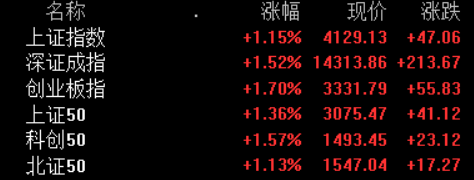
Market Performance - On the first trading day of the Year of the Horse, the three major indices in A-shares opened higher, with the Shanghai Composite Index rising by 1.15% to 4129.13 points, the Shenzhen Component Index increasing by 1.52% to 14313.86 points, and the ChiNext Index up by 1.7% to 3331.79 points [1] - The total trading volume in the Shanghai and Shenzhen markets reached 30.315 billion yuan, with nearly 5000 stocks rising across the market [1] Sector Performance - The gold and oil sectors led the gains, while stocks related to robotics, energy metals, CPO, ultra-high voltage, consumer electronics, and semiconductors were active [1] - Conversely, sectors such as duty-free shops, short drama games, and seed dance themes showed weakness [1] International Market Overview - U.S. stock indices closed down over 1%, with the Dow Jones falling by 821 points (1.66%), the Nasdaq down by 1.13%, and the S&P 500 decreasing by 1.04% [2] - Major tech stocks faced pressure, with Microsoft dropping over 3%, Tesla and META nearly 3%, and Amazon down over 2% [2] - In Europe, most major indices also declined, with the Eurostoxx 50 down by 0.24% and the DAX 30 down by 1.01% [2] Economic Policies and Developments - An article by Xi Jinping emphasized the importance of domestic demand and the construction of a strong domestic market, with plans to boost consumption and investment [3] - The U.S. Supreme Court ruled against the government's imposition of certain tariffs, which China opposes, urging the U.S. to eliminate unilateral tariff measures [3] - The Chinese Ministry of Industry and Information Technology issued guidelines for the liquor industry, aiming to cultivate multiple billion-yuan production areas by 2028 [4] Technology and Innovation - SK Hynix indicated that the storage market has entered a seller's market, driven by real demand from AI and limited cleanroom space, predicting continued price increases for storage products [5] - Chinese scientists achieved a breakthrough in optical communication and 6G technology, creating a new integrated communication system that sets a record for data transmission rates [5] Investment Outlook - Industrial trends, policy expectations, and improved liquidity are expected to drive the A-share market upward after the holiday, with a focus on technology growth sectors [6][8][10] - The market is anticipated to see a return of the technology growth style, supported by easing concerns over AI and positive developments in robotics and large models [10] - The rebalancing of market styles is shifting from a focus solely on AI to a broader range of physical sectors, with an emphasis on commodities and manufacturing recovery [11]

逆向买入信号闪烁!投行Cantor Fitzgerald:AI恐慌砸出黄金坑 基本面将支撑美股牛市延续
智通财经网· 2026-02-24 02:00
智通财经APP获悉,投行Cantor Fitzgerald最新发布的报告指出,在投资者因人工智能(AI)AI颠覆性力 量的担忧而撤出市场之后,当前形势为美国股市进一步上涨创造了理想的布局。该机构指出,看跌期权 购买激增、恐慌指标上升以及乐观情绪下滑,都是典型的逆向买入信号。与此同时,盈利超预期和股票 回购等基本面依然强劲。分析师Eric Johnston表示:"鉴于基本面背景相当强劲,这为下一阶段的上涨行 情提供了非常好的布局。" 此外,更广泛的利好因素还包括:标普500指数每股收益预期升至320美元;在AI推动下,等权重指数的 利润率扩张;预算赤字收窄(2025年降至GDP的5.2%);除医疗保健行业外就业增长疲弱;以及消费者销售表 现强劲。此外,Eric Johnston及其团队在近期去风险化之后,仍然"看涨比特币",认为宽松货币和流动 性顺风将带来支撑。 Cantor Fitzgerald目前看好大型科技股和软件股,这些股票近期因现金流担忧和AI颠覆风险而受挫,但 已处于超卖水平。例如纳斯达克的市盈率与盈利增长比率处于10年低点,而"七巨头"相对标普500指数 的表现强劲,但其相对强弱指数RSI仅为23 ...
美股三大指数昨晚集体大跌 IBM股价破纪录暴跌超13%
Sou Hu Cai Jing· 2026-02-24 01:55
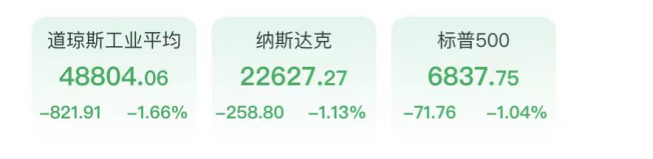
Group 1 - The U.S. stock market experienced a significant decline, with the Dow Jones dropping over 821 points, a decrease of 1.66%, while the Nasdaq fell by 1.13% and the S&P 500 decreased by 1.04% [1] - Major technology stocks such as Microsoft, Amazon, Meta, and Tesla saw notable declines, while Nvidia and Apple, which are set to release earnings this week, experienced gains [1] Group 2 - The AI sector played a crucial role in the market turmoil, particularly after Anthropic announced new programming features for its Claude Code product, raising concerns about IBM's mainframe business, leading to a more than 13% drop in IBM's stock, marking its largest single-day decline in over 25 years [3] - The software sector was heavily impacted, with the software ETF IGV falling nearly 5%, reaching a two-year low [3] - A widely circulated article titled "The Intelligent Crisis of 2028" heightened investor anxiety, suggesting that abundant machine intelligence could compress labor income and trigger demand contraction, negatively affecting the stocks of mentioned companies [3] Group 3 - Goldman Sachs reported that the U.S. stock market is in a phase of "extreme calm in indices, but severe turbulence in individual stocks," indicating a significant divergence [5] - Institutional investors are selling U.S. stocks at the highest rate in four years while simultaneously buying down protection [5] - There is a clear sector differentiation, with funds aggressively selling software and internet stocks while purchasing semiconductor and memory chip stocks [5]

期权交易员加码做空软件公司贷款ETF,规模创2023年来新高
Hua Er Jie Jian Wen· 2026-02-24 01:43
Group 1 - The core sentiment in the market indicates a growing pessimism towards the software industry, leading traders to heavily bet against software company loans through record levels of put options on ETFs like Invesco's BKLN [1] - The BKLN ETF has approximately 18% exposure to software company loans, including notable firms like McAfee and Proofpoint, which has driven the surge in bearish bets [1] - Over the past three weeks, the total number of put options on BKLN has exceeded 400,000 contracts, marking the highest open interest in put options since 2023 [1] Group 2 - Recent market transactions reflect investor pessimism, with a notable purchase of 30,000 put options for BKLN with a strike price of $20, indicating expectations of a 3.5% decline [2] - An additional 50,000 put options were traded, betting on a similar decline in the ETF by mid-July [2] Group 3 - The BKLN ETF has seen a decline of about 1% to $20.44, reaching its lowest point since April 10, 2022, and has experienced continuous outflows totaling nearly $1 billion over the past four weeks [3] - Investors are increasingly hedging against the ETF's decline by purchasing put options, with a total of 250,000 put options bought for July expiration [3] Group 4 - Market sentiment has shifted from speculation on a rebound in software stocks to a complete abandonment of bullish positions, as evidenced by the selling of call options on the iShares Expanded Tech-Software ETF (IGV) [4] - This selling action indicates that investors no longer expect a short-term rebound in the software sector, reflecting a broader capitulation in market sentiment [4]
A股开盘:三大指数集体高开涨逾1%,创业板指涨1.7%,全市场近5000股上涨,黄金、石油板块领涨
Jin Rong Jie· 2026-02-24 01:37
马年A股首个交易日,三大指数集体高开,沪指涨1.15%,报4129.13点,深成指涨1.52%,报14313.86 点,创业板指涨1.7%,报3331.79点,科创50指数涨1.57%,报1493.45点。沪深两市合计成交额303.15亿 元,全市场近5000只个股上涨。 纽约尾盘,现货黄金涨2.38%,报5229.70美元/盎司。COMEX黄金期货涨3.31%,报5248.90美元/盎司。 现货白银涨3.99%,报88.0245美元/盎司,北京时间04:52曾达到89.0460美元。COMEX白银期货涨 7.26%,报89.000美元/盎司,04:52曾达到89.500美元。 【重要资讯】 1、2月16日出版的第4期《求是》杂志发表中共中央总书记、国家主席、中央军委主席习近平的重要文 章《当前经济工作的重点任务》。文章强调,2026年经济工作头绪多,要抓住关键、纲举目张。坚持内 需主导,建设强大国内市场。统筹促消费和扩投资,用好我国超大规模市场优势。深入实施提振消费专 项行动,制定实施城乡居民增收计划,扩大优质商品和服务供给,优化"两新"政策实施,清理消费领域 不合理限制措施,释放文旅等服务消费潜力。 2、 ...
AI“恐怖故事”再次洗血美股:一篇2028年的“假想”作文引发恐慌,IBM暴跌创25年之最
Xin Lang Cai Jing· 2026-02-24 01:05
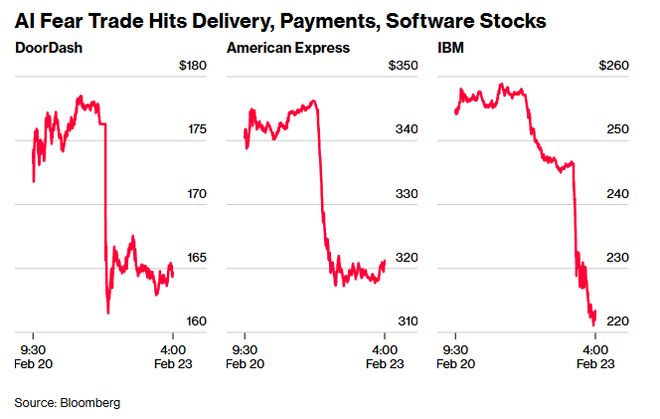
来源:智通财经网 周一,人工智能(AI)"恐慌交易"再度爆发,对AI颠覆性力量的担忧日益加剧,拖累了快递、支付和软件 公司的股价,并导致IBM(IBM.US)创下25年来最大单日跌幅。 此次抛售始于一家名为Citrini Research的小型机构在过去这个周末发布的一份悲观报告。该报告通过设 定未来的假想情景,概述了AI可能对全球经济多个领域带来的风险。据悉,报告设定了一个假想情 景,时间点为2028年6月。在这个情景中,AI的颠覆性影响导致大量白领失业,消费者支出下降,由软 件支持的贷款出现违约,经济陷入收缩。 报告写道:"本文的唯一目的,是对一个此前相对缺乏深入探讨的情景进行建模。希望读完之后,你能 为人工智能让经济变得越来越'奇怪'所带来的潜在尾部风险做好准备。"不过,报告也明确强调:"以下 内容只是一个情景设想,而不是预测。" 值得一提的是,Citrini在报告中特别点名食品配送服务和信用卡公司将面临困境。报告中假设, DoorDash(DASH.US)和Uber Eats等外卖应用的主导地位将被所谓的"vibe-coded"(氛围编程)替代方案取 代,而AI代理将通过消除万事达(MA.US)和Vi ...
晨星DBRS称2月评级下调比例创新高 私募信贷质量持续恶化
Xin Lang Cai Jing· 2026-02-24 00:48
Core Insights - The rating agency Morningstar DBRS reported a record high in the proportion of downgrades in February, indicating a continued deterioration in private credit quality this year [1][2] - The number of downgrades this month is 3.3 times the number of upgrades, surpassing last year's ratio of 2.4 times [1][2] - Morningstar DBRS's Senior Vice President Michael Dimler stated that due to squeezed profit margins across various industries and rising debt levels, the rating outlook for 2026 remains negative [1][2] Industry Analysis - Morningstar DBRS provides private credit ratings for approximately 450 mid-market borrowers in North America and Europe, with an average annual revenue of $250 million [1][2] - The agency is monitoring the disruption risk posed by artificial intelligence (AI) to software companies, although Dimler noted that the current impact of AI on these companies' ratings is not yet significant [1][2] - Dimler compared the current changes to the transition of software from physical distribution to cloud and subscription models a decade ago, stating that while software developers faced performance challenges for several years, those that invested ultimately completed their transformation and improved profitability [1][2]
“2028AI末日预言”吓坏市场,投资者掀起抛售潮,美股多板块盘中集体重挫
Xin Lang Cai Jing· 2026-02-24 00:45
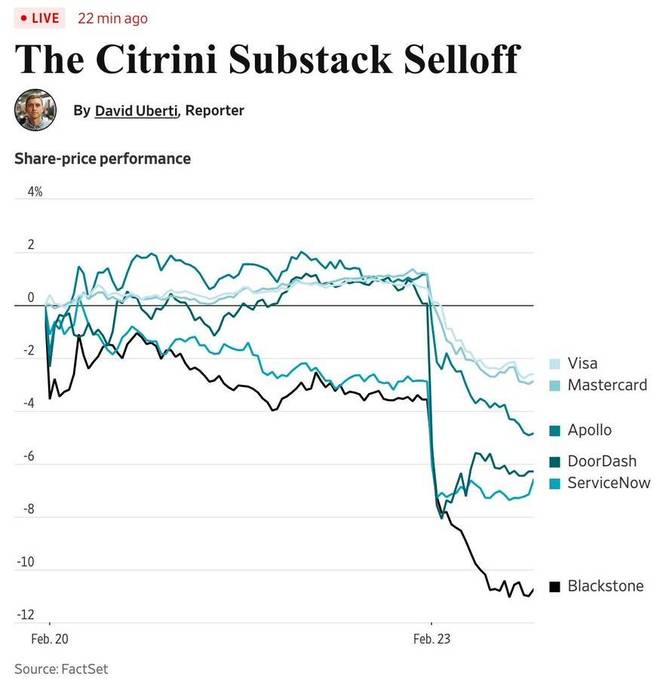
Group 1 - Citrini Research's report highlights potential risks of AI impacting various sectors, leading to significant stock declines in food delivery, payment, software, and IT services [1][7] - Specific stock declines include DoorDash (-7%), Uber (-4%), American Express (-8%), Visa (-5%), and Mastercard (-6%) among others, with several companies experiencing drops of at least 3% [1][6] - The report presents a hypothetical scenario for June 2028, suggesting AI could cause widespread white-collar job losses and a contraction in consumer spending [4] Group 2 - The report describes a future where AI could replace dominant food delivery apps like DoorDash and Uber Eats with alternative solutions [5] - AI could potentially eliminate transaction fees charged by payment processors like Mastercard and Visa, benefiting users financially [6] - The recent "AI panic" has led to sell-offs across multiple sectors, including software, wealth management, and logistics, as investors react to perceived risks [8]


关税恐慌再现!道指大跌超800点 金融软件板块重挫 白银逼近90美元
Di Yi Cai Jing· 2026-02-24 00:29
Market Overview - The three major U.S. stock indices experienced significant declines, with the Dow Jones falling by 821.91 points (1.66%), the Nasdaq down by 258.80 points (1.13%), and the S&P 500 decreasing by 71.76 points (1.04%) [1][2] - The VIX, a measure of market volatility, surged by 11.05% to 21.20, indicating increased market anxiety [1] Sector Performance - The financial sector dropped by 3.3%, with major banks like Wells Fargo, Citigroup, and JPMorgan falling over 4% [4] - Software companies faced a 4.0% decline, with DoorDash and ServiceNow dropping over 5%, and Oracle down by 4.59% [4] - The airline and travel sectors plummeted by 3.7% and 4.0%, respectively, due to severe winter storms affecting transportation [4] Key Stock Movements - Notable tech stocks showed mixed results, with Nvidia rising by 0.91% and Apple by 0.60%, while Google fell by 1.02%, and Amazon, Meta, Tesla, and Microsoft all dropped over 2% [2][3] Economic and Policy Context - The U.S. Supreme Court ruled that the Trump administration's tariffs on imports were unconstitutional, leading to new trade threats from the White House [5] - Trump announced a new 10% tariff on all U.S. imports, which was later raised to 15%, creating uncertainty in the market [5] - The average effective tariff rate is expected to decrease from 16% to 13.7% following the Supreme Court's decision [5] Investor Sentiment - Investors reacted negatively to the uncertainty surrounding trade policies, leading to a sell-off in U.S. assets [6] - Concerns about the potential for other countries to respond negatively to U.S. policies have heightened market anxiety [6] - The market is currently characterized by a preference for selling first and asking questions later, reflecting a strong aversion to uncertainty [6] Bond Market Reaction - In response to the latest tariff announcements, investors shifted towards U.S. Treasury bonds for safety, with the 10-year Treasury yield falling to 4.03% [7] - The two-year Treasury yield decreased by 3.6 basis points to 3.44%, indicating a flight to safety amid rising inflation concerns [7] Upcoming Events - Nvidia's earnings report is anticipated to impact market volatility, as it holds a significant weight in the S&P 500 index [8]