飞机制造

Search documents
5月核心CPI涨幅扩大 居民消费需求正逐步回暖
Zheng Quan Shi Bao· 2025-06-09 17:53
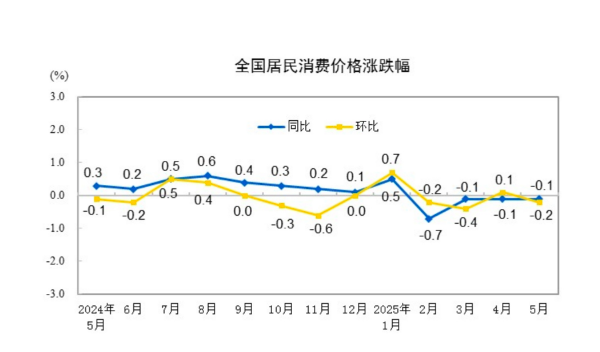
Group 1 - The Consumer Price Index (CPI) decreased by 0.2% month-on-month and 0.1% year-on-year in May, while the Producer Price Index (PPI) fell by 0.4% month-on-month and 3.3% year-on-year, indicating a continued impact of consumption-boosting policies [1][2] - Energy prices were the main factor dragging down both the CPI and PPI, with energy prices decreasing by 6.1% year-on-year and 1.7% month-on-month, significantly affecting the overall CPI decline [1] - Core CPI, excluding food and energy, increased by 0.6% year-on-year, with hotel accommodation and tourism prices rising by 4.6% and 0.8% respectively, indicating a recovery in certain sectors [1] Group 2 - PPI data showed marginal improvement in terminal consumer demand, with life goods prices stabilizing and some manufacturing prices narrowing their year-on-year decline [2] - High-tech product demand is expanding, with prices in sectors like integrated circuit packaging and testing, aircraft manufacturing, and wearable smart devices increasing by 3.6%, 3.0%, and 2.1% respectively [2] - Economic analysts predict a likely upward trend in the price index, with CPI expected to gradually recover and PPI showing signs of marginal improvement due to previous consumption-boosting policies [2]
我国5月份核心CPI同比上涨0.6%
Qi Huo Ri Bao Wang· 2025-06-09 16:08
Group 1: CPI Analysis - In May, the Consumer Price Index (CPI) decreased by 0.2% month-on-month and 0.1% year-on-year, with energy prices dropping by 6.1% year-on-year, contributing approximately 0.47 percentage points to the CPI decline [1][2] - Core CPI increased by 0.6% year-on-year, with the growth rate expanding by 0.1 percentage points compared to the previous month, indicating resilience in domestic consumption [2][3] - Prices of gold jewelry, household textiles, and durable entertainment goods rose by 40.1%, 1.9%, and 1.8% respectively, while fuel and new energy vehicle prices fell by 4.2% and 2.8%, showing a narrowing decline [2][3] Group 2: PPI Analysis - The Producer Price Index (PPI) fell by 0.4% month-on-month and 3.3% year-on-year, with the year-on-year decline widening by 0.6 percentage points [1][3] - The decline in PPI is primarily attributed to weak commodity prices and significant input price pressures, particularly in the coal, steel, and cement sectors due to seasonal demand fluctuations [3][4] - Some sectors, such as high-end equipment manufacturing, saw price increases, with integrated circuit packaging and testing prices rising by 3.6% [3] Group 3: Future Outlook - The outlook for domestic prices suggests a likely moderate recovery in CPI, with food prices expected to remain stable and energy prices potentially rebounding [4] - PPI is anticipated to show marginal improvement, but it may take time to exit negative territory, influenced by external trade dynamics and domestic demand recovery [4] - Key areas to monitor include ongoing input price pressures, recovery in domestic demand, particularly in real estate, and trends in core consumption [4]
东航南航参股国产飞机座椅制造商
第一财经· 2025-06-09 11:59
记者今日从航宇嘉泰获悉,东航和南航成为国产飞机座椅制造商航宇嘉泰的新股东,其中东航通过旗 下东航产投持股9%,南航通过旗下南航资本持股11%。 在此之前,航宇嘉泰为中航工业集团旗下公司全资持有,公司是国产飞机C919目前唯一的座椅供应 商。 ...

新华全媒+|物价总体稳定 供需有所改善——5月份物价数据透视
Sou Hu Cai Jing· 2025-06-09 09:31
Group 1 - The overall consumer price index (CPI) showed a slight decline in May, with a month-on-month decrease of 0.2% and a year-on-year decrease of 0.1%, influenced by seasonal factors and falling oil prices [1][2] - Core CPI, excluding food and energy, increased by 0.6% year-on-year, indicating a strengthening demand in certain sectors, supported by holiday consumption and a recovery in travel services [2][3] - Energy prices fell by 1.7% month-on-month, contributing significantly to the overall CPI decline, with a year-on-year decrease of 6.1% [1][2] Group 2 - Food prices decreased by 0.2% month-on-month, with fresh vegetable prices dropping by 5.9%, while some fresh fruits and fish saw price increases due to supply constraints [2][3] - The producer price index (PPI) decreased by 0.4% month-on-month and 3.3% year-on-year, but some sectors showed positive price trends, particularly in consumer goods [3][4] - Prices in high-tech industries, such as integrated circuits and wearable devices, increased year-on-year, reflecting a shift towards high-end, intelligent, and green production [4][5] Group 3 - The demand for high-tech products is growing, leading to price increases in related industries, while the prices in the solar and lithium battery sectors showed a narrowing decline [5] - The positive impact of macroeconomic policies is expected to further stimulate domestic demand and promote reasonable price recovery in the future [5]
这一涨幅创近十年新高!重磅数据出炉,最新解读来了
券商中国· 2025-06-09 06:51
Core Viewpoint - The article discusses the recent trends in China's Consumer Price Index (CPI) and Producer Price Index (PPI), highlighting the impact of energy prices on CPI and the structural changes in supply and demand across various industries [1][4][5]. CPI Analysis - In May, the CPI decreased by 0.2% month-on-month and 0.1% year-on-year, marking a shift from previous increases [1][4]. - Energy prices significantly influenced the CPI, with a year-on-year decline of 6.1%, contributing approximately 0.47 percentage points to the CPI's decrease [4]. - The core CPI showed signs of recovery, indicating a gradual improvement in consumer demand due to supportive consumption policies [5][6]. PPI Analysis - The PPI fell by 0.4% month-on-month and 3.3% year-on-year, with the year-on-year decline widening by 0.6 percentage points compared to the previous month [1][8]. - Factors contributing to the PPI decline include international input factors and a decrease in domestic energy and raw material prices [9]. - Certain sectors, such as high-end equipment manufacturing and new energy industries, showed signs of improved supply-demand relationships, with some prices stabilizing or recovering [10]. Market Outlook - Analysts expect the PPI to remain in a bottoming phase for an extended period, while the CPI is projected to maintain low levels [12]. - The anticipated stabilization of international oil prices may reduce the downward pressure on CPI, although fluctuations in pork prices could introduce new challenges [13].

能源价格拖累,5月份CPI环比下降0.2%
Di Yi Cai Jing· 2025-06-09 03:11
Core CPI and Economic Policy - The core CPI shows a steady upward trend, reflecting the effectiveness of macroeconomic policies and the increasing impact of domestic demand on prices [1][5] - In May, the core CPI excluding food and energy prices rose by 0.6% year-on-year, an increase of 0.1 percentage points from the previous month [2][4] CPI and PPI Trends - In May, the CPI decreased by 0.2% month-on-month and 0.1% year-on-year, while the PPI fell by 0.4% month-on-month and 3.3% year-on-year, with the year-on-year decline widening by 0.6 percentage points [2][7] - Energy prices dropped by 6.1% year-on-year, contributing approximately 0.47 percentage points to the CPI decline [4] Food Prices and Consumer Demand - Food prices decreased by 0.4% year-on-year, with pork prices rising by 3.1% but showing a decline in growth rate compared to the previous month [4] - The analysis indicates that consumer demand is in a critical recovery phase, with expectations of gradual improvement in consumption as counter-cyclical policies take effect [4][5] Sector-Specific Price Movements - Certain sectors are experiencing marginal price improvements, with some consumer goods seeing price stabilization or increases [8] - High-tech product demand is expanding, leading to price increases in sectors such as integrated circuits and aircraft manufacturing [8] Future Price Outlook - Short-term inflation may face dual pressures, with expectations of continued negative growth in CPI and PPI in the second and third quarters [9] - Recent financial policies may signal the start of a new round of incremental policies aimed at stabilizing employment, businesses, and market expectations [9]
国家统计局城市司首席统计师董莉娟解读2025年5月份CPI和PPI数据
Guo Jia Tong Ji Ju· 2025-06-09 01:44
Group 1: CPI Analysis - In May, the Consumer Price Index (CPI) decreased by 0.2% month-on-month and by 0.1% year-on-year, while the core CPI, excluding food and energy, increased by 0.6%, with the growth rate expanding by 0.1 percentage points compared to the previous month [1][2][3] - The month-on-month decline in CPI was primarily driven by a 1.7% decrease in energy prices, which accounted for approximately 70% of the total decline in CPI [2] - Food prices fell by 0.2%, with seasonal vegetables seeing a 5.9% price drop, while prices for eggs, pork, and poultry slightly decreased by 0.3% to 1.0% [2][3] Group 2: PPI Analysis - The Producer Price Index (PPI) decreased by 0.4% month-on-month and by 3.3% year-on-year, with the year-on-year decline expanding by 0.6 percentage points compared to the previous month [1][4][5] - The month-on-month PPI decline was influenced by international factors, including a 5.6% drop in oil and gas extraction prices and a 3.5% decrease in refined oil product manufacturing prices [4] - Some sectors showed marginal price improvements, with consumer demand policies positively impacting prices in certain industries, such as a 12.8% increase in the price of arts and crafts and a 0.8% rise in footwear manufacturing [5]
国家统计局:5月份CPI略有下降,核心CPI同比涨幅扩大
news flash· 2025-06-09 01:35
Group 1: CPI Analysis - The Consumer Price Index (CPI) decreased by 0.2% month-on-month and 0.1% year-on-year in May, with the core CPI (excluding food and energy) increasing by 0.6% year-on-year, an expansion of 0.1 percentage points from the previous month [1][2][3] - The month-on-month decline in CPI was primarily driven by a 1.7% decrease in energy prices, which accounted for approximately 70% of the total decline [2][3] - Food prices fell by 0.2%, with seasonal vegetables seeing a 5.9% price drop, while hotel accommodation and tourism prices rose by 4.6% and 0.8%, respectively, indicating a recovery in consumer demand [2][3] Group 2: PPI Analysis - The Producer Price Index (PPI) decreased by 0.4% month-on-month and 3.3% year-on-year, with the year-on-year decline expanding by 0.6 percentage points compared to the previous month [1][4][5] - The month-on-month PPI decline was influenced by international factors, including a 5.6% drop in oil and gas extraction prices, which contributed significantly to the overall decline [4][5] - Despite the overall decline, some sectors showed positive price movements, with consumer goods prices stabilizing and certain industries, such as high-end equipment manufacturing, experiencing price increases due to improved demand [5]
法媒:“鲲龙”——全球未来水上飞机的标杆
Huan Qiu Wang Zi Xun· 2025-06-06 22:41
Core Viewpoint - The successful certification of China's AG600 amphibious aircraft marks a significant advancement in the country's aviation industry, enhancing its technological and industrial influence on the global stage [1][2]. Group 1: Certification and Market Readiness - The AG600 has received a type certificate from the Civil Aviation Administration of China, indicating its readiness for mass production and safe operation [1]. - This certification is a crucial milestone in the aircraft's lifecycle, ensuring its safe operation on land and water, and signifies China's progress towards aviation independence [1]. Group 2: Technical Specifications and Capabilities - The AG600 features impressive dimensions, measuring 38.9 meters in length and 38.8 meters in wingspan, allowing stable operation both on water and in the air [2]. - It is designed for multiple functions, including water rescue and forest firefighting, thanks to its unique integration of aircraft and hull structures [2]. - The aircraft is powered by four WJ6 engines, providing stable performance even in extreme weather conditions, which is critical for rapid disaster response [2]. - The aerodynamic design of the AG600 has been optimized for energy efficiency, reducing its environmental impact during flights [2]. Group 3: Strategic Positioning and Future Outlook - Through the integration of modern technology and enhanced R&D capabilities, China positions itself as a major player in the global aviation market [2]. - The AG600 exemplifies China's ambition for technological leadership in aviation, with plans to continue advancing its aerospace industry [2].
这一机型停场数量创历史新高!供应链问题困扰航司,谁在受益
Di Yi Cai Jing· 2025-06-05 10:03
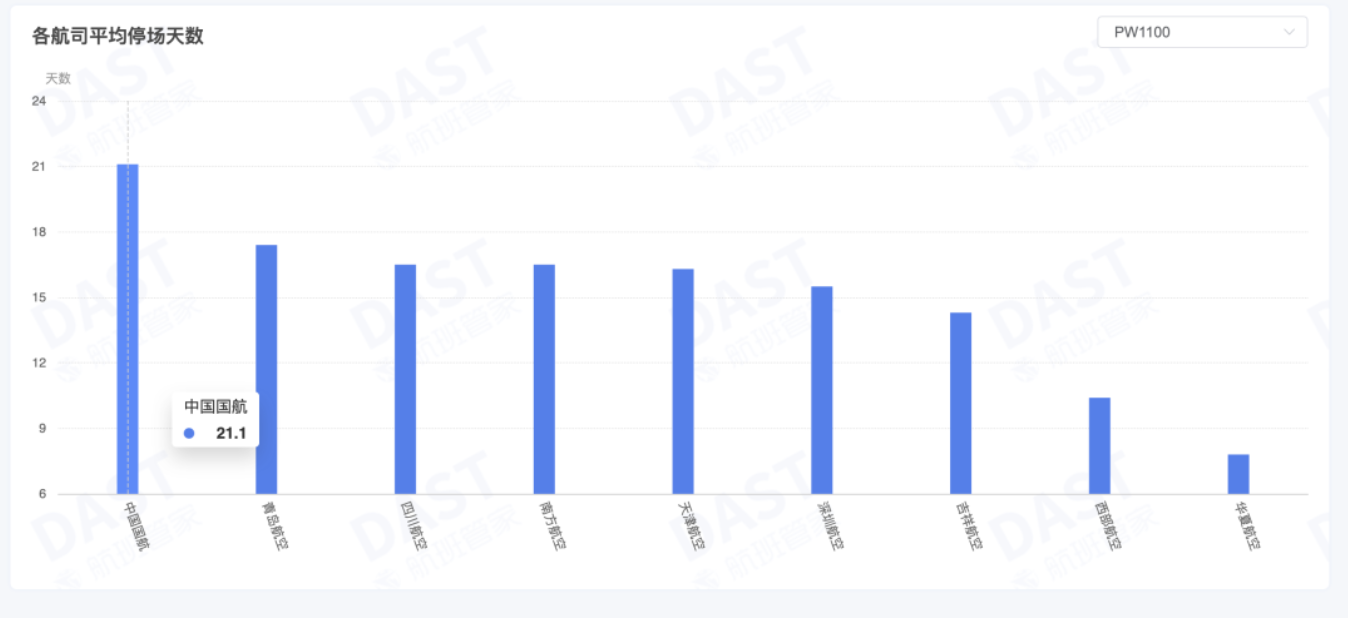
Core Insights - The aviation industry is facing significant challenges in 2025 due to engine issues and parts shortages, leading to record-high grounded aircraft numbers [1][2] - Willie Walsh, the IATA director general, highlighted the ongoing disappointment among airlines regarding delayed aircraft deliveries and engine-related operational disruptions [1][5] Group 1: Engine Issues - Nearly 70% of grounded aircraft globally are equipped with Pratt & Whitney's PWG1000 series engines, particularly affecting the A320neo fleet [2] - The PW1100 engine has been flagged for safety concerns, requiring extensive inspections that could lead to an average of 350 aircraft being grounded daily from 2024 to 2026 [2][3] - In May 2025, domestic airlines reported an average of 4.4 days of grounded aircraft, with PW1100-equipped planes averaging 16.2 days, significantly higher than the average [3] Group 2: Supply Chain and Delivery Delays - The backlog of undelivered aircraft has surged to over 17,000 units, double the pre-pandemic average, with delivery times potentially extending to 14 years [5][6] - Airlines are experiencing increased rental costs due to limited aircraft supply, with narrow-body aircraft rental rates rising by 20-30% compared to 2019 [7] - The supply chain issues are expected to persist through 2025 and possibly into the next decade, impacting airline operations and profitability [5][6] Group 3: Market Dynamics - While some airlines face challenges due to aircraft shortages, the delays in new aircraft deliveries may alleviate overcapacity in the domestic market [6] - Aircraft leasing companies are benefiting from the situation, with Avolon reporting a 36% increase in net profit in Q1 2023 [9] - The delays in Boeing and Airbus deliveries are providing opportunities for domestic manufacturers like COMAC, which plans to ramp up production of the C919 aircraft [9]