
对冲基金

Search documents
另类投资简报 | 对冲基金减持七巨头而增持中概股,谁最受青睐?4月抄底的对冲基金如今怎样了?
彭博Bloomberg· 2025-06-23 02:58
Core Insights - The hedge fund market experienced a significant increase in May 2024, with a 2.3% rise, marking the largest gain since March 2024, driven by the Bloomberg Stock Hedge Fund Index [5] - Hedge funds have shown a year-to-date increase of 1.7%, with equity funds leading the gains at 3.3%, while macro funds recorded a maximum decline of 1.2% [5] Private Equity Market Review - The report highlights the ongoing trends in private equity fundraising and investment activities, emphasizing the dynamics of the market [3][8] Hedge Fund Market Overview - In the first quarter of 2024, hedge funds reduced their holdings in the "seven major tech giants" while increasing exposure to Chinese companies listed in the U.S. [8] - Despite escalating U.S.-China trade tensions, hedge funds have favored Chinese stocks, particularly Alibaba, Pinduoduo, and Baidu [8] - A Chinese hedge fund capitalized on a significant drop in the Chinese stock market in April due to new U.S. tariffs, achieving a 20% return since then and a cumulative return of 1,485% since its inception ten years ago [8] Market Dynamics - The report notes that Hong Kong is intensifying tax scrutiny on private equity and venture capital funds, indicating a shift in regulatory focus [9] - PAG is leading the acquisition of 48 shopping centers owned by Dalian Wanda, showcasing active investment strategies in the private equity space [9] - Stonepeak has agreed to acquire the container leasing company Seaco, reflecting ongoing consolidation in the industry [9]


2025年宏观对冲策略半年报:宏观对冲策略25年H1回顾与展望
Guo Tai Jun An Qi Huo· 2025-06-22 12:07
Core Insights - The report indicates that from the beginning of 2025, macro hedge strategies, particularly risk parity strategies, face significant challenges due to increased policy uncertainty and market volatility, leading to a higher correlation among asset classes compared to the end of the previous year [2][3] - The performance of risk parity strategies has been notably poor, with a net value index of 0.989 as of May 16, 2025, reflecting a slight loss, while asset rotation strategies have shown better performance with a net value index of 1.013 [19][20] - The report suggests a cautious outlook for macro hedge strategies in the second half of 2025, recommending a reduction in allocations to risk parity managers and a focus on their ability to manage tail risks and dynamically adjust positions [3][19] Group 1: Performance Review and Strategy Classification - Macro hedge strategies are categorized into two primary types: "risk parity" and "asset rotation," with further distinctions based on subjective versus quantitative trading approaches [6][8] - The risk parity strategy aims for balanced risk allocation across various macroeconomic environments, while asset rotation strategies focus on actively trading based on economic conditions and market predictions [9][13] - In the first half of 2025, risk parity strategies experienced a maximum drawdown of -4.09%, while asset rotation strategies had a maximum drawdown of -3.46%, indicating that risk parity strategies underperformed [19][20] Group 2: Market Correlation and Asset Class Analysis - The correlation between major asset classes has increased in 2025, with the report noting a significant positive correlation between commodities and equity indices, while the negative correlation between bonds and equities has weakened [29][30] - The risk parity index showed the highest correlation with the commodity index at 0.607, while the asset rotation index had a higher correlation with the mid-cap index at 0.675, indicating differing dependencies on asset classes [30][31] - The report highlights that risk parity strategies are more reliant on bond performance compared to asset rotation strategies, which are more dependent on equity performance [39][44] Group 3: Investment Outlook and Recommendations - The report advises investors to maintain a cautious stance on macro hedge strategies, particularly risk parity strategies, due to anticipated continued volatility and potential negative returns [3][19] - It emphasizes the importance of evaluating managers' capabilities in managing tail risks and their flexibility in adjusting positions in response to market conditions [3][19] - The report also suggests focusing on asset rotation strategies that demonstrate advantages in specific asset classes to enhance portfolio resilience [3][19]
全球经济不确定性加剧 加强国际合作呼声升温
Zhong Guo Jing Ying Bao· 2025-06-20 11:49
Group 1 - The current monetary policy divergence and financial market volatility pose challenges to global financial stability [1] - The global economy is facing high uncertainty, necessitating enhanced economic supervision and policy coordination among major international financial organizations [1] - The "three no" state of global macroeconomic regulation indicates a lack of institutions, tools, and consensus, complicating coordinated responses to potential crises [1][2] Group 2 - The Global Financial Stability Report highlights a significant increase in global financial stability risks due to tightening financial conditions and uncertainty in economic trade policies [1] - High valuations in key market sectors may lead to further adjustments if economic prospects worsen, impacting emerging markets significantly [1] - The growth of high-leverage financial institutions raises concerns about their ability to manage risks during market turmoil, potentially leading to forced deleveraging [2] Group 3 - International cooperation and policy coordination are increasingly urgent in the context of global financial uncertainty [3] - The UN report projects a slowdown in global economic growth to 2.4% in 2025, down from 2.9% in 2024, highlighting challenges for trade-dependent developing countries [3] - The current global economic landscape emphasizes the need for coordinated policies and international collaboration to stabilize the economy and promote sustainable development [3]
贸易战缓和预期升温,对冲基金大举押注亚洲,交易增长创五年最强
Hua Er Jie Jian Wen· 2025-06-17 07:51
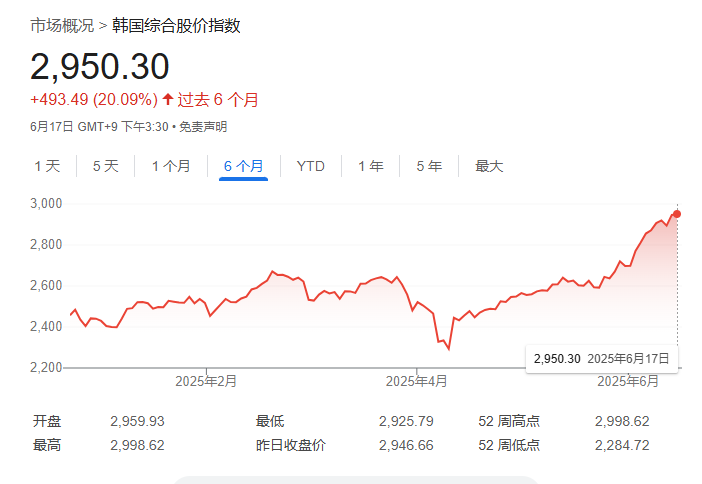
Group 1 - The core viewpoint of the articles highlights a significant surge in capital inflow into Asian markets, driven by increased trading activity from hedge funds, marking the highest level in over five years [1] - According to Goldman Sachs, net long positions among hedge funds rose to the highest level since September 2024 during the period from June 6 to June 12 [1] - The share of developed Asian markets in the total risk exposure tracked by hedge funds has increased to 9%, placing it in the 94th percentile of the past five years, indicating a high allocation level [1] Group 2 - The uptick in hedge fund activity coincides with easing signals from high-level trade negotiations between China and the U.S., which took place in London on June 9-10 [2] - The new pro-market South Korean president has boosted confidence in Asian markets, with promises to push the Kospi index to 5000 and legislative reforms to enhance shareholder rights [2] - Since the election of the new South Korean president, the Kospi index has risen over 7%, surpassing 2900 points [2] Group 3 - Some market participants suggest that the trend of "de-dollarization" to hedge against further dollar weakness is also supporting the overall Asian market [5]
地缘政治不确定性持续,私募信贷与私募二级市场成全球投资者“避风港”?
Di Yi Cai Jing· 2025-06-17 03:36
Group 1 - The announcement of large-scale tariffs by Trump has led to a significant slowdown in the IPO market, with reports indicating it is "almost at a standstill" [1][6] - In the context of ongoing geopolitical and economic uncertainty, investors are increasingly turning to alternative investments for yield, with BlackRock setting a fundraising target of $400 billion for its private equity business by 2030, aiming to increase its revenue share from 15% to over 30% [2] - Coller Capital's report indicates that most investors plan to increase allocations to private credit and secondary market assets in the coming year, driven by structural growth factors [2][3] Group 2 - Private credit is the most favored asset class among investors in the alternative asset space, with 45% planning to increase allocations, up from 37% six months ago [3] - Geopolitical risks are now a core consideration for portfolio construction, with 44% of investors increasing their focus on these risks, particularly regional conflicts and trade wars [3] - The application of artificial intelligence (AI) in investment portfolio management is becoming a significant trend, with 90% of U.S. investors planning to leverage AI for value addition [4] Group 3 - Traditional exit channels are facing liquidity challenges, prompting over half of global investors to consider trading private equity assets in the secondary market within the next two years [5] - The total transaction volume in the global secondary market is projected to reach $160 billion in 2024, while IPO exits are expected to generate only $1.1 trillion and $1.3 trillion in 2023 and 2024, respectively, significantly lower than the $600 billion in 2021 [5] - The current environment has led private equity executives to prioritize alternative exit strategies, such as divestitures and continuation funds, with 80% of top fund managers entering the continuation fund market [6]
历史上第一次对冲基金有正式估值:“多策略巨头”千禧年估值140亿美元
Hua Er Jie Jian Wen· 2025-06-17 02:57
Group 1: Core Insights - Millennium Management is set to be valued at $14 billion as it discusses selling 10% to 15% of its equity in partnership with Petershill Partners [1] - The transaction aims to attract strategic investors, including major contributors to Millennium's funds, positioning it among the highest-valued hedge fund management companies globally [1] - Millennium operates over 320 investment teams under a strict risk framework, similar to other multi-strategy giants like Citadel and Point72 [1] Group 2: Valuation Logic - The $14 billion valuation has sparked a reevaluation of hedge fund valuation logic, traditionally based on management fees and performance incentives [2] - Millennium's revised fee structure, particularly the 1% minimum fee, stabilizes its revenue stream, supporting its high valuation [2] - Despite the high valuation, some private equity advisors argue that even with long-term capital locks, Millennium's management fee multiples are generally lower than those of established private equity firms [2] Group 3: Institutional Preparation - Founder Izzy Englander is preparing for a "post-Englander era" by institutionalizing the company, marking a shift from sole ownership to shared ownership among the core team [3] - The minority stake sale is part of a dual strategy to attract stable external investors and incentivize top talent through equity distribution among senior management [3] - Englander has already implemented measures to solidify the company's capital base and strengthen leadership by recruiting senior management from firms like Goldman Sachs [3] Group 4: Fee Structure and Strategic Partnerships - Millennium has introduced a new fee model requiring investors to pay a minimum fee of around 1% of assets or 20% of investment returns, aligning its revenue structure closer to stable management fees [5] - The company is also in discussions with BlackRock for potential strategic collaboration, which may include a small equity acquisition [5]
Citadel格里芬:市场动荡期“防守策略几乎总是亏钱”,持有现金
Hua Er Jie Jian Wen· 2025-06-17 00:59
Group 1 - The core message from Ken Griffin, founder of Citadel, is that adopting a defensive strategy in turbulent markets is likely to lead to losses, as it creates a false sense of security [1] - Griffin emphasizes that during times of heightened risk aversion, "safe trades" become overcrowded, making them the most vulnerable to losses [1][2] - Instead of following the crowd into crowded defensive assets, Griffin advocates for maintaining cash flexibility to seize genuine opportunities when they arise [1] Group 2 - Griffin's warnings are rooted in the current challenging market conditions, including unpredictability in Trump's policies and rising geopolitical risks, which have led investors to instinctively seek defensive strategies [2] - He proposes a shift in mindset from "risk aversion" to "risk neutrality," suggesting that decisions closer to risk neutrality are more optimal from a profit perspective [2] - Citadel has successfully fostered a culture that encourages employees to take calculated risks, accepting occasional failures as a pathway to significant victories [3]
年薪给到“数千万美元”!华尔街为明星交易员“抢破头”
华尔街见闻· 2025-06-15 10:08
Core Insights - The article discusses a fierce competition among hedge funds to recruit top traders, likening it to a sports signing event, with significant financial incentives involved [1][3][6]. Group 1: Recruitment Competition - Billionaire Steve Cohen signed young trader Kevin Liu to a five-year contract worth $100 million, highlighting the lengths hedge funds will go to secure top talent [1]. - The competition for top traders is driven by the rise of multi-strategy hedge funds, which require traders who can consistently generate profits rather than just capital [3][5]. - High salaries for star investment managers can reach hundreds of millions, comparable to Wall Street CEOs, reflecting their scarcity and value in the industry [3][4]. Group 2: Trader Expectations and Pressure - Multi-strategy hedge funds demand traders to operate with high frequency and short cycles, leading to a low tolerance for errors and high-pressure environments [3][7]. - Traders face significant pressure during earnings seasons, often working over 14 hours a day, with strict performance thresholds leading to high turnover rates [7]. Group 3: Cost Structure and Client Impact - The high salaries of traders are funded by clients, with operational costs representing 8% of fund assets, significantly higher than traditional hedge funds [9][10]. - Despite complaints about costs, clients remain willing to pay for high performance, as evidenced by the strong returns of firms like Citadel and Millennium [11][12]. Group 4: Career Choices of Top Traders - Many top traders prefer joining multi-strategy hedge funds over starting their own firms due to the support these platforms provide in non-investment tasks [13]. - Some traders seek greater autonomy within these firms, as seen with Peter Goodwin, who was allowed to operate a sub-fund while benefiting from the resources of Balyasny [14][15].

年薪给到“数千万美元”!华尔街为明星交易员“抢破头”
Hua Er Jie Jian Wen· 2025-06-14 11:14
Group 1 - The core of the article discusses a fierce competition among hedge funds to recruit top traders, likening it to a sports signing event, with significant financial incentives involved [1][2] - Billionaire Steve Cohen of Point72 successfully signed young trader Kevin Liu with a five-year contract worth $100 million, highlighting the lengths to which firms will go to secure talent [1][2] - The rise of multi-strategy hedge funds has created a talent shortage, making skilled traders the most valuable asset in the industry, with some earning salaries comparable to Wall Street CEOs [2][6] Group 2 - Multi-strategy hedge funds operate with a structure that requires traders to deliver consistent short-term profits, leading to high-pressure environments and high turnover rates [5][6] - The compensation for top traders is often funded by clients, with operational costs significantly higher than traditional hedge funds, raising questions about the sustainability of such high salaries [6][7] - Despite concerns over costs, clients continue to tolerate high fees due to strong performance, with firms like Citadel and Millennium reporting annualized returns of approximately 22% and 13% respectively [7][8] Group 3 - Many top traders prefer joining multi-strategy hedge funds over starting their own firms due to the support these platforms provide in non-investment areas, allowing them to focus on trading [8] - Some traders, like Peter Goodwin, have negotiated for greater autonomy within these firms, combining the benefits of high compensation with the freedom to manage their own funds [8]
“全市场最伟大的交易员之一”Cohen谈:如何取胜
Hua Er Jie Jian Wen· 2025-06-13 14:14
在高盛最新一期《Great Investors》播客中,"全市场最伟大的交易员之一"、对冲基金大佬、Point72创 始人Steve Cohen罕见分享了他近50年投资生涯中的关键经验与洞见。 在这场对话中,他更多地谈到如何"持续赢"。Cohen从小就对市场充满热情,14岁便开始研究股价行 情,靠模式识别能力预测价格走势。他指出,热爱是成功的前提,但这远远不够,"你必须拥有核心能 力,并且不断适应变化"。 面对当今竞争激烈的对冲基金行业,Cohen坚定看好多策略(multi-strategy)模式。他认为,相比单一 策略的基金,"分散的策略、地域与团队,使我们可以专注于发掘好点子,而不是分心于招聘和管理。 对于市场,Cohen承认当下是"被新闻驱动的环境",并预期未来美国经济将放缓,预计市场可能会进入 一个震荡交易区间。 他警惕高估值风险,但也认为人工智能将带来新的利润红利:"谁不部署AI,就会落后。"他正在推动 Point72内部全面引入AI工具,以提升分析效率和决策质量。 如今已69岁的Cohen虽不再亲自交易,但他强调:"我退出交易后,公司反而更强了。"他把更多时间投 入到指导年轻人上,帮助他们突破思维 ...