
文化创意

Search documents
非遗焕新,潮玩赋能:华远集团“远方有礼”探索城市生活服务新路径
Sou Hu Wang· 2025-08-27 10:16
Group 1 - The event "Night Moves in Beijing" marked a significant step for Huayuan Group's cultural brand "Far Away has Gifts," integrating intangible cultural heritage with sports, highlighting the company's shift towards "urban life services" [1] - The "Far Away has Gifts" exhibition attracted considerable attention, showcasing innovative interpretations of traditional crafts, such as the non-heritage carpet series and interactive installations that engage children and families [2] - The market at Dajixiang represents a crucial step in bringing intangible cultural heritage into everyday life, aligning with the brand's mission to enhance cultural soft power and preserve historical narratives [2] Group 2 - Huayuan Group is leveraging its restructuring to focus on four new business brands: construction, apartments, elderly dining, and culture, aligning with national urban development goals [3] - The new brands aim to address urban renewal, youth housing needs, community elderly services, and cultural heritage, reflecting the company's transition from merely building houses to providing comprehensive urban services [3] - Huayuan Group's strategic approach serves as a model for state-owned enterprises in high-quality development, contributing to urban integration and offering a replicable framework for the industry [3]

新华视点丨文化跨界赋能 催生产业新浪潮
Xin Hua Wang· 2025-08-27 07:05
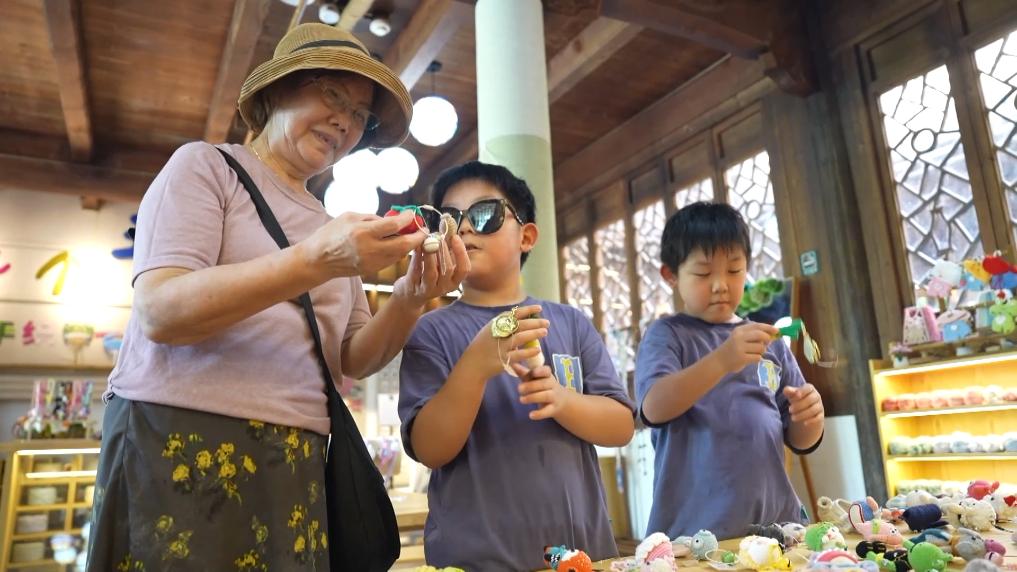
Group 1: Emerging Trends in Cultural and Fashion Industries - The "doll clothes" market is experiencing explosive growth, with sales expected to increase by over 117.08% year-on-year in 2024, and monthly sales surpassing 10 million yuan in May 2023 [2] - The production of "doll clothes" is primarily concentrated in Tongxiang, Zhejiang, where a long-established clothing factory has adapted to this trend, producing various styles that are in high demand despite a price point of around 100 yuan per piece [2][4] - The rise of emotional consumption among young consumers is significant, with over 40.1% of them willing to pay for emotional value and personal interests [3][5] Group 2: Cultural and Tourism Integration - The integration of traditional culture with modern experiences is creating new economic opportunities, as seen in the combination of coffee culture with traditional cave dwellings in Gansu, attracting numerous visitors [10] - In Shandong's Wudi Ancient City, a variety of cultural tourism activities, including performances and exhibitions, have led to a 30% increase in daily visitor numbers during the summer, averaging nearly 20,000 visitors per day [12][13] - Local investments in cultural infrastructure, such as wedding art centers and intangible cultural heritage museums, are enhancing the visitor experience and promoting sustained engagement with the area [12][13]

湖北郧西:七夕产业“旺”起来
Ren Min Wang· 2025-08-26 11:29
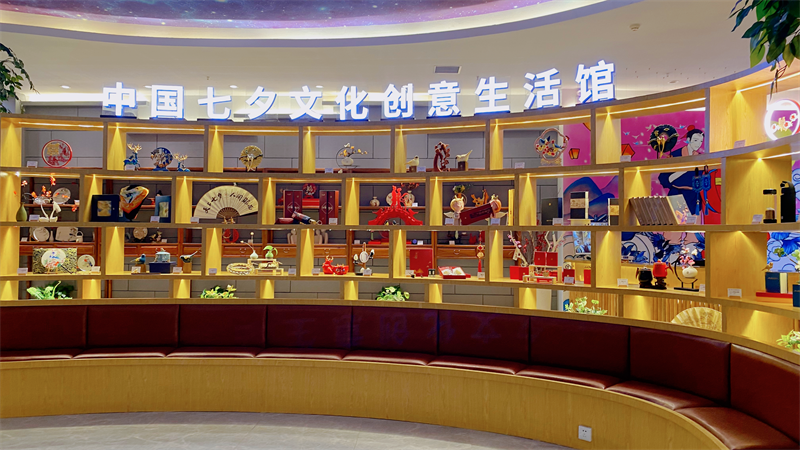
Group 1 - The core viewpoint of the articles highlights the integration of local cultural resources, specifically the Qixi Festival culture, into economic development, transforming traditional customs into economic empowerment for the region [2][6]. - The Qixi Tea Company in Yuxi County has produced 30,000 pounds of finished red tea this year, with an expected annual output value of over 35 million yuan, showcasing effective utilization of local tea resources [1]. - The county has developed over 5,000 acres of tea plantations through land transfer, directly benefiting over 500 local farmers by increasing their income [1]. Group 2 - The China Qixi Cultural Creative Life Museum has seen significant sales, with over 10,000 items sold in three days, generating more than 900,000 yuan in revenue, indicating strong consumer interest in Qixi-themed products [2]. - The county has launched various cultural products that incorporate Qixi elements, such as wedding customs and travel gift boxes, enhancing the cultural and economic synergy [2][6]. - Yuxi County has over 110 cultural industry enterprises related to the Qixi chain and has registered more than 120 trademarks, reflecting a robust growth in cultural entrepreneurship [6]. Group 3 - The county actively participates in national events to promote its cultural and agricultural products, aiming to expand the reach of "Yuxi Qixi" beyond local boundaries [6]. - Yuxi's Qixi cultural IP was recognized as one of the "Top 10 Annual IPs" at a major event, highlighting its potential for national recognition alongside other significant cultural IPs [6].
深圳:一座定义未来的闯关之城
Xin Lang Cai Jing· 2025-08-26 03:59
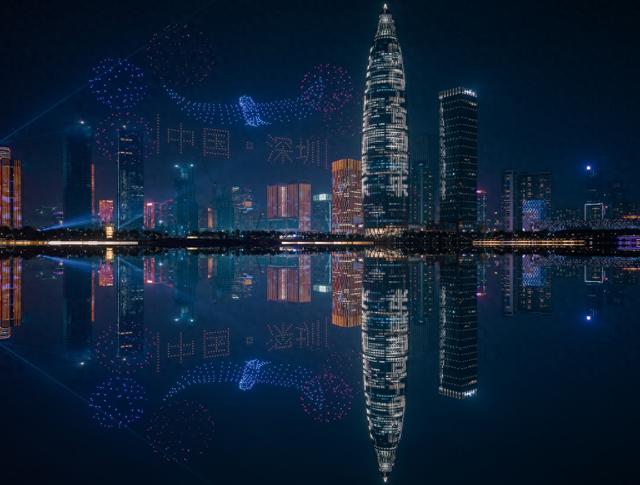
Economic Growth - Shenzhen's GDP reached 3.68 trillion yuan in 2024, with 1.83 trillion yuan in the first half of 2025 [1] - The city has transformed from a small town with a GDP of only 2.7 million yuan in 1980 to a major economic hub [1] Innovation and Technology - Shenzhen has an average of 663 patent authorizations per day and 12.5 high-tech enterprises per square kilometer [2] - The city aims to become a global leader in low-altitude economy by establishing over 1,200 takeoff and landing points and 1,000 low-altitude commercial flight routes by the end of 2026 [6] - Shenzhen's R&D investment accounts for 6.46% of its GDP, with corporate R&D investment at 208.67 billion yuan, representing 93.3% of total R&D investment [10] Cultural Development - Shenzhen has evolved from being labeled a "cultural desert" to a vibrant cultural hub, hosting various cultural events and institutions [15] - The city has over 1,800 cultural facilities, contributing to a cultural industry revenue of 1.29 trillion yuan in 2024, accounting for 51.5% of Guangdong's total [18] Regional Collaboration - Shenzhen is enhancing its role in the Guangdong-Hong Kong-Macau Greater Bay Area, facilitating efficient flow of talent, technology, and capital [11] - The establishment of the Qianhai Cooperation Zone has attracted over 9,900 Hong Kong-funded enterprises, promoting cross-border collaboration [14] Future Outlook - Shenzhen is positioned to continue defining possibilities rather than merely proving miracles, focusing on sustainable and high-quality growth [4][20] - The city is actively exploring new areas such as synthetic biology and aerospace technology, aiming for breakthroughs in these "unmanned zones" [6]
许知远的“单向空间江苏旗舰店”明年将在第一丝厂开业
Su Zhou Ri Bao· 2025-08-25 22:41
Core Insights - The establishment of "Single Space" in Suzhou marks a significant cultural initiative, aiming to blend traditional and contemporary cultural elements [1][2][3] Group 1: Company Overview - "Single Space" is a comprehensive cultural and creative institution founded in 2005 by media figures including Xu Zhiyuan, with a network of physical bookstores and cultural spaces across multiple cities [1] - The new flagship store in Suzhou will be located in the historic first silk factory, which dates back to 1926, aiming to revitalize the cultural landscape of the area [1][3] Group 2: Cultural Strategy - The collaboration with Suzhou aligns with the city's "Cultural Strong City" strategy, which encourages the innovation of physical bookstores and public cultural services [2] - The focus will be on "localization" and "high quality," with curated city-specific reading lists and literary events to engage the local community [2][3] Group 3: Future Prospects - The project aims to create a dialogue between traditional silk culture and modern digital technology, enhancing the cultural offerings of Suzhou [3] - The integration of "Single Space" is expected to elevate the cultural supply and quality in the city, contributing to a new cultural landmark that connects the past with the future [4]
文化中国行丨国家图书馆:文化共享与跨界融合 让古籍文物“活”起来
Xin Hua Wang· 2025-08-25 20:06
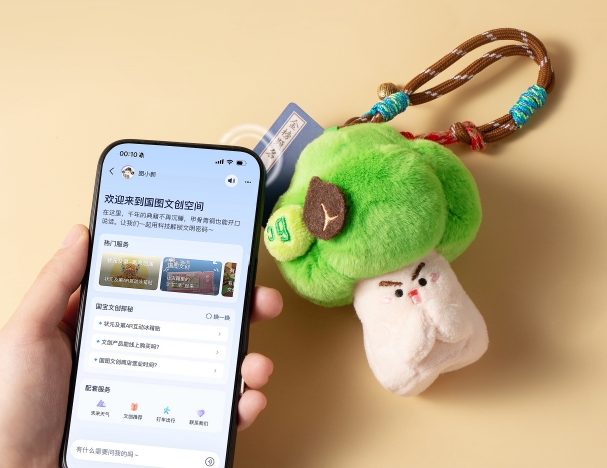
Core Viewpoint - The National Library of China is actively engaging in cultural sharing and cross-industry integration to revitalize ancient books and cultural relics through innovative projects and community involvement [1][4]. Group 1: Cultural Engagement and Education - The National Library has designed hands-on educational activities for youth, allowing them to experience the restoration of ancient texts and understand the evolution of bookbinding in ancient China [1]. - The library's initiatives aim to awaken dormant cultural relics by combining preservation with creative activation, enhancing public engagement with ancient texts [1][6]. Group 2: Creative Product Development - The library has developed over 1,800 cultural and creative products inspired by ancient texts, integrating traditional elements with modern design [3]. - These products have gained recognition in national cultural creative competitions and have become part of everyday life for the public [3]. Group 3: High-Quality Cultural Services - A cultural creative exhibition titled "Ink and Fragrance, Culture Enriches Tianshan" will be held in December 2024, showcasing the development of Chinese traditional cultural classics [4]. - The exhibition employs interactive games and immersive projections to engage visitors, making traditional texts more accessible and enjoyable [4][6]. Group 4: Local Collaboration and Cultural Integration - The National Library has established creative stores in Lijiang, integrating local ethnic culture with its resources, enhancing the cultural tourism experience [7][9]. - A strategic partnership with Huzhou has led to the creation of a comprehensive cultural space that combines various cultural services, becoming a new cultural landmark since its opening in 2024 [7][9]. Group 5: National Collaboration and Future Plans - The library has initiated the "National Library Cultural Creative Product Development Alliance," which includes 116 libraries, to share resources and expertise in product development and marketing [9]. - The library aims to continue promoting cultural sharing and cross-industry integration, fostering a collective effort in the preservation and revitalization of ancient cultural heritage [9].
2025北京文化论坛|中轴线文创“出圈” 解锁北京文化新表达
Bei Jing Shang Bao· 2025-08-25 13:17
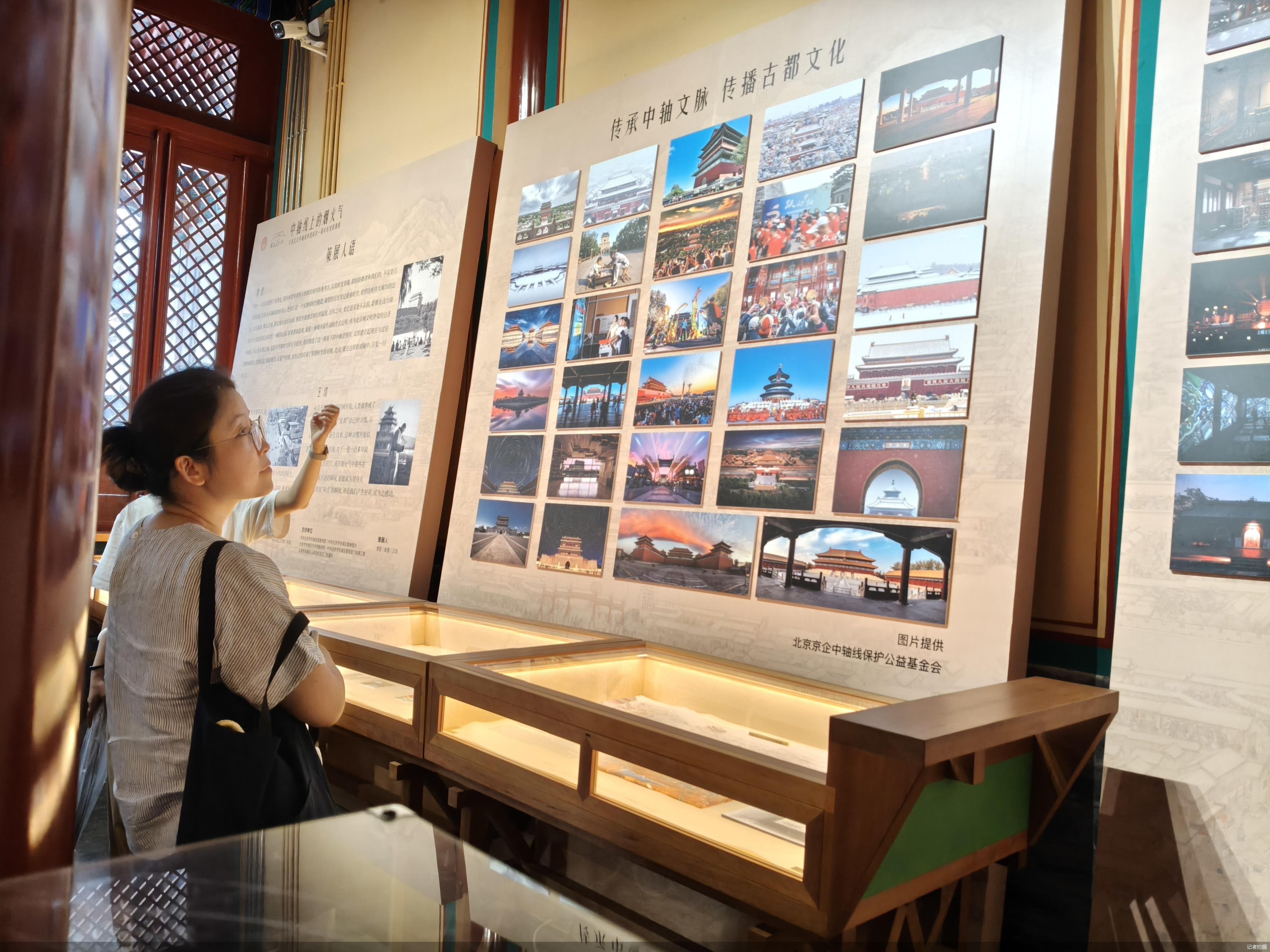
Core Insights - The article highlights the revitalization of cultural heritage sites in Beijing, particularly through the development of creative cultural products that resonate with modern consumers [1][5][21] - The success of the Beijing Central Axis in being listed as a UNESCO World Heritage Site has led to increased visitor engagement and the promotion of cultural narratives [1][22] Group 1: Cultural Heritage and Visitor Engagement - The annual visitor count at the White Pagoda Temple has increased from approximately 300,000 to around 500,000 due to enhanced cultural promotion [8] - The introduction of various cultural activities, such as the White Pagoda Cultural Week, aims to attract more visitors and enhance their cultural experience [5][8] - The Clock and Drum Tower has seen a significant rise in educational groups and foreign tourists, indicating a shift towards deeper cultural appreciation among the public [17] Group 2: Creative Cultural Products - The White Pagoda Temple has launched a range of creative products inspired by its cultural elements, including keychains and notebooks, which have become popular among visitors [5][8] - The development of new product lines, such as the upcoming Year of the Horse themed items, aims to diversify the offerings beyond traditional souvenirs like refrigerator magnets [8] - The Ancient Architecture Museum has reported a surge in demand for its unique cultural products, particularly the Tian Gong Zao Jing refrigerator magnets, which have become top-selling items [17] Group 3: Institutional Efforts and Future Directions - The Beijing Central Axis Heritage Protection Office emphasizes the importance of public participation in cultural heritage protection through various community activities and educational programs [21] - The ongoing projects for the preservation and utilization of historical sites in the capital, including the renovation of significant buildings, reflect a commitment to maintaining cultural integrity [21][22] - Future initiatives will focus on enhancing the visibility and accessibility of cultural heritage, ensuring that it remains an integral part of daily life for residents and visitors alike [21][22]

会展激活文旅新势能,答案就在2025 IPX世界文旅流量大会!
Zhong Guo Jing Ji Wang· 2025-08-25 02:37
Group 1 - The core viewpoint of the articles emphasizes the growing significance of the exhibition economy as a driving force for the cultural tourism industry in Shenzhen, highlighting its potential to stimulate new consumption patterns [1][3][11] - The exhibition economy is described as a vast economic ecosystem, with an industry multiplier effect of approximately 1:9, indicating that for every unit of revenue generated by exhibition venues, about nine units of revenue are generated in related industries [1][2] - Shenzhen is positioning itself as a leader in the exhibition economy, aiming to become the "first city for inbound consumption" by leveraging its young consumer base and vibrant cultural and creative industries [3][10] Group 2 - The articles illustrate how exhibitions have evolved beyond mere business gatherings to become significant catalysts for cultural tourism consumption, with cities like Singapore and Tokyo showcasing the spillover effects of exhibitions on local economies [2][4] - Shenzhen's approach to exhibitions includes innovative designs and operations that attract a diverse audience, transforming attendees from passive observers into active participants in cultural experiences [4][6] - The Shenzhen Cultural Tourism Promotion Association plays a crucial role in integrating cultural, tourism, and consumption resources, organizing influential events like the Shenzhen International IP Licensing Industry Expo [5][7] Group 3 - The upcoming "2025 IPX World Cultural Tourism Flow Conference" is highlighted as a significant event for Shenzhen, aiming to showcase the city's cultural tourism potential and attract global attention [8][9] - The conference will feature various activities, including forums and exhibitions, designed to engage both industry professionals and the general public, promoting immersive cultural experiences [8][9] - The articles note that Shenzhen's strategic layout in the exhibition economy and cultural tourism consumption aims to create natural growth in urban tourism while providing immersive experiences for both inbound tourists and local residents [9][10]
人民日报头版头条点赞四川:蜀道新歌
Ren Min Ri Bao· 2025-08-25 01:46
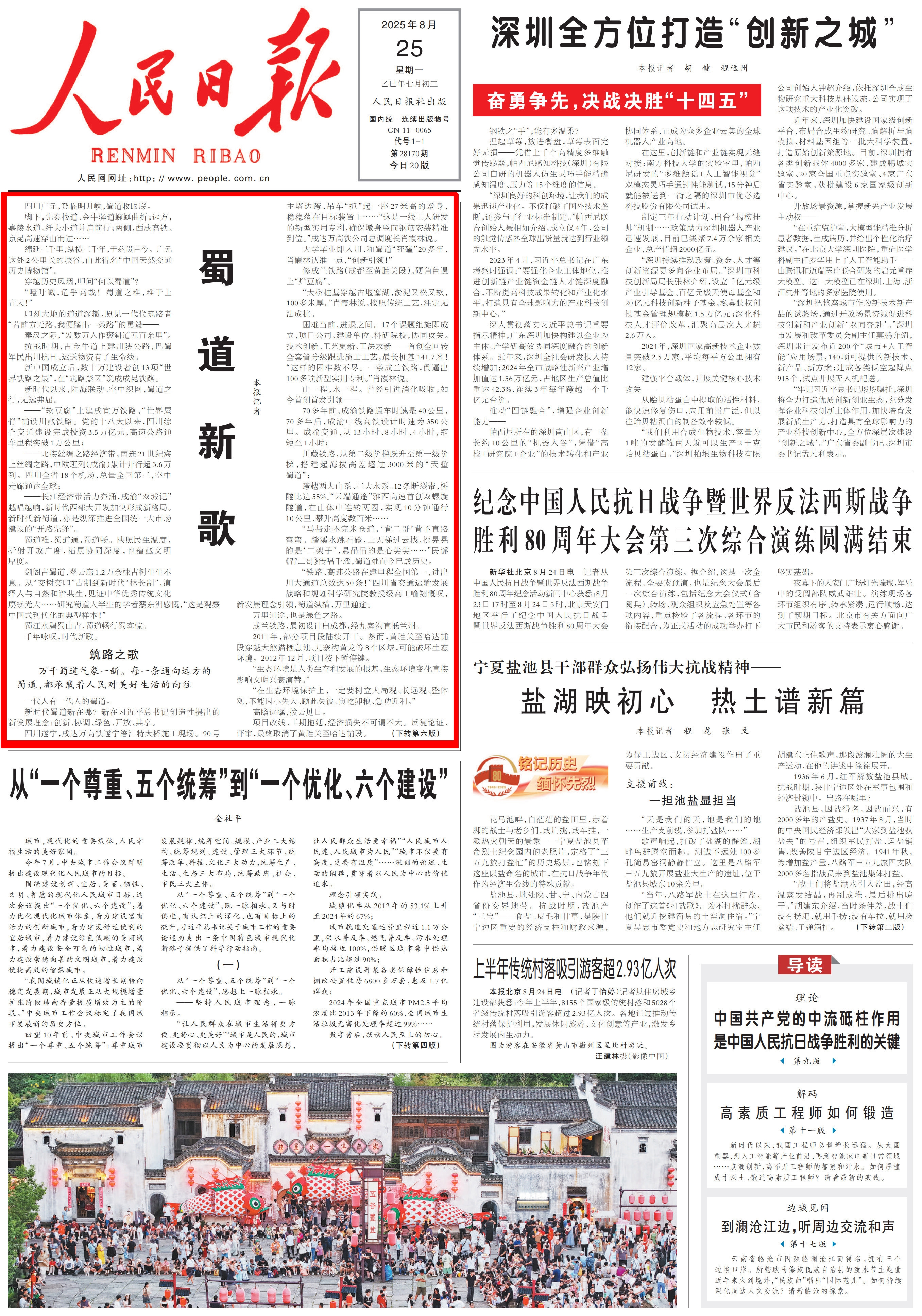
Core Viewpoint - The article "New Song of Shu Road" highlights the transformation of Sichuan's transportation infrastructure from the historical challenges of "Shu Road" to a modern, interconnected network that supports economic growth and regional integration [1][5]. Group 1: Historical Context - The article traces the historical significance of the Shu Road, emphasizing its evolution from ancient pathways to modern transportation systems, showcasing the resilience and innovation of builders throughout history [3][28]. - Key milestones include the construction of the Baoshan Road during the Qin and Han dynasties and the establishment of the Chengdu-Chongqing Railway, which marked significant advancements in transportation [29][30]. Group 2: Modern Infrastructure Development - Since the 18th National Congress, Sichuan has invested 3.5 trillion yuan in comprehensive transportation construction, with over 10,000 kilometers of expressways completed [32]. - The region has established 50 major transportation corridors, with the Chengdu-Chongqing economic circle becoming a national model for integrated development [44][70]. Group 3: Economic Integration and Growth - The Chengdu-Chongqing economic circle's GDP increased from 6.3 trillion yuan in 2019 to 8.7 trillion yuan in 2024, reflecting significant economic growth and regional collaboration [70]. - The establishment of the cross-provincial tax collection service center in the Gaotong New District exemplifies efforts to streamline administrative processes and enhance economic cooperation between Sichuan and Chongqing [60][66]. Group 4: Environmental Considerations - The article emphasizes the importance of ecological protection in infrastructure projects, highlighting the need for sustainable development practices that consider long-term environmental impacts [51][54]. - The construction of the Chengdu-Lanzhou Railway faced challenges due to environmental concerns, leading to project modifications to protect sensitive ecosystems [51][52]. Group 5: Future Prospects - The article concludes with a vision for the future of the Shu Road, emphasizing its role as a "pioneer" in promoting a unified national market and facilitating international trade [5][81]. - The development of logistics and transportation networks is expected to enhance the region's competitiveness in global markets, particularly through initiatives like the China-Europe Railway Express [81][85].
山东为乡村著名让邮路畅通 设置村牌、街路巷牌、楼门(户)牌等标志
Da Zhong Ri Bao· 2025-08-25 01:05
Group 1 - The core viewpoint of the news is the collaboration between the provincial civil affairs department and the postal administration to enhance rural governance and public service levels through improved postal and logistics services [1] - The notification emphasizes the need to complete the naming of rural residential points, roads, and significant public service facilities by June 2026 to facilitate the "smooth postal routes" initiative [2] - The initiative includes the establishment of a standard address system and the integration of smart geographic markers that combine postal services, public services, and cultural promotion [2] Group 2 - The notification encourages the incorporation of geographic names into rural industry brand promotion and the development of postal cultural products that reflect local culture [2] - It also promotes the involvement of postal workers in volunteer services related to geographic name culture and information collection [2]