
软件

Search documents
低配美国科技股终成制胜策略
Xin Lang Cai Jing· 2026-02-20 16:31
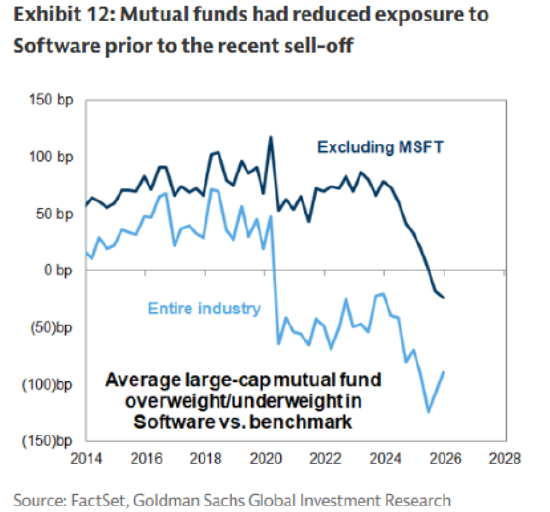
Core Insights - The performance of large-cap mutual funds has improved significantly as many fund managers have reduced their exposure to large technology stocks, with nearly 60% of these funds outperforming their benchmarks, the highest rate since 2007 [1][11] - The S&P 500 index has seen a reshuffling of winners and losers, with technology stocks declining over 4%, while energy and materials sectors have risen by at least 15% [1][11] - The volatility in the market is largely attributed to the potential disruption caused by artificial intelligence (AI) across various industries, leading to significant declines in software companies and other sectors [1][11] Group 1 - Many active fund managers are not necessarily anti-tech; they are reluctant to pay high premiums for crowded large-cap and software stocks, and strategies that diversify away from tech have started to yield returns [2][12] - The market breadth, which measures how many stocks are participating in the rally, has become increasingly important for fund managers, with about 66% of S&P 500 constituents currently above their 100-day moving average [5][14] - The dispersion, or the gap between the best and worst-performing stocks in the benchmark index, has widened to 41 percentage points, placing it in the 93rd percentile since 1980 [8][17] Group 2 - Since 1990, market breadth and return dispersion have been the two most important drivers of mutual fund performance [10][19] - Active funds have benefited from the dramatic rotation in the stock market, with the equal-weighted S&P 500 index reaching a record high recently [5][14] - Fund managers who have consistently reduced their exposure to technology stocks since early 2024 are seeing timely returns as the performance divergence expands, particularly in the software sector [8][17]



Wedbush:陷入AI恐惧后,扭转美股科技股颓势的10大关键消息
智通财经网· 2026-02-20 13:35
Core Insights - The article discusses the challenges faced by the technology sector due to fears surrounding artificial intelligence (AI) and its impact on software companies, highlighting a significant capital expenditure of nearly $700 billion in AI for the year [1] Group 1: AI Market Dynamics - AI is perceived as a threat across all industries, particularly impacting the software sector, which is seen as the primary target [1] - The AI technology industry is at a critical juncture, necessitating leadership from major tech companies [1] Group 2: Key Drivers for AI Technology Growth - OpenAI has completed a $100 billion funding round, alleviating external concerns [2] - NVIDIA's CEO is expected to reaffirm the strong demand trajectory for AI chips, surpassing Wall Street expectations [2] - Oracle has achieved strong initial success in its $45 billion to $50 billion funding efforts [2] - Salesforce's earnings guidance indicates that AI monetization has begun [2] - Strategic and large-scale public software mergers and acquisitions are anticipated in the coming months [2] - Apple has launched the first phase of Siri AI, marking the beginning of consumer-level AI [2] - CrowdStrike is the first cybersecurity company to profit from AI, as reflected in its upcoming earnings report [2] - AI monetization is expected to be evident in Microsoft and ServiceNow's March performance [2] - Meta Platforms and Alphabet's Google are set to accelerate AI monetization in digital advertising by the first half of 2026 [3] - Companies are beginning to implement Anthropic's Claude, facing scalability and security challenges [3]



低配科技股,终于成了制胜的股票策略
Xin Lang Cai Jing· 2026-02-20 11:53
Core Insights - The investment landscape is shifting, with a significant reversal expected by 2026, moving away from large-cap tech stocks that have historically been a safe bet for fund managers [1] - Active fund managers are benefiting from a market rotation, as they are increasingly allocating to sectors outside of technology, which has led to improved performance [2] Group 1: Market Performance - Nearly 60% of large-cap mutual funds have outperformed their benchmarks this year, marking the highest rate since 2007 [1] - The S&P 500 index has remained flat for seven consecutive weeks, but underlying market dynamics show a reshuffling of winners and losers [1] - Technology stocks in the index have dropped over 4%, while energy and materials sectors have surged by at least 15% [1] Group 2: Fund Manager Strategies - Many active fund managers are not opposed to technology but are reluctant to chase a few overcrowded large-cap tech stocks [2] - The market breadth, which measures how many stocks are participating in the rally, has become increasingly important for active managers [2] - Approximately 66% of S&P 500 stocks are trading above their 100-day moving average, indicating a broad market rally [2] Group 3: Performance Metrics - The dispersion of returns within the benchmark index has widened to 41 percentage points, reaching a high percentile since 1980 [2][3] - Since early 2024, fund managers have started to reduce their exposure to tech stocks, particularly software stocks, which have been heavily impacted [2]
港股软件股重挫,金蝶国际跌5%,科网股大跌,百度跌近6%
2 1 Shi Ji Jing Ji Bao Dao· 2026-02-20 04:51
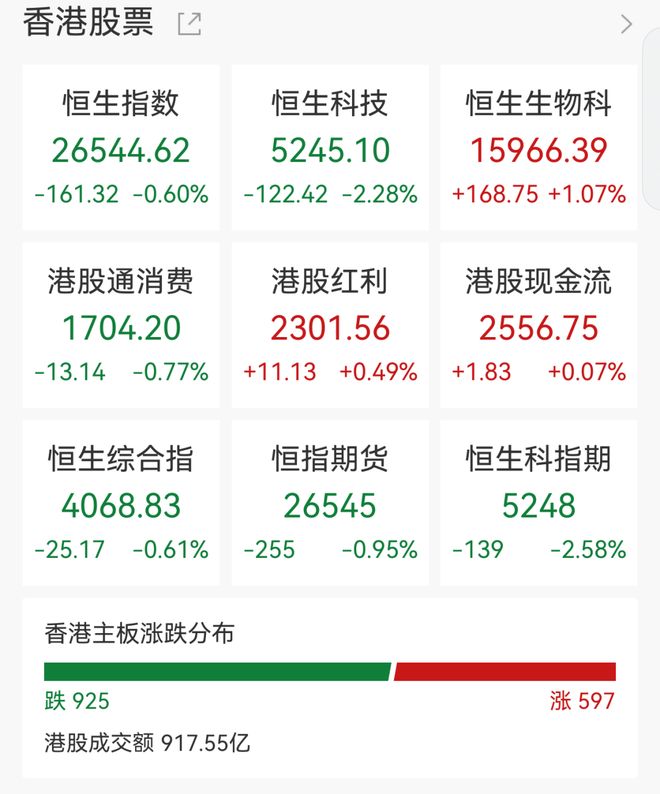
Market Overview - The Middle East situation is becoming increasingly tense, leading to heightened risk aversion, resulting in a decline in US stocks and a further drop in Hong Kong stocks on the first trading day of the Year of the Rabbit [1] - As of midday, the Hang Seng Technology Index fell by 2.28%, the Hang Seng Index decreased by 0.6%, and the National Enterprises Index dropped by over 1% [1] Stock Performance - The Hang Seng Index is at 26,544.62, down by 161.32 points or 0.60%, while the Hang Seng Technology Index is at 5,245.10, down by 122.42 points or 2.28% [2] - Semiconductor stocks weakened, with Huahong Semiconductor down over 3%, Shanghai Fudan down over 2%, and SMIC, Beike Micro, and ZTE all down over 1% [2] - Conversely, storage concept stocks performed well, with Lanqi Technology rising over 8% at one point, and Aixin Yuan Zhi increasing by 19.89%, reaching a historical high [2] Sector Highlights - The robotics sector continued its upward trend, with Yujian rising by 19%, Sutech increasing by over 9%, and Ubtech up by over 6% [3] - Oil sector stocks surged, with China Petroleum up by 4.58% and Yanchang Petroleum International up by 5%, driven by rising international oil prices amid escalating tensions between the US and Iran [3] - Within the Hang Seng Technology Index, Baidu Group fell nearly 6%, JD Health dropped over 5%, Tencent Music decreased over 4%, and Bilibili fell over 5% [3] Additional Stock Movements - Software sector stocks mostly declined, with Kingdee International down over 5% and Tian Shi Resources down over 3% [5] - In the consumer sector, both discretionary and staple consumer stocks collectively fell, with Laopu Gold down over 3% [5] - Spot gold prices fell by approximately $20, currently reported at $4,991.15 per ounce, while spot silver decreased by $1, now at $77.64 per ounce [5]
美股齐跌!金融股、软件股跌惨了!标普500抹去年内涨幅
Di Yi Cai Jing Zi Xun· 2026-02-20 01:39
Market Overview - The three major US stock indices closed lower on Thursday, with the Dow Jones down 267.50 points (0.54%) at 49,395.16, the Nasdaq down 70.91 points (0.31%) at 22,682.73, and the S&P 500 down 19.42 points (0.28%) at 6,861.89 [2] - Concerns over risks in the private credit sector led investors to withdraw from financial stocks, while escalating tensions between the US and Iran put additional pressure on the market [2] - The S&P 500 index nearly erased all its gains for the year, and the Nasdaq has seen a year-to-date decline of 2.41% [2] Technology Sector Performance - Major tech stocks showed weak performance, with Apple down 1.43%, Netflix down 1.27%, Microsoft down 0.29%, Alphabet down 0.16%, and Nvidia down 0.04% [2] - In contrast, Meta rose 0.24% and Tesla increased by 0.12% [2] Company Highlights - Amazon officially surpassed Walmart to become the world's highest-grossing company, with Amazon's revenue at $716.9 billion for the fiscal year ending in December, compared to Walmart's $713.2 billion for the fiscal year ending in January [2] - Walmart's annual sales fell below Amazon's for the first time [2] Chinese Concept Stocks - The Nasdaq Golden Dragon China Index fell by 0.35%, with notable declines in Alibaba (down 0.96%), Pinduoduo (down 0.94%), and Baidu (down 0.55%) [3] - However, some stocks like Niu Technologies rose by 2.08% and Zhihu increased by 0.86% [3] Financial Sector Developments - Blue Owl Capital announced the sale of $1.4 billion in loan assets and tightened liquidity arrangements for investors, leading to a sell-off in private credit stocks [4] - Blue Owl Capital's stock fell by 5.93%, while Blackstone and Apollo Global Management also experienced declines of 5.37% and 5.21%, respectively [5] - The tightening of liquidity arrangements raised concerns about the liquidity risks associated with private credit funds [5] Software Sector Challenges - The software sector faced pressure, with Salesforce down 1.30%, Intuit down 2.06%, and Cadence Design Systems down 2.76% [5] - Concerns about AI potentially disrupting the industry have contributed to the sector's challenges, with a statement from Mistral AI's CEO suggesting that over 50% of enterprise software could be replaced by AI [6] Oil Market Dynamics - International oil prices continued to rise, with WTI crude oil futures up 1.90% at $66.43 per barrel and Brent crude oil futures up 1.86% at $71.66 per barrel [7] - Geopolitical risks in the Middle East, particularly regarding Iran, have been a driving factor behind the rising oil prices [7] - Additionally, a surprise decline in US crude oil inventories reported by the EIA further supported the increase in oil prices [8] Gold Market Update - Spot gold rose by 0.42% to $4,998.50 per ounce, while COMEX gold futures increased by 0.09% to $5,014 per ounce [9]


昨夜,美股普跌!瑞典先买后付平台暴跌超26%
证券时报· 2026-02-20 00:52
Market Overview - On February 19, U.S. stock indices fell collectively due to multiple negative factors, including tightening liquidity in the private credit industry and escalating geopolitical tensions between the U.S. and Iran. The Dow Jones Industrial Average dropped by 267.5 points, a decline of 0.54%, while the S&P 500 and Nasdaq Composite fell by 0.28% and 0.31%, respectively, with the Nasdaq experiencing a cumulative decline of over 2% since 2026 [1][2]. Private Credit Industry - A liquidity crisis in the private credit sector was a core reason for the market's weakness. Blue Owl Capital announced the sale of $1.4 billion in loan assets and tightened investor liquidity, leading to a significant drop in its stock price by 1%. This triggered a collective decline in the private credit sector, with major firms like Blackstone and Apollo Global Management seeing their stock prices fall by over 5% [2][3]. Geopolitical Tensions - The geopolitical tension between the U.S. and Iran has become another major market disturbance. President Trump indicated a decision on potential military action against Iran would be made within ten days, which has heightened investor caution and led to a general sell-off of risk assets [3]. Corporate Earnings and Guidance - Discrepancies in corporate earnings and guidance have intensified market volatility. Walmart's fourth-quarter revenue and profit exceeded expectations, but its annual profit guidance fell short, resulting in a stock price drop of over 1%. In contrast, Amazon surpassed Walmart in projected net sales for 2025, reaching $716.9 billion [4]. Economic Data - Recent economic data showed initial jobless claims in the U.S. fell to 206,000, significantly below expectations, indicating resilience in the labor market. The Philadelphia Fed Manufacturing Index rose to 16.3, the highest since September of the previous year. However, the trade deficit unexpectedly widened to $70.3 billion in December 2025, with the annual goods trade deficit reaching a record $1.2409 trillion, an increase of $25.5 billion or 2.1% from the previous year [4]. Market Sentiment - According to a recent survey by the American Association of Individual Investors, the proportion of bearish retail investors has exceeded bullish investors for the first time since November of the previous year, with bearish, bullish, and neutral sentiments at 36.9%, 34.5%, and 28.5%, respectively. This reflects a growing caution among investors [5]. Sector Rotation - The U.S. stock market is undergoing a rotation in leading sectors. Excluding the top companies, other stocks in the S&P 500 are in urgent need of earnings momentum. Despite a decline in valuations for the "Magnificent Seven," their price-to-sales ratios remain at historical highs, indicating they are not in undervalued territory [5].

多重利空压顶,美股三大指数集体下跌
财联社· 2026-02-20 00:19
Market Overview - On February 19, U.S. stock markets opened lower and closed down, with all three major indices declining [1][2] - The Dow Jones Industrial Average fell by 0.54% to 49,395.16 points, the S&P 500 decreased by 0.28% to 6,861.89 points, and the Nasdaq Composite dropped by 0.31% to 22,682.73 points [2][3] Asset Management Sector - Blue Owl Capital announced the sale of $1.4 billion in loan assets from three private debt funds, raising concerns among investors about potential losses in the private loan sector [4] - Following this news, several asset management companies experienced significant stock declines: Blue Owl Capital down 5.93%, Blackstone down 5.37%, Apollo Global Management down 5.21%, Ares Management down 3.08%, and Brookfield down 2.68% [4] Software Industry - The software sector also showed weakness, with notable declines in stocks such as Cadence Design Systems down 2.76%, SAP down 2.41%, Intuit down 2.06%, and ServiceNow down 1.33% [4] - Concerns about artificial intelligence potentially disrupting the software industry were highlighted, with Mistral AI's CEO stating that over 50% of enterprise software could be replaced by this technology [4] Energy Sector - Energy stocks mostly rose amid ongoing tensions between the U.S. and Iran, with ConocoPhillips up 0.97% and Chevron up 0.49% [5] Retail Sector - Walmart's stock fell by 1.38% after the company provided a fiscal year profit guidance that fell short of market expectations, overshadowing its better-than-expected fourth-quarter results [5] Technology Stocks - Major tech stocks had mixed performances: Nvidia down 0.04%, Apple down 1.43%, Alphabet down 0.13%, Microsoft down 0.29%, Amazon up 0.03%, Meta up 0.24%, and Tesla up 0.12% [6][7] Chinese Stocks - The LiFeng Chinese stock index fell by 0.54%, and the Nasdaq Golden Dragon China Index decreased by 0.35% [8] - Popular Chinese stocks mostly declined, with Bawang Tea down 2.5%, Trip.com down 2.28%, Alibaba down 0.96%, and Pinduoduo down 0.94% [8] Company News - Amazon surpassed Walmart to become the highest-grossing company globally, reporting $717 billion in sales for the fiscal year ending December, compared to Walmart's $713.2 billion [9] - AMD announced it will support a $300 million loan to Crusoe, backed by chip products [10] - Hims & Hers Health is acquiring Australian digital health company Eucalyptus for up to $1.15 billion, which boosted its stock by approximately 7% in pre-market trading [11] - Yorkville America Equities LLC announced plans to acquire the Point Bridge America First ETF, focusing on investments aligned with former President Trump's "America First" ideology [12] - BE Semiconductor Industries reported fourth-quarter revenue of €166.4 million, exceeding analyst expectations, and projected a revenue growth of 5%-15% for the first quarter [13]
2月20日收盘:美股收跌道指跌超260点 私人信贷与中东局势拖累市场
Xin Lang Cai Jing· 2026-02-19 21:14
事实上,Mistral AI首席执行官Arthur Mensch表示,企业超50%的软件可能被AI技术替代。 随着伊朗核计划对峙推升油价延续涨势,华尔街保持警惕。 北京时间2月20日凌晨,美股周四收跌,道指跌超260点。投资者撤出金融板块并密切关注美伊紧张局 势,标普500指数年内涨幅近乎归零。 道指跌267.50点,跌幅为0.54%,报49395.16点;纳指跌70.91点,跌幅为0.31%,报22682.73点;标普 500指数跌19.42点,跌幅为0.28%,报6861.89点。 截止周四收盘,标普500指数年内累计上涨0.2%,道指涨幅超过2%。但科技股权重较高的纳斯达克指数 2026年已累计下跌逾2%。 私募市场和另类资产管理公司蓝猫头鹰资本(Blue Owl Capital)宣布出售14亿美元贷款资产后将收紧投 资者流动性,引发市场对隐秘私募贷款领域亏损的担忧,投资者纷纷撤离私人信贷板块。该公司股价下 跌6%,黑石集团、阿波罗全球管理公司等机构股价均下挫5%。 除了资产管理公司,软件板块同样承压。赛富时股价下跌逾1%,财捷集团跌幅超2%,铿腾电子下滑近 3%。该板块近期成为市场痛点,因投资者担忧人 ...
亿万富翁对冲基金经理做空美股做多全球 美资产回报率全球20市排末位 估值较全球其他资产高40%
Jin Rong Jie· 2026-02-19 21:06
Core Viewpoint - Rob Citrone, founder of Discovery Capital and billionaire hedge fund manager, publicly outlines his investment strategy: "shorting the U.S. market and going long on global markets" [1] Group 1: U.S. Market Performance - Over the past year, U.S. asset returns, when measured in dollars, have been the weakest among 20 global markets, lagging emerging markets by approximately 30 percentage points [1] - The U.S. ranks last (20th) among these 20 markets, indicating a significant performance gap [1] Group 2: Reasons for U.S. Market Underperformance - Global investors are significantly over-allocated to U.S. assets, with U.S. institutions averaging about 80% of their funds invested domestically, suggesting a potential shift of capital towards other markets [1] - U.S. asset valuations are considered high, trading at about 40% above global asset prices [1] - The U.S. market faces uncertainties regarding the development of artificial intelligence (AI) businesses, with unclear monetization plans and concerns over high AI investment expenditures, leading to selling pressure in sectors like software, real estate, and trucking [1] Group 3: Emerging Market Opportunities - Citrone expresses a favorable outlook on emerging market investment opportunities, specifically highlighting Mexico as a top choice due to its deep integration with the U.S. economy, strong leadership, and competitive local companies that possess significant competitive advantages through monopolistic or oligopolistic positions [1] - Other countries such as Argentina and Brazil are also noted as having attractive investment potential [1] Group 4: Shift in Investor Focus - Since the implementation of tariff policies by Trump, there has been a growing trend of investors shifting their focus to other markets [1] - Institutions like Goldman Sachs and Lazard indicate that the U.S.'s dominant position in the global market may continue to weaken [1]
美股前瞻 | 三大股指期货齐跌 期权市场狂赌美联储降息超预期
智通财经网· 2026-02-19 12:21
Market Movements - U.S. stock index futures are all down, with Nasdaq futures down 0.32%, S&P 500 futures down 0.30%, and Dow futures down 0.39% [1] - European indices are also experiencing declines, with Germany's DAX down 0.88%, UK's FTSE 100 down 0.83%, France's CAC40 down 0.78%, and the Euro Stoxx 50 down 0.83% [2] - WTI crude oil is up 1.25% at $65.86 per barrel, while Brent crude is up 1.18% at $71.18 per barrel [2] Market News - U.S. Federal Reserve officials signal a hawkish stance, while rate option traders are betting on more aggressive rate cuts than currently expected [3] - A warning from Universa Investments' founder suggests that the S&P 500 could rise to 8000 points before a significant drop, indicating a potential market bubble [4] - Foreign investment in U.S. long-term financial assets is projected to increase to $1.55 trillion by 2025, countering the "sell America" narrative [5] - Retail investors are aggressively buying software stocks, with spending reaching historical highs, despite a sell-off due to AI threats [6] Individual Company News - NVIDIA's CEO announces the unveiling of several unprecedented new chips at the upcoming GTC 2026 conference, which is expected to solidify its leadership in AI infrastructure [8] - Google partners with Sea to develop AI tools for e-commerce and gaming, marking a significant step in the commercialization of AI models [9] - Warner Bros. is in a bidding war, with expectations that the bid for control will increase, as Paramount is likely to raise its offer [9] - Occidental Petroleum reports Q4 earnings exceeding expectations, with adjusted EPS of $0.31 and revenue of $5.42 billion, despite a 5.2% year-over-year decline [10] - Rio Tinto's annual earnings remain flat, slightly below expectations, with strong copper performance offsetting weak iron ore results [11] - Teck Resources reports strong Q4 profits driven by rising copper prices, with EBITDA increasing from CAD 835 million to CAD 1.51 billion [12]
