生物技术

Search documents
Wall Street Analysts Believe Biodesix (BDSX) Could Rally 325.67%: Here's is How to Trade
ZACKS· 2025-12-03 15:55
Core Viewpoint - Biodesix, Inc. (BDSX) shows significant upside potential with a mean price target of $33.33, indicating a 325.7% increase from the current trading price of $7.83 [1] Price Targets - The average price target consists of three estimates ranging from a low of $20.00 to a high of $40.00, with a standard deviation of $11.55, suggesting a variability in analyst estimates [2] - The lowest estimate indicates a potential increase of 155.4%, while the highest suggests a 410.9% upside [2] Analyst Sentiment - Analysts are optimistic about BDSX's earnings prospects, as indicated by a positive trend in earnings estimate revisions, which historically correlates with stock price movements [4][11] - The Zacks Consensus Estimate for the current year has increased by 9% over the past month, with one estimate rising and no negative revisions [12] Zacks Rank - BDSX holds a Zacks Rank 2 (Buy), placing it in the top 20% of over 4,000 ranked stocks based on earnings estimates [13] Price Target Reliability - While consensus price targets are often sought after, they may not reliably indicate actual stock price movements, and investors should approach them with skepticism [3][10]



港股生物技术板块持续走弱,歌礼制药(01672.HK)跌超13%
Mei Ri Jing Ji Xin Wen· 2025-12-03 07:29
Group 1 - The Hong Kong biotechnology sector is experiencing a decline, with notable drops in stock prices for several companies [1] - Gilead Sciences (01672.HK) has seen a decrease of over 13% [1] - Other companies such as Clover Biopharmaceuticals (02197.HK), WuXi AppTec (02359.HK), BeiGene (06160.HK), and CanSino Biologics (06185.HK) also reported declines, with Clover down over 4% [1]

估值低,仓位轻!摩根大通上调中国股市评级,看好AI应用加速和反内卷
Hua Er Jie Jian Wen· 2025-12-03 03:27
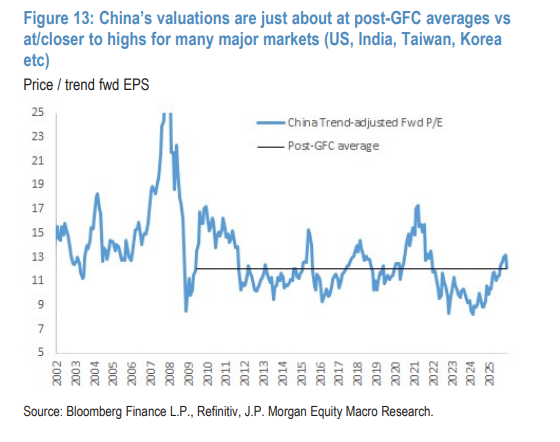
Core Viewpoint - Wall Street is optimistic about the recovery momentum of the Chinese stock market, driven by factors such as the accelerated application of artificial intelligence and the "anti-involution" policies aimed at improving corporate profitability [1][2]. Group 1: Market Outlook - JPMorgan has upgraded its rating for the Chinese stock market from "neutral" to "overweight," indicating that the market is in the early stages of recovery with acceptable valuations and light investor positions providing a solid foundation for potential gains [1][3]. - The report predicts a target of 100 points for the MSCI China Index by the end of 2026, representing a 19% upside from the report's release, with bullish and bearish scenarios set at 120 points and 80 points, respectively [1]. Group 2: Structural Changes - The upgrade reflects JPMorgan's positive outlook on a series of structural changes in the Chinese market, including the rapid application of AI, "anti-involution" policies aimed at enhancing corporate profitability, and increasing shareholder returns [2][8]. - The report emphasizes that the "anti-involution" policy is a significant shift aimed at curbing destructive price competition and restoring profitability across various sectors, including traditional industries and emerging fields like solar energy and e-commerce [7][8]. Group 3: Valuation and Positioning - JPMorgan believes that the current moment is favorable for positioning in the Chinese stock market, as it remains at the bottom of the cycle, with improved risk-reward ratios due to long-term adjustments [3][6]. - Compared to other major markets, China's valuation levels are still at or near the average levels post-global financial crisis, making it an attractive investment opportunity [3]. Group 4: Fund Allocation and Liquidity - Global active funds are still underweight in Chinese stocks, indicating significant potential for capital inflows once market sentiment shifts [6]. - The report notes a shift in domestic asset allocation, with early signs of households moving from cash and deposits to equity assets, supported by favorable macro policies and liquidity changes [11][12]. Group 5: AI and Technological Innovation - AI applications and technological innovation are viewed as key drivers for the upward momentum of the Chinese market, with 2025 expected to be a pivotal year for generative AI applications [7]. - The report highlights China's holistic approach to AI, which encompasses power production, open-source models, domestic applications, and semiconductor development [7]. Group 6: Corporate Actions - Chinese companies, particularly state-owned enterprises, are actively enhancing shareholder returns, with significant increases in stock buybacks and dividend payments observed since 2024 [9][11].
Tectonic Therapeutic (NasdaqGM:TECX) FY Conference Transcript
2025-12-02 21:32
Summary of Tectonic Therapeutic FY Conference Call Company Overview - **Company**: Tectonic Therapeutic (NasdaqGM: TECX) - **Event**: FY Conference on December 02, 2025 Key Industry Insights - **Focus**: The conference highlighted the significance of the APEX study, which is expected to be pivotal for Tectonic in 2026, marking the beginning of a critical two-year period for the company [1][2] Core Points and Arguments 1. **Enrollment Progress**: - Tectonic met its mid-year recruitment objectives and is on track to meet its end-of-year recruitment goal. As of November, recruitment has shifted to patients with a pulmonary vascular resistance (PVR) greater than three [4][5] - 70% of the total patient population falls within the PVR greater than three category [11][13] 2. **Data Safety Monitoring**: - The last data safety monitoring committee (DSMB) meeting occurred at the end of September, with no safety signals reported. Continuous monitoring is in place [5][6] 3. **Patient Population and Study Design**: - The study is enriched for patients with chronic stable heart failure and high PVR, aiming to improve outcomes in this specific group [30][34] - The primary endpoint focuses on PVR reduction, with a previous phase 1b study showing a 30% decrease in PVR [23][24] 4. **Comparison with Competitors**: - Tectonic's TX45 is differentiated from competitors like AstraZeneca and Lilly based on patient selection and study design. Tectonic's study focuses on a more homogeneous population with specific PVR criteria [30][37] - The mechanism of action for TX45 includes vasodilation and potential antifibrotic effects, which may provide advantages over competitors [39][41] 5. **Future Development Plans**: - Tectonic is considering various options for future studies in heart failure with preserved ejection fraction (HFpEF), including standalone phase 2 or phase 2/3 studies [29][30] - The company plans to start a healthy volunteer study for TX2100 in early 2026, focusing on pharmacokinetics and safety [47] Other Important Information - **Financial Position**: Tectonic reported approximately $268 million in cash, providing a runway into the fourth quarter of 2028 [49] - **Market Context**: The discussion emphasized the complexity of the heart failure market, with multiple mechanisms and treatment options available, indicating a significant opportunity for Tectonic's therapies [43][44]
Savara (NasdaqGS:SVRA) FY Conference Transcript
2025-12-02 20:32
Summary of Savara (NasdaqGS:SVRA) FY Conference Call - December 02, 2025 Company Overview - **Company**: Savara - **Product**: Molgramostim (MOLBREEVI) - **Market**: Autoimmune Pulmonary Alveolar Proteinosis (APAP) Key Points BLA Resubmission and Regulatory Timeline - The BLA resubmission for Molgramostim is on track for December 2025, with a 60-day review anticipated, leading to a PDUFA date around August 2026 [4][5] - Submissions for MAAs in Europe and the U.K. are expected by the end of Q1 2026 [4][32] Market Opportunity and Patient Population - Approximately 5,500 diagnosed APAP patients identified in the U.S. through claims database analysis [8][9] - The company has confirmed 1,000 patients that are actively managed and have "line of sight" for the U.S. launch [8][9] - Patient concentration is noted in major centers of excellence and large group practices, facilitating a robust launch trajectory [10] Commercial Strategy and Team Preparation - A commercial team of about 30 customer-facing individuals is being established, with hiring planned to be completed post-approval [14][16] - The team is focused on building relationships with healthcare professionals and preparing for patient education and prescription processes upon approval [11][12] Distribution and Payer Mix - A single exclusive specialty pharmacy will manage claims adjudication and patient services, providing a "white glove" service model [17] - Anticipated payer mix includes approximately 60% commercial payers, one-third Medicare, and the remainder Medicaid [18] Pricing and Market Access - Pricing for Molgramostim is expected to be between $400,000 and $500,000 per patient per year, with payers showing understanding of the product's value [19][20] - Prior authorization will likely require proof of diagnosis, with no significant concerns from payers regarding budget impact due to the small patient population [19][23] Diagnostic Testing and Patient Identification - Implementation of a no-cost dry blood spot test for diagnosing autoimmune PAP is ongoing, with high sensitivity and specificity [28][29] - The test aims to identify undiagnosed patients, particularly in ILD clinics, enhancing the understanding of the patient population [30] European Market Strategy - The company plans to independently launch in Europe and the U.K., with a patient population size similar to that in the U.S. [33][34] - The recent financing positions the company well for both U.S. and European launches, with over $260 million in cash and additional royalty financing [35] Advocacy and Awareness - Support groups such as the PAP Foundation and PAP Alliance are active in raising awareness for autoimmune PAP, contributing to patient advocacy efforts [31] Additional Insights - The company emphasizes the importance of hiring experienced personnel for the commercialization of rare disease drugs, particularly in navigating the complexities of the orphan drug market [16] - The long-term strategy includes continuous education for payers and healthcare professionals about the disease burden and the clinical benefits of Molgramostim [19][20]

Sana Biotechnology(SANA) - 2025 FY - Earnings Call Transcript
2025-12-02 20:30
Financial Data and Key Metrics Changes - The company has streamlined its pipeline to focus on SC451 for type 1 diabetes and SG293 for in vivo CAR-T, indicating a strategic shift towards more targeted therapies [2][6] - The company aims to initiate a clinical study for SC451 next year, with an IND submission expected soon, reflecting confidence in its development timeline [6][21] Business Line Data and Key Metrics Changes - The type 1 diabetes program is positioned as a one-time curative therapy, with the potential to significantly improve patient outcomes by eliminating the need for insulin and immunosuppression [6][12] - The in vivo CAR-T platform is designed to deliver treatments for various blood cancers and autoimmune disorders, with a focus on cell specificity and safety [8][42] Market Data and Key Metrics Changes - There are approximately 10 million people with type 1 diabetes in the U.S., projected to grow to 15 million in 15 years, highlighting a significant market opportunity [4][23] - The company is preparing to address a large unmet need in the type 1 diabetes market, emphasizing the urgency and potential impact of its therapies [41][52] Company Strategy and Development Direction - The primary focus remains on advancing the type 1 diabetes program, with the in vivo CAR-T platform serving as a secondary opportunity for diversification and potential capital generation [53][54] - The company is actively engaging with global regulators to ensure alignment on clinical protocols, aiming for a straightforward path to human testing [15][40] Management's Comments on Operating Environment and Future Outlook - Management expressed optimism about the type 1 diabetes program, citing successful gene edits and the establishment of a master cell bank as significant de-risking events [52][54] - The company acknowledges the challenges of scaling manufacturing to meet potential demand but believes it can address these issues independently [30][31] Other Important Information - The company has established a master cell bank that retains pluripotency and does not mutate, which is crucial for the safety and efficacy of its therapies [20][21] - There is a recognition of the need for partnerships to enhance financial resiliency and improve the probability of success for its therapies, particularly in the context of type 1 diabetes [28][29] Q&A Session Summary Question: What is the current status of the IND preparation for type 1 diabetes? - The company is focused on completing the non-clinical toxicology package and GMP manufacturing to move forward with human testing [11][19] Question: How does the company plan to scale manufacturing for the type 1 diabetes therapy? - The company is addressing both the science and capital aspects of scaling, emphasizing the need for a partner to help with scientific challenges [28][29] Question: What are the key safety concerns associated with the type 1 diabetes therapy? - Management highlighted the risks of severe hypoglycemia and potential tumor formation as primary safety concerns that need to be managed during preclinical testing [12][14]

Edgewise Therapeutics (NasdaqGS:EWTX) FY Conference Transcript
2025-12-02 20:02
Summary of Edgewise Therapeutics FY Conference Call Company Overview - **Company**: Edgewise Therapeutics (NasdaqGS:EWTX) - **Industry**: Biotechnology, specifically focusing on heart conditions such as Hypertrophic Cardiomyopathy (HCM) Key Points and Arguments Market Potential and Product Differentiation - The run rate for Mavacamten in the HCM market is now above **$1 billion**, indicating a substantial market opportunity [2] - Current limitations in the market for Mavacamten are due to its utilization primarily within academic centers, with community cardiologists facing challenges related to the complexity of REMS (Risk Evaluation and Mitigation Strategy) [2] - Edgewise's mechanism does not rely on changes in ejection fraction for efficacy, which could facilitate broader adoption among community cardiologists and expand the market significantly [2][3] Upcoming Data Disclosures - In December, Edgewise plans to disclose additional data at the **25 mg** dose level for **28 days**, demonstrating no effects on ejection fraction, which is a key differentiating factor for their mechanism [2][4] - The company aims to provide a quantitative readout for both obstructive and non-obstructive cohorts, with a focus on new patients rather than those previously studied [5][10] Patient Selection and Study Protocol - The company has optimized patient selection criteria to exclude those with sick heart valves and to ensure a history of atrial fibrillation (AF) is limited to around **15%** [14] - The protocol for the **12-week study** includes a dose escalation strategy starting at **25 mg** and increasing to **150 mg** over the study duration [9][10] Efficacy and Safety Measures - Edgewise emphasizes the importance of measuring depth of response in NT-proBNP and NYHA class changes rather than solely focusing on ejection fraction [21][22] - The goal is to minimize the need for multiple echoes during the study, which is a common requirement for CMIs [21] Future Development Plans - The company is on track to initiate a **Phase 3 trial** in the fourth quarter of **2026**, pending efficacy data from the ongoing studies [20] - Edgewise is also preparing for a pivotal study reading out in Q4, which could lead to significant opportunities in orphan indications [29] Leadership and Strategic Insights - The recent addition of Chris Martin, a former chief commercial officer, is expected to enhance Edgewise's commercial strategy as they prepare for market entry in HCM and Becker's muscular dystrophy [32][33] - The company is focused on building a strong commercial team with experience in rare diseases, which is crucial for successful product launches [33][34] Additional Important Insights - The company is exploring the relationship between dose and efficacy, particularly in non-obstructive patients, to understand how treatment effects may deepen over time [18][24] - Edgewise is committed to presenting a robust data package to the FDA to potentially avoid REMS requirements, which could facilitate broader market access [20] This summary encapsulates the critical aspects of Edgewise Therapeutics' conference call, highlighting the company's strategic direction, market potential, and upcoming milestones in their clinical development pipeline.
TG Therapeutics (NasdaqCM:TGTX) FY Conference Transcript
2025-12-02 18:32
TG Therapeutics FY Conference Summary Company Overview - **Company**: TG Therapeutics (NasdaqCM:TGTX) - **Product**: Briumvi, an anti-CD20 therapy for multiple sclerosis (MS) - **Market Presence**: Briumvi has been on the market for approximately 2.75 years, with a revenue target of $585 million for the current year [4][4] Financial Performance - **Revenue Target**: $585 million for FY 2025, with expectations for significant growth in FY 2026 [4][4] - **Future Guidance**: No specific guidance provided for next year, but anticipated to be a larger number than the current year [4][4] Market Dynamics - **CD20 Market Share**: Briumvi captures approximately 20% share among the CD20 class and about 10% share among all new MS starts [11][12] - **Patient Awareness**: Patient awareness was around 35% previously, with plans to double this over the next one to two years [19][19] Sales Strategy - **Sales Force Expansion**: TG Therapeutics plans to expand its sales force strategically, focusing on underperforming areas rather than a broad geographical expansion [25][27] - **Community vs. Hospital Practices**: The company is currently the second most prescribed in community settings and aims to become the number one in that category [26][26] Product Development - **Subcutaneous (Sub-Q) Program**: The Sub-Q program is progressing well, with enrollment expected to complete in the first half of next year and data anticipated by the end of next year [5][38] - **Formulation and Patents**: The new Sub-Q formulation is highly concentrated, with provisional patents filed that could extend protection until 2045 [42][42] Competitive Landscape - **Azer-cel and Cell Therapies**: The company is optimistic about the potential of cell therapies but acknowledges that current advancements are not yet transformative for patients with progressive forms of MS [50][51] - **Market Positioning**: TG Therapeutics aims to achieve parity coverage with competitors upon the launch of the Sub-Q formulation, expected in 2028 [45][45] Challenges and Considerations - **Gross-to-Net Spread**: The gross-to-net spread may be affected by 340B discounts, particularly in the hospital segment [33][33] - **Resource Management**: The company believes it can manage the expansion of its commercial and R&D efforts without significant strain, utilizing outsourcing for R&D as needed [59][60] Key Takeaways - TG Therapeutics is focused on increasing market share and patient awareness for Briumvi while strategically expanding its sales force - The company is optimistic about the future growth of its Sub-Q program and the potential of cell therapies - Resource management strategies are in place to handle potential growth in both commercial and R&D sectors without compromising execution quality [59][60]

Aclaris Therapeutics (NasdaqGS:ACRS) FY Conference Transcript
2025-12-02 17:02
Aclaris Therapeutics FY Conference Summary Company Overview - Aclaris Therapeutics is a development-stage biotech company focused on large and small molecule therapeutics, leveraging expertise from large pharma and a robust discovery platform [2][3] Pipeline and Clinical Assets - Aclaris has three clinical-stage assets: - **O52**: An IL-4 and TSLP bispecific antibody currently undergoing SAD/MAD studies - **TSLP mAb**: Targeting moderate-to-severe atopic dermatitis, with results expected next year - **2138**: An ITK JAK3 oral inhibitor, with a lead indication expected to start next year [2][3] - By 2026, Aclaris anticipates having four clinical-stage assets, with a cash runway extending into Q3 2028, holding $167 million on the balance sheet [3] Financial Management - The company maintains a modest cash burn of approximately $10 million to $13 million per quarter, allowing for efficient management of multiple programs [4] TSLP mAb Program - The TSLP mAb is positioned to address multi-billion-dollar markets, particularly in atopic dermatitis, with expectations of best-in-class potency [4][5] - Aclaris claims their TSLP mAb is 70 times more potent than Tezspire, with a focus on improving residence time and binding efficacy in the skin [8][10] Clinical Trial Design and Strategy - Aclaris is implementing central photography and adjudication to minimize placebo effects in clinical trials, ensuring accurate patient enrollment [13][15] - The company is open to including patients who have previously failed treatments like Dupixent, as TSLP operates through a different mechanism [21] Upcoming Data and Expectations - Significant data from the TSLP mAb program is expected in the second half of 2026, with a focus on responder rates and efficacy measures [24][41] - The bispecific TSLP-IL-4 program is currently in phase one SAD-MAD studies, with early data anticipated next year [30][36] New Indications and Market Strategy - Aclaris is pursuing lichen planus as a lead indication for their ITK program, targeting a market with less competitive intensity and a prevalence of 2% [45][46] - The company plans to initiate a phase two trial with a placebo control, enrolling approximately 70-80 patients [47] JAK-Sparing ITK Development - Aclaris is developing a JAK-sparing ITK molecule, aiming for IND submission by the end of 2026, targeting both respiratory and dermatological indications [57][59] Multi-Specific Antibody Platform - The company is exploring multi-specific antibodies using TSLP as a backbone, with plans to disclose more information as development progresses [62][64] Conclusion - Aclaris Therapeutics is positioned for significant growth with multiple clinical assets and a strong financial foundation, with 2026 expected to be a pivotal year for data releases and potential market entries [66]

Avalo Therapeutics (NasdaqCM:AVTX) FY Conference Transcript
2025-12-02 16:32
Summary of Avalo Therapeutics FY Conference Call (December 02, 2025) Company Overview - **Company**: Avalo Therapeutics (NasdaqCM:AVTX) - **Focus**: Development of AVTX-009 for hidradenitis suppurativa (HS) Key Points Industry Context - **2025 Performance**: The year was described as exciting, with expectations for 2026 to be even more promising [4][5] - **Competitor Landscape**: Mention of Lutikismab, a competitor in the HS market, currently in phase 3 studies [49] Clinical Trial Updates - **LOTUS Trial**: - Phase 2 trial for HS with AVTX-009 has completed enrollment as of October 29, 2025, exceeding the target of 222 patients, reaching 250 [6][16] - The trial is designed to show a 20% delta difference in HiSCR75 on a placebo-adjusted basis with 80% power, and 90% power for a 25-30% difference [16][18] - Top-line data expected in Q2 2026, following a 16-week treatment duration and a six-week follow-up [10][11][12] Trial Design and Execution - **Demographics**: The trial includes a higher proportion of biologically experienced patients, with over a third expected to be biologically experienced [21][22] - **Site Management**: - Approximately 90 sites involved, primarily in the U.S. and Canada, with rigorous site qualification and training processes implemented [29][30] - Emphasis on managing the placebo effect through strict protocols and training for both investigators and patients [30][35] Future Development Plans - **Phase 3 Trials**: - The anchor dose for the phase 3 program will likely be one of the two doses tested in phase 2, with a preference for a more patient-friendly dosing schedule [43][44] - Discussions with the FDA will determine the need for additional dose-ranging studies [44][45] Competitive Positioning - **Differentiation from Lutikismab**: - AVTX-009 is expected to offer a longer dosing interval and potentially higher efficacy due to its higher potency [49][51] - The company aims to demonstrate a benign side effect profile similar to Lutikismab while exploring efficacy in various patient populations [52][56] Financial Considerations - **Capital Needs**: Significant capital will be required for two large phase 3 trials, with expectations of strong investor interest due to the drug's potential [58] - **Expansion Opportunities**: Potential to explore other indications related to IL-1 beta, including dermatology and rheumatology [59] Conclusion - **Outlook**: The company is optimistic about the upcoming data and its potential impact on the market, with a strong focus on execution and differentiation in a competitive landscape [62]