卡车运输

Search documents
美股年末行情大反转!华尔街押注2026年经济复苏 狂买滞涨板块
Zhi Tong Cai Jing· 2025-12-08 12:31
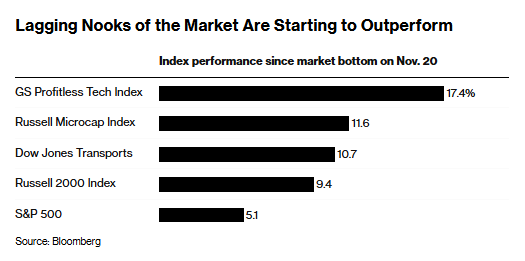
Group 1 - Investors are shifting away from technology giants and moving towards underperforming small-cap stocks and traditional economic sectors like transportation, as evidenced by the Russell 2000 index rising 9.4% since November 20, compared to a 5.1% increase in the S&P 500 index [1] - The market is questioning the sustainability of the "AI boom" that has previously driven tech stocks, with major players like Nvidia and Microsoft seeing stagnation in their stock performance [1] - There is growing optimism about a U.S. economic recovery in the first half of 2026, prompting investors to favor value stocks over growth stocks [1] Group 2 - Strategas Asset Management recommends overweighting an equal-weighted S&P 500 index over a traditional market-cap weighted version, anticipating that upcoming tax reforms and events like the World Cup will boost economic growth [4] - Bank of America suggests that sectors closely tied to the economic cycle, such as residential construction, retail, and transportation, will see the best relative returns [4] - Oppenheimer Asset Management predicts an 18% increase in the S&P 500 index to around 8100 points in 2026, based on expectations of steady economic growth and loose monetary policy [4] Group 3 - In November, the equal-weighted S&P 500 index rose 1.7%, while the traditional market-cap weighted version only increased by 0.3%, indicating a shift in market leadership [5] - The healthcare sector led the market in November with a 9.1% increase, while the information technology sector fell by 4.4%, highlighting a reversal in the performance of value versus growth stocks [5] - Momentum stocks have significantly underperformed the market, suggesting a transition in market leadership from previously dominant sectors to those that had lagged [5] Group 4 - The rotation within the market continues, with the Russell 2000 index outperforming both the S&P 500 and Nasdaq 100 indices [6] - Concerns over AI spending data following tech earnings reports have triggered this rotation, allowing previously underperforming sectors to catch up [6] - Despite a recent pullback, the technology sector has still shown substantial gains over the year, with over two-thirds of its components trading above their 200-day moving average [6]

研究400年30次泡沫后,这家540亿美元对冲基金为何依然坚定看好AI?
美股IPO· 2025-10-27 16:07
Core Viewpoint - The hedge fund Coatue asserts that betting on AI remains a sound investment choice, based on a comprehensive analysis of over 30 market bubbles over the past 400 years, highlighting fundamental differences between the current AI boom and historical bubbles [1][5]. Summary by Sections AI Boom Analysis - Coatue analyzed the current AI hype against historical bubbles, concluding that the speed of AI adoption significantly surpasses that of personal computers and the internet [4]. - The probability of an "AI boom" scenario, where AI enhances productivity and GDP while controlling inflation, is estimated at two-thirds [2]. Risk Assessment - The risk of an AI bubble bursting leading to a market crash and economic recession is assessed at one-third [3]. - Despite acknowledging some concerning traits of the current AI landscape, such as the large scale of leading companies and high capital expenditure levels, Coatue emphasizes that these similarities to past bubbles are less critical than the differences [7]. Financial Metrics - Current AI leaders' price-to-earnings (P/E) ratios are not at the extreme highs seen during the internet bubble, indicating healthier valuation levels [6]. - The capital expenditures in AI are primarily funded by robust operating cash flows rather than excessive leverage, which is a positive indicator [6]. Long-term Growth Potential - Coatue believes that AI-driven profit growth will support substantial investments over the next 5 to 10 years, with significant impacts on various sectors beyond technology, including e-commerce and advertising [6]. - The fund cites examples from companies like Amazon and Shopify, which are experiencing notable growth due to AI advancements [6]. Investment Portfolio - Coatue's investment portfolio reflects a strong belief in AI, with major holdings in companies like CoreWeave, Meta Platforms, Amazon, GE Vernova, and Microsoft, alongside a 5% allocation to companies closely tied to the AI ecosystem, such as Constellation Energy, TSMC, and Nvidia [8].

“华尔街恐慌指数”飙升
财联社· 2025-10-16 23:59
Core Viewpoint - The article highlights the recent decline in U.S. stock indices due to concerns over regional bank loan issues and ongoing trade tensions, which have negatively impacted market sentiment [1][2]. Market Dynamics - The Dow Jones Industrial Average fell by 301.07 points, a decrease of 0.65%, closing at 45,952.24 points; the Nasdaq dropped 107.54 points, down 0.47%, ending at 22,562.54 points; and the S&P 500 index decreased by 41.99 points, a decline of 0.63%, closing at 6,629.07 points [6]. - The S&P 500's 11 sectors experienced widespread declines, with the financial sector down 2.75% and the energy sector down 1.12%, while the information technology sector saw a slight increase of 0.13% [7]. Banking Sector Concerns - Zions Bank's stock plummeted by 13% after revealing unexpected loan losses in its California division, raising concerns about potential credit pressures in the banking system amid an uncertain economic outlook and high interest rates [1]. - Western Alliance's shares fell by 10.8% following the announcement of a fraud lawsuit against a borrower, contributing to heightened anxiety regarding commercial loan risks [1]. Investor Sentiment - The VIX index, known as the "Wall Street Fear Index," surged to 25.31, marking the highest closing level since April 24, indicating increased market volatility [3]. - Investors are particularly sensitive to any signs of credit-related losses, leading to declines in most small financial and bank stocks [2]. Trade and Economic Outlook - The uncertainty surrounding global trade is exacerbating market instability, with analysts noting that the potential impacts on the economy and markets are significant [3]. - The ongoing U.S. government shutdown has delayed the release of key economic data, further complicating the economic landscape [5]. Earnings Expectations - Analysts project that S&P 500 companies will see an overall earnings growth of 9.2% year-over-year for the third quarter, an increase from the previous forecast of 8.8% [4].

US heavy truck sales have plunged in latest red flag for American economy — 3 ways to protect your wealth now
Yahoo Finance· 2025-09-19 21:00
Core Viewpoint - Heavy-duty truck sales, a critical indicator of industrial health, have dropped to their lowest level in four years, signaling potential economic challenges ahead for the U.S. economy [1] Group 1: Economic Indicators - Trucking has historically been a leading indicator of economic health; increased truck purchases indicate business expansion, while decreased orders suggest anticipated economic downturns [2] - Economists note that heavy truck sales often decline before recessions, with past data showing noticeable drops leading up to economic crises, including the 2008 recession [3] Group 2: Current Challenges - Weak freight volumes are observed as consumers are spending more cautiously, resulting in fewer goods available for transport [4] - A cooldown in construction activity due to higher borrowing costs has delayed projects and reduced demand for heavy equipment transport [5] - Tariff pressures from import duties on steel, aluminum, and parts are increasing costs and squeezing margins for manufacturers and fleet operators [5] - Regulatory uncertainty, including the phase-out of clean-energy tax credits and unresolved emissions rules, is causing fleet managers to hesitate on large new orders [6] Group 3: Economic Outlook - The current pullback in truck sales may not lead to a severe recession, as the U.S. economy has evolved, with services and technology now comprising a larger share of GDP, helping maintain positive growth despite industrial weaknesses [7]
Schneider National (NYSE:SNDR) FY Conference Transcript
2025-09-12 00:52
Summary of Schneider National FY Conference Call - September 11, 2025 Company Overview - **Company**: Schneider National (NYSE: SNDR) - **Key Executives Present**: CEO Mark Rourke, CFO Darrell Campbell, VP of IR and Corporate Finance Christyne McGarvey Industry Insights - **Current Market Conditions**: The trucking and intermodal sectors are experiencing steady demand, with some seasonal fluctuations expected. The second quarter did not show the anticipated pull forward in demand, and August was characterized as slightly below seasonal expectations [2][5][8]. - **Intermodal Demand**: There is uncertainty regarding inventory levels, particularly on the West Coast, which could affect intermodal movements. The company anticipates a potential ramp down in intermodal demand sooner than typical, possibly before December [5][6][8]. - **Truckload Market**: Demand has improved, with mid to single-digit increases in contractual renewals. The company is prepared to capitalize on seasonal opportunities in the fourth quarter [9][10]. Financial Performance - **Contractual Renewals**: The company is experiencing mid to single-digit increases in contractual renewals, with more flexibility in the spot market [9]. - **Churn Rates**: The company has experienced higher customer churn in dedicated services compared to the previous year, but retention rates remain above 90% [19][22]. - **Pipeline for Dedicated Services**: The pipeline has returned to levels seen in 2024, indicating potential growth despite current market conditions [20]. Strategic Focus - **Dedicated vs. One-Way Services**: Schneider National is focusing on dedicated services, which account for 70% of its truck fleet. This strategy is aimed at providing stable revenue streams and meeting driver preferences for scheduled routes [16][17]. - **Private Fleet Conversions**: There is a notable shift in the market, with an increase in private fleets. The company sees opportunities for converting these fleets back to dedicated services as customers reassess their needs [24][25][28]. - **Capacity Constraints**: The company acknowledges that industry capacity is tightening due to regulatory enforcement and a lack of new truck orders. This could lead to a more favorable environment for established players [30][32]. Technological Advancements - **AI and Automation**: Schneider National is leveraging AI to improve productivity in its brokerage operations, achieving a 61% year-over-year improvement in carrier-broker matching [61][62]. - **Autonomous Vehicles**: The company is optimistic about the future of autonomous trucking but is focused on understanding the economic models and operational integration before making significant investments [73][75]. Environmental Initiatives - **Electric Vehicles (EVs)**: The company operates around 100 Class 8 electric trucks in California, with plans to explore natural gas options more aggressively than electric in the near term due to current market conditions [76][77]. M&A Strategy - **Acquisition Plans**: Schneider National aims to pursue strategic acquisitions every 12 to 18 months, focusing on areas that enhance growth and return on investment. The company is not currently looking to expand into LTL but remains open to transformative opportunities [80][83]. Conclusion - Schneider National is navigating a complex market landscape with a focus on dedicated services, technological advancements, and strategic growth through acquisitions. The company is well-positioned to adapt to changing market conditions while maintaining a strong operational focus.

印度卡车司机导致美国这类签证暂停发放!
第一财经· 2025-08-22 10:16
Core Viewpoint - The article discusses the recent decision by U.S. Secretary of State Rubio to suspend work visas for foreign commercial truck drivers, citing public safety concerns due to an increase in accidents involving foreign drivers [3][4]. Group 1: Regulatory Changes - Rubio's announcement aims to address safety issues linked to foreign truck drivers, particularly after a fatal accident involving an Indian driver who failed an English proficiency test [3][4]. - The article highlights the existing federal law requiring commercial drivers to demonstrate sufficient English proficiency to communicate and read road signs [7][12]. Group 2: Incident Details - The incident that triggered the regulatory scrutiny involved a truck driven by Harjinder Singh, who was involved in a crash that resulted in three fatalities [3][4]. - Singh, who was found to lack English proficiency, had obtained commercial driving licenses in California and Washington, raising concerns about the licensing process [4][12]. Group 3: Enforcement and Compliance - Wyoming has recently begun enforcing English proficiency tests for truck drivers, resulting in approximately 240 drivers being suspended for language deficiencies since June 25 [10]. - The article notes that federal officials have not provided specific data on accidents caused by non-English speaking drivers, but emphasize that truck-related accidents tend to be more severe and costly [8][10]. Group 4: Testing Standards - The standardized test for drivers includes answering 14 specific questions and recognizing 37 different road signs, with reports indicating that Singh could only answer 2 questions and recognize 1 sign [11][12]. - The article mentions that law enforcement officers conduct random checks to assess drivers' English capabilities, and those who fail may be escorted to safety rather than arrested [12].

标普500或面临5%回调?BTIG:失守6100点后是布局良机
Zhi Tong Cai Jing· 2025-08-04 00:00
Group 1 - The S&P 500 index has recently halted its upward trend, with a warning from BTIG strategist Jonathan Krinsky about potential market volatility due to seasonal headwinds in early October [1] - The S&P 500 index closed below the 20-day moving average for the first time in weeks, indicating a possible risk of a rapid pullback, especially as it approached the 6100-point mark [1] - On the previous Friday, the S&P 500 index dropped approximately 1.6% to close at 6238.01 points, influenced by new tariffs from the Trump administration and unexpectedly weak non-farm payroll data [1] Group 2 - Krinsky identified five key observations for the August market, noting that the period from early August to early October is typically the weakest of the year, increasing the probability of a market pullback [2] - There is a divergence between software and semiconductor stocks, with the IGV index underperforming the semiconductor ETF (SMH.US) by about 17% since early May, but historical patterns suggest a potential mean reversion opportunity for software stocks [2] - The utilities sector continues to strengthen, with the SPDR Utilities Select Sector ETF (XLU.US) reaching a 52-week high, highlighting its defensive characteristics [2] - Homebuilders are benefiting from declining interest rates, and unless there is a significant economic downturn, the upward trend in this sector is expected to continue [2] - The restaurant and trucking sectors are under significant pressure, with several restaurant stocks failing to break previous highs during the summer and the trucking sector reaching new relative lows [2] Group 3 - Overall, Krinsky maintains a cautious yet opportunistic strategy, suggesting that while the S&P 500 may dip to 6100 points, historical patterns could provide a buying opportunity [3] - The recommendation is to tilt allocations towards software, utilities, and homebuilders while avoiding weak sectors such as restaurants and trucking [3]
关税冲击有多大?华尔街紧盯港口、卡车和供应链数据
Hua Er Jie Jian Wen· 2025-05-07 13:19
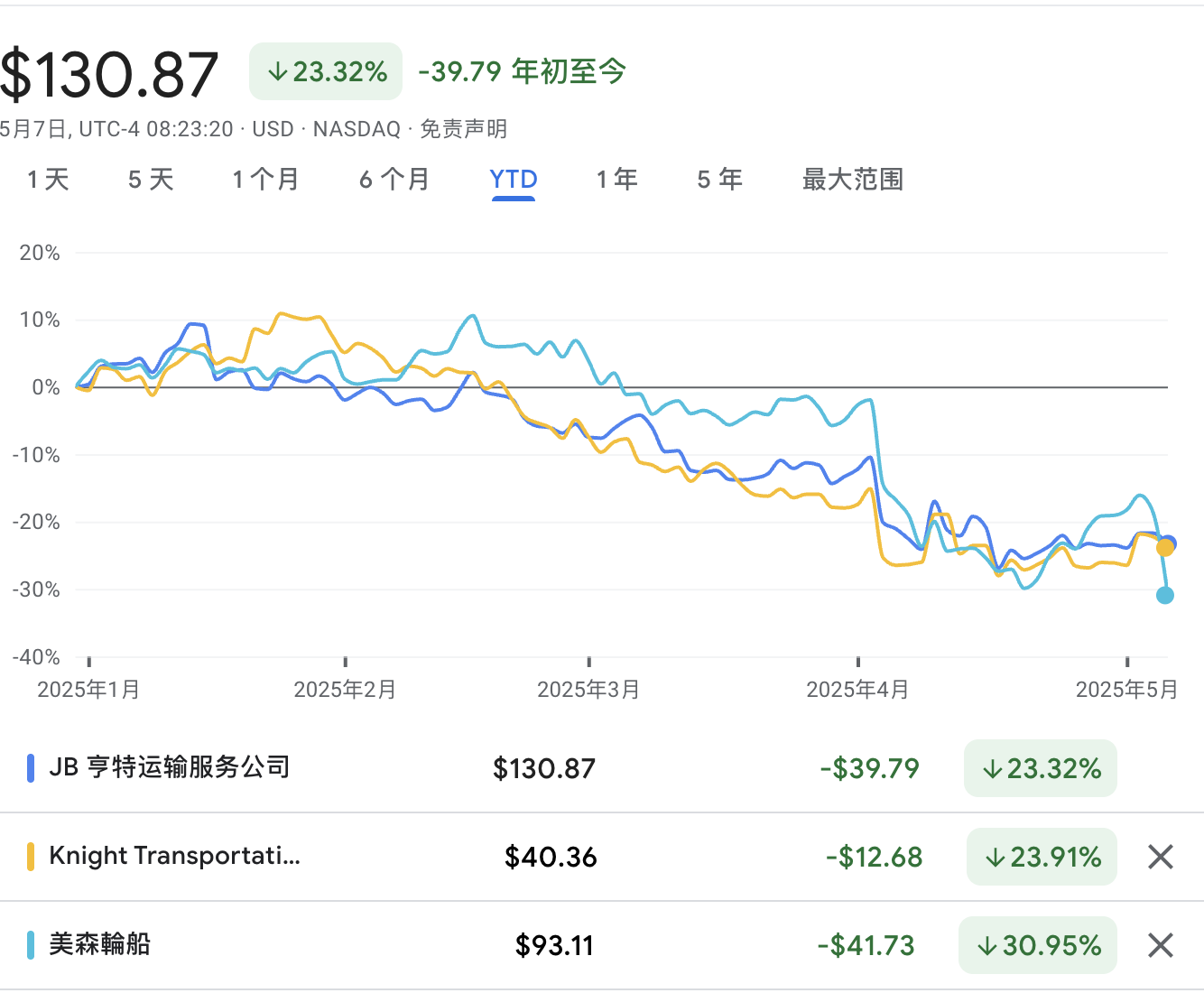
Core Insights - The shipping and logistics data is being closely monitored by Wall Street to assess the impact of the Trump administration's tariff policies on the economy [1] - The Dow Jones Transportation Average has underperformed the Dow Jones Industrial Average by over 9 percentage points this year, marking its worst performance in the past decade [1] Shipping Industry - Major freight companies in the U.S., such as J.B. Hunt Transport Services, Knight-Swift Transportation Holdings, and Matson, have seen their stock prices plummet this year [2] - There has been a significant decline in container shipping bookings to the U.S., with a 60% drop reported since April 9, according to Flexport [4] - Nearly 30% of trans-Pacific voyages to the U.S. have been canceled as of the week of May 4 [4] - The import volume at the Port of Los Angeles is expected to decrease by 35% compared to the same period last year [4] Trucking Industry - Trucking companies are reducing orders for heavy trucks due to tariff concerns, with net orders in North America falling to 16,500 units in March, a year-over-year decline of 5.9% [5] - The cancellation rate for truck orders has reached a two-year high, and dealer inventories have hit a record 91,600 units [5] - Truck drivers are facing profit levels similar to those during the global financial crisis [5] Supply Chain - The GEP Global Supply Chain Volatility Index reached a five-year low in March, driven by reduced manufacturing activity in North America [6] - Companies are preparing for higher procurement costs and potential consumer spending slowdowns, with expectations of further reductions in April readings [6]