
飞行汽车

Search documents
启明信息:公司将持续关注航空航天、飞行汽车及新能源汽车等行业的发展
Zheng Quan Ri Bao Wang· 2026-01-27 07:49
Core Viewpoint - The company, Qiming Information, is focusing on the development of industries such as aerospace, flying cars, and new energy vehicles, and is looking for collaboration opportunities and business entry points based on its main business [1] Group 1 - The company will continue to monitor the development of the aerospace industry [1] - The company is also interested in the flying car industry [1] - The company is exploring opportunities in the new energy vehicle sector [1] Group 2 - The company emphasizes the importance of timely seeking collaboration opportunities [1] - The company will provide updates through announcements and regular reports [1]

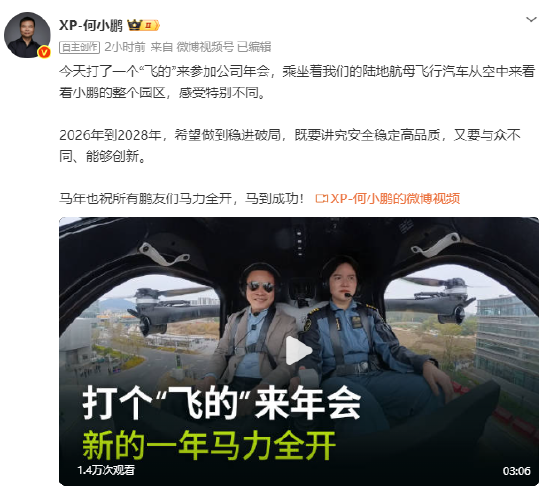
何小鹏打“飞的”参加公司年会:希望2026-2028稳进破局
Xin Lang Cai Jing· 2026-01-27 07:21
Group 1 - The chairman of XPeng Motors, He Xiaopeng, participated in the company's annual meeting via a flying car, showcasing the company's innovative approach to transportation [1][4] - He expressed the company's ambition to achieve steady progress and breakthroughs between 2026 and 2028, emphasizing the importance of safety, stability, high quality, and innovation [1][4]


小鹏汽车-W(09868):“一车双能+新车型”开启强势周期战略转型“物理AI”公司
NORTHEAST SECURITIES· 2026-01-26 07:50
Investment Rating - The report maintains a "Buy" rating for the company [7][4]. Core Insights - The company has transitioned from being a "smart electric vehicle new force" to a "global AI automotive intelligent technology enterprise," focusing on building an integrated intelligent ecosystem of "automobiles + robots + flying cars" [1][20]. - The introduction of the "dual-energy strategy" and multiple new models is expected to initiate a strong product cycle, with significant sales growth anticipated [2][21]. - The company is shifting from a phase of "technology leadership but profitability under pressure" to a profitability inflection point driven by "mass-market hits + technology output" [1][20]. Financial Forecast - Revenue projections for 2025-2027 are estimated at 758 billion, 1321 billion, and 1663 billion respectively, with year-on-year growth rates of 85.5%, 74.3%, and 25.9% [4][5]. - The company is expected to achieve a net profit of -16.4 billion, 24.0 billion, and 64.8 billion for the same period, indicating a significant recovery in profitability [4][5]. Product Strategy - The company has launched its first range-extended model, the X9 EREV, with a large battery and high energy conversion efficiency, addressing user range anxiety [2][3]. - A total of four new models are expected to be launched in 2026, including two SUVs based on the MONA platform and a full-size six-seat SUV [2][21]. AI Strategy - The company is transitioning to a "physical AI" company, showcasing its commitment to this transformation with the release of the VLA 2.0 model, which significantly enhances reasoning efficiency [3][20]. - The company plans to commercialize its self-developed Robotaxi and has set ambitious goals for its humanoid robot, IRON, to begin mass production by the end of 2026 [3][20]. Organizational Changes - The company has undergone significant organizational restructuring to enhance efficiency and product development capabilities, which is expected to support its transition to a more robust business model [20][46]. Market Position - The company is positioned to leverage its technological advancements and strategic partnerships, particularly with Volkswagen, to enhance its competitive edge in the automotive market [20][21].
江苏南京:会飞的汽车再升级 “东大·鲲鹏2号”首秀
Zhong Guo Xin Wen Wang· 2026-01-26 02:36
Core Insights - The article highlights the successful test flight of the "Dongda·Kunpeng No. 2," a flying car developed by Southeast University, showcasing its capabilities in both aerial and terrestrial operations [1] Group 1: Product Features - "Dongda·Kunpeng No. 2" is designed as a multifunctional platform focusing on high task reliability and seamless operation between air and ground [1] - The flying car incorporates an innovative foldable arm structure, addressing challenges related to parking and driving [1] Group 2: Market Application - The vehicle aims to provide efficient solutions for professional operational scenarios, particularly in logistics, inspection, and emergency response within the low-altitude economy [1] - The design philosophy emphasizes ease of cargo transport and convenient driving, redefining the approach for large-scale commercial applications [1]
会折叠更灵活 东南大学“东大·鲲鹏2号”飞行汽车新年首飞
Xin Lang Cai Jing· 2026-01-24 07:17
Core Viewpoint - The "Dongda Kunpeng 2" flying car developed by Southeast University has been publicly showcased, featuring improvements in design and functionality compared to its predecessor, the "Dongda Kunpeng 1" [2][5]. Group 1: Product Features - The "Dongda Kunpeng 2" is designed to be more lightweight and compact, with foldable arms that allow for greater flexibility and efficiency in completing various tasks [2][4]. - It serves as a composite operational platform that integrates both aerial and terrestrial capabilities, focusing on multi-functional adaptability and high task reliability [4]. Group 2: Development and Presentation - The flying car was publicly unveiled on January 23, with demonstrations taking place in the university campus [5][7]. - The project is led by Professor Yin Guodong, who highlighted the advancements made since the first model [2][5].
瞄准低空经济“载物” 高校发布“鲲鹏2号”飞行汽车
Zhong Guo Xin Wen Wang· 2026-01-24 02:25
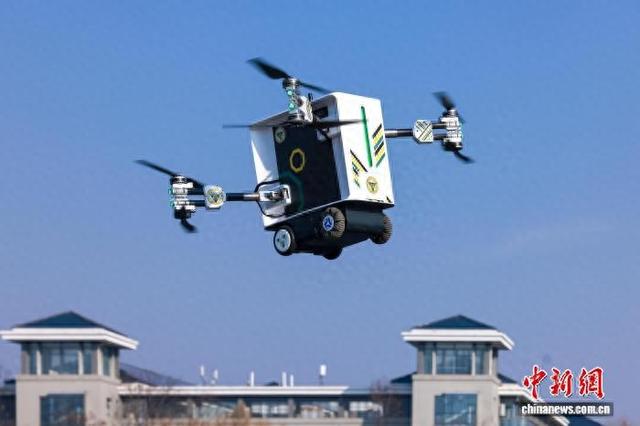
Core Viewpoint - The "Kunpeng 2" flying car, developed by Southeast University, represents a significant advancement in the low-altitude economy, focusing on practical applications for logistics and emergency scenarios [1][3]. Group 1: Product Development - The "Kunpeng 2" is a more compact and lightweight version compared to its predecessor, the "Kunpeng 1," featuring an innovative foldable arm structure that allows for quicker mode switching [3]. - The development of the foldable arm is a critical step for transitioning the flying car from laboratory testing to practical engineering, addressing previous challenges related to ground transportation and storage [3][5]. Group 2: Technical Specifications - The "Kunpeng 2" utilizes a quad-rotor eight-blade "X" design, ensuring stable flight and safe landing even in the event of a single rotor or motor failure [5]. - It is equipped with a composite steering all-drive chassis system, which, combined with high-torque wheel-side motors and omnidirectional wheels, enables it to turn in place [5]. Group 3: Future Applications - The focus of "Kunpeng 2" is on achieving scalability in commercial applications, particularly in logistics, inspection, and emergency operations, aiming to transition from initial validation to widespread implementation [5]. - The research team plans to continue developing application scenarios, promoting the evolution of flying cars towards deeper intelligence and systematic integration, exploring a low-altitude operation system comprising "single platform + cloud scheduling + ground facilities" [5].
飞行汽车再升级,“东大·鲲鹏2号”来了!
Yang Zi Wan Bao Wang· 2026-01-23 14:33
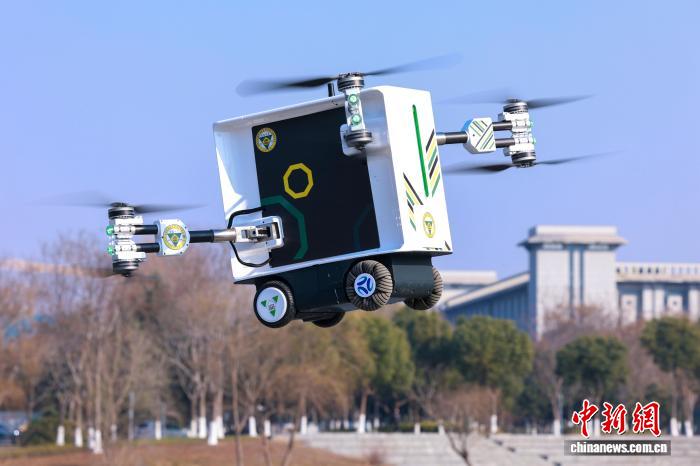
Core Insights - The "Dongda Kunpeng 2" flying car, developed by Southeast University, showcases advancements in design and functionality compared to its predecessor, the "Dongda Kunpeng 1" [1] - The new model features a foldable arm structure, enhancing its versatility for different modes of operation, including flying and driving [1] Design and Technology - The foldable arm is a significant innovation that addresses the limitations of the fixed arm in the previous model, improving commercial viability [2] - The "Dongda Kunpeng 2" employs a four-axis eight-rotor "X" design, allowing for stable flight even with a single rotor or motor failure, and optimizing aerodynamic efficiency [2] - The vehicle has a payload capacity of 100 kilograms and is designed to operate in adverse weather conditions while maintaining maneuverability [2] Navigation and Applications - The vehicle integrates Livox Mid-360 lidar and cameras for high-precision navigation, achieving positioning accuracy of 2-5 centimeters and enabling autonomous obstacle avoidance [3] - It is positioned as a practical solution for low-altitude economic applications, including logistics, infrastructure inspection, and emergency rescue [3] - Future plans include enhancing the product line with deep intelligence and system integration, focusing on specialized configurations for various scenarios [3]
报告揭秘:飞行汽车面临八大核心命题,市场如何走向?
Guan Cha Zhe Wang· 2026-01-22 23:04
Core Insights - China's first flying car is expected to be delivered in 2026, driven by government support and the emergence of eVTOL manufacturers, indicating a gradual commercialization of the low-altitude economy [1] - GAC Group's flying car subsidiary, GOVO, has announced 2,000 orders valued at over 3.3 billion RMB, enhancing confidence in the early commercialization of flying cars [1] - The Civil Aviation Administration of China predicts that the low-altitude economy could exceed 1 trillion RMB in annual revenue once fully commercialized, with a market size approaching 3 trillion RMB by 2035 [1] Industry Trends - The flying car sector is becoming a competitive arena for global automotive giants and tech companies, with firms like Volkswagen, Toyota, and Hyundai actively exploring flying car technologies [1] - Xpeng Heitech plans to deliver its first flying car in the second half of this year, targeting a price below 2 million RMB per unit [1] Challenges and Recommendations - The "Flying Car Development Report 2.0" identifies eight core issues facing the industry, including prioritization of application scenarios, technological bottlenecks, and the evolution of business models [3][4] - Key technical challenges include payload range, airworthiness safety, and intelligent driving, while regulatory frameworks and airspace management are critical bottlenecks for commercialization [4] - Recommendations include adapting power routes based on scenario needs and promoting a dual-path approach for application scenarios to foster industry-scale development [4] Future Outlook - As the business model for flying cars matures and key technologies continue to advance, flying cars are expected to accelerate industrialization and become a vital part of the future air-ground integrated transportation system [5]
飞行汽车发展报告2.0:迈向空地一体交通新时代
中国汽车工程学会· 2026-01-21 11:54
Investment Rating - The report does not explicitly state an investment rating for the flying car industry, but it emphasizes the significant growth potential and strategic importance of flying cars within the low-altitude economy. Core Insights - Flying cars represent a new form of transportation that integrates air and ground travel, aiming to transform traditional transportation paradigms and enhance urban mobility [6][11]. - The flying car industry is positioned as a key driver for the evolution of the automotive sector, transitioning from electrification to intelligence and ultimately to three-dimensional transportation [7]. - The market for flying cars is expected to experience substantial growth, with projections indicating a commercial explosion between 2025 and 2030, driven by advancements in technology and increasing demand for urban air mobility [9][8]. Summary by Sections Industry Definition - Flying cars are defined as electric vertical take-off and landing (eVTOL) vehicles designed for urban air mobility, including pure flying, hybrid, and amphibious models [6]. Industry Applications - The report identifies dual pathways for flying car applications: professional use (e.g., emergency services, logistics) and mass-market use (e.g., urban commuting) [20]. - Initial applications focus on tourism and regional transport, with future developments aimed at intercity flights and integration into urban transport networks [19][20]. Business Model Evolution - The business model for flying cars is expected to evolve from product sales to a comprehensive ecosystem that includes infrastructure, transportation equipment, and full-service operations [22]. - The transition will involve a shift from product-service coupling to an integrated operational ecosystem, emphasizing scalability and sustainability [22]. Industry Challenges - The flying car industry faces systemic challenges in scaling, including the need for a robust supply chain, regulatory frameworks, and technological advancements [23][29]. - Key challenges include the reliance on imported materials and components, uneven distribution of capabilities across the supply chain, and the necessity for a comprehensive regulatory environment [31][26]. Technological Innovations - The report highlights three major technological challenges: payload capacity, flight range, and safety standards, which must be addressed for the practical implementation of flying cars [38]. - The technological framework for flying cars includes advancements in propulsion systems, safety technologies, and intelligent driving capabilities [39][40]. Infrastructure Support - Infrastructure development for flying cars is constrained by land availability, funding, and regulatory challenges, necessitating a phased approach to infrastructure deployment [48][50]. - Future infrastructure should integrate with existing urban transport systems and utilize a tiered network of hubs, stations, and nodes to facilitate operations [52]. Regulatory Framework - The report discusses the need for a comprehensive regulatory framework that adapts to the unique challenges posed by flying cars, including airspace management and safety standards [53][56]. - Future regulations are expected to evolve from principle-based to risk-oriented management, promoting a collaborative approach across various regulatory bodies [59][60].
飞行汽车发展来到2.0时代 迈向空地一体交通新纪元
Zhong Guo Qi Che Bao Wang· 2026-01-21 07:51
Core Insights - The "Flying Car Development Report 2.0" outlines a clear path for the flying car industry to transition from concept validation to large-scale development, emphasizing its potential to reshape the transportation industry and unlock a trillion-dollar market space [1][7] Industry Definition - The report provides a precise definition of flying cars as electric vertical takeoff and landing vehicles designed for integrated air-ground transportation, distinguishing them from other flying vehicles [2] Application Scenarios - The report proposes a dual-track approach for application scenarios: specialized scenarios focusing on public safety and industry efficiency, and popular scenarios progressing through stages from low-altitude tourism to urban transportation integration [3] - Specialized scenarios will provide essential data for technical validation, while popular scenarios will help reduce costs through market expansion [3] Technical Challenges - Key technical challenges for large-scale flying car applications include payload capacity, flight range, and safety, with specific requirements of payload ≥100kg and range ≥100km [3] - A collaborative system of three technical domains and five key technologies is necessary to address these challenges [3] Power Technology Routes - The report identifies a diversified power technology landscape: pure electric for short-distance, low-load scenarios; hybrid for medium to long-distance, high-load scenarios; and hydrogen as a long-term green energy solution [4] Industry Chain Characteristics - The flying car industry exhibits a spindle-shaped characteristic, with strong midstream manufacturing capabilities but weaker upstream material and software dependencies [5] - The report suggests strengthening the industry chain and enhancing ecological support through policy and infrastructure improvements [5] Infrastructure and Regulatory Challenges - Delays in infrastructure and regulatory standards are major barriers to commercialization, with constraints including land limitations, funding shortages, and lack of standards [6] - The regulatory framework is shifting towards risk-based management, aiming to create a comprehensive system involving multiple departments [6] Opportunities and Challenges - The flying car industry is at a critical turning point, with increasing policy support and a growing demand for integrated transportation solutions due to urban congestion [7] - Challenges include the need for ongoing investment in technology and core component performance, as well as public concerns regarding safety and noise pollution [7]