
综合

Search documents
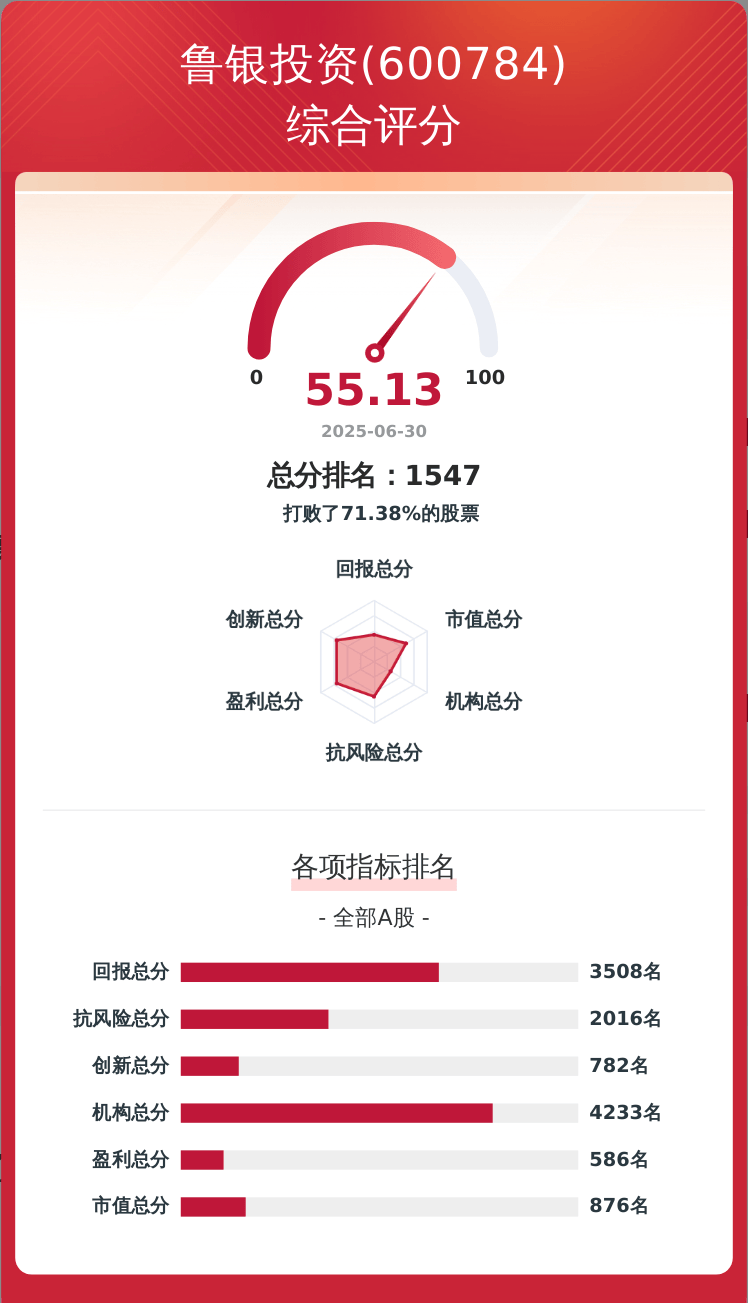
上市公司韧性评价 | 鲁银投资总分55.13分,居行业第3位,净利率创6年新高
Sou Hu Cai Jing· 2025-08-22 11:16
Core Viewpoint - Luyin Investment, a significant player in the salt and powder metallurgy industries, has a resilience evaluation score of 55.13, ranking 1547th among 5405 comparable listed companies in A-shares [1] Dimension Summaries - **Return Dimension**: Luyin Investment scored 44.2, equivalent to 7.07 points [4] - **Innovation Dimension**: The company achieved a score of 70.21, translating to 9.83 points, assessed through R&D expenses, personnel, patent numbers, and sales expense ratios [4] - **Profitability Dimension**: The score was 70.04, equating to 14.01 points [5] - **Risk Resistance Dimension**: The score was 56.36, corresponding to 9.02 points [6] - **Institutional Dimension**: The score was 31.15, which translates to 5.61 points [7] - **Market Value Dimension**: The score was 60.01, equivalent to 9.6 points [8] Overall Performance - Luyin Investment shows strong innovation and profitability capabilities, with scores of 70.21 and 70.04 respectively, while it needs improvement in return, institutional recognition, and market value, with scores of 44.2, 31.15, and 60.01 respectively [8] Industry Position - Within its industry, Luyin Investment ranks 3rd among 19 listed companies, with an industry average score of 42.03, indicating a leading position [9] - As of August 22, 2025, Luyin Investment's stock price was 6.82 yuan, with a total market value of 4.608 billion yuan and a P/E ratio of 17.83 [9] - For the first half of 2025, the company reported revenue of 1.652 billion yuan, a decrease of 2.62% year-on-year, and a net profit of 129 million yuan, down 27.35% year-on-year, with a net profit margin of 8.30% [9]


市场全天高位震荡,三大指数涨跌不一
Dongguan Securities· 2025-08-21 23:31
Market Overview - The A-share market experienced high volatility with mixed performance across major indices, with the Shanghai Composite Index closing at 3771.10, up by 0.13%, while the Shenzhen Component Index fell by 0.06% to 11919.76 [1][2] - The total market capitalization of A-shares reached 101.31 trillion yuan, marking an increase of 15.63 trillion yuan from the end of last year, when it was approximately 85.68 trillion yuan [3] Sector Performance - The top-performing sectors included Agriculture, Forestry, Animal Husbandry, and Fishery, which rose by 1.50%, and Oil and Petrochemicals, which increased by 1.39% [1] - Conversely, sectors such as Machinery Equipment and Defense Industry saw declines of 1.08% and 0.69% respectively [1][2] Concept Indices - Notable concept indices included significant gains in sectors like Combustible Ice and Digital Currency, which rose by 3.12% and 2.38% respectively [2] - In contrast, sectors such as Rare Earth Permanent Magnet and Military Restructuring Concept experienced declines of 2.14% and 2.11% [2][3] Trading Volume and Market Sentiment - The trading volume in the Shanghai and Shenzhen markets reached 2.42 trillion yuan, an increase of 158 billion yuan from the previous trading day, marking the seventh consecutive day of trading volume exceeding 2 trillion yuan [4] - Despite the high trading volume, there was a net outflow of funds, indicating cautious market sentiment among investors [4] Future Outlook - The report suggests that as long as there are no significant fluctuations in the macroeconomic environment, optimistic market sentiment is likely to continue [4] - Recommended sectors for investment focus include Technology, Media, Telecommunications (TMT), Financials, Public Utilities, and Consumer sectors [4]
滨州高新区“个转企”一件事激活市场主体升级新动能
Qi Lu Wan Bao Wang· 2025-08-21 08:30
Core Viewpoint - The article highlights the efforts of Binzhou High-tech Zone in promoting the transformation of individual businesses into enterprises through innovative service models and supportive policies [1] Group 1: Service Innovations - Binzhou High-tech Zone has launched a "one-stop" reform initiative for the transformation of individual businesses, integrating seven key processes including tax information verification, business registration, and social insurance registration into a streamlined service [1] - The "one-stop" approach allows individual businesses to submit all necessary documents at once, facilitating a smoother transition to enterprise status [1] Group 2: Policy Support - The administrative approval bureau of the high-tech zone, in collaboration with nine other departments, has introduced over ten incentive policies aimed at reducing the costs associated with the transformation of individual businesses [1] - These policies cover various areas such as tax reductions, simultaneous issuance of permits, comprehensive loan support, and various subsidies for entrepreneurship, talent, and research and development [1] Group 3: Impact and Future Plans - The combination of active promotion and policy incentives has significantly increased the willingness of individual businesses to transition into enterprises [1] - The high-tech zone plans to continue optimizing services and enhancing policy implementation to support more "development-oriented" individual businesses in their transformation, thereby injecting new vitality into regional economic development [1]
东阳光股价又创新高,今日涨2.17%
Zheng Quan Shi Bao Wang· 2025-08-21 03:49
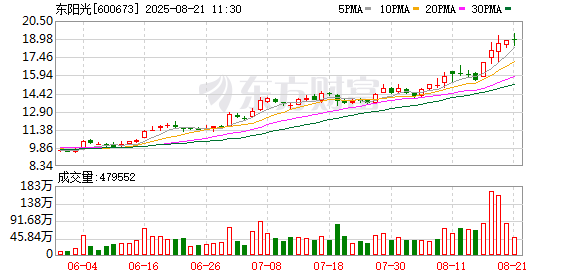
Group 1: Stock Performance - Dongyangguang's stock price has reached a historical high, with 10 trading days in the past month setting new records [2] - As of 10:56, the stock is up 2.17%, priced at 19.27 yuan, with a trading volume of 40.05 million shares and a transaction amount of 752 million yuan [2] - The latest total market capitalization of the stock is 57.994 billion yuan, and the circulating market capitalization is 57.840 billion yuan [2] Group 2: Industry Overview - The comprehensive industry to which Dongyangguang belongs has an overall increase of 1.33%, with 9 stocks rising, including Zhangzhou Development and Yueda Investment [2] - The top gainers in the industry are Zhangzhou Development and Yueda Investment, with increases of 10.09% and 7.41% respectively [2] - There are 6 stocks in the industry that have declined, with the largest drop being 3.21% for Yatai Group [2] Group 3: Financial Performance - In the first half of the year, the company achieved operating revenue of 7.124 billion yuan, a year-on-year increase of 18.48% [3] - The net profit for the same period was 613 million yuan, reflecting a significant year-on-year growth of 170.57% [3] - The basic earnings per share are 0.2090 yuan, with a weighted average return on equity of 6.71% [3] Group 4: Margin Trading Data - As of August 20, the latest margin trading balance for Dongyangguang is 2.029 billion yuan, with a financing balance of 2.012 billion yuan [2] - In the past 10 days, the margin trading balance has increased by 349 million yuan, representing a 21.00% growth [2] Group 5: Analyst Ratings - In the past 10 days, 2 institutions have rated the stock, with a target price set at 19.41 yuan by CICC on August 15 [2]

格林大华期货早盘提示-20250821
Ge Lin Qi Huo· 2025-08-20 23:31
1. Report Industry Investment Rating - The report recommends a long position for macro and financial index futures, including IM, IC, IF, IH [1]. 2. Core View of the Report - The major indices of the two markets on Wednesday first declined and then rose, with the chip sector surging in the afternoon and the Shanghai Composite Index reaching a new high in this round. The trading volume of the two markets was 2.40 trillion yuan. The inflow of continuous funds will drive the stock market to maintain an upward trend [1][2]. 3. Summary by Relevant Catalogs 3.1 Market Review - The major indices of the two markets on Wednesday first declined and then rose, with the chip sector surging in the afternoon and the Shanghai Composite Index reaching a new high in this round. The trading volume of the two markets was 2.40 trillion yuan. The CSI 1000 Index closed at 7305 points, up 62 points or 0.86%; the CSI 500 Index closed at 6728 points, up 72 points or 1.09%; the SSE 300 Index closed at 4271 points, up 48 points or 1.14%; the SSE 50 Index closed at 2846 points, up 34 points or 1.23%. Among industry and theme ETFs, the top gainers were Science and Technology Innovation Chip ETF, Artificial Intelligence ETF Science and Technology Innovation, Chip 50 ETF, Science and Technology Innovation Information ETF, and Semiconductor Equipment ETF, while the top losers were Financial Technology ETF, Film and Television ETF, and Biological Vaccine ETF. Among the sector indices of the two markets, the top gainers were commercial vehicles, chemical fibers, semiconductors, hotel and catering, and optical and optoelectronic indices, while the top losers were navigation equipment, ground military equipment, radio and television, film and television theater chains, and CXO concept indices. The settlement funds of CSI 1000, SSE 300, CSI 500, and SSE 50 index futures had net inflows of 9.9 billion, 3.6 billion, 3.4 billion, and 0.8 billion yuan respectively [1]. 3.2 Important Information - Among the 31 Shenwan primary industries, 28 have risen overall this year. The top five gainers are the communication, non-ferrous metals, pharmaceutical and biological, machinery and equipment, and comprehensive industries, with annual increases of over 20%. The communication and non-ferrous metals industries have both increased by over 30% [1]. - As of the close on August 18, among the 5424 A-share stocks, 4514 have risen overall this year, accounting for 83%. 360 stocks have doubled this year, accounting for 6.6% [1]. - Overseas capacity construction has shifted its focus to equipment procurement. The imports of production equipment such as milling machines and grinding machines in the US, India, Malaysia, etc. have significantly increased since the second half of 2024, and the imports of generators and transformers are also picking up [1]. - Wall Street traders are buying a large number of "disaster puts" on the Invesco QQQ Trust Series 1 ETF that tracks the Nasdaq 100 Index, seemingly worried about a repeat of the sell-off in April [1]. - A MIT report states that "95% of organizations have received zero returns on their generative AI investments," combined with a bubble warning from OpenAI CEO Sam Altman, causing investors to flee high-momentum technology stocks and move to defensive sectors [1]. - Japan's export data for July reflects the continuous impact of tariffs. Japan's exports of automobiles and parts to the US decreased by 28.4% and 17.4% respectively, and exports of semiconductor manufacturing equipment decreased by 31.3%. Economists warn that Japan may fall into a recession [2]. - The US government has quietly expanded the scope of steel and aluminum tariffs, adding over 400 product categories with a 50% tariff rate, which will add more cost-push inflation pressure [2]. - The US Commerce Secretary is exploring how to obtain more equity in major chip manufacturers through the Chip Act funds. If the equity-for-subsidy model is fully implemented, the US government will become an important shareholder in major global chip manufacturers [2]. 3.3 Market Logic - The major indices of the two markets on Wednesday first declined and then rose, with the chip sector surging in the afternoon and the Shanghai Composite Index reaching a new high in this round. Hedge funds' net purchases of Chinese stocks last week reached the highest in seven weeks, making China the market with the largest net capital inflow on the Goldman Sachs platform since August [1][2]. 3.4 Future Market Outlook - The major indices of the two markets on Wednesday first declined and then rose, with the chip sector surging in the afternoon and the Shanghai Composite Index reaching a new high in this round. As of the close on August 18, among the 5424 A-share stocks, 4514 have risen overall this year, accounting for 83%. 360 stocks have doubled this year, accounting for 6.6%. Hedge funds' net purchases of Chinese stocks last week reached the highest in seven weeks, making China the market with the largest net capital inflow on the Goldman Sachs platform since August. Goldman Sachs believes that China's humanoid robot industry is undergoing product iterations at an astonishing speed, and the commercialization path is becoming increasingly clear. The chief strategist of Bank of America believes that the Fed may deal with debt through currency depreciation, making shorting the US dollar the core investment theme. Gold, cryptocurrencies, commodities, and emerging markets will be the biggest winners. The probability of a Fed rate cut in September has risen to 100%. The "de-Americanization" of global financial asset reallocation is expected to accelerate the inflow of international funds into the A-share market. The short-term technical index correction has ended, and the major indices of the two markets have entered an upward phase again. Continuous capital inflows will drive the stock market to maintain an upward trend [1][2]. 3.5 Trading Strategy - For index futures directional trading, the short-term technical index correction has ended, and the major indices of the two markets have entered an upward phase again. Continuous capital inflows will drive the stock market to maintain an upward trend [2]. - For index option trading, with continuous capital inflows, investors can choose to buy out-of-the-money long-term call options on growth index futures [3].
浙江东日股价微跌0.08% 董事会审议临时股东会议案
Jin Rong Jie· 2025-08-20 15:30
Core Viewpoint - Zhejiang Dongri's stock price experienced a slight decline, reflecting market fluctuations and investor sentiment [1] Company Overview - Zhejiang Dongri's stock price as of August 20, 2025, was 51.15 yuan, down 0.04 yuan or 0.08% from the previous trading day [1] - The company operates in a diversified industry, with business segments including commodity sales, wholesale market operations, and leasing [1] Financial Performance - In the 2024 financial report, commodity sales accounted for 46.44% of total revenue, wholesale market income contributed 25.86%, and leasing business made up 22.68% [1] Market Activity - On August 20, the stock opened at 51.00 yuan, reached a high of 51.99 yuan, and a low of 50.16 yuan, with a trading volume of 118,100 hands and a transaction value of 604 million yuan [1] - The net outflow of main funds on that day was 81.39 million yuan, representing 0.39% of the circulating market value; over the past five days, the cumulative net outflow was 251 million yuan, or 1.19% of the circulating market value [1] Corporate Governance - Zhejiang Dongri announced the convening of the 10th Third Board Meeting to review the proposal for the 2025 Fifth Extraordinary Shareholders' Meeting [1]

侃股:绩差股与绩优股分化愈发明显
Bei Jing Shang Bao· 2025-08-20 12:02
Group 1 - The current A-share market is characterized by a significant divergence between high-performing stocks and underperforming stocks, with high-performing stocks reaching new highs while underperforming stocks are increasingly abandoned by investors [1][2] - High-performing stocks have gained recognition due to their robust operational strategies, continuous innovation, and strong financial health, reflecting optimistic market expectations for their future growth potential [1][2] - The strong performance of high-performing stocks is supported by their core competitiveness, shareholder return strategies such as dividends and buybacks, and increased market focus on quality companies following the full implementation of the registration system [1][2] Group 2 - Underperforming stocks have faced a "cooling" trend due to poor management, deteriorating financial conditions, and bleak industry prospects, leading to a significant decline in their stock prices [2] - The market has increasingly abandoned underperforming stocks as they lack the momentum and potential for sustained earnings growth, making it difficult for them to innovate or transform in a competitive environment [2] - The divergence between high-performing and underperforming stocks reflects a rational market return and value discovery, with investors becoming more focused on intrinsic value and long-term growth potential [2][3]
亚通股份:8月20日召开董事会会议
Mei Ri Jing Ji Xin Wen· 2025-08-20 11:21
Group 1 - The core viewpoint of the news is that Yatong Co., Ltd. held its 11th second board meeting on August 20, 2025, to discuss the election of members for the audit committee [1] - For the fiscal year 2024, the revenue composition of Yatong Co., Ltd. is as follows: 74.94% from merchandise sales, 8.72% from engineering services, 7.86% from real estate sales, 3.79% from transportation services, and 2.7% from other businesses [1] - As of the report date, the market capitalization of Yatong Co., Ltd. is 3.1 billion yuan [1]

【盘中播报】86只A股封板 石油石化行业涨幅最大
Zheng Quan Shi Bao Wang· 2025-08-20 06:43
证券时报·数据宝统计,截至下午13:58,今日沪指涨0.35%,A股成交量1241.74亿股,成交金额19151.22 亿元,比上一个交易日减少11.53%。个股方面,2491只个股上涨,其中涨停86只,2734只个股下跌, 其中跌停13只。从申万行业来看,石油石化、汽车、美容护理等涨幅最大,涨幅分别为1.34%、 1.33%、1.15%;医药生物、房地产、通信等跌幅最大,跌幅分别为0.87%、0.71%、0.62%。(数据宝) | 电力设备 | | | | 中恒电气 | | | --- | --- | --- | --- | --- | --- | | 通信 | -0.62 | 1020.79 | -12.65 | 光库科技 | -7.46 | | 房地产 | -0.71 | 214.59 | -18.58 | 衢州发展 | -9.75 | | 医药生物 | -0.87 | 1412.08 | -21.02 | 诚意药业 | -9.99 | 注:本文系新闻报道,不构成投资建议,股市有风险,投资需谨慎。 (文章来源:证券时报网) 今日各行业表现(截至下午13:58) | 申万行业 | 行业涨跌(%) | 成交 ...
A股83%个股今年来整体上涨 360只个股翻倍
Cai Jing Wang· 2025-08-20 00:48
Market Overview - The A-share market has shown a strong upward trend, with the Shanghai Composite Index, Shenzhen Component Index, and ChiNext Index rising by 11.23%, 13.64%, and 21.69% respectively since the beginning of the year [1] - There is significant internal structural differentiation in the market, with 28 out of 31 Shenwan first-level industries experiencing overall increases, particularly in telecommunications and non-ferrous metals, which have both exceeded 30% growth [1][2] Industry Performance - The top five performing industries include telecommunications, non-ferrous metals, pharmaceutical biology, machinery equipment, and comprehensive industries, all with annual growth rates exceeding 20% [1] - Conversely, industries such as coal, food and beverage, and oil and petrochemicals have seen overall declines this year [1] - Among thematic industries, biotechnology, precious metals, pharmaceuticals, and software have all recorded growth rates above 30%, while sectors like highways, oil and gas, and coal remain in a downward trend [1] Individual Stock Performance - Out of 5,424 A-shares, 4,514 stocks have risen this year, representing 83% of the total [2] - 360 stocks have doubled in value, accounting for 6.6% of the total, with only 6 of these having a market capitalization above 100 billion yuan, indicating a strong performance from smaller companies [2] - Among the 160 stocks with a market capitalization over 100 billion yuan, 49 have declined, showing that smaller market cap companies are outperforming larger ones [2] Market Drivers - The current market uptrend is primarily driven by liquidity, with quantitative products, small active equity products, and retail investors contributing significantly to the influx of funds into small-cap stocks [3][4] - The financing heat in smaller sectors is rising faster than in larger weight sectors, indicating a preference for small-cap investments [3] Valuation and Future Outlook - Despite some industries experiencing significant growth, the overall valuation of the A-share market remains within a reasonable range, with the CSI 300's dynamic price-to-earnings ratio around 12.2 times, which is approximately at the 69th percentile historically since 2010 [5] - The total market capitalization of A-shares is around 100 trillion yuan, with the ratio to GDP remaining relatively low compared to major global markets, suggesting potential for further growth [5][6] Liquidity and Capital Flow - The market liquidity is improving, with the average monthly trading volume as a percentage of the A-share market capitalization reaching the 74.80th percentile since 2015 [7] - The margin financing balance has surpassed 2 trillion yuan, approaching historical peaks, indicating a healthy liquidity environment [7]