金融业

Search documents
国家统计局:8月国民经济运行总体平稳、稳中有进
Yang Shi Xin Wen Ke Hu Duan· 2025-09-16 01:02
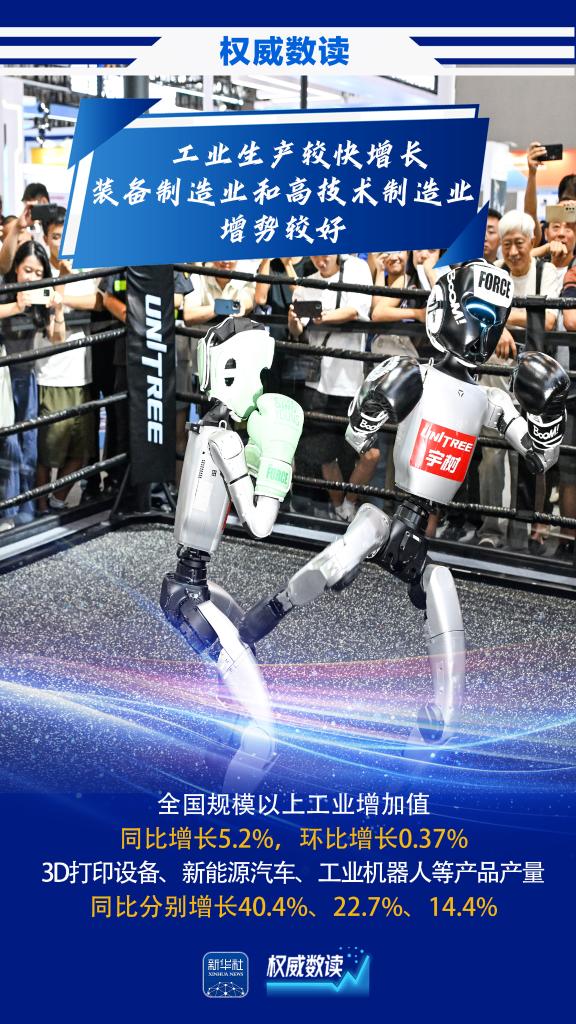
Economic Overview - The national economy showed overall stability and progress in August 2025, with industrial production and service sectors experiencing growth [1][2] Industrial Production - In August, the industrial added value for large-scale enterprises increased by 5.2% year-on-year and 0.37% month-on-month [1] - The equipment manufacturing sector saw an 8.1% year-on-year increase, while high-tech manufacturing grew by 9.3%, outperforming the overall industrial growth by 2.9 and 4.1 percentage points respectively [1] - The manufacturing purchasing managers' index was at 49.4, a slight increase of 0.1 percentage points from the previous month [1] Service Sector - The service production index rose by 5.6% year-on-year in August, with significant growth in information transmission, software, and financial services [2] - The business activity index for the service sector was at 50.5, indicating expansion, with a 0.5 percentage point increase from the previous month [2] Retail Sales - The total retail sales of consumer goods reached 39,668 billion yuan in August, marking a 3.4% year-on-year increase [3] - Online retail sales amounted to 99,828 billion yuan, with a year-on-year growth of 9.6%, accounting for 25% of total retail sales [3] Fixed Asset Investment - From January to August, fixed asset investment (excluding rural households) was 326,111 billion yuan, showing a year-on-year increase of 0.5% [4] - Manufacturing investment grew by 5.1%, while real estate development investment declined by 12.9% [4] Trade Performance - In August, the total import and export value reached 38,744 billion yuan, with exports growing by 4.8% and imports by 1.7% [5][6] - The proportion of general trade in total trade was 63.9%, indicating a stable trade structure [6] Employment Situation - The urban surveyed unemployment rate was 5.3% in August, reflecting a seasonal increase [7] - The average weekly working hours for employees were reported at 48.5 hours [7] Price Trends - The Consumer Price Index (CPI) decreased by 0.4% year-on-year in August, with food prices dropping significantly [8] - The Producer Price Index (PPI) for industrial producers fell by 2.9% year-on-year, with a narrowing decline compared to the previous month [8]
解码北京经济的韧性和潜力
Bei Jing Shang Bao· 2025-09-15 16:14
Core Insights - Beijing's economy is making solid progress towards high-quality development, with a focus on new technologies and industries, as highlighted in the recent press conference on the achievements during the 14th Five-Year Plan period [1] Economic Growth and Structure - The total economic output of Beijing is expected to exceed 5 trillion yuan, with a significant increase in the value added by the information service industry, which has surpassed 1 trillion yuan, making it the city's largest pillar industry [3][7] - The GDP is projected to grow by an average of 5.2% annually from 2021 to 2024, with a total economic increment of approximately 1.4 trillion yuan during the 14th Five-Year Plan [3] - By 2024, the per capita GDP is expected to reach $32,000, and labor productivity is projected at 444,000 yuan per person, leading among all provinces and cities [3] Technological Innovation - Beijing is home to over 2,400 artificial intelligence companies, accounting for about half of the national total, establishing itself as the "capital of artificial intelligence" [5][7] - The city has integrated education and technology talent initiatives to enhance the overall efficiency of its innovation system, with significant investments in research and development [6][7] - The commercial space industry is also growing, with a notable presence of core R&D units and unicorn companies [6] Consumer Market Dynamics - The consumer market in Beijing is expected to exceed 3 trillion yuan by 2025, driven by new consumption trends such as pop culture, events, and concerts [8] - Service consumption has seen an average annual growth of over 7.5% in the past four years, becoming a key driver of overall consumption [8] - Investment in high-tech industries has increased significantly, with the proportion of high-tech industry investment rising from 9.5% in 2020 to 22.6% in 2024 [8] Rural Development and Urban Integration - Beijing is advancing urban-rural integration, with initiatives to enhance rural tourism and local economies, leading to a 20% increase in collective income for demonstration villages [9] - The city is also focusing on sustainable practices and the "Two Mountains" concept, promoting both technological innovation and smart agriculture [9] Future Outlook - The dual drivers of technological and consumption innovation are expected to continue supporting Beijing's high-quality development, with a focus on artificial intelligence, digital economy, and new consumption models [9]

“十四五”时期北京GDP预计超5万亿元!经济增量等于“新增一个海淀区”
券商中国· 2025-09-15 15:13
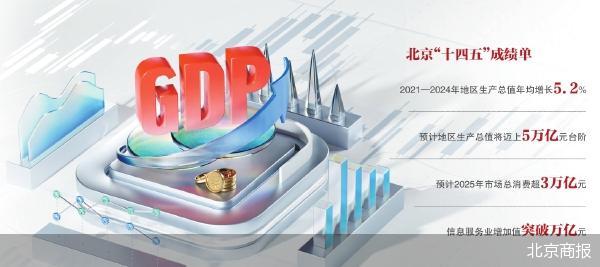
Core Viewpoint - Beijing's economic development during the "14th Five-Year Plan" has achieved significant progress, with high-value patents and economic growth exceeding expectations, indicating a solid step towards high-quality development [1][2]. Economic Growth and Structure - Beijing's GDP is expected to exceed 5 trillion yuan, with an economic increment of approximately 1.4 trillion yuan over five years, equivalent to the total economic output of Haidian District [2]. - By 2024, the per capita GDP of Beijing is projected to reach $32,000, with labor productivity at 444,000 yuan per person, leading among all provinces and cities in China [2]. Industry and Demand Dynamics - The average annual GDP growth rate for Beijing from 2021 to 2024 is projected at 5.2%, supported by strong industrial foundations and demand [3]. - The information service industry has become the largest pillar of Beijing's economy, with its added value surpassing 1 trillion yuan [3]. - The financial sector's asset scale exceeds 220 trillion yuan, accounting for about half of the national total [3]. Investment Trends - The proportion of high-tech industry investment in Beijing has increased from 9.5% in 2020 to 22.6% in 2024, marking a historical high [4]. Technological Innovation - Beijing aims to become an international technology innovation center, with R&D investment intensity maintained at around 6%, ranking among the top global innovation cities [5]. - The city has launched 158 large models in artificial intelligence, accounting for about 30% of the national total, and has seen significant applications of innovative robotic products [5]. Collaborative Development - The economic total of the Beijing-Tianjin-Hebei region is expected to reach 11.5 trillion yuan by 2024, with all three areas' GDP growth rates exceeding the national average [7]. - The output of technology contracts from Beijing to Tianjin and Hebei has reached 230.87 billion yuan during the "14th Five-Year Plan," nearly double that of the previous five years [8].
8月份国民经济:运行总体平稳
Xin Hua She· 2025-09-15 13:35
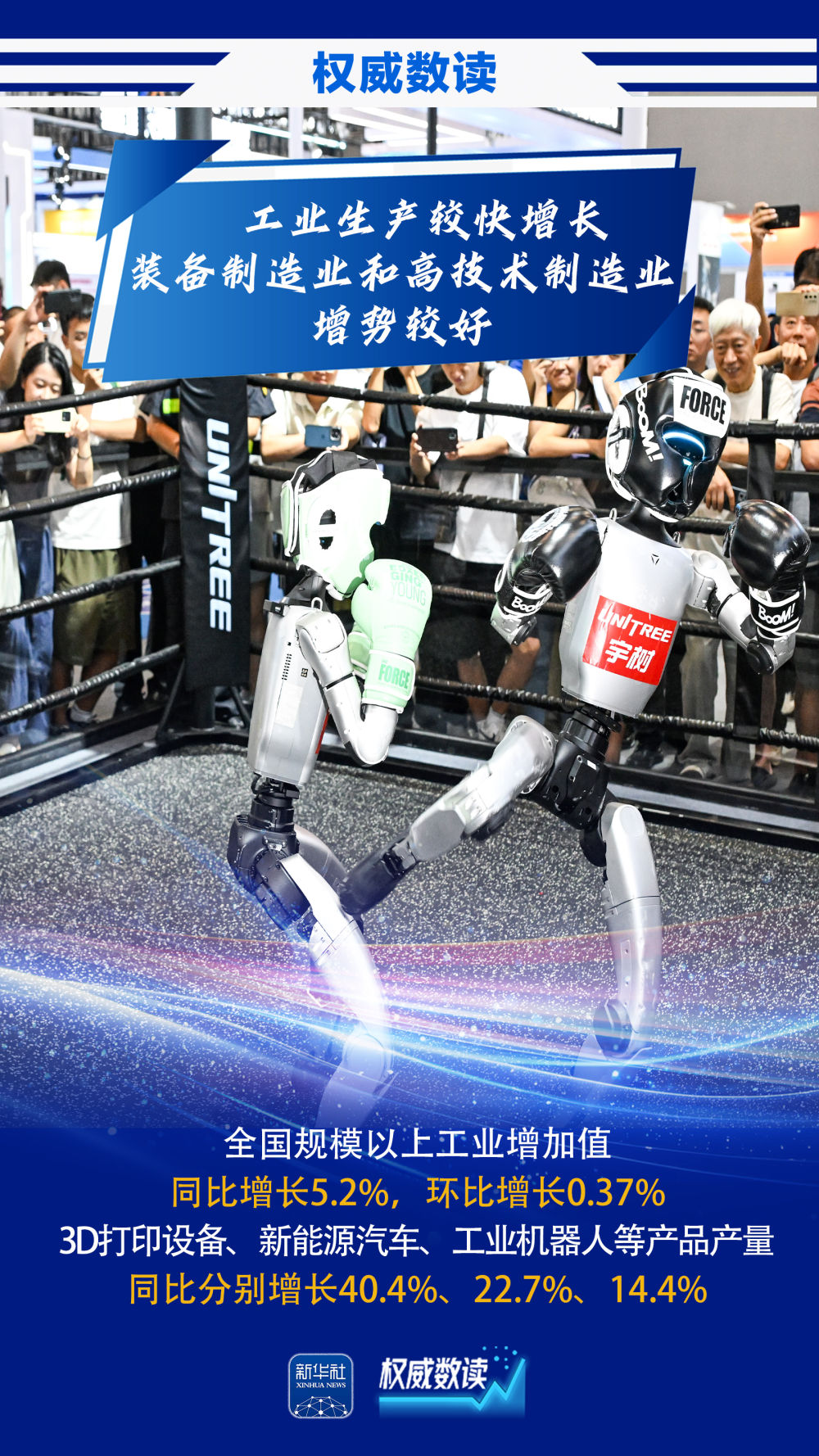
Group 1 - The production index of the service industry increased by 5.6% year-on-year, with significant growth in information transmission, software, and IT services at 12.1%, financial services at 9.2%, and leasing and business services at 7.4% [3] - The total retail sales of consumer goods reached 39,668 billion yuan, showing a year-on-year increase of 3.4% and a month-on-month increase of 0.17% [5] - Fixed asset investment (excluding rural households) from January to August totaled 326,111 billion yuan, reflecting a year-on-year growth of 0.5% [8] Group 2 - The total value of goods imports and exports reached 38,744 billion yuan, with a year-on-year increase of 3.5%, indicating a continuous growth in trade and an optimization of trade structure [11] - The production of 3D printing equipment, new energy vehicles, and industrial robots saw year-on-year increases of 40.4%, 22.7%, and 14.4% respectively, highlighting strong demand in these sectors [2]
国泰海通宏观:总量需加力,结构有亮点
Ge Long Hui· 2025-09-15 13:23
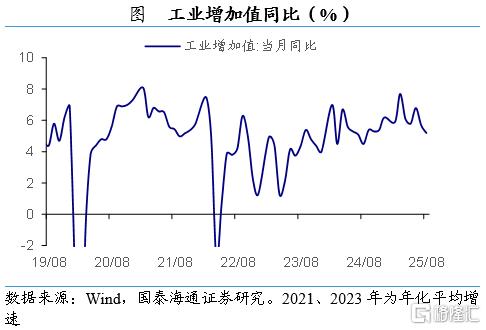
Economic Overview - The domestic economy continued to slow down in August, with a mix of resilience in production and pressure on demand, leading to increased internal differentiation [2][3] - Industrial value-added growth year-on-year was 5.2% in August, down from 5.7% in July, indicating a slight decline but still at a relatively high level [4][6] - The overall economic trend is expected to maintain a slow and stable trajectory with structural optimization, but demand recovery will take time [2][3] Production Sector - The production growth rate showed a slight decline, primarily due to external demand pressures and some upstream industries experiencing production cuts [4][6] - The production-sales rate decreased from 97.1% to 96.6%, indicating a marginal improvement in domestic consumption capacity [4] - Policy-related industries, such as transportation equipment and non-ferrous metals, showed resilience, while export and consumer-related sectors faced significant pressure [6][7] Service Sector - The service sector's production index grew by 5.6% year-on-year in August, down 0.2 percentage points from July, reflecting a slowdown [7] - High-value-added industries like information technology and finance showed growth, while leasing and business services faced challenges due to weak corporate expansion intentions [7] Employment - The urban survey unemployment rate rose slightly to 5.3% in August, primarily due to seasonal pressures from the influx of recent graduates into the labor market [9] Consumption Sector - Retail sales growth year-on-year was 3.4% in August, down 0.3 percentage points from July, indicating a need for stronger consumption recovery [12][15] - Dining consumption showed signs of recovery, while retail sales growth for goods slowed down, reflecting a mixed performance across different categories [14][15] - Essential consumption categories faced declines, while some upgraded consumption categories showed resilience, supported by seasonal demand and policy measures [15] Investment Sector - Fixed asset investment growth was 0.5% year-on-year for January to August, with August showing a significant decline of 7.1% compared to July [16][19] - Investment in manufacturing, infrastructure, and real estate all experienced negative growth, necessitating policy support to break the downward cycle [16][20] - The real estate sector continued to face fundamental pressures, with sales area and sales value both declining significantly year-on-year [20]

“十四五”时期北京GDP预计跨过5万亿!经济增量等于“新增一个海淀区”
Zheng Quan Shi Bao Wang· 2025-09-15 12:27
Core Insights - Beijing's economic development has made significant progress during the "14th Five-Year Plan" period, with GDP expected to exceed 5 trillion yuan and an economic increment of approximately 1.4 trillion yuan, equivalent to the total economic output of a district like Haidian [1][2] - The city has focused on high-quality development, with a strong emphasis on technological and industrial innovation, aiming to enhance its economic vitality and opportunities [1][2] Economic Growth - The average annual GDP growth rate for Beijing from 2021 to 2024 is projected at 5.2%, indicating a recovery trend despite various challenges [2] - The information service industry has become the largest pillar of Beijing's economy, with its added value surpassing 1 trillion yuan [2][4] Investment Trends - Investment in high-tech industries has increased significantly, with the proportion rising from 9.5% in 2020 to 22.6% in 2024, marking a historical high [3] - The city is directing investments towards future development, urban governance, and improving quality of life [3] Technological Innovation - Beijing aims to establish itself as an international technology innovation center, with R&D investment intensity maintained at around 6%, ranking among the top global innovation cities [4] - The city has launched 158 large models in artificial intelligence, accounting for about 30% of the national total, and has seen a significant increase in the application of robotic products [4][5] Regional Collaboration - The collaboration among Beijing, Tianjin, and Hebei has led to a combined economic total of 11.5 trillion yuan by 2024, with all three regions' GDP growth rates exceeding the national average [6][7] - The "Beijing R&D, Tianjin-Hebei manufacturing" model is evolving, with technology contract transactions reaching 230.87 billion yuan during the "14th Five-Year Plan" period, nearly double that of the previous five years [7]
GDP迈上5万亿台阶,解码北京经济的韧性和潜力
Bei Jing Shang Bao· 2025-09-15 12:26
Core Insights - Beijing's economy is making solid progress towards high-quality development, with a focus on new technologies and industries, as highlighted in the recent press conference on the achievements during the 14th Five-Year Plan period [1][5] Economic Growth and Structure - The total economic output of Beijing is expected to exceed 5 trillion yuan, with a significant increase in the value added of the information service industry, which has surpassed 1 trillion yuan, making it the city's largest pillar industry [3][4] - The GDP is projected to grow at an average annual rate of 5.2% from 2021 to 2024, with a total economic increment of approximately 1.4 trillion yuan during the 14th Five-Year Plan [3][8] - By 2024, the per capita GDP is expected to reach $32,000, and the labor productivity is projected to be 444,000 yuan per person, leading among all provinces and cities in China [3][4] Technological Innovation - Beijing is home to over 2,400 artificial intelligence companies, accounting for about half of the national total, solidifying its status as the "capital of artificial intelligence" [6][8] - The city has established 115 unicorn companies and 1,035 "little giant" enterprises, leading the nation in these categories [6][8] - The integration of technology and industry is evident, with significant advancements in sectors such as integrated circuits and new energy vehicles, where the output of integrated circuits is expected to grow by 51.2% compared to 2020 [3][7] Consumer Market Dynamics - The consumer market in Beijing is projected to exceed 3 trillion yuan by 2025, with a notable increase in service consumption, which has grown at an average annual rate of over 7.5% in the past four years [9][10] - The city is actively enhancing its consumption environment, with nearly 2,000 large-scale events planned for 2024, averaging five events per day [9][10] - Investment in high-tech industries has increased, with the proportion of high-tech industry investment rising from 9.5% in 2020 to 22.6% in 2024, marking a historical high [9][10] Rural Development and Integration - Beijing is advancing urban-rural integration, with initiatives aimed at revitalizing rural areas and enhancing local economies, leading to a 20% increase in collective operating income in demonstration villages [10][11] - The total income from rural tourism in Beijing is expected to exceed 3.5 billion yuan by 2024, reflecting the growing appeal of rural areas for leisure and tourism [10][11] Future Outlook - The dual drivers of technological and consumer innovation are expected to continue supporting economic growth, with artificial intelligence, digital economy, and new consumption patterns playing crucial roles in the future [11][12]
GDP迈上5万亿台阶 解码北京经济的韧性和潜力
Bei Jing Shang Bao· 2025-09-15 12:10
Core Insights - Beijing's economy is making solid progress towards high-quality development during the 14th Five-Year Plan period, with a projected GDP exceeding 5 trillion yuan [1][5][9] - The information service industry has become the largest pillar industry in Beijing, with its added value surpassing 1 trillion yuan, maintaining the top position nationwide [1][5][9] - Consumption has seen new highlights, with service consumption growing at an average annual rate of over 7.5% in the past four years, becoming a major driver of economic growth [1][10][11] Economic Growth and Structure - The GDP is expected to achieve a significant increase of approximately 1.4 trillion yuan over five years, with an average annual growth rate of 5.2% from 2021 to 2024 [5][9] - By 2024, the per capita GDP is projected to reach $32,000, with labor productivity at 444,000 yuan per person, leading among all provinces and cities [5][9] - The financial sector's asset scale exceeds 220 trillion yuan, accounting for about half of the national total, while the manufacturing sector is optimizing towards high-end industries [5][8] Technological Innovation - Beijing is recognized as the "Artificial Intelligence Capital," with over 2,400 AI companies, accounting for about half of the national total [7][9] - The city has established a robust innovation ecosystem, with significant investments in R&D, maintaining an intensity of around 6% of GDP [7][9] - The integration of new technologies has led to the development of various innovative products, including robots and advanced manufacturing technologies [8][9] Consumption Trends - The market total consumption is expected to exceed 3 trillion yuan by 2025, with fixed asset investment surpassing 1 trillion yuan [10][11] - The "first store economy" is leading nationwide, with nearly 2,000 large-scale events held in 2024, averaging five events per day [10][11] - Over 70% of residents engage in short-distance vacations annually, indicating a growing trend in leisure and tourism [10][11] Urban-Rural Integration - Beijing is advancing urban-rural integration, enhancing rural service industries and increasing collective income by over 20% in demonstration areas [11][12] - The rural tourism revenue is projected to exceed 3.5 billion yuan in 2024, reflecting the successful implementation of rural revitalization strategies [11][12] - The dual drive of technological and consumption innovation is optimizing the economic structure and enhancing development momentum [11][12]
8月经济数据点评:供需分化的三个结果
Soochow Securities· 2025-09-15 10:33
Supply and Demand Analysis - In August, industrial added value grew by 5.2% year-on-year, down from 5.7% in July, while the service production index increased by 5.6%, down from 5.8%[4] - External demand weakened with exports growing by 4.4% year-on-year, down from 7.2% in July, and below the expected 5.9%[4] - Domestic demand also declined, with retail sales growing by 3.4%, unchanged from July, and below the expected 3.8%[4] - Fixed asset investment (FAI) showed a cumulative growth of 0.5%, down from 1.6% in July, with monthly growth dropping from -5.2% to -6.3%[6] Economic Outlook - The divergence between supply and demand is expected to lead to three outcomes: GDP growth will align more closely with supply data, with Q3 GDP growth projected around 5%[4] - Strong supply relative to weak demand may increase price pressures, necessitating stronger policy support for price recovery[4] - Historically, if demand does not strengthen, supply will follow suit, indicating greater pressure on Q4 GDP compared to Q3[4] Sector Performance - High-tech manufacturing remains a key driver of production resilience, with its added value growing by 9.3% year-on-year in August[4] - The restaurant sector showed a rebound in consumption, with retail sales in this category growing by 2.1%, up from 1.1% in July[5] - Fixed asset investment in infrastructure and real estate continued to decline, with infrastructure investment dropping from -1.9% to -6.4% and real estate investment from -17.2% to -19.4%[6]
权威数读|8月份国民经济:运行总体平稳
Xin Hua Wang· 2025-09-15 10:08
Group 1 - The core viewpoint of the articles indicates that the national economy is operating steadily with coordinated macro policies, and there are new achievements in high-quality development and transformation upgrades [1] Group 2 - Industrial production has shown rapid growth, with the national industrial added value increasing by 5.2% year-on-year and 0.37% month-on-month. Notable growth in production includes 3D printing equipment (40.4%), new energy vehicles (22.7%), and industrial robots (14.4%) [2] Group 3 - The service industry is also experiencing rapid growth, with the national service production index increasing by 5.6% year-on-year. Specific sectors such as information transmission, software and IT services (12.1%), finance (9.2%), and leasing and business services (7.4%) are performing well [3] Group 4 - Retail sales are showing stable growth, with the total retail sales of consumer goods reaching 39,668 billion yuan, a year-on-year increase of 3.4% and a month-on-month increase of 0.17%. Categories such as daily necessities (7.7%), grain and oil products (5.8%), and sports and entertainment goods (16.9%) have seen significant retail growth [5] Group 5 - Fixed asset investment remains on the rise, with a total of 326,111 billion yuan in fixed asset investment (excluding rural households) from January to August, reflecting a year-on-year growth of 0.5% [8] Group 6 - The total value of goods import and export reached 38,744 billion yuan, marking a year-on-year increase of 3.5%, indicating a continuous growth in trade and an optimization of trade structure [9] Group 7 - The Consumer Price Index (CPI) remained stable month-on-month, while the Producer Price Index (PPI) saw a narrowing decline of 0.7% compared to the previous month. The core CPI, excluding food and energy prices, increased by 0.9% year-on-year, with a slight expansion of 0.1 percentage points from the previous month [10]