
玩具

Search documents
群兴玩具:截至2025年9月30日公司股东总数为40241户
Zheng Quan Ri Bao Zhi Sheng· 2025-12-18 07:49
Group 1 - The company, Qunxing Toys, reported that as of September 30, 2025, the total number of shareholders was 40,241 [1]

AI玩具的风,吹动投资人
3 6 Ke· 2025-12-18 02:23
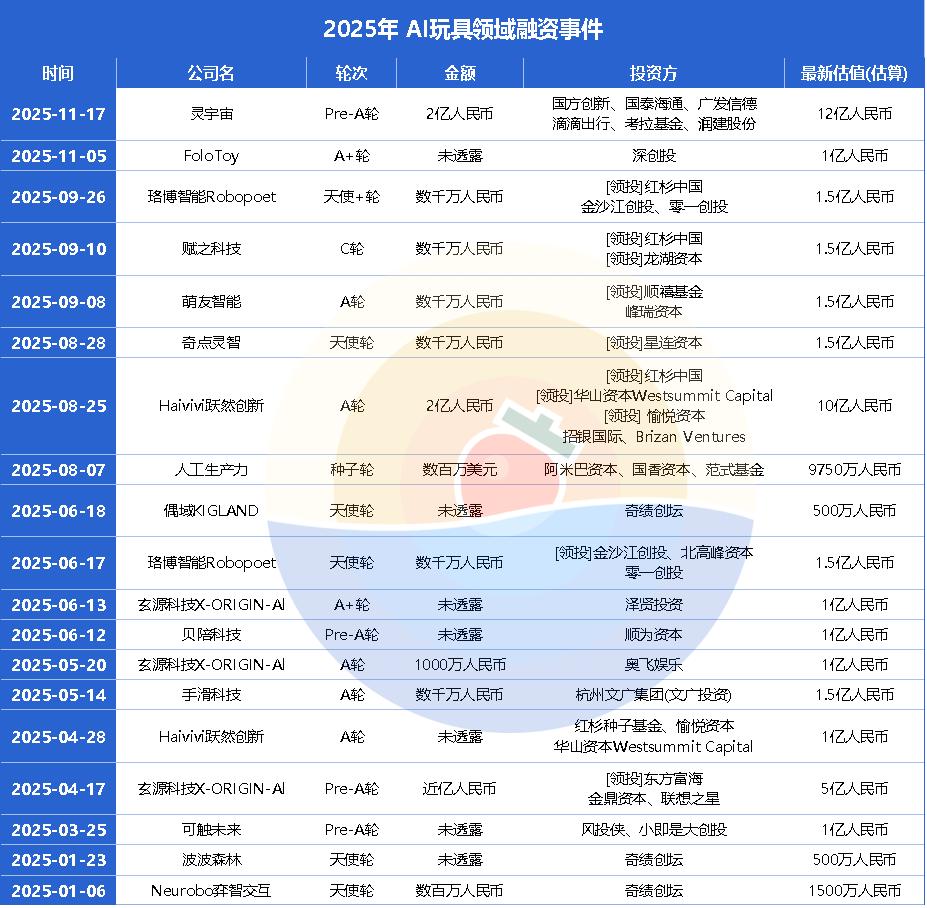
Core Insights - The AI toy sector is experiencing a surge in investment interest, driven by the commercialization of AI technology and the emergence of new companies in the market [1][2] - The global AI toy market is projected to reach nearly $20 billion by 2024, with a compound annual growth rate of approximately 14%-16%, potentially exceeding $35.11 billion by 2030 and $60 billion by 2034 [1] - Investment activity in the AI toy sector has significantly increased, with 19 financing events reported in 2025, up from 14 in 2024 and just 3 in 2023 [2] Investment Trends - The financing scale for AI toy companies has started at around tens of millions of RMB, with several companies founded in 2023-2024 already achieving valuations exceeding 1 billion RMB [2] - Major investment firms such as Sequoia China, GSR Ventures, and Didi Chuxing are actively participating in funding rounds, indicating strong institutional interest [2][13] - Notable financing events include Lingyu Universe's 200 million RMB Pre-A round and Haivivi's 200 million RMB A round, both achieving valuations over 1 billion RMB [4][7] Company Developments - Lingyu Universe, founded in 2023, has rapidly completed three rounds of financing within six months, achieving a valuation of 1.2 billion RMB [4] - Haivivi, originally focused on children's hardware, pivoted to AI toys in response to market changes and has successfully launched products like BubblePal, selling over 300,000 units [5][6] - Other companies in the sector, such as Robopoet and Bepei Technology, have also secured significant funding, contributing to the overall growth of the AI toy market [8] Market Dynamics - The AI toy market is characterized by a diverse range of products and a growing number of startups, with over 100 investment institutions involved [9][13] - The competitive landscape includes both established players and new entrants, with a focus on emotional interaction and user engagement as key selling points [11][18] - The decline in technology costs and the robust supply chain in regions like the Pearl River Delta are facilitating the rapid commercialization of AI toys [17] User Experience and Challenges - High return rates for some AI toys, reported at 20%-40%, highlight challenges in user experience and product differentiation [15] - Concerns about product quality and the prevalence of "pseudo-AI" products have been raised, indicating a need for genuine innovation in the sector [15] - The emotional value provided by AI toys is seen as a significant driver of demand, particularly in urban environments where companionship is increasingly sought after [18]

扬州恩和欣玩具有限公司成立 注册资本3万人民币
Sou Hu Cai Jing· 2025-12-18 00:36
天眼查App显示,近日,扬州恩和欣玩具有限公司成立,法定代表人为周恩慧,注册资本3万人民币, 经营范围为一般项目:玩具销售;玩具、动漫及游艺用品销售;木制玩具销售;母婴用品销售;日用杂 品销售;服装服饰零售;服装服饰批发;产业用纺织制成品销售;针纺织品及原料销售;针纺织品销 售;塑料制品销售;家居用品销售;金属切割及焊接设备销售;金属切削机床销售(除依法须经批准的 项目外,凭营业执照依法自主开展经营活动)。 ...
奇梦岛上涨2.14%,报5.25美元/股,总市值2.86亿美元
Jin Rong Jie· 2025-12-17 15:21
据交易所数据显示,12月17日,奇梦岛(HERE)盘中上涨2.14%,截至22:35,报5.25美元/股,成交3.86万 美元,总市值2.86亿美元。 财务数据显示,截至2025年09月30日,奇梦岛收入总额1.27亿人民币,同比减少84.31%;归母净利润 2.92亿人民币,同比增长261.41%。 资料显示,奇梦岛集团有限公司通过"奇梦岛"品牌,创造可收藏的流行玩具,激发快乐,激发全球文化。以 创新的设计和故事为核心,公司提供与全球收藏家紧密联系的沉浸式体验。公司以快乐、诚信、奇迹、 共创为指导,构建充满活力的文化生态系统,让粉丝塑造和分享梦想。 本文源自:市场资讯 作者:行情君 ...
合肥研发中心成立 实丰文化加码AI玩具技术突破与商业化落地
Zheng Quan Shi Bao Wang· 2025-12-17 02:55
Industry Overview - The year 2025 is anticipated to be the "Year of AI Toys," with continuous capital inflow throughout the year. The domestic market for AI toys is expected to exceed 10 billion by 2030, with a compound annual growth rate (CAGR) exceeding 70%. In the first half of 2025, AI toy sales are projected to grow sixfold quarter-on-quarter and over 200% year-on-year [1]. Company Developments - Shifeng Culture has established a wholly-owned subsidiary, Anhui Shifeng Zhilian Information Technology Co., Ltd., in Hefei, Anhui, focusing on technological breakthroughs in AI toy products. The company aims to create a leading domestic end-edge-cloud collaborative interaction architecture to support core interaction technology for AI toys [1]. - The company emphasizes Hefei's advantages in AI industry infrastructure and talent reserves, making it an optimal choice for establishing a research and development center. This will provide comprehensive support for the transformation of Shifeng Culture's AI toy business [1]. - Shifeng Zhilian will have departments for basic algorithms, application development, and testing, which will work in conjunction with the headquarters' product design, manufacturing, and marketing. The company plans to establish strategic alliances with upstream and downstream resources in the industry chain to accelerate the commercialization of technological achievements [1]. Product Portfolio - Shifeng Culture focuses on two core business segments: toys and games, with a specific emphasis on trendy and AI toys. The company has developed a diverse IP matrix, including international and domestic popular IPs such as Pokémon, Disney, and various animated series [2]. - The company collaborates with leading domestic foundational model vendors to enhance AI capabilities, ensuring the advanced and stable performance of its products. Additionally, partnerships with experienced IoT hardware solution providers are in place to ensure stable connectivity and functional responsiveness of toy interaction [2]. - Current AI products include AI Magic Star, designed for children aged 3-10, and Feifei Rabbit, aimed at children aged 3-6, among others. These products feature plush designs with detachable clothing and are positioned as innovative AI upgrades of Baidu's mascot [2]. Future Product Strategy - Shifeng Culture plans to focus on three core product directions: 1. Fun tool-type products that provide instant response capabilities across various scenarios 2. Emotional companion-type products with unique personality traits 3. Growth mentor-type products that leverage AI technology for personalized educational adaptations, combining enlightenment and popular science education [3].

奇点玩心(上海)玩具有限公司成立 注册资本1000万人民币
Sou Hu Cai Jing· 2025-12-16 21:14
天眼查App显示,近日,奇点玩心(上海)玩具有限公司成立,法定代表人为解东军,注册资本1000万 人民币,经营范围为一般项目:玩具销售;技术服务、技术开发、技术咨询、技术交流、技术转让、技 术推广;版权代理;知识产权服务(专利代理服务除外);图文设计制作;会议及展览服务(出国办展 须经相关部门审批);专业设计服务;组织文化艺术交流活动;市场营销策划;计算机及通讯设备租 赁;工艺美术品及礼仪用品销售(象牙及其制品除外);日用百货销售;五金产品零售;文具用品零 售;电子产品销售;化工产品销售(不含许可类化工产品);机械设备销售;体育用品及器材零售;珠 宝首饰批发;服装服饰批发;鞋帽批发;货物进出口;技术进出口;国内货物运输代理;广告制作;广 告发布;广告设计、代理;制鞋原辅材料销售。(除依法须经批准的项目外,凭营业执照依法自主开展 经营活动)。 ...
东莞市燃玩设玩具有限公司成立 注册资本100万人民币
Sou Hu Cai Jing· 2025-12-16 09:24
Core Insights - Dongguan Ranwan Toy Co., Ltd. has been established with a registered capital of 1 million RMB, indicating a new player in the toy industry [1] Company Overview - The legal representative of the company is Sun Jinyang, suggesting a centralized leadership structure [1] - The company’s business scope includes a wide range of activities such as toy sales, cultural and artistic exchange activities, and various retail and wholesale services [1] Business Activities - The company is involved in the sale of toys, anime, and gaming products, as well as pet food and supplies, indicating a diversified product offering [1] - Additional services include software development, professional design services, and information technology consulting, showcasing a focus on technology integration [1] - The company also engages in import and export activities, which may enhance its market reach and operational flexibility [1]
US tariffs are having an uneven effect on holiday prices and purchases
The Economic Times· 2025-12-16 04:44
Core Insights - The holiday shopping season is facing challenges due to high tariffs on imported goods, leading to increased prices and cautious consumer spending [1][4][20] - Consumers are opting for less expensive gift options, with a notable decrease in estimated gift budgets [2][5][20] - Despite initial fears, the worst-case impact of tariffs on consumer prices has not fully materialized, although certain categories have seen significant price increases [6][20] Consumer Behavior - There is a noticeable shift in consumer behavior, with many choosing lower-priced items, such as a $100 gift basket instead of a $150 one [2][4] - A Gallup index indicates a decline in consumer confidence, reaching a 17-month low, with gift budgets decreasing by $229 from October to November [5][20] Product Categories Affected - **Games and Toys**: Prices for toys have increased by 5% to 20% due to tariffs, with some items seeing price hikes from $20-$25 to $30-$35 [7][8][20] - **Electronics**: In 2023, China accounted for 78% of U.S. smartphone imports and 79% of laptop imports, with companies like Best Buy adjusting their inventory to cater to lower-income shoppers [9][10][20] - **Jewelry**: Price increases are more influenced by rising gold prices than tariffs, although tariffs on imports from countries like Switzerland and India are expected to affect prices in the future [12][14][20] - **Holiday Decorations**: Tariffs have slowed production and increased prices for holiday decor items, with some products seeing price increases from $8.95 to $10.95 [15][16][20] Strategic Shopping Recommendations - Consumers are advised to explore secondhand stores and discount retailers to avoid tariff-related price increases, as these stores often have inventory that predates the tariffs [17][20] - Domestically produced goods such as books, food, and beverages are suggested as good gift options to mitigate the impact of tariffs [18][20]


香薰、盲盒与古法金:观夏、泡泡玛特、老铺黄金的"千亿情绪生意",是怎样炼成的?
3 6 Ke· 2025-12-16 03:34
Core Insights - The article discusses the shift in consumer behavior from functional products to those that provide emotional value, emphasizing the importance of meaning, stories, and emotions attached to products [1][2][4] Group 1: Emotional Consumption - Emotional consumption is driven by two societal psychological factors: the pursuit of instant gratification and the fragmentation of social connections [2][4] - The need for instant gratification leads consumers to seek products that provide immediate emotional satisfaction, similar to the quick emotional stimuli found in platforms like TikTok [2][4] - The urbanization process has increased feelings of loneliness, prompting consumers to seek products that fulfill deeper emotional needs for connection and belonging [4] Group 2: Layers of Emotional Value - The first layer of emotional value is "small happiness," where consumers pay for minor yet certain feelings of joy, such as comfort food or relaxing home items [5][7] - The second layer involves identity construction, where consumers use products to express who they are and find their social group, as traditional identity markers weaken [8][10] - The third layer focuses on co-creation, where consumers desire to participate in the brand narrative, seeking a sense of agency and influence over the products they consume [18][19] Group 3: Case Studies - The case of "Guanxia" illustrates how a brand can create a cultural identity through a sophisticated symbol system, allowing consumers to align with a modern, cultured lifestyle [11][13] - The collaboration of Luckin Coffee demonstrates the creation of social currency through trendy products, where the value lies in the shared experience and belonging to a cultural moment [14][15] Group 4: Strategies for Brands - Brands should focus on creating immediate emotional gratification through appealing design, storytelling, and user empowerment [22][23] - Designing user participation in emotional narratives allows consumers to feel like protagonists in their experiences with the brand [23][25] - Building a community around the brand enhances loyalty, as consumers seek connection with like-minded individuals [26] - Brands should develop products that serve as emotional companions, addressing the need for comfort and connection in daily life [27] - Encouraging co-creation with consumers transforms them from passive buyers to active participants in the brand's evolution [28] Group 5: Market Potential - The emotional consumption market in China is projected to reach a trillion scale, indicating a significant shift in commercial logic towards emotional connections and shared brand narratives [28]


轻工-2026年度策略:内外兼修,优选个股α制胜
2025-12-16 03:26
Summary of Key Points from Conference Call Industry Overview - The conference call primarily discusses the home furnishing and light industry sectors, highlighting the impact of real estate downturns on furniture manufacturing and related businesses [1][5][6]. Core Insights and Arguments - **Revenue and Profit Decline**: In the first three quarters of 2025, the furniture manufacturing industry experienced a revenue decline of 6.7% and a profit drop of 19.1%, with 30% of companies reporting losses [1][5]. - **Government Support**: The Chinese government has allocated 150 billion yuan in 2024 for consumer goods replacement programs, with retail sales in the home furnishing sector expected to grow by 3.6% [1][5][6]. - **Market Adaptation**: Leading home furnishing companies are expanding their product offerings and services, focusing on comprehensive design and one-stop services, while also increasing their international presence [1][6]. - **Smart Mattress Market Growth**: The smart mattress market is projected to reach nearly 60 billion yuan by 2030, with a compound annual growth rate (CAGR) of 15% [1][7]. - **Packaging Industry Dynamics**: The packaging sector is facing challenges due to raw material cost fluctuations and competition, but consolidation efforts are expected to improve profitability [3][8]. Additional Important Content - **Toy Market Growth**: The toy market in China is experiencing growth, driven by IP culture, with retail sales of licensed products reaching 140.4 billion yuan in 2023, a 0.8% increase year-on-year [3][11]. - **Durable Consumer Goods Export Outlook**: The export chain for durable consumer goods is expected to perform well due to recovering demand and depleted overseas inventories, with key companies to watch including Yongxin Co., Hengli Co., and Songlin Technology [3][14]. - **Market Performance Comparison**: From the beginning of 2025 to the present, the light manufacturing sector has seen a performance increase of 16.83%, closely mirroring the 16.85% increase of the CSI 300 index [4][13]. Investment Recommendations - **Focus on Leading Companies**: Investment recommendations include leading custom home furnishing companies such as Oppein Home, Sophia, and Zhihong Home, as well as soft furniture companies like Kuka Home and Mousse [3][13]. - **Emerging Opportunities**: Companies with strong international growth potential in the toy industry, such as Pop Mart and Blukoo, are highlighted for their robust overseas performance [3][12].


