
新能源车

Search documents
A股三大指数飘绿,福建板块逆势走强,嘉戎技术、招标股份20CM涨停
2 1 Shi Ji Jing Ji Bao Dao· 2025-12-02 04:22
Market Overview - A-shares opened lower on December 2, with major indices in the red and a half-day trading volume exceeding 1 trillion yuan, expected to reach 1.65 trillion yuan for the day, a decrease of over 230 billion yuan compared to the previous day [1] - Over 3,900 stocks declined while nearly 1,300 stocks rose [1] Sector Performance - The Fujian stocks outperformed, with companies like Jiarong Technology hitting the daily limit, and several others including Aerospace Development and Pingtan Development also reaching the limit [2] - The commercial aerospace sector saw fluctuations, with Zhaobiao Co. hitting the daily limit and Jinfu Technology achieving a seven-day limit-up streak, closing at 24.83 yuan per share with over 80,000 buy orders at the limit [2] - The real estate sector showed strength, with Huaxia Happiness hitting the limit and Shilianhang rising nearly 7% [3] - The furniture sector experienced a broad rally, with Haolaike hitting the limit and *ST Yazhen rising 5% to the limit [3] - The ice and snow industry saw short-term gains, with companies like Bing Shan Leng Re hitting the limit [3] Stock Movements - *ST Lifang resumed trading and immediately hit the limit down, with a price of 2.69 yuan per share, a decline of 19.94% [4] - In the Hong Kong market, the Hang Seng Index was slightly up, while the Hang Seng Technology Index turned down by 0.5% [4] - New energy vehicle stocks weakened, with NIO down nearly 6% and XPeng down over 4% [4] Market Outlook - There is a growing call to "pre-arrange for the spring market rally" as December approaches [5] - Several major brokerages, including CITIC Securities and Huatai Securities, are optimistic about the annual A-share spring market [6] - Analysts suggest that December may serve as an important window for positioning ahead of the anticipated spring rally in 2026, with a focus on key economic data and policy meetings [7] - Investment strategies should focus on high-probability sectors, technology, and cyclical stocks, while being mindful of potential market constraints [7]

A股三大指数飘绿,福建板块逆势走强,嘉戎技术、招标股份20CM涨停,港股科网股跳水
2 1 Shi Ji Jing Ji Bao Dao· 2025-12-02 04:03
12月2日,A股三大指数集体低开,截至午盘,A股主要板块指数飘绿,沪深两市半日成交额超1万亿, 预计全日成交额1.65万亿,较昨日缩量超2300亿,全市场超3900股下跌,近1300股上涨。 盘面上,A股市场福建股逆势走强,嘉戎技术(301148)20CM涨停,航天发展(000547)、平潭发展 (000592)、榕基软件(002474)等集体涨停,海峡创新(300300)涨超10%。 资金"抱团"近期热门股。商业航天板块震荡拉升,招标股份(301136)20CM涨停,金富科技 (003018)走出7连板,截至午盘,该股报24.83元/股,涨停板上封单超8万手。至此,该股已连续7个 交易日涨停。公司日前提示,当前公司股票价格短期涨幅较大,可能存在市场情绪过热的情形,可能存 在非理性炒作风险。 连板指数走强,海王生物(000078)5连板,道明光学(002632)、通宇通讯(002792)4连板,瑞玛精 密(002976)等3连板。人造肉概念海欣食品(002702)再度涨停。 房地产板块走强,华夏幸福(600340)涨停,世联行(002285)涨近7%,多股跟涨。家具板块普涨, 其中,好莱客(603898)10 ...
多股逆势拉升,600828,6天5板,这只港股大涨超54%
Zheng Quan Shi Bao· 2025-12-02 04:00
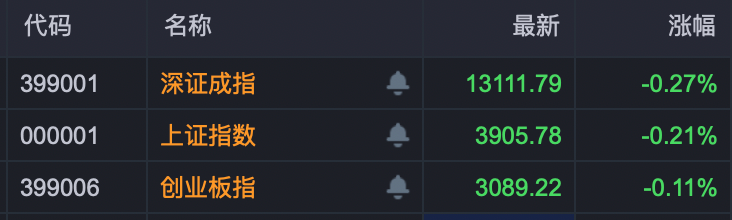
Market Overview - A-shares opened slightly lower on December 2, with the Shenzhen Component Index at 13,111.79 (-0.27%), Shanghai Composite Index at 3,905.78 (-0.21%), and ChiNext Index at 3,089.22 (-0.11%) [2] - Active sectors included automotive services, consumer stocks, coal, insurance, and AI mobile concepts, while precious metals, commercial retail, non-ferrous metals, photovoltaic equipment, and lithography machine concepts saw declines [2] AI Mobile Concept - The AI mobile concept continued to show strength, with companies like Daoming Optics achieving four consecutive trading limits, and Furon Technology achieving two consecutive trading limits [3] - On December 1, Doubao announced the technical preview of Doubao Mobile Assistant, a collaboration with mobile manufacturers, with a limited release of the engineering sample nubia M153 [6] Retail Sector - The retail sector experienced a surge, with Maoye Commercial (600828) achieving five trading limits in six days, alongside gains from Hebai Group, Wenfeng Shares, Hemei Group, Baida Group, and Wushang Group [7] Commercial Aerospace Sector - The commercial aerospace sector saw gains, with local stocks in Fujian rising, including Pingtan Development and Rongji Software hitting trading limits, and Haixia Innovation rising over 10% [10] - The Fujian Provincial Party Committee released recommendations for the 15th Five-Year Plan, emphasizing the deepening of state-owned enterprise reforms and a new round of special actions for state-owned enterprise reform [12] - Tongyu Communication reported in an institutional survey that it has expanded its satellite communication business, covering the entire product chain, with over 700 authorized patents in the RF communication field by June 2025 [14] Real Estate Sector - The real estate sector showed signs of recovery, with companies like Shilianhang and Ningbo Fuda hitting trading limits, along with gains from Huaxia Happiness, Wolong New Energy, Tefa Service, and I Love My Home [15] Hong Kong Market - In the Hong Kong market, Apple concept stocks remained active, with companies like AAC Technologies and Hon Teng Precision rising over 4%, and Qiu Tai Technology rising over 3% [16] - John Giannandrea, Apple's Senior Vice President of Machine Learning and AI Strategy, is set to leave the company, leading to a restructuring of the AI team [16] - Super Modern saw a significant increase of over 54% after announcing a placement agreement for up to 32.95 million shares at HKD 0.225 each [16] - Xiangxing International rose over 14% following an announcement of a partial tender offer by Xijing Holdings at HKD 0.21 per share, representing a discount of approximately 7.89% from its last trading price [18]
港股异动 | 理想汽车-W(02015)跌近2% 11月份交付量同比跌近32%
智通财经网· 2025-12-02 03:57
Group 1 - The core viewpoint of the article highlights that Li Auto's stock has declined nearly 2%, with a current price of 69.1 HKD and a trading volume of 332 million HKD [1] - In November, Li Auto delivered 33,181 vehicles, representing a year-on-year decrease of 31.92%, marking six consecutive months of decline [1] - According to a recent report by CMB International, Li Auto reported a net loss attributable to shareholders of 625 million RMB in Q3, the first loss in three years, which was below market expectations of a profit of 440 million RMB, primarily impacted by the MEGA recall [1] Group 2 - The report indicates that if the MEGA recall impact is excluded, the results would align more closely with expectations [1] - CMB International has lowered its rating on Li Auto to "Neutral" and reduced the target price for H-shares to 74 HKD, citing a lack of strong catalysts for the company's fundamentals in the coming four months [1] - On December 2, Li Auto announced a strategic partnership with Zeiss to launch a smart glasses product, with a launch event scheduled for December 3 at 19:30 [1]

港股科技ETF(513020)近20日净流入近3亿元,巨头加速算力布局,港股科技持续引领
Mei Ri Jing Ji Xin Wen· 2025-12-02 03:34
Group 1 - The core viewpoint is that major companies are accelerating their computing power layout, and there is a sustained optimism for the Hong Kong stock technology sector's leading role, particularly in the allocation value of internet heavyweight assets [1] - The Q3 earnings season for the internet sector has concluded without significant narrative changes, with expectations for individual stock EPS recovery, especially for those previously impacted by competition, and a long-term valuation uplift driven by AI options for next year [1] - The recommendation is to strategically invest in fundamentally sound Hong Kong technology assets that benefit from AI catalysts during market dips [1] Group 2 - The Hong Kong Technology ETF (513020) tracks the Hong Kong Stock Connect Technology Index (931573), covering core assets in sectors such as internet, innovative pharmaceuticals, and new energy vehicles, reflecting the diversified characteristics of the technology industry and overall performance of core technology companies in the Hong Kong market [1] - The Hong Kong Stock Connect Technology Index has a higher allocation in new energy vehicles and innovative pharmaceuticals compared to the Hang Seng Technology Index, with a cumulative return of 256.46% from the base date at the end of 2014 to October 2025, outperforming the Hang Seng Technology Index (96.94%) by nearly 160% [1]
平安证券(香港)港股晨报-20251202
Ping An Securities Hongkong· 2025-12-02 02:33
Market Overview - The Hong Kong stock market experienced fluctuations, with the Hang Seng Index closing at 23,831 points, down 145 points or 0.61% [1] - The US stock market saw declines across major indices, with the Dow Jones falling by 427.09 points or 0.90% [2] - Southbound funds maintained a net inflow of 121.9 billion HKD in November, indicating continued interest in Hong Kong stocks [3] Sector Performance - The materials sector, particularly non-ferrous metals, led the gains in the Hong Kong market, with notable increases in stock prices for companies like Sunny Optical Technology, which rose by 6.2%, and Zijin Mining, which increased by 5.3% [1][5] - In the US market, technology stocks faced profit-taking pressure, particularly in AI-related stocks, contributing to the overall market decline [2] Investment Opportunities - The report emphasizes the importance of technological self-reliance as a core theme for future performance in the Hong Kong market, suggesting that leading companies in AI, semiconductors, and industrial software may present long-term growth opportunities [3] - Specific recommendations include focusing on sectors with lower valuations and higher dividends, as well as companies benefiting from anticipated Federal Reserve interest rate cuts [3] Company Highlights - XPeng Motors reported a 19% year-on-year increase in vehicle deliveries for November, totaling 36,728 units, and a cumulative delivery of 391,937 units for the year, reflecting a 156% increase [9] - Alibaba, ZTE, and Meituan were among the top net purchases by southbound funds, indicating strong investor interest in these companies [9] Stock Performance - The Hang Seng Index and its sub-indices showed varied performance over the past month, with the Hang Seng Technology Index up by 0.8% [16] - Notable stock performances include Tencent Holdings, which saw a 1.3% increase, and Alibaba, which rose by 2.2% [16]





资讯早班车-2025-12-02-20251202
Bao Cheng Qi Huo· 2025-12-02 01:58
1. Report Industry Investment Rating No relevant information provided. 2. Core Viewpoints of the Report - In the short - term, supply - demand and prices are the two major economic concerns. The manufacturing industry was in a state of passive de - stocking in November, and the relationship between production and demand improved slightly. However, the sustainability needs to be observed, and the endogenous demand in consumption and real estate needs to be strengthened. The price index has been repaired, with the front - end stronger than the back - end in structure [28]. - After the December Politburo meeting, the general policy direction for 2026 will be set, and the subsequent Central Economic Work Conference will make further deployments. Key areas of focus include monetary policy, fiscal policy, technological self - reliance, etc. The overall environment is favorable for the market [28]. 3. Summary of Each Section 3.1 Macro Data Overview - GDP growth rate in Q3 2025 was 4.8% year - on - year, down from 5.2% in the previous quarter but up from 4.6% in the same period last year [1]. - In November 2025, the manufacturing PMI was 49.2%, slightly up from 49.0% in the previous month but down from 50.3% in the same period last year; the non - manufacturing PMI for business activities was 49.5%, down from 50.1% in the previous month and 50.0% in the same period last year [1]. - In October 2025, the monthly increase in social financing scale was 816.1 billion yuan, significantly lower than 3529.9 billion yuan in the previous month but higher than 1412.0 billion yuan in the same period last year [1]. 3.2 Commodity Investment Reference 3.2.1 Comprehensive - From December 3, 2025, the speculative trading margin standard for the polysilicon futures PS2601 contract will be adjusted to 13%, and the hedging trading margin standard to 12%. The daily opening volume limit for non - futures company members or clients will be 500 lots [2]. - China's S&P manufacturing PMI in November was 49.9, down from 50.6 in the previous month [3]. - On December 1, 36 domestic commodity varieties had positive basis, and 30 had negative basis [3]. - The Bank of Japan Governor signaled a possible interest rate hike [3]. 3.2.2 Metals - Due to supply shortages and expectations of Fed rate cuts, silver prices soared to record highs. On Monday, spot silver reached over $58 per ounce, with a year - to - date increase of over 100% [4]. - On December 1, the price of battery - grade lithium carbonate rose to 94,400 yuan/ton, and the price of lithium hydroxide rose to 82,500 yuan/ton [5]. - As of November 28, lead, aluminum, and nickel inventories decreased, while zinc inventory increased [6]. 3.2.3 Coal, Coking, Steel, and Minerals - The China Iron and Steel Association emphasized accelerating key iron ore projects to enhance the industry's resource security capacity [8]. - Saudi Arabia launched a new round of mineral exploration tenders covering 13,000 square kilometers [8]. - Indonesia set the benchmark prices for different grades of coal for the first half of December [8]. 3.2.4 Energy and Chemicals - Two shale gas industry standards will be implemented on March 28, 2026, to support shale gas development [10]. - On December 1, international oil prices rose due to geopolitical risks and supply - side factors [10]. - Saudi Aramco and Algerian National Oil Company raised LPG prices by 3% - 5% in December [10]. 3.2.5 Agricultural Products - The domestic corn market has been rising strongly, with significant price increases in major ports [11]. - On December 1, the domestic live - hog futures contract 2601 was at a low level, and the spot market prices mostly fell [11]. - The USDA reported weekly export sales data for various agricultural products in the US [11][12]. 3.3 Financial News Compilation 3.3.1 Open Market - On December 1, the central bank conducted 107.6 billion yuan of 7 - day reverse repurchase operations, with a net withdrawal of 231.1 billion yuan [14]. 3.3.2 Key News - French President Macron will visit China from December 3 - 5 [15]. - The CSRC is promoting the pilot of commercial real estate investment trusts (REITs) to support the real estate market [16]. - As of the end of October, the balance of loans in the Yangtze River Delta region showed certain growth trends [17]. - In November, new energy vehicle sales rankings were released, with BYD leading [17]. 3.3.3 Bond Market Summary - The Chinese bond market was mostly strong and volatile. Interest - rate bond yields mostly declined, and treasury - bond futures had mixed performance [21]. - Exchange - traded bonds, especially Vanke bonds, generally declined [21]. - The CSI Convertible Bond Index rose 0.10% [22]. 3.3.4 Foreign Exchange Market - The on - shore RMB against the US dollar rose 69 basis points on December 1 [27]. - The US dollar index fell 0.03% in New York trading [27]. 3.3.5 Research Report Highlights - Huatai Fixed - Income commented on the November official manufacturing PMI, highlighting supply - demand and price concerns [28]. - Guosheng Macro's Xiong Yuan released a report on the possible policy directions after the December Politburo meeting [28]. 3.3.6 Today's Reminders - On December 2, 155 bonds will be listed, 101 bonds will be issued, 54 bonds will be settled, and 135 bonds will pay principal and interest [29][30]. 3.4 Stock Market Key News - A - shares rose unilaterally, with technology themes active. The Shanghai Composite Index rose 0.65%, and the trading volume expanded to 1.89 trillion yuan [31]. - The Hong Kong Hang Seng Index rose 0.67%, and the Southbound funds had a net purchase of HK$2.148 billion [31]. - Shenzhen Stock Exchange will adjust samples of multiple indices on December 15 [31].
阿里巴巴、快手、网易、腾讯集体上涨
Di Yi Cai Jing Zi Xun· 2025-12-02 01:44
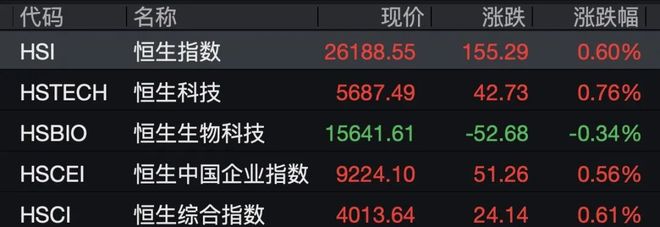
12月2日,香港恒生指数高开0.6%,恒生科技指数涨0.76%。 | 名称 | 现价 | 涨跌幅 ◆ | | --- | --- | --- | | 阿里巴巴-W | 160.100 | 3.36% | | 9988.HK | | | | 快手-W | 70.500 | 3.15% | | 1024.HK | | | | 网易-S | 226.400 | 1.80% | | 9999.HK | | | | 比亚迪股份 | 99.050 | 1.12% | | 1211.HK | | | | 腾讯控股 | 625.500 | 0.97% | | 0700.HK | | | | 海尔智家 | 26.940 | 0.90% | | 6690.HK | | | | 阿里健康 | 5.550 | 0.73% | | 0241.HK | | | | 联想集团 | 9.810 | 0.72% | | --- | --- | --- | | 0992.HK | | | | ASMPT | 77.050 | 0.72% | | 0522.HK | | | | 百度集团-SW | 116.400 | 0.69% | | 9888 ...

11月新能源车销量跟踪:“翘尾”行情遇冷,全年格局基本落定
Haitong Securities International· 2025-12-02 01:40
Investment Rating - The report does not explicitly provide an investment rating for the automotive industry or specific companies within it [26]. Core Insights - The year-end sales data for major automakers indicates a significant divergence in performance, with the typical "year-end tailwind" being weaker than in previous years. The phase-out of the "two-new" subsidy policies is contributing to a trend of slowing or declining sales growth [8][9]. - BYD's November sales were 480,000 units, down 5% year-on-year but up 9% month-on-month, primarily due to weaker domestic demand. Domestic sales were 348,000 units, down 27% year-on-year. Cumulative sales from January to November reached 4.18 million units, an 11% increase year-on-year [9][10]. - Geely's November sales reached 310,000 units, a 24% year-on-year increase, with cumulative sales of 2.79 million units, up 42% year-on-year, putting its annual target of 3 million units within reach. NEV sales for Geely in November were 188,000 units, a 53% year-on-year increase [9][10]. - Leapmotor exceeded 70,000 units in November, marking a 75% year-on-year increase, with cumulative deliveries reaching 536,000 units, surpassing its annual target ahead of schedule [10][11]. - Xiaomi Auto delivered over 40,000 units in November, maintaining this level for three consecutive months, and raised its full-year delivery outlook to over 400,000 units [12]. - Li Auto's November deliveries were 33,000 units, down 32% year-on-year, with cumulative deliveries of 362,000 units, an 18% decrease year-on-year [13]. - NIO's November sales were 36,000 units, a 76% year-on-year increase, but cumulative deliveries totaled 278,000 units, indicating challenges in achieving profitability in Q4 [14][15]. Summary by Sections Sales Performance - BYD's November sales were 480,000 units, with domestic sales at 348,000 units, reflecting a significant year-on-year decline [9][10]. - Geely's sales performance showed strong growth, particularly in NEVs, with a notable increase in overseas exports [9][10]. - Leapmotor and Xiaomi Auto demonstrated robust sales growth, exceeding their targets [10][12]. Market Dynamics - The automotive market is experiencing a reshuffling of sales rankings, with leading new energy vehicle (NEV) players facing slowing growth [10][11]. - The competitive landscape is intensifying, with companies needing to balance volume and profitability as subsidies phase out [15].



滚动更新丨A股三大指数集体低开,AI手机概念延续强势
Di Yi Cai Jing Zi Xun· 2025-12-02 01:37
Group 1 - The AI mobile concept continues to show strong performance, with companies like Da Ming Optical achieving a four-day consecutive rise, and Fu Rong Technology seeing a two-day consecutive rise. Other companies such as Mei Xin Sheng, ZTE, Transsion Holdings, and Zhongshi Technology also opened high [1] - The A-share market opened with all three major indices declining slightly, with the Shanghai Composite Index down 0.14%, the Shenzhen Component Index down 0.13%, and the ChiNext Index down 0.04% [2][3] - In the market, sectors such as lithium battery electrolyte, superhard materials, photolithography machines, 6G, commercial aerospace, and CPO concept stocks weakened, while cross-strait integration and AI application themes strengthened [3] Group 2 - The Hong Kong stock market opened with the Hang Seng Index up 0.6% and the Hang Seng Tech Index up 0.76%. Tech stocks generally performed well, with Alibaba and Kuaishou rising over 3%, while new energy vehicle stocks weakened, with NIO falling over 6% [4] - The central bank conducted a 7-day reverse repurchase operation of 156.3 billion yuan at an interest rate of 1.4%, with 302.1 billion yuan of reverse repos maturing on the same day [5] - The central parity rate of the RMB against the US dollar was reported at 7.0794, depreciating by 35 basis points from the previous trading day's rate of 7.0759 [6]
