
高端制造

Search documents
六大机构,研判A股后市!
Zhong Guo Zheng Quan Bao· 2025-11-09 15:42
Core Viewpoint - A-shares are experiencing weak fluctuations, with the Shanghai Composite Index hovering around 4000 points, but still showing resilience supported by stable economic and policy expectations, indicating potential for further growth in the Chinese stock market from foreign investors [1] Economic Indicators - In October, the Consumer Price Index (CPI) rose by 0.2% month-on-month and year-on-year, while the core CPI (excluding food and energy) increased by 1.2%, marking the sixth consecutive month of growth [2] - The Producer Price Index (PPI) saw a month-on-month increase of 0.1%, the first rise this year, while the year-on-year decline narrowed to 2.1%, a reduction of 0.2 percentage points from the previous month [2] - The People's Bank of China reported a continuous increase in gold reserves for the 12th consecutive month, reaching 74.09 million ounces by the end of October [2] Market Adjustments - MSCI announced the inclusion of 26 new Chinese stocks in its China Index, while removing 20, with new additions including several resource stocks and technology companies in semiconductors and high-end manufacturing [3] Investment Recommendations - CITIC Securities suggests increasing allocations in sectors like chemicals, non-ferrous metals, and renewable energy, which are at historical low profitability and industry prosperity levels [4] - Zhongtai Securities highlights opportunities in robotics, brokerage firms, and other sectors benefiting from consumption policies and market recovery, focusing on strategic upstream industries and technology applications [5] - Industrial Securities emphasizes the resilience of A-shares, recommending investments in cyclical sectors such as steel, chemicals, and new consumption, while also maintaining focus on AI-related technology growth [6] Market Valuation - In terms of valuation, the MSCI China Index has a forward P/E ratio of 13.9, significantly lower than the S&P 500's 22.9, indicating that the Chinese stock market remains attractive despite recent increases [7] - The Chinese market is seen as appealing due to diversified economic growth, improving liquidity, and upward revisions in corporate earnings forecasts, supported by ongoing fiscal policies [7] - The demand for energy storage is driving lithium prices up, with expectations of continued high growth in the storage market, potentially leading to a significant increase in lithium prices by 2026 [7]
年均增速超过15%!进博会溢出效应指数发布
Zheng Quan Shi Bao· 2025-11-08 11:12
Group 1 - The 8th China International Import Expo (CIIE) will be held in Shanghai from November 5 to 10, 2024, showcasing its significant impact on national and regional economic development [1] - The national spillover effect index for 2024 is projected to reach 67.04, a year-on-year increase of 2.23%, with an average annual growth rate of 15.54% [1] - Shanghai's spillover effect index is 66.56, with an average annual growth rate of 16.90%, while the Hongqiao International Central Business District index is 82.75, reflecting a remarkable annual growth rate of 50.45% [1] Group 2 - The CIIE has evolved beyond a mere exhibition to become a powerful engine for industrial upgrading, regional collaboration, and global trade activation [3] - The report indicates that while investment promotion has seen a decline compared to 2023, the overseas investment index is 4.5 times that of 2018, and China remains one of the top three investment destinations globally [3] - The report suggests a shift in export-oriented thinking, optimizing the business environment, enhancing cultural exchanges, and broadening cooperation channels with major economies to strengthen trade resilience [3] Group 3 - Shanghai's transaction intention amount index for 2024 is 2.42, with a year-on-year growth of 17.16%, maintaining its position as the leading local trading group for seven consecutive years [6] - The report highlights that Shanghai has become a global launchpad for new products, with over 3,000 launch events held annually since the first CIIE in 2018 [7] - The high-end industry development in Shanghai is significantly supported by the CIIE, with the industrial transformation index showing a year-on-year increase of 16.61% [7] Group 4 - The Hongqiao International Central Business District has seen a comprehensive driving effect from the CIIE, with the exhibition economy index reaching 22.08, a year-on-year increase of 16.70% [8] - The report emphasizes the need for increased investment in high-tech industries and the optimization of investment promotion environments to address challenges such as declining export ratios of high-tech products [7][8] - The CIIE has facilitated the establishment of over 200 enterprises in the cross-border e-commerce and industrial belt pilot area, with a trade scale exceeding 5 billion [8]
深市上市公司与国际投资者双向奔赴 AI投资机遇受关注
Shang Hai Zheng Quan Bao· 2025-11-07 19:10
Group 1 - The Shenzhen Stock Exchange hosted the "Investment in New Opportunities in China" event in Hong Kong, featuring a collective roadshow with 9 representative companies from sectors like AI and high-end manufacturing, engaging with nearly 30 international asset management and insurance institutions [1] - International investors expressed increased confidence in the A-share market and China's economic transformation through direct communication with company management, particularly regarding innovation in AI [1][2] - Companies such as Shenghong Technology, Lens Technology, BOE Technology Group, and others discussed their operational status and strategic layouts, with a focus on AI innovations [1] Group 2 - At Dazhu Laser, international investors learned about the company's AI-driven automation solutions and precision processing equipment, while at Lingyi Technology, they observed significant R&D investments in high-value AI terminal hardware [2] - Investors noted that Chinese companies' technological capabilities are underestimated, with A-share companies transitioning from price competition to value competition, enhancing their global innovation recognition [2] - Chinese firms are expanding into overseas emerging markets while deepening their domestic market presence, gaining high recognition from international institutions [2] Group 3 - Companies like Focus Media, Zhongchong Co., and Xinwanda showcased their globalization achievements, with Focus Media expanding to 11 countries and regions, deploying over 180,000 media devices [3] - Zhongchong Co. established a supply chain system with 22 pet food production bases globally, achieving stable revenue growth both domestically and internationally [3] - Xinwanda has set up 25 major production bases across various countries to meet global customer demands, reflecting a shift from "product export" to "brand export" [3] Group 4 - Overall, international investors are increasingly optimistic about the long-term prospects of Chinese companies and the A-share market, recognizing the global competitiveness of China's technological innovation [3] - The "14th Five-Year Plan" emphasizes technological self-reliance, shifting industrial policy focus from scale to productivity, which is expected to reshape the profitability landscape of A-share companies [3] - The potential for capital reallocation towards Chinese assets remains significant, given the relative undervaluation of Chinese stocks in the global market [3]
工信部副部长熊继军会见日本经济产业省经济产业审议官松尾刚彦
Zheng Quan Shi Bao Wang· 2025-11-07 11:57
Core Viewpoint - The meeting between China's Ministry of Industry and Information Technology and Japan's Ministry of Economy, Trade and Industry aims to strengthen industrial cooperation between the two countries and continue the vice-ministerial consultations in 2026 [1] Group 1: Cooperation Mechanism - The two ministries have effectively utilized the vice-ministerial consultation mechanism to achieve fruitful cooperation results based on mutual respect and win-win principles [1] - There is a consensus to further enhance policy communication and deepen practical cooperation in areas such as petrochemicals, high-end manufacturing, industrial green development, and corporate innovation [1] Group 2: Future Engagement - Both parties expressed a commitment to implement the important consensus reached during the meetings of their leaders [1] - Japan's representative praised the progress made after the fourth vice-ministerial consultation and emphasized the importance of continuing this dialogue mechanism to elevate the level of industrial cooperation [1]
近一月953公司被调研, 半导体、高端制造成焦点,多股已大涨
2 1 Shi Ji Jing Ji Bao Dao· 2025-11-07 01:48
Core Insights - The article highlights the increasing activity of broker research following the disclosure of third-quarter reports by listed companies, with a notable focus on sectors such as solar energy, semiconductor materials, and consumer electronics [2][5]. Group 1: Broker Research Trends - As of early November, over 35 brokers have conducted research on companies in the solar component supply chain, semiconductor materials, and leading consumer electronics firms [2]. - From October 1 to November 5, a total of 953 listed companies in A-shares received broker research, with 42 companies receiving research from 40 or more brokers [5]. - The most researched companies include Aibo Medical, Huace Testing, and Jinpan Technology, which received 65, 64, and 62 broker inquiries respectively, all categorized under the new productivity label [5]. Group 2: Sector Focus - Brokers are particularly interested in sectors such as semiconductors, industrial automation, and high-end manufacturing, reflecting ongoing market attention to technology-driven industries [2][6]. - Companies like Zhaoyi Innovation and Canadian Solar have also attracted significant broker interest, receiving 55 and 49 inquiries respectively [5]. - The research interest extends to various industries, including medical devices, power equipment, and gaming, indicating a broad focus on high-growth sectors [6]. Group 3: Investment Strategies - Broker investment strategies are concentrated on high-prosperity industries, with a focus on sectors like AI, semiconductor equipment, and consumer electronics [10]. - The research teams from CITIC Securities and CICC suggest that the electronic sector's performance is expected to remain strong, driven by AI and domestic production growth [10][11]. - Recommendations for November include focusing on new economic sectors such as AI software and semiconductor equipment, while traditional sectors like coal and steel are also highlighted [11].






近一月953公司被调研, 半导体、高端制造成焦点,多股已大涨
21世纪经济报道· 2025-11-07 01:38
Core Viewpoint - The article highlights the increasing activity of broker research in various sectors following the disclosure of Q3 financial reports, with a particular focus on technology and new productivity sectors [1][2]. Group 1: Broker Research Activity - As of early November, over 953 A-share listed companies have been researched by brokers, with 42 companies receiving attention from 40 or more brokers [3]. - The most popular companies include Aibo Medical, Huace Testing, and Jinpan Technology, which received 65, 64, and 62 broker research reports respectively, all associated with new productivity [3]. Group 2: Sector Focus - Brokers are particularly interested in the semiconductor industry, high-end equipment, and companies with strong technological barriers and growth potential [5][6]. - Notable companies receiving significant attention include storage chip leader Zhaoyi Innovation and solar component leader Artis, which received 55 and 49 broker research reports respectively [3]. Group 3: Investment Strategies - Broker investment strategies are concentrated on high-growth industries, with a focus on sectors like AI, semiconductor equipment, and consumer electronics [8][9]. - The research teams suggest that the electronic sector is expected to maintain its performance, driven by AI and domestic production growth [8]. Group 4: Market Trends and Recommendations - The article emphasizes the importance of monitoring annual performance expectations and the quality of corporate earnings, as well as the potential for market funds to shift between technology, consumer, and defensive sectors [10]. - Investors are advised to consider policy direction, industry hotspots, valuation rationality, and risk control when making investment decisions [10].

A股放量大涨 三大指数齐升
Bei Jing Qing Nian Bao· 2025-11-06 18:52
Group 1 - The A-share market experienced a broad-based rally, with the Shanghai Composite Index recovering above 4000 points, closing at 4007.76, up 0.97%, while the Shenzhen Component rose by 1.73% [1] - Trading volume significantly increased, with total turnover in the Shanghai, Shenzhen, and Beijing markets reaching 20,759 billion, a rise of 1,816 billion from the previous trading day, indicating enhanced market activity and increased willingness of external funds to enter [1] - Over 2,800 stocks in the market rose, with notable performances from leading companies in the technology and new energy sectors, driving the indices upward [1] Group 2 - Structural opportunities were particularly prominent, with major players in the new energy sector, such as Sungrow Power and TBEA, leading the market with transaction amounts of 21.734 billion and 21.488 billion respectively, boosting the photovoltaic and wind power industries [1] - The technology sector also showed strong performance, with companies like Cambrian, Zhongji Xuchuang, and NewEase surpassing transaction amounts of 14 billion, while chip-related stocks like Haiguang Information and SMIC attracted significant attention from investors [1] - The flow of main funds confirmed market hotspots, with significant net inflows into technology and high-end manufacturing sectors, indicating strong investor interest in these areas [2]
利好!多只A股、港股被纳入
凤凰网财经· 2025-11-06 13:03
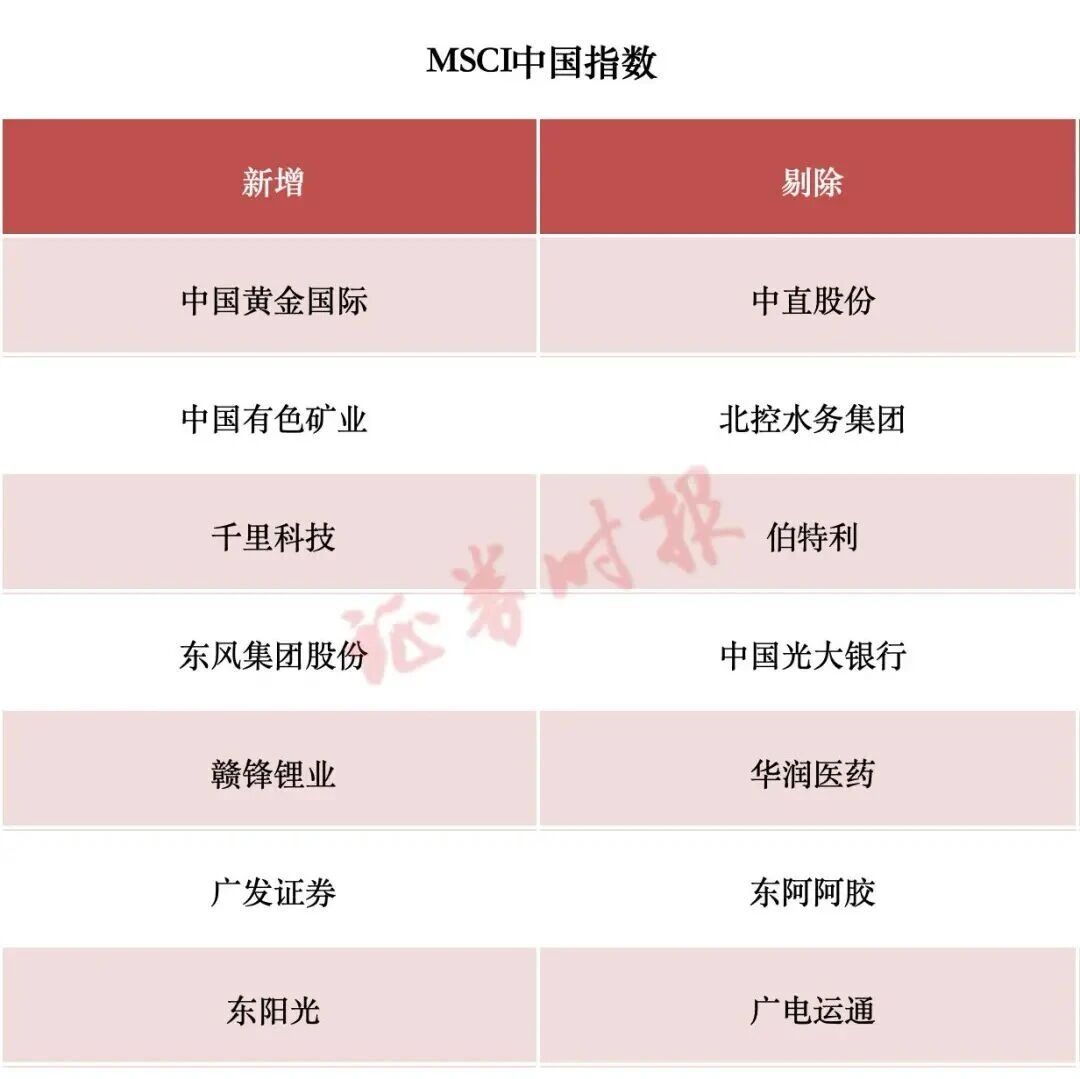
Group 1 - MSCI announced the results of its index review for November 2025, with 69 stocks added and 64 stocks removed from the global standard index, effective after market close on November 24 [1] - The three largest securities added to the MSCI global index by market capitalization are CoreWeave, Nebius Group, and Insmed [1] - The three largest securities added to the MSCI emerging markets index are Barito Renewables Energy, Zijin Mining International, and GF Securities H-shares [1] Group 2 - In the MSCI China index, 26 Chinese stocks were added while 20 were removed, including resource stocks and technology companies such as China Gold International and Ganfeng Lithium [2] - The stocks removed from the MSCI China index include Haige Communications, Dong-E E-Jiao, and HLA Corp [2][4] - The MSCI China A-share index added 17 stocks and removed 16, with notable additions including Qianli Technology and Huahong Semiconductor [6] Group 3 - The MSCI China onshore A-share index added 18 stocks and removed 24, with new additions like Baiwei Storage and Shengtun Mining [6] - The MSCI China index serves as a key benchmark for global investors for asset allocation and investment analysis, impacting passive fund tracking [8] - The adjustments in MSCI indices will lead to increased fund allocation to newly added companies and forced selling of removed companies by index funds [9] Group 4 - Recent insights from foreign investment firms indicate a preference for emerging markets over developed markets, with a positive outlook on the Chinese stock market due to anticipated consumer stimulus measures [9][10] - Despite mixed views on the Chinese stock market, there is recognition of significant growth potential within the second-largest economy [10]
美国对华进行301调查,中国3种金属管制反击,扼住美高端制造命脉
Sou Hu Cai Jing· 2025-11-06 11:52
Core Points - The recent developments in the US-China trade war indicate a significant escalation, with both countries adopting new strategies in their ongoing economic rivalry [1][2] - The US has initiated a new round of investigation under Section 301, citing the need to verify the implementation of the 2020 trade agreement, which is perceived as a political maneuver rather than a genuine trade concern [2][4] - China's response includes implementing export licensing for critical metals such as tungsten, antimony, and silver, leveraging its resource dominance to counter US pressure [6][7] US Actions - The US Trade Representative announced the initiation of a Section 301 investigation against China, claiming it is to check compliance with the 2020 trade agreement [1][2] - The US government has been criticized for using Section 301 as a tool for political leverage rather than fair trade practices, reflecting a pattern of inconsistent policies [2][4] - The US aims to exert maximum pressure on China to secure concessions in future negotiations, but this approach is seen as outdated and ineffective [4] China's Response - In retaliation, China has announced export controls on tungsten, antimony, and silver, which are essential for various high-tech industries, potentially impacting US manufacturing capabilities [6][7] - China holds a significant advantage in the production of these metals, controlling 83% of global tungsten production and substantial shares of antimony and silver, which positions it favorably in the trade conflict [6][7] - The export control policy signals China's strategic resource management and its ability to respond effectively to US actions [9][14] Geopolitical Context - The ongoing trade tensions reflect a broader geopolitical struggle, with the US attempting to contain China's growth through military and economic means, while China seeks to expand its influence through initiatives like RCEP and the Belt and Road Initiative [11][13] - China's trade with RCEP countries has reached 50.3%, indicating a successful shift towards regional cooperation amidst US pressures [11] - The economic outlook shows a stark contrast, with the IMF projecting a 2.0% growth for the US in 2025 compared to China's 4.5%, highlighting the differing trajectories of the two economies [11][13] Strategic Implications - The trade conflict underscores the importance of comprehensive strength, strategic foresight, and wisdom in international relations, with China maintaining a steady approach while the US grapples with internal political challenges [14][15] - The focus of this economic rivalry is shifting from immediate outcomes to long-term strategic positioning, with China appearing to solidify its advantages in resource control and industrial capabilities [14][15]

2025“中国南京周”走进德国 开启“未来城市”发展对话
Yang Zi Wan Bao Wang· 2025-11-06 10:56
Group 1 - The "Future City" dialogue and Nanjing city promotion event in Munich marks the beginning of the 2025 "Nanjing Week" and celebrates the 50th anniversary of diplomatic relations between China and the EU [1] - Nanjing has a strong manufacturing base and numerous higher education institutions, while Munich excels in high-end manufacturing and engineering, indicating significant potential for technological cooperation and industrial synergy [1][2] - Jiangsu province has over 400 investment projects in Germany, totaling over $4 billion, and aims to enhance the business environment for foreign enterprises [1] Group 2 - Nanjing has historically been a key node for East-West trade and cultural exchange, maintaining good economic and cultural relations with several German cities [2] - The event featured discussions on deepening cooperation in sectors such as automotive, artificial intelligence, and green industries, with an invitation for German partners to experience Nanjing's unique charm [2] - The event included presentations from Nanjing's investment promotion bureau, showcasing the city's investment environment and industrial advantages, particularly in alignment with Germany's "Industry 4.0" initiative [2][3] Group 3 - Qinhuai District contributes 8.3% of GDP and 38% of total tourism revenue with only 0.75% of the city's land, highlighting its economic effectiveness [3] - Jianye District focuses on finance and digital economy, positioning itself as a modern international city center [3] - Representatives from various sectors engaged in discussions on joint research, talent cultivation, and shared opportunities, emphasizing the ongoing industrial collaboration between China and Germany [3] Group 4 - The Bosch global R&D center in Nanjing is the largest of its kind for the group, showcasing the city's role in international cooperation [4] - The event coincided with the China International Import Expo, providing a platform for Nanjing's cooperation with Stuttgart, including a special exhibition for friendly cities [4] - The event aimed to strengthen industrial connections between Nanjing and Munich, creating a key platform for building a cooperative ecosystem [4] Group 5 - Nanjing's cultural outreach strategy includes the 2025 "Nanjing Week" in various German cities, promoting cultural heritage and deepening Sino-German integration [5] - The collaboration includes vocational training projects with German enterprises, fostering friendship and mutual trust between the two nations [5]