
造船

Search documents
未来10年再造一个中国高技术产业
Mei Ri Jing Ji Xin Wen· 2025-10-26 14:30
Core Points - The Central Committee of the Communist Party of China held a press conference on October 24 to interpret the spirit of the Fourth Plenary Session of the 20th Central Committee, which took place from October 20 to 23, marking a critical period for achieving the main goals of the 14th Five-Year Plan and laying the foundation for socialist modernization [1][3] Economic and Social Development - The Plenary Session approved the "Suggestions on Formulating the 15th Five-Year Plan for National Economic and Social Development," which comprehensively outlines the economic and social development strategies for the next five years [3][4] - The plan emphasizes building a modern industrial system and strengthening the foundation of the real economy, with four key tasks: upgrading existing industries, fostering innovation, expanding capacity and improving quality, and enhancing efficiency [4] Industry Development - The plan aims to enhance key industries such as chemicals, machinery, and shipbuilding, projecting an additional market space of approximately 10 trillion yuan over the next five years [4] - It proposes the development of emerging pillar industries, including new energy, new materials, aerospace, and low-altitude economy, which are expected to create several trillion-yuan markets [4] - The plan also highlights the importance of future industries like quantum technology, biomanufacturing, hydrogen energy, and sixth-generation mobile communication as new economic growth points [4] Infrastructure and Investment - The plan calls for coordinated planning of infrastructure and the construction of new types of infrastructure, aiming to improve the modern comprehensive transportation system [5] - It emphasizes expanding domestic demand as a strategic foundation, focusing on enhancing consumption and investment, and implementing significant projects to stimulate economic growth [5] - The plan suggests optimizing government investment structures to increase the proportion of investments in public welfare and improve the overall effectiveness of government investments [5] Regional Development - The plan outlines five key tasks for regional development, focusing on optimizing layouts, promoting new urbanization, and coordinating land and sea development [5] Health and Medical Services - The health sector aims to increase the average life expectancy of Chinese residents to around 80 years over the next five years, with a focus on preventive care and improving health literacy [7][8] - The plan emphasizes a comprehensive service model to enhance early diagnosis and treatment of chronic diseases, improving the efficiency and effectiveness of health outcomes [7] - It also aims to strengthen the collaboration between different levels of medical institutions to provide accessible and high-quality healthcare services [8]

多部门详解“十五五”规划建议,国资将向新兴产业集中
Di Yi Cai Jing· 2025-10-26 13:30
Core Viewpoint - The article emphasizes the importance of building a modern industrial system and strengthening the foundation of the real economy as a primary task in China's 14th Five-Year Plan, with a focus on high-quality development and innovation-driven growth [2][3]. Group 1: Modern Industrial System - The construction of a modern industrial system is prioritized in the 14th Five-Year Plan, with a focus on solidifying and expanding the real economy [2][3]. - Key tasks include upgrading traditional industries, fostering new and future industries, and enhancing the quality and efficiency of the manufacturing sector [3][5]. - The manufacturing sector is projected to contribute significantly to global manufacturing growth, with an expected increase in value added from 26.6 trillion yuan to 33.6 trillion yuan during the 14th Five-Year Plan [4]. Group 2: Traditional Industries - Traditional industries account for approximately 80% of the manufacturing sector's value added, serving as the foundation of China's industrial system [5]. - The government aims to enhance the competitiveness of key traditional industries such as chemicals, machinery, and shipbuilding, with an estimated market space increase of around 10 trillion yuan over the next five years [5]. Group 3: Emerging Industries - The plan includes the development of strategic emerging industries such as new energy, new materials, and aerospace, which are expected to create several trillion-yuan markets [7]. - The focus on innovation and reform is crucial for the growth of emerging industries, which currently represent only about 13.4% of GDP compared to traditional industries [8]. Group 4: State-Owned Enterprises - Central enterprises have invested approximately 8.6 trillion yuan in strategic emerging industries since the beginning of the 14th Five-Year Plan, with a projected revenue of over 11 trillion yuan in 2024 [9]. - The government encourages state-owned enterprises to concentrate capital in emerging industries to enhance competitiveness and ensure strategic security in critical areas [10][11].
申万宏源交运一周天地汇:三大因素反转强调船舶板块历史机会,油轮影响因素过多转向现实驱动
Shenwan Hongyuan Securities· 2025-10-25 11:18
Investment Rating - The report maintains a positive outlook on the shipping sector, highlighting a shift from expectation-driven to reality-driven stock price movements, with sufficient safety margins around current valuations [5][6]. Core Insights - The shipping sector is experiencing a historical opportunity as three negative factors (policy, exchange rates, and ship prices) have reversed to positively impact the market. The Clarksons second-hand ship price index is steadily breaking through 2024 highs, indicating an approaching inflection point for new ship prices [5][6]. - The report recommends specific companies such as China Merchants Energy Shipping and COSCO Shipping Energy, while also suggesting to monitor Haitong Development and Pacific Shipping [5]. - The report emphasizes the potential for significant upward revisions in global oil shipping profitability forecasts and reset costs, with current charter rates around $50,000 per day expected to rise [5][6]. Summary by Sections Shipping Market Overview - VLCC rates stabilized at high levels around $80,000 per day, despite an 8% week-on-week decline to $78,862 per day. The overall market remains calm, with charterers attempting to suppress rates through private deals [5][6]. - The report notes a 5% week-on-week decline in Suezmax rates to $65,724 per day, while Aframax rates increased by 14% to $56,567 per day, indicating mixed market conditions [5][6]. Air Transportation - The report highlights unprecedented challenges in the aircraft manufacturing supply chain, with an aging global fleet expected to constrain supply over the next 5-10 years. This situation is anticipated to lead to significant improvements in airline profitability as demand for international flights increases [5][6]. Express Delivery - The express delivery sector is entering a new phase of competition, with three potential scenarios outlined: price stabilization leading to profit recovery, continued competitive pressure in certain regions, and potential for higher-level mergers and acquisitions [5][6]. Rail and Road Transportation - Rail freight volume and highway truck traffic are showing resilience, with national railway freight reaching 80.32 million tons, a 2.33% week-on-week increase, and highway truck traffic increasing by 24.72% [5][6]. High Dividend Stocks in Transportation - The report lists high dividend stocks in the transportation sector, including Bohai Ferry with a dividend yield of 8.09% and Zhonggu Logistics at 10.88%, indicating strong potential for income generation [5][6].
苏美达(600710):业绩符合预期,造船受益于最新港口费政策,柴发业务弹性被低估
Shenwan Hongyuan Securities· 2025-10-25 09:23
Investment Rating - The investment rating for the company is "Buy" (maintained) [3] Core Insights - The company's performance is in line with expectations, benefiting from the latest port fee policy in shipbuilding, while the elasticity of the diesel generator business is underestimated [1][6] - The company reported a revenue of 87.423 billion yuan for Q1-Q3 2025, a year-on-year increase of 0.5%, and a net profit attributable to the parent company of 1.104 billion yuan, up 10.0% year-on-year [6] - The shipbuilding sector is entering a profit release phase, aided by a new port fee policy that exempts ships built in China from certain fees, which is expected to boost shipbuilding orders returning to China [6] - The diesel generator business is highlighted for its ongoing demand, particularly in the AIDC sector, with significant market potential driven by the growth in AI computing power [6] - The company's diversified operations and global layout provide stability against market fluctuations, with a balanced trade structure reducing vulnerability to changes in trade policies [6] - The projected dividend yield for 2025 is approximately 4.2%, supported by a payout ratio of 42% [6] - The profit forecasts for 2025E-2027E are 1.349 billion, 1.478 billion, and 1.609 billion yuan respectively, with corresponding PE ratios of 10, 9, and 8 [6] Financial Data and Profit Forecast - Total revenue for 2025E is estimated at 115.3 billion yuan, with a year-on-year decrease of 1.6% [2] - The net profit attributable to the parent company for 2025E is projected to be 1.349 billion yuan, reflecting a year-on-year growth of 17.5% [2] - The company's gross margin is expected to improve from 6.4% in 2025Q1-3 to 7.4% in 2025E [2] - The return on equity (ROE) is forecasted to be 16.2% for 2025E [2]

从“十五五”的字里行间抓住发展的机会,搭上政策顺风车!
Yang Shi Wang· 2025-10-25 01:37
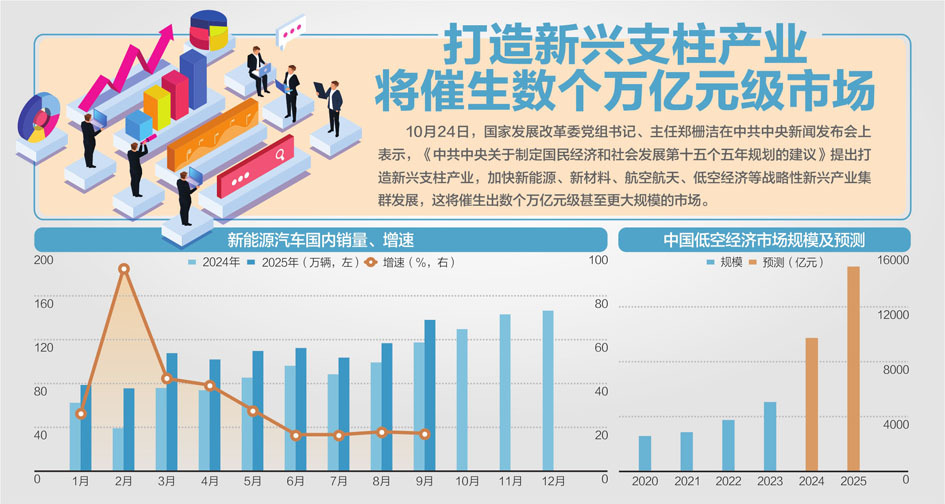
Group 1 - The "14th Five-Year Plan" emphasizes the development of strategic emerging industries such as new energy, new materials, aerospace, and low-altitude economy, which are expected to create trillion-level markets [3] - The advanced manufacturing sector is projected to see a market expansion of approximately 10 trillion yuan over the next five years, with opportunities across the supply chain from components to maintenance and testing services [4] - The service industry is expected to undergo transformation, integrating with manufacturing and agriculture, creating new opportunities for traditional service providers [6] Group 2 - The health and welfare sector is highlighted as a significant growth area, with an anticipated increase in life expectancy to 80 years, leading to a burgeoning market for elderly care services and community support teams [8] - There is a strong demand for childcare services, with government support for establishing regulated childcare facilities, presenting opportunities for entrepreneurs [8] - The overall economic landscape is described as a vast ocean, with various sectors such as advanced manufacturing, emerging industries, and essential services providing fertile ground for ordinary individuals to establish themselves [8]

在关键时期争取更大主动
Zhong Guo Qing Nian Bao· 2025-10-24 23:19
Group 1: Economic Development Strategy - The core outcome of the 20th Central Committee's Fourth Plenary Session is the approval of the "Suggestions on Formulating the 15th Five-Year Plan for National Economic and Social Development" [1] - The "15th Five-Year" period is crucial for achieving socialist modernization, with a focus on solidifying foundations and breaking through bottlenecks [1][2] - The emphasis is on relying on the real economy for future growth, with a significant contribution from the "three new" economies, which accounted for over 18% of GDP in 2024 [2] Group 2: Industrial and Agricultural Modernization - The plan outlines 12 strategic tasks, with the first being the construction of a modern industrial system to strengthen the real economy [2][3] - Traditional industries, which account for about 80% of manufacturing value, will undergo quality upgrades, with an estimated market space increase of around 10 trillion yuan over the next five years [3] - Agricultural modernization is prioritized, with specific measures to enhance agricultural productivity and ensure rural revitalization [4][5] Group 3: Technological Innovation - Technological innovation is highlighted as a key driver for economic and social development, with R&D investment expected to exceed 3.6 trillion yuan in 2024, a 48% increase from 2020 [7][8] - The focus will be on integrating technology with industry to enhance productivity and foster new economic growth points, particularly in artificial intelligence and high-tech sectors [8] Group 4: Open Economy and Global Integration - The strategy aims to shift from a "follower" to a "leader" in global trade, with initiatives to expand autonomous openness and enhance trade innovation [10][11] - China aims to leverage its large market potential, with over 800 million people expected to join the middle-income group in the next decade, to boost consumption and attract foreign investment [11]
擘画高质量发展新蓝图
Zhong Guo Zheng Quan Bao· 2025-10-24 20:19
Core Viewpoint - The 20th Central Committee's Fourth Plenary Session has approved the "Suggestions on Formulating the 15th Five-Year Plan for National Economic and Social Development," marking a critical period for achieving socialist modernization and laying a solid foundation for future development [1][2]. Group 1: Economic Goals and Development Strategy - The main goals for the "15th Five-Year Plan" include achieving significant results in high-quality development, enhancing self-reliance in technology, deepening reforms, improving social civilization, and increasing the quality of life for the people [2][3]. - By 2035, the aim is for per capita GDP to reach the level of moderately developed countries, reflecting confidence in China's long-term development prospects [2][3]. Group 2: High-Quality Development Focus - The theme of high-quality development continues from the "14th Five-Year Plan," emphasizing economic construction as the central focus for policy formulation [3][4]. - The plan aims to ensure reasonable growth in quantity while effectively enhancing quality, with a focus on optimizing macroeconomic governance [3][4]. Group 3: Strategic Tasks and Economic Structure - A series of strategic tasks have been outlined to ensure decisive progress in achieving socialist modernization, including the construction of a modern industrial system and the promotion of high-level technological self-reliance [4][5]. - The plan emphasizes the importance of solidifying the foundation of the real economy and enhancing the competitiveness of key industries such as chemicals, machinery, and shipbuilding [5][6]. Group 4: Innovation and Technological Advancement - The plan highlights the need for significant advancements in technology and innovation, with a focus on original innovation and the integration of technology with industry [5][6]. - The development of strategic emerging industries such as new energy, aerospace, and artificial intelligence is prioritized to create new economic growth points [5][6]. Group 5: Reform and Opening Up - The "15th Five-Year Plan" will implement over 300 reform measures aimed at deepening reforms and expanding high-level opening up, which will inject continuous vitality into the modernization process [6][7]. - The focus will shift from "following" to "leading" in terms of opening up, particularly in the service sector, with plans to expand pilot programs in various fields [7][8]. Group 6: People-Centric Development - The development strategy emphasizes a people-centered approach, aiming to translate the modernization blueprint into tangible benefits for the population [8][9]. - Key tasks include consolidating poverty alleviation achievements, promoting quality employment, and improving the income distribution system to enhance the quality of life [8][9].
中共中央举行新闻发布会解读党的二十届四中全会精神 系统谋划全面发力 “十五五”锚定七大目标推动高质量发展
Zheng Quan Shi Bao· 2025-10-24 19:28
Core Points - The Fourth Plenary Session of the 20th Central Committee of the Communist Party of China reviewed and approved the "Suggestions on Formulating the 15th Five-Year Plan for National Economic and Social Development" [1][2] - The "Suggestions" outline seven key goals for the 15th Five-Year Plan, emphasizing high-quality development, technological self-reliance, deepening reforms, improving social civilization, enhancing living standards, advancing ecological progress, and strengthening national security [2][4] Group 1: Economic Development - The "Suggestions" consist of 15 parts and 61 articles, divided into three main sections: general overview, specific strategic tasks, and tasks to strengthen centralized leadership [2] - The expected GDP for this year is approximately 140 trillion yuan, indicating continued economic growth [2] - The 15th Five-Year Plan aims to create around 10 trillion yuan of new market space over the next five years through the enhancement of key industries [4] Group 2: Industrial Strategy - The plan prioritizes building a modern industrial system and strengthening the foundation of the real economy [4] - It emphasizes upgrading traditional industries and developing advanced manufacturing clusters, particularly in sectors like chemicals, machinery, and shipbuilding [4] - The plan also focuses on fostering emerging industries such as new energy, new materials, and aerospace, with an aim to create new economic growth points [4] Group 3: Domestic Demand Expansion - The strategy to expand domestic demand includes three aspects: increasing volume, improving efficiency, and facilitating circulation [5][6] - The plan proposes actions to boost consumption and investment, including implementing special actions to stimulate consumption and enhancing service consumption [6] - It aims to create a unified national market by breaking down local protectionism and market segmentation [6] Group 4: Social Development - The plan sets a target to increase the average life expectancy of Chinese residents to around 80 years by the end of 2024 [7] - It emphasizes the need for a comprehensive approach to healthcare, including optimizing medical insurance and drug procurement policies [7] - The plan also focuses on promoting a fertility-friendly society, improving elderly care, and developing the silver economy [7]
未来十多年中等收入群体将超8亿
21世纪经济报道· 2025-10-24 14:32
Core Viewpoint - The article discusses the key objectives and strategies outlined in the "15th Five-Year Plan" (2021-2025) as approved by the Chinese Communist Party, emphasizing the importance of high-quality development, technological self-reliance, and expanding domestic demand to achieve modernization by 2035 [1][2]. Economic Growth and Development Goals - The main goals for the "15th Five-Year Plan" include achieving significant results in high-quality development, maintaining economic growth within a reasonable range, and significantly improving the resident consumption rate [4]. - The plan aims for a substantial increase in the level of technological self-reliance, with rapid breakthroughs in key core technologies and deep integration of technological and industrial innovation [4]. - It emphasizes the need for comprehensive reforms to enhance the socialist market economy and improve the high-level opening-up system [4]. Domestic Demand and Consumption - The strategy focuses on expanding domestic demand as a key foundation for modernization, with a projected retail sales total of 48.3 trillion yuan in 2024, expected to exceed 50 trillion yuan in 2025 [7]. - The plan includes initiatives to boost consumption, such as implementing special actions to stimulate consumption and enhancing the quality of public services to improve living standards [10][8]. - The government aims to optimize investment structures and increase the proportion of government investment in public welfare [8]. Modern Industrial System - The plan prioritizes building a modern industrial system, with a focus on optimizing traditional industries and fostering emerging sectors such as new energy and advanced manufacturing [12]. - It anticipates a market space of approximately 10 trillion yuan over the next five years, driven by the development of strategic emerging industries [12]. - The plan also includes forward-looking initiatives in future industries like quantum technology and artificial intelligence, which are expected to contribute significantly to economic growth [12][13]. Technological Innovation - The "15th Five-Year Plan" emphasizes the importance of technological modernization, aiming to enhance the national innovation system and boost self-innovation capabilities [13]. - Specific measures include supporting enterprises in leading innovation efforts and increasing R&D investment, particularly in artificial intelligence and other digital technologies [14]. - The government plans to strengthen the ecosystem for artificial intelligence development, focusing on foundational research and governance [14]. High-Level Opening-Up - The plan outlines strategies for expanding high-level opening-up, including promoting trade innovation and enhancing bilateral investment cooperation [17]. - It aims to leverage China's large market to attract foreign investment and create a favorable business environment [18]. - The emphasis is on balancing GDP growth with national income (GNI) considerations, reflecting a shift towards recognizing the importance of income generated from overseas investments [19][20].

韩国三家造船公司三季度营业利润有望突破1.5万亿韩元
Shang Wu Bu Wang Zhan· 2025-10-24 13:19
Core Viewpoint - The operating profit outlook for three major South Korean shipbuilding companies (HD Hyundai Shipbuilding & Marine, Hanwha Ocean, and Samsung Heavy Industries) in Q3 is projected to be 1.5 trillion KRW, approximately three times higher than the same period last year (543.9 billion KRW) [1] Group 1: Company Performance - HD Hyundai Shipbuilding & Marine's operating profit outlook is 932.9 billion KRW, Hanwha Ocean's is 349.6 billion KRW, and Samsung Heavy Industries' is 217.5 billion KRW [1] - In terms of growth rates, Hanwha Ocean shows a year-on-year increase of 1265%, while HD Hyundai Shipbuilding & Marine and Samsung Heavy Industries report increases of 134% and 81% respectively [1] Group 2: Market Dynamics - The significant increase in operating profits for these shipbuilding companies is largely attributed to high-value ship orders, particularly for liquefied natural gas (LNG) carriers, which are priced over twice that of container ships, leading to higher profitability [1] - The sales proportion of LNG carriers for HD Hyundai Shipbuilding & Marine and Hanwha Ocean exceeds 70% and 60% respectively [1] - In August, Samsung Heavy Industries secured orders for six LNG carriers worth 2 trillion KRW [1] Group 3: Industry Outlook - There is considerable industry interest regarding whether the profitability of these shipbuilding companies will continue to improve [1]