
化肥

Search documents
能源化工尿素周度报告-20260118
Guo Tai Jun An Qi Huo· 2026-01-18 07:44
1. Report Industry Investment Rating No relevant content provided. 2. Core View of the Report - The short - term view on urea is for a period of sideways consolidation. The short - term price may experience a correction, but the decline is expected to be limited due to strong agricultural demand expectations, and the medium - term trend remains bullish. The future upward drive depends on the continuity of mid - stream restocking. For the 05 contract, the fundamental resistance level is around 1,830 yuan/ton, and the support level is estimated to be between 1,700 - 1,720 yuan/ton [2]. 3. Summary by Related Catalogs Valuation End: Price and Spreads - Multiple charts show the historical trends of urea basis (including Zheng Yuan, Bo Da, Jin Kai, Dong Ping), monthly spreads (5 - 9, 1 - 5, 9 - 1), and warehouse receipt numbers, as well as domestic and international spot prices [5][6][18]. Domestic Supply - **Capacity**: The expansion pattern of urea production capacity continued in 2025. Many companies had new capacity additions or device restarts, with a total of 664 million tons of new capacity added in 2025 and an expected 651 million tons in 2026 [22]. - **Production Plan**: A list of urea production enterprise maintenance plans from 2025 to 2026 is provided, including details such as enterprise name, annual production capacity, raw materials, and maintenance reasons [24]. - **Output**: Despite production profits being at the break - even point, the daily output of urea remains at a high level. Charts show historical trends of daily output, capacity utilization, and coal - based and gas - based urea output [25][26]. - **Cost**: Raw material prices have stabilized, and the factory's cash - flow cost line has increased. Cost calculations for different production processes (fixed - bed, gas - based, and fluidized - bed) are presented [28]. - **Profit**: The profit corresponding to the urea cash - flow cost is currently in a profitable state, and charts show the profit trends of different production processes [33]. - **Net Import (Export)**: During the reserve period, export policies have tightened. Tables show monthly and annual net import/export data from 2018 to 2025 [38]. Domestic Demand - **Agricultural Demand**: Agricultural demand shows seasonal strength. Different regions and crops have different demand patterns throughout the year. High - standard farmland construction has increased the demand for urea from corn [44][47]. - **Industrial Demand** - **Compound Fertilizer**: The compound fertilizer industry's fundamentals include capacity utilization, production costs, production margins, and factory inventories [54]. - **Melamine**: The melamine industry's fundamentals include production margins, market prices, output, and capacity utilization [55]. - **Real Estate and Panels**: The demand for panels from the real estate sector has limited support, but panel exports show resilience [58]. Inventory - The upstream inventory accumulation pattern continues. As of January 14, 2026, the total inventory of Chinese urea enterprises was 98.61 million tons, a week - on - week decrease of 3.61 million tons or 3.53%. As of January 15, 2026, the port inventory was 13.4 million tons, a week - on - week decrease of 0.6 million tons or 4.29% [62][63]. International Urea - Charts show the historical trends of international urea prices, including FOB prices of large - granular urea in China, the Baltic Sea, and the Middle East, and the CFR price of large - granular urea in Brazil [18][67].
“高中签率”新股,来了!
中国基金报· 2026-01-18 05:51
Summary of Key Points Core Viewpoint - Three new stocks are available for subscription next week, including Zhenstone Co., which has a total issuance of 261 million shares, marking it as the first A-share stock since 2026 to exceed 200 million shares in issuance [2][4]. Group 1: New Stock Offerings - On January 19, investors can subscribe to the new stocks of Agricultural University Technology on the Beijing Stock Exchange and Zhenstone Co. on the Shanghai Stock Exchange, while on January 23, they can subscribe to Shimon Co. on the Shenzhen Stock Exchange [3]. - Agricultural University Technology, known as the "first stock of new fertilizers," has an issuance price of 25.00 yuan per share and an issuance PE ratio of 13.40 times, compared to the industry average of 30.39 times [6]. - Zhenstone Co. has an issuance price of 11.18 yuan per share and an issuance PE ratio of 32.59 times, with a total issuance of 261 million shares, including 54.82 million shares for online subscription [10]. Group 2: Agricultural University Technology - Agricultural University Technology's main business includes the research, production, and sales of new fertilizers and their intermediates, with key products such as humic acid fertilizers and controlled-release fertilizers [6]. - The company has been recognized as the industry leader in the production and sales of coated urea and ranks second in humic acid compound fertilizers from 2020 to 2022 [6]. - Financial projections for Agricultural University Technology indicate expected revenues of 2.2 billion to 2.4 billion yuan in 2025, with a year-on-year change of -6.91% to 1.56% [9]. Group 3: Zhenstone Co. - Zhenstone Co. specializes in the research, production, and sales of fiber-reinforced materials for clean energy, particularly wind turbine blades, and holds over 35% of the global market share for wind power fiberglass fabrics [11]. - The company’s revenue for 2022 to 2024 is projected at 5.267 billion yuan, 5.124 billion yuan, and 4.439 billion yuan, with net profits of 774 million yuan, 790 million yuan, and 606 million yuan respectively [11]. - For 2025, Zhenstone Co. anticipates revenues between 7 billion and 7.5 billion yuan, reflecting a year-on-year growth of 57.70% to 68.69% [15]. Group 4: Shimon Co. - Shimon Co. focuses on providing integrated supply chain logistics solutions for multinational manufacturing enterprises, with a total issuance of 23.07 million shares [18]. - The company’s revenue for 2022 to 2024 is reported at 808 million yuan, 835 million yuan, and 1.028 billion yuan, with net profits of 112 million yuan, 133 million yuan, and 170 million yuan respectively [19]. - Projections for 2025 indicate expected revenues of 925 million yuan, a decrease of 10.08% year-on-year, with net profits expected to decline by 12.70% [22].


基础化工三大龙头预计2025年业绩翻倍,股价渐涨
Xin Lang Cai Jing· 2026-01-18 02:35
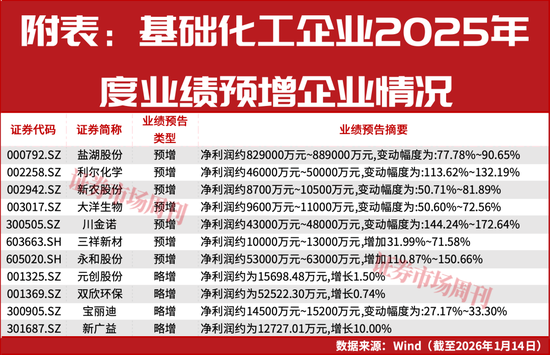
Core Viewpoint - The rebound in potassium and lithium product prices has led to a rapid recovery in the performance of leading companies in the basic chemical sector, with some companies expected to double their earnings by 2025 [1][15]. Group 1: Earnings Forecasts - As of January 14, 2026, 21 basic chemical companies in the A-share market have disclosed their earnings forecasts for 2025, with 11 companies expecting profit growth, indicating a recovery in multiple sub-sectors [1][15]. - Salt Lake Co. (000792.SZ) expects a net profit of approximately 8.29 billion to 8.89 billion yuan, representing a year-on-year increase of 77.78% to 90.65% [2][16]. - Lier Chemical (002258.SZ) and Chuanjin Nuo (300505.SZ) both anticipate a minimum profit growth exceeding 100% [1][16]. Group 2: Sector Performance - The companies with expected profit increases are primarily concentrated in the fertilizer and pesticide sectors, with the fourth quarter of 2025 expected to see strong performance in the phosphate and lithium chemical sectors, driving significant earnings growth [1][3]. - The fertilizer and pesticide index (886007.WI) has seen a year-to-date increase of 49.94%, outperforming the 33.29% increase in the Shenwan Basic Chemicals index [19]. Group 3: Salt Lake Co. Performance - Salt Lake Co. is projected to achieve a net profit of 8.29 billion to 8.89 billion yuan for 2025, with a significant acceleration in profit growth expected in the fourth quarter, driven by rising prices of potassium chloride and lithium carbonate [4][21]. - The company reported a production of approximately 4.9 million tons of potassium chloride and 46,500 tons of lithium carbonate, with prices for potassium chloride and lithium carbonate showing significant year-on-year increases [5][22]. Group 4: Lier Chemical Performance - Lier Chemical expects to achieve an operating income of 8.8 billion to 9.1 billion yuan in 2025, with a net profit forecast of 460 million to 500 million yuan, reflecting a year-on-year increase of 113.62% to 132.19% [9][26]. - The company attributes its earnings growth to increased demand for certain products and an improvement in overall gross margin [26]. Group 5: Chuanjin Nuo Performance - Chuanjin Nuo anticipates a record high in 2025, with expected operating income of 3.8 billion to 4.2 billion yuan and a net profit of approximately 430 million to 480 million yuan, representing a year-on-year increase of 144.24% to 172.64% [12][30]. - The company has focused on optimizing production plans and product structures to enhance profitability [30]. Group 6: Market Trends - The prices of potassium and lithium products are expected to continue rising due to tightening supply and increasing demand, benefiting companies like Salt Lake Co. and Chuanjin Nuo [8][25]. - The average price of industrial-grade lithium carbonate has surged to 158,000 yuan per ton, reflecting a significant increase compared to previous months [25].


亚钾国际(000893):董事会进行换届选举 治理结构有望进一步优化
Xin Lang Cai Jing· 2026-01-18 02:29
Group 1 - The company held its 24th meeting of the 8th Board of Directors on January 13, 2026, approving the election of the 9th non-independent and independent directors, which indicates a smooth transition in management and further optimization of the governance structure [1] - Shareholders Huineng Group and Zhongnong Group nominated candidates for the 9th Board of Directors, with Huineng Group becoming the largest shareholder with a 14.05% stake after acquiring 46.2026 million shares from Zhongnong Group [1] - The election confirms the changes in the company's equity structure and promotes a stable transition in management [1] Group 2 - The company signed a strategic cooperation framework agreement with Zhongnong Holdings, a subsidiary of its major shareholder Zhongnong Group, to enhance shareholder empowerment [2] - Under the agreement, Zhongnong Holdings will handle at least 50% of the company's potassium fertilizer import trade annually, ensuring a stable sales channel and increasing market share in China [2] - The expected daily related transactions with Zhongnong Group and its subsidiaries for 2026 are projected to not exceed 3.12 billion RMB [2] Group 3 - The company forecasts net profits attributable to shareholders of 1.85 billion, 2.85 billion, and 3.55 billion RMB for 2025-2027, representing year-on-year growth of 94.8%, 53.8%, and 24.7% respectively [3] - Based on the closing price on January 13, the corresponding price-to-earnings ratios (PE) are projected to be 25, 16, and 13 times [3] - The company maintains a "recommended" rating based on these projections [3]

三艘外轮“排队”装化肥 莆田边检站智能化通关助推中国化肥出口“加速跑”
Xin Lang Cai Jing· 2026-01-17 11:31
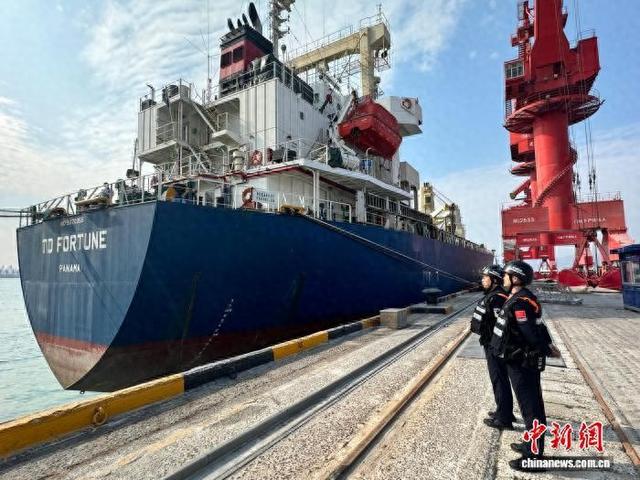
Core Insights - The article highlights the rapid growth of fertilizer exports from China's Xiuyu Port, particularly focusing on ammonium sulfate shipments to international markets, showcasing the port's operational efficiency and strategic importance in the global agricultural supply chain [1][3]. Group 1: Export Volume and Growth - In 2022, the ammonium sulfate throughput at Xiuyu Port reached a record high of 3.4236 million tons, representing a year-on-year increase of 18.89% [3]. - Ammonium sulfate is identified as China's largest nitrogen fertilizer export product, noted for its cost-effectiveness and ability to enhance soil fertility by providing both nitrogen and sulfur [3]. Group 2: Operational Efficiency - The Xiuyu Port has implemented an intelligent port service system, promoting a "one-stop inspection, full-chain service" model, which includes online pre-reporting and pre-inspection measures to streamline operations [3][4]. - The port's logistics efficiency has improved significantly, with logistics costs reduced by over 20% due to direct loading of ammonium sulfate from production facilities to ships, minimizing transfer and handling times [4]. Group 3: Strategic Importance - Xiuyu Port has established shipping routes covering Southeast Asia, South America, Europe, and Africa, positioning itself as a critical node in the global agricultural supply chain [4]. - The port's integration with advanced material enterprises, including a world-class caprolactam factory and the largest nylon polymerization base, enhances its competitive edge in the fertilizer export market [4].
2025年1-11月中国农用氮磷钾化肥(折纯)产量为5922.8万吨 累计增长7.9%
Chan Ye Xin Xi Wang· 2026-01-17 04:00
上市企业:盐湖股份(000792),湖北宜化(000422),云天化(600096),鲁西化工(000830),新洋丰 (000902),史丹利(002588),四川美丰(000731),阳煤化工(600691) 2020-2025年1-11月中国农用氮磷钾化肥(折纯)产量统计图 数据来源:国家统计局,智研咨询整理 知前沿,问智研。智研咨询是中国一流产业咨询机构,十数年持续深耕产业研究领域,提供深度产业研 究报告、商业计划书、可行性研究报告及定制服务等一站式产业咨询服务。专业的角度、品质化的服 务、敏锐的市场洞察力,专注于提供完善的产业解决方案,为您的投资决策赋能。 相关报告:智研咨询发布的《2026-2032年中国化肥行业市场研究分析及前景战略研判报告》 根据国家统计局数据显示:2025年11月中国农用氮磷钾化肥(折纯)产量为552万吨,同比增长5.1%; 2025年1-11月中国农用氮磷钾化肥(折纯)累计产量为5922.8万吨,累计增长7.9%。 ...

史丹利农业集团股份有限公司关于为子公司提供担保的进展公告
Shang Hai Zheng Quan Bao· 2026-01-16 20:56
Group 1 - The company Stanley Agricultural Group Co., Ltd. has announced a guarantee for its subsidiaries, with a total expected guarantee amount not exceeding RMB 760 million for the year 2025 [2] - The company plans to provide a guarantee of up to RMB 300 million for its wholly-owned subsidiary Shandong Huafeng Fertilizer Co., Ltd. and up to RMB 460 million for its controlling subsidiary Songzi Stanley Yihua New Materials Technology Co., Ltd. [2] - The guarantees will be valid for 12 months from the date of approval by the shareholders' meeting and will be provided in the form of joint liability guarantees [2] Group 2 - The company has signed guarantee contracts with China Industrial and Commercial Bank and China Merchants Bank, with the guarantee amount for Songzi Stanley Yihua New Materials Technology Co., Ltd. being RMB 41.075 million [3] - The guarantee for Shandong Huafeng Fertilizer Co., Ltd. has a maximum limit of RMB 100 million, covering principal and related fees [6] - The total external guarantee balance of the company and its subsidiaries is RMB 1.4101665 billion, accounting for 20.67% of the latest audited net assets [6]

ICL Group (ICL) Upgraded to Buy: Here's Why
ZACKS· 2026-01-16 18:00
Core Viewpoint - ICL Group has been upgraded to a Zacks Rank 2 (Buy), indicating a positive outlook on its earnings estimates, which significantly influence stock prices [1][3]. Earnings Estimates and Stock Performance - The Zacks rating system emphasizes the correlation between changes in earnings estimates and stock price movements, suggesting that revisions in earnings estimates are a powerful indicator of future stock performance [4][6]. - ICL Group is projected to earn $0.36 per share for the fiscal year ending December 2025, with no year-over-year change, but the Zacks Consensus Estimate has increased by 11.1% over the past three months [8]. Investment Implications - The upgrade reflects an improvement in ICL Group's underlying business, which is expected to lead to higher stock prices as investors respond positively to the improving business trend [5]. - The Zacks Rank system classifies stocks based on earnings estimates, with only the top 20% of stocks receiving a "Strong Buy" or "Buy" rating, indicating ICL Group's strong position in terms of earnings estimate revisions [9][10].


业内专家重磅解读!新质生产力如何重构化肥行业增长逻辑?
Xin Lang Cai Jing· 2026-01-16 13:38
Core Viewpoint - The "Work Plan for Stable Growth in the Petrochemical Industry (2025-2026)" emphasizes the importance of ensuring fertilizer production and supply stability, optimizing production management, and promoting innovative development of various types of fertilizers [1][5]. Group 1: Nitrogen Fertilizer Industry - The nitrogen fertilizer industry aims to strengthen capacity regulation to ensure supply stability and reasonable profits for enterprises, with projected capacities for synthetic ammonia and urea exceeding 82 million tons and 73 million tons respectively by 2025 [1][5]. - The industry is encouraged to pursue green and low-carbon transformation by reducing energy consumption and carbon emissions, while upgrading to advanced, high-efficiency equipment [1][5]. - The focus on technological innovation is crucial for driving industry upgrades, with an emphasis on clean and efficient gasification and advanced gas purification technologies [2][6]. Group 2: Potassium Fertilizer Industry - The plan highlights the need for overseas resource development, with Chinese companies achieving significant potassium resource discoveries in Laos, totaling approximately 1 billion tons [3][7]. - The potassium fertilizer industry is evolving towards functional products and balanced capacity distribution, integrating services such as soil testing and intelligent logistics [3][7]. - A strategic focus on high-quality development and technological innovation is essential, with an emphasis on coordinating domestic and international markets [3][7]. Group 3: Phosphate Fertilizer Industry - The phosphate fertilizer industry aims to enhance resource utilization and value chain efficiency, focusing on extending, supplementing, and strengthening the industry chain [4][8]. - Emphasis is placed on technological innovation to improve the utilization of by-products and develop green production processes [4][8]. - The industry is encouraged to adopt digital technologies to enhance competitiveness and achieve sustainable development goals [4][8].
高价抵制,尿素高位回落为主
Yin He Qi Huo· 2026-01-16 11:44
Group 1: Report Industry Investment Rating - No relevant content found Group 2: Core Viewpoints of the Report - Last week's view was that due to high - price resistance, urea would fluctuate. This week's view is that with low - price procurement, urea will continue the fluctuating pattern, and external disturbances should be noted. The mainstream ex - factory prices in major regions have remained stable overall since the weekend, with low market sentiment, weak trading, and sporadic orders received by manufacturers. In Shandong, Henan, and delivery areas, ex - factory prices are expected to remain firm. The daily output of domestic urea has rebounded to around 200,000 tons. The Indian tender result is CFR $420 per ton, with a counter - offer of around 960,000 tons, and the impact on the domestic market is limited. The compound fertilizer开工率 in the Central and Northeast regions has increased, and raw material inventory is being replenished at low prices. The procurement intensity of seasonal storage enterprises will gradually slow down. As the ex - factory price rises, downstream resistance emerges, and the ex - factory price will mainly decline. The trading strategy is to go short unilaterally without chasing the short, and to wait and see for arbitrage and over - the - counter trading [3][4] Group 3: Summary by Relevant Catalogs 1. Core Data Changes - Supply: In the 2nd week of 2026 (January 8 - 14), the capacity utilization rate of coal - based urea in China was 94.60%, a 1.54% increase from the previous week; the capacity utilization rate of gas - based urea was 51.35%, a 3.79% increase. In Shandong, the capacity utilization rate was 97.90%, a 1.11% decrease [5] - Demand: In the 3rd week of 2026 (January 9 - 15), the average weekly capacity utilization rate of melamine in China was 62.18%, a 7.83 - percentage - point increase from the previous week. The capacity utilization rate of compound fertilizer was 40.08%, a 2.91 - percentage - point increase. As of January 16, 2026, the urea demand of sample compound fertilizer production enterprises in Linyi, Shandong was 1,380 tons, a 12.66% decrease from the previous week. The arrival volume of urea in the Northeast this week was 95,000 tons, a decrease of 15,000 tons from the previous week. As of January 14, 2026, the pre - order days of Chinese urea enterprises were 6.06 days, a 5.46% decrease from the previous period [5] - Inventory: On January 14, 2026, the total inventory of Chinese urea enterprises was 986,100 tons, a 3.53% decrease from the previous week. As of January 15, 2026, the sample inventory of Chinese urea ports was 134,000 tons, a 4.29% decrease from the previous week [5] - Valuation: The price of Jincheng anthracite lump coal rebounded, the price of Yulin pulverized coal was stable, the spot price of urea increased, and the production profit of urea expanded. The fixed - bed production profit was 70 yuan per ton, the water - coal - slurry production profit was 150 yuan per ton, and the entrained - flow bed production profit was 390 yuan per ton. The futures rebounded, the basis was around - 80 yuan per ton, and the 5 - 9 spread was 28 yuan per ton [5]