
房地产

Search documents
十大宏观趋势分析报告
Sou Hu Cai Jing· 2026-02-26 12:31
Group 1 - The core viewpoint of the report is that China's economy will continue to experience "reparative growth" in 2026, with the real estate sector being a key variable affecting the overall economic landscape [2][13][26] - The real estate cycle is defined as an "L-shaped" bottoming phase, indicating that it will neither continue to decline deeply nor experience a V-shaped recovery, but will stabilize gradually [2][26] - The report emphasizes that real estate is no longer the primary driver of economic growth, with a shift in policy focus towards a "new development model" that includes affordable housing construction and urban renewal [2][26] Group 2 - Inflation is expected to rise moderately, with nominal GDP growth projected to rebound from 4% in 2025 to 5% in 2026, which is crucial for improving corporate profits and household incomes [3][30][38] - The report notes that the prolonged period of low inflation has pressured corporate profit margins, leading to a perception that earning money has become increasingly difficult [3][30] - The anticipated recovery in inflation is expected to be driven by stable food prices and a rebound in core service consumption, which will positively impact nominal GDP growth [3][30][38] Group 3 - Fiscal policy is expected to become more proactive, shifting from large-scale stimulus to optimizing expenditure structures, focusing on supporting livelihoods and technology rather than traditional infrastructure [4][13][26] - The report predicts that the fiscal deficit rate may remain high, around 4%, but emphasizes the importance of where the funds are allocated [4][15][26] - There is a notable shift in fiscal spending towards social security, employment, and technology, indicating a focus on long-term competitiveness and addressing demographic challenges [4][15][26] Group 4 - The consumption engine is transitioning from goods consumption to service consumption, with an expected increase in the household consumption rate [5][14][26] - In 2025, the "trade-in" policy for appliances and automobiles was a major driver of consumption, but by 2026, service consumption is expected to take over, supported by increased transfer income and improved nominal GDP [5][14][26] - The report highlights that young families, with higher marginal consumption tendencies, will particularly drive growth in service sectors such as dining, tourism, and healthcare [5][14][26] Group 5 - Investment growth is expected to stabilize and rebound, with a narrowing decline in real estate development investment, while manufacturing and infrastructure investments will act as stabilizers [6][14][26] - The report notes that fixed asset investment experienced negative growth in 2025, but factors such as relaxed housing policies in first-tier cities and increased fiscal support for investment may lead to a turnaround in 2026 [6][14][26] - Predictions indicate a 10% decline in real estate development investment, while manufacturing and infrastructure investments are expected to grow by 5%, leading to an overall fixed asset investment growth of around 2% [6][14][26] Group 6 - The transition from old to new economic drivers is accelerating, with capital expenditure in "new economy" sectors like artificial intelligence replacing traditional real estate and infrastructure investments [7][14][26] - The report confirms this shift through macro-level data and micro-level corporate spending, indicating that technology firms are maintaining high growth in capital expenditure while real estate companies are contracting [7][14][26] - This "temperature difference" in capital allocation reveals the core drivers of future growth, emphasizing the need for technological innovation and equipment upgrades rather than reliance on traditional construction [7][14][26] Group 7 - The global liquidity environment is expected to remain accommodative, with both the Federal Reserve and the People's Bank of China likely to pursue easing measures [8][15][26] - The report suggests that if financial markets face pressure, the Federal Reserve will likely inject liquidity again, while China may also implement a reserve requirement ratio cut and interest rate reduction in 2026 [8][15][26] - This "loose monetary" environment is seen as a crucial support for stock markets and resource performance [8][15][26] Group 8 - The US dollar is expected to maintain a strong position, while the Chinese yuan may appreciate further, driven by internal and external economic rebalancing [9][15][26] - The report explains that the strong fundamentals of the US economy compared to Europe and Japan support a strong dollar, while easing trade tensions between China and the US may increase demand for the yuan [9][15][26] - The appreciation of the yuan is viewed as a reflection of China's shift from external demand reliance to internal-driven growth, which will attract international capital inflows [9][15][26] Group 9 - A-shares are seen as having more favorable opportunities compared to bonds, with a "slow bull" market foundation remaining solid [10][15][26] - The report highlights that the friendly policy environment and rising inflation will benefit corporate profit recovery, while rising bond yields will enhance the relative attractiveness of stocks [10][15][26] - The re-evaluation of technology assets, particularly in AI, and the expectation of re-inflation are expected to guide the recovery of traditional economic fundamentals [10][15][26] Group 10 - Resource commodities, especially precious and non-ferrous metals, are expected to see their strategic value continue to rise, facing long-term opportunities [11][15][26] - The report identifies three key factors: the favorable impact of a global loose monetary environment on commodity prices, increased demand for non-ferrous metals driven by the AI revolution and high-end manufacturing, and the geopolitical uncertainties leading to a "security premium" for critical minerals [11][15][26] - Particularly for gold, the report suggests that its status as a reserve asset is returning, with prices likely to rise in the context of loose monetary policy and high debt levels [11][15][26]


博时市场点评2月26日:指数小幅震荡,通信行业涨幅领先
Xin Lang Cai Jing· 2026-02-26 11:37
Market Overview - The three major indices in the A-share market showed mixed results, with trading volume slightly increasing compared to the previous day [6] - The communication sector led the gains among the Shenwan first-level industries, with a rise of 2.84% [6] Currency Impact - The offshore RMB to USD exchange rate broke 6.84, while the onshore rate surpassed 6.87, both reaching new highs since April 2023 [1] - The appreciation of the RMB is attributed to a decline in external USD credit and a weakening USD index, supported by the resilience of China's economic fundamentals [1] - The strong performance of the RMB enhances the attractiveness of RMB-denominated assets, potentially increasing foreign capital inflows and improving overall market risk appetite [1] Real Estate Policy Changes - Shanghai's new real estate policy, known as "沪七条," significantly relaxes purchase restrictions and housing fund policies, including reducing the social security requirement for non-local residents from 3 years to 1 year [2] - The maximum loan amount for first-time homebuyers using housing funds has been raised from 1.6 million to 2.4 million RMB, with potential increases up to 3.24 million RMB [2] - This policy aims to lower the entry barriers for new residents and is expected to boost market sentiment, particularly in the real estate sector, which is crucial for stabilizing fixed asset investment and consumer confidence [2] Nvidia's Financial Performance - Nvidia reported Q4 revenue of $68.127 billion, a 73% year-over-year increase, with net profit rising 94% to $42.96 billion [3][10] - The data center business generated $62 billion in revenue, accounting for 91% of total revenue, and grew 75% year-over-year [10] - CEO Jensen Huang emphasized the "Inference Equals Revenue" concept, indicating that AI capabilities are transitioning from training to inference, which clarifies the business model and addresses concerns about the sustainability of AI capital expenditures [11] Lithium Supply Disruption - Zimbabwe announced a suspension of all lithium ore and concentrate exports, which is expected to exacerbate the short-term supply tightness of lithium for China, as approximately 19% of China's lithium concentrate imports come from Zimbabwe [4][12] - This export ban is likely to increase procurement costs and uncertainty for domestic lithium salt manufacturers, reinforcing the price increase logic in the lithium sector [12]

浙商证券浙商早知道-20260226
ZHESHANG SECURITIES· 2026-02-26 11:25
Market Overview - On February 26, the Shanghai Composite Index fell by 0.01%, the CSI 300 decreased by 0.19%, the STAR Market 50 rose by 0.85%, the CSI 1000 increased by 0.76%, the ChiNext Index dropped by 0.29%, and the Hang Seng Index declined by 1.44% [3][4] - The best-performing sectors on February 26 were telecommunications (+2.84%), electronics (+1.98%), defense and military (+1.52%), machinery and equipment (+1.41%), and steel (+1.33%). The worst-performing sectors were real estate (-2.25%), media (-1.45%), non-bank financials (-1.42%), retail (-1.22%), and food and beverage (-1.2%) [3][4] - The total trading volume for the A-share market on February 26 was 25,566 billion yuan, with a net outflow of 7.366 billion HKD from southbound funds [3][4] Important Insights - The report focuses on the fixed income credit bond market, analyzing the pricing dynamics around the Chinese New Year. Historical trends show a pattern of "rising before the festival, followed by divergence afterward," characterized by three phases: loose trading, expectation adjustments, and the establishment of macro themes [5] - The institutional buying patterns across the festival period indicate that insurance companies maintained stable net purchases, while funds followed market trends. Major banks increased net selling after the festival, and smaller banks and wealth management products are expected to see concentrated allocation windows post-festival [5] - The report highlights that the pricing power in the bond market is shifting from the allocation of institutional investors to trading dynamics as the festival approaches. Notable characteristics include major banks focusing on purchasing 7-10 year government bonds, while smaller banks tend to buy in the first half and sell in the second half of the period [5][6]
从“拥有”到“体验”:为什么经济越差,旅游反而越火?
3 6 Ke· 2026-02-26 11:00
Group 1 - The core viewpoint of the articles highlights a significant shift in consumer behavior in China, where high savings rates coexist with a booming tourism market, indicating a preference for experiential spending over traditional asset ownership [2][9]. - The phenomenon of "lipstick effect" is evident, where consumers are opting for smaller, emotionally satisfying purchases during economic downturns, leading to record-high domestic travel expenditures during the Spring Festival [2][4]. - The younger generation, particularly Generation Z, is driving a transformation in consumption patterns, prioritizing experiences and emotional value over material possessions, which reflects a broader societal shift from ownership to experience [5][10]. Group 2 - The tourism industry is facing structural challenges, including oversupply and seasonal demand fluctuations, as evidenced by drastic price drops in accommodation following peak seasons [7][8]. - There is a growing emphasis on emotional consumption, with consumers seeking experiences that provide psychological relief, which is reshaping the tourism landscape [4][6]. - The need for innovation in service offerings is critical, as the market becomes saturated with similar experiences, necessitating differentiation to maintain pricing power and consumer interest [8][9].
每日投行/机构观点梳理(2026-02-26)
Jin Shi Shu Ju· 2026-02-26 10:27
Group 1 - Bank of America predicts gold prices may reach $6,000 per ounce within the next 12 months, while silver prices could exceed $100 per ounce again this year despite current demand concerns from solar panel manufacturers [1] - Citigroup analysts indicate that emerging markets are expected to be the most favored trading markets this year, with major asset management firms investing in emerging market stocks and bonds, betting on strong global economic growth and a weaker dollar [1] - ING suggests that investors looking to avoid volatility in the U.S. stock market due to AI developments may find European government bonds attractive, as they offer relatively stable yields amid rising U.S. market volatility [1] Group 2 - JPMorgan forecasts that the Bank of Thailand will maintain its policy interest rate at 1% until 2027 to preserve policy space amid rising uncertainties, with the Thai economy expected to accelerate further due to political stability post-election [2] - CITIC Securities reports that Zimbabwe's ban on lithium exports is likely to lead to a significant increase in lithium prices, as the country is projected to account for 12% of global lithium resource output by 2026 [3] - Huatai Securities notes that the U.S. designation of phosphate-based agricultural inputs as strategic resources could impact market prices, particularly if demand increases due to supply stability concerns [3] Group 3 - CITIC Securities believes that the non-ferrous metals bull market is far from over, suggesting that investors should hold positions but avoid blindly chasing prices, with opportunities arising during market corrections [4][5] - CICC reports that recent policy adjustments in Shanghai may help stabilize housing prices in key cities, as the supply-demand structure shows positive changes [5][6] - Galaxy Securities indicates that the real estate industry may see overall valuation recovery as housing demand is expected to be released, leading to a healthier market development [6][7]




新鸿基地产(00016)将于3月19日派发中期股息每股0.98港元
智通财经网· 2026-02-26 08:46
智通财经APP讯,新鸿基地产(00016)发布公告,将于2026年3月19日派发截至2025年12月31日止六个月 的中期股息每股0.98港元。 ...

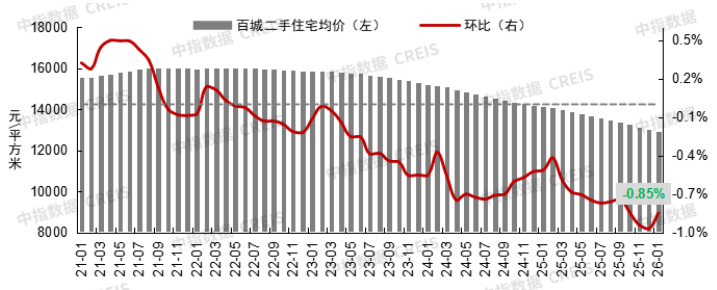
中指研究院:2026年1月全国百城二手住宅均价环比下跌0.85%
智通财经网· 2026-02-26 08:46
Summary of Key Points Core Viewpoint - The real estate market in China is experiencing a decline in second-hand residential prices across major cities, with a national average price of 12,905 yuan per square meter in January 2026, reflecting a month-on-month decrease of 0.85% and a year-on-year decrease of 8.67% [1]. Group 1: Second-Hand Residential Market - The average price of second-hand residential properties in first-tier, second-tier, and third/fourth-tier cities has decreased by 1.14%, 0.87%, and 0.73% month-on-month, respectively, with year-on-year declines of 7.64%, 9.34%, and 8.43% [1]. - In January, Beijing saw a transaction volume of 15,000 units, down 12.3% month-on-month but up 20.8% year-on-year due to the impact of the previous year's holiday [3]. - Shanghai's second-hand residential transactions reached approximately 20,000 units, with a month-on-month increase of 0.9% and a year-on-year increase of 27.5%, while prices fell by 1.22% month-on-month and 7.61% year-on-year [3]. - Guangzhou's second-hand residential prices decreased by 1.04% month-on-month and 9.04% year-on-year, indicating ongoing market pressure [3]. Group 2: New Residential Market - The average price of new residential properties across 100 cities is 17,114 yuan per square meter, reflecting a month-on-month increase of 0.18% and a year-on-year increase of 2.52% [6]. - High-end improvement projects in cities like Chengdu, Shanghai, and Hangzhou have contributed to a structural increase in new home prices [6]. Group 3: Rental Market - The average rental price for residential properties in 50 cities is 34.00 yuan per square meter per month, showing a month-on-month decrease of 0.45% and a year-on-year decrease of 3.67% [6]. Group 4: Transaction Volume and Year-on-Year Changes - Notable year-on-year transaction increases were observed in cities such as Shaoxing (46.9%), Wuxi (45.4%), and Ningbo (43.6%) [7][8]. - Conversely, cities like Chengdu (-11.3%), Suzhou (-19.4%), and Wenzhou (-21.9%) experienced significant declines in transaction volumes [9].
中国奥园(03883)根据强制性可转换债券的转换而发行59.23万股
智通财经网· 2026-02-26 08:39
智通财经APP讯,中国奥园(03883)发布公告,于2026年2月9日-2026年2月24日根据2024年3月20日发行 的2028年到期强制性可转换债券的转换而发行59.23万股新股份。 ...
太平洋房地产日报:上海出台楼市新政
Xin Lang Cai Jing· 2026-02-26 08:34
Market Performance - On February 25, 2026, the equity market saw most sectors rise, with the Shanghai Composite Index and Shenzhen Composite Index increasing by 0.72% and 1.21% respectively, while the CSI 300 and CSI 500 rose by 0.60% and 1.60% respectively [1] Individual Stock Performance - The top five gainers in the real estate sector were Huangting International, I Love My Home, Hualian Holdings, City Investment Holdings, and Zhujiang Shares, with increases of 10.05%, 10.03%, 9.96%, 9.96%, and 6.77% respectively [2] - The largest decliners included Hefei Urban Construction, Sanxiang Impression, Ningbo Fuda, Jinqiao B Share, and Haitai Development, with declines of -5.33%, -1.52%, -1.13%, -0.53%, and -0.45% respectively [2] Industry News - On February 25, 2026, five departments in Shanghai announced a reduction in housing purchase restrictions, effective February 26, 2026. Non-Shanghai residents can now purchase homes in the outer ring with a social security or tax payment history of just 1 year, and those with 3 years can buy an additional property [3] - The maximum housing provident fund loan for first-time homebuyers has been increased from 1.6 million yuan to 2.4 million yuan. Additionally, families with multiple children can receive a 20% increase in the maximum loan amount for purchasing a second home [3] - From January 1, 2026, adult children of local residents purchasing their only home will be exempt from personal housing property tax [4] Company Announcements - China Overseas Macro Real Estate Group announced that the buyback registration period for "23 Hongyang 02" bonds is from March 2 to March 9, 2026, with the repayment date set for April 3, 2026 [6] - Poly Real Estate Group announced the early delisting of "23 Baozhi 01" bonds, with a total buyback amount of 1 billion yuan. The bonds will be canceled due to this buyback [6]



ETF收评 | AI硬件股全线领涨,中韩半导体ETF逼近涨停
Ge Long Hui· 2026-02-26 07:37
Market Performance - The three major A-share indices showed mixed results, with the Shanghai Composite Index down 0.01%, the Shenzhen Component Index up 0.19%, and the ChiNext Index down 0.29% [1] - The total trading volume in the Shanghai, Shenzhen, and Beijing markets reached 25,566 billion yuan, an increase of 757 billion yuan compared to the previous day, with over 2,400 stocks rising [1] Sector Performance - Leading sectors included CPO, copper cable high-speed connections, optical fibers, PCBs, liquid-cooled servers, wind power equipment, aviation engines, cultivated diamonds, semiconductors, and sugar substitute concepts, which saw significant gains [1] - Underperforming sectors included film and television, insurance, real estate, short drama games, complete automobiles, precious metals, duty-free shops, liquor, and retail, which experienced notable declines [1] ETF Performance - AI hardware stocks led the gains, with the China-Korea Semiconductor ETF nearing a limit-up, while various communication ETFs saw increases of 3.41%, 2.78%, 2.58%, and 2.54% [1] - The electric grid sector also performed well, with the electric grid ETF and electric grid equipment ETF rising by 3.23% and 2.91%, respectively [1] - The medical sector faced declines, with the Hang Seng Medical ETF and other related ETFs dropping over 3%, while the real estate ETF fell by 3% [1]