焦炭

Search documents
广发期货日评-20250819
Guang Fa Qi Huo· 2025-08-19 05:29
1. Report Industry Investment Ratings No industry - wide investment ratings are provided in the report. 2. Core Views - The second - round China - US trade talks extended the tariff exemption clause, and the Politburo meeting's policy tone was consistent with the previous one. The TMT sector rose strongly, and the stock index increased with heavy trading volume. However, the improvement in corporate earnings needs to be verified by the upcoming mid - year report data [2]. - Multiple negative factors such as the central bank's mention of "preventing idle funds from circulating" in the second - quarter monetary policy report, the strong performance of the stock market, and the tightening of funds during the tax payment period led to a significant decline in bond futures. The bond market sentiment remains weak [2]. - The meeting of US, Ukrainian, and European leaders brought hope for easing the Russia - Ukraine conflict, which increased risk appetite and caused precious metals to rise and then fall. Gold and silver prices are in a range - bound state [2]. - The container shipping index (European line) is in a weak and volatile state, and the short position of the October contract should be continued to hold [2]. - Steel prices are supported due to limited inventory accumulation in steel mills and upcoming production restrictions. Iron ore follows the price fluctuations of steel, while some coal prices are showing signs of weakness [2]. - The prices of non - ferrous metals such as copper, aluminum, and zinc are in a narrow - range or weak - range fluctuation, and different trading strategies are recommended for each metal [2]. - The energy and chemical sectors show different trends. Some products are in a range - bound state, while others are facing supply - demand pressures and are recommended for short - selling or other strategies [2]. - In the agricultural products sector, different products have different trends, such as the upward trend of palm oil and the weakening trend of corn [2]. - Special commodities like glass are in a weak state, and new energy products such as polysilicon and lithium carbonate need to pay attention to policy and supply - related factors [2]. 3. Summary by Relevant Catalogs Financial - **Stock Index**: The stock index rose with heavy volume, but the improvement in earnings needs mid - year report data verification. It is recommended to sell put options on MO2509 with an exercise price around 6600 at high prices and have a moderately bullish view [2]. - **Treasury Bonds**: Multiple negative factors led to a decline in bond futures. The bond market is in an unfavorable situation, and it is recommended to stay on the sidelines in the short term [2]. - **Precious Metals**: Gold is recommended to build a bullish spread strategy through call options at the low - price stage after price corrections. Silver is recommended to maintain a low - buying strategy or build a bullish spread strategy with options [2]. Black - **Steel**: Steel prices are supported due to limited inventory accumulation in steel mills and upcoming production restrictions. The 10 - month contracts of hot - rolled coils and rebar should pay attention to the support levels of 3400 yuan and 3200 yuan respectively [2]. - **Iron Ore**: The shipping volume increased, and the port inventory and port clearance improved. It follows the price fluctuations of steel, and it is recommended to short at high prices [2]. - **Coking Coal**: After the exchange's intervention, the futures price peaked and declined, and some coal prices weakened. It is recommended to short at high prices [2]. - **Coke**: The sixth - round price increase of mainstream coking plants has been implemented, and the seventh - round price increase is in progress. It is recommended to short at high prices [2]. Non - ferrous - **Copper**: The main contract fluctuates within the range of 78000 - 79500 yuan [2]. - **Aluminum Oxide**: The main contract fluctuates within the range of 3000 - 3300 yuan [2]. - **Aluminum**: The price fluctuated downward due to the additional tariff on aluminum. The main contract should pay attention to the pressure level of 21000 yuan and fluctuates within the range of 20000 - 21000 yuan [2]. - **Zinc**: The main contract fluctuates within the range of 22000 - 23000 yuan [2]. - **Tin**: It is recommended to wait and see, paying attention to the import situation of Burmese tin ore [2]. - **Nickel**: The main contract fluctuates within the range of 118000 - 126000 yuan [2]. - **Stainless Steel**: The main contract fluctuates in a narrow range, with cost support but demand drag, and fluctuates within the range of 12800 - 13500 yuan [2]. Energy and Chemical - **Crude Oil**: The short - term geopolitical risk is the main factor. It is recommended to stay on the sidelines for single - side trading and expand the spread between the October - November/December contracts. The support levels for WTI, Brent, and SC are given [2]. - **Urea**: The Indian tender news has a certain boost to the market. If there are no more positive factors after the price rebound, it is recommended to short at high prices [2]. - **PX**: The supply - demand pressure is not significant, and the demand is expected to improve. It is recommended to go long at the lower end of the 6600 - 6900 range and expand the PX - SC spread at a low level [2]. - **PTA**: The processing fee is low, and the cost support is limited. It is recommended to go long at the lower end of the 4600 - 4800 range and conduct a reverse spread operation on TA1 - 5 at high prices [2]. - **Short - fiber**: The supply - demand situation is expected to improve, but there is no obvious short - term driver. It is recommended to try to go long at the lower end of the 6300 - 6500 range [2]. - **Bottle - grade PET**: The production reduction effect is obvious, and the inventory is slowly decreasing. It is recommended to go long on the processing fee at a low price [2]. - **Ethanol**: The supply of MEG is gradually returning, and it is expected to follow the fluctuations of commodities. It is in the range of 4300 - 4500 yuan [2]. - **Caustic Soda**: The main downstream buyers are purchasing well, and the spot price is stable. It is recommended to wait and see [2]. - **PVC**: The supply - demand pressure is still high, and it is recommended to take a short - selling approach [2]. - **Benzene**: The supply - demand expectation has improved, but the driving force is limited due to high inventory. It follows the fluctuations of oil prices and styrene [2]. - **Styrene**: The supply - demand situation has marginally improved, but the cost support is limited. It is recommended to short on rebounds within the 7200 - 7400 range [2]. - **Synthetic Rubber**: The cost is in a range - bound state, and the supply - demand is loose. It is recommended to hold the seller position of the short - term put option BR2509 - P - 11400 [2]. - **LLDPE**: The basis remains stable, and the trading volume is acceptable. It is in a short - term volatile state [2]. - **PP**: The spot price has little change, and the trading volume has weakened. It is recommended to take profit on the short position in the 7200 - 7300 range [2]. - **Methanol**: The inventory is continuously tightening, and the price is weakening. It is recommended to conduct range - bound operations within 2350 - 2550 [2]. Agricultural Products - **Soybeans and Related Products**: The cost support is strong, and a long - term bullish expectation remains. It is recommended to arrange long positions for the January contract [2]. - **Pigs**: The spot price is in a low - level volatile state, and attention should be paid to the rhythm of production release [2]. - **Corn**: The supply pressure is emerging, and the futures price is in a weak state. It is recommended to short at high prices [2]. - **Palm Oil**: The Malaysian palm oil price is rising, and the domestic palm oil price is following the upward trend. It is expected to reach the 10000 - yuan mark in the short term [2]. - **Sugar**: The overseas supply outlook is loose. It is recommended to reduce the short position established at the previous high price [2]. - **Cotton**: The downstream market is weak. It is recommended to reduce the short position [2]. - **Eggs**: The spot price is weak. It is bearish in the long - term [2]. - **Apples**: The sales are slow. Attention should be paid to the price trend of early - maturing apples. The main contract is around 8250 [2]. - **Jujubes**: The price is stable. It is recommended to be cautious when chasing high prices and focus on short - term trading [2]. - **Soda Ash**: The supply is at a high level, and the fundamentals are weakening. It is recommended to try short - selling at high prices [2]. Special Commodities - **Glass**: The industry is in a negative feedback cycle, and the futures price is weak. It is recommended to hold the short position [2]. - **Rubber**: Attention should be paid to the raw material price increase during the peak production period [2]. - **Industrial Silicon**: Attention should be paid to the change in production capacity [2]. New Energy - **Polysilicon**: Attention should be paid to the change in policy expectations [2]. - **Lithium Carbonate**: The supply is subject to continuous disturbances, and the fundamentals are marginally improving. It is recommended to be cautious and try to go long with a light position at a low price [2].
《黑色》日报-20250819
Guang Fa Qi Huo· 2025-08-19 03:00
1. Investment Rating No investment rating for the industry is provided in the reports. 2. Core Views Steel - Recently, rebar production increased and inventory accumulated while apparent demand declined. The rebar basis weakened, but the hot-rolled coil basis was relatively strong. In the medium term, steel mill production remains high, and demand seasonally declines in August, leading to inventory increases. There is an expectation of production cuts in mid - to late August. In the short term, steel mill inventory pressure is not significant, and production cuts can relieve the pressure on the peak season from high production and trader inventory. Steel prices are expected to remain in high - level oscillations, and the market needs to wait for clear peak - season demand. Support levels for hot - rolled coil and rebar are around 3400 yuan/ton and 3150 yuan/ton respectively [1]. Iron Ore - The iron ore 2601 contract showed a volatile downward trend. Fundamentally, global iron ore shipments increased significantly month - on - month, and the arrival volume at 45 ports decreased. Based on recent shipment data, the subsequent average arrival volume is expected to rebound. On the demand side, steel mill profit margins are at a relatively high level, the amount of maintenance decreased slightly, and hot metal production increased slightly at a high level, remaining around 240 million tons per day. However, downstream apparent demand decreased month - on - month. In terms of inventory, port inventory increased slightly, the port clearance volume decreased month - on - month, and steel mill equity ore inventory increased month - on - month. Considering production cuts by Hebei steel mills in the second half of the month, hot metal production in August is expected to decline slightly at a high level, with an average of around 236 million tons per day. Steel mill profits support raw materials, and there is a seesaw effect between coking coal and iron ore. Due to the off - season and weakening steel apparent demand, recent finished steel prices fell again, and iron ore followed suit. It is recommended to short at high prices [3]. Coke - The coke futures showed a volatile downward trend, and prices fluctuated sharply recently. The sixth round of price increases was implemented, and the seventh round started on the 19th. On the supply side, due to the implementation of price increases, coking profits improved, and coke enterprise operations increased slightly. On the demand side, blast furnace hot metal fluctuated at a high level, and downstream demand remained resilient. It is expected that hot metal production will decline slightly in August. In terms of inventory, coking plant inventory continued to decrease, port inventory decreased slightly, and steel mill inventory decreased. Overall inventory is at a medium level. Due to tight supply and demand, downstream steel mills still have restocking needs, and there is still an expectation for the seventh round of coke price increases. Coke futures are at a premium to the spot, providing hedging opportunities [5]. Coking Coal - The coking coal futures showed a volatile downward trend, and prices fluctuated sharply recently. Spot auction prices for some coal types loosened, and Mongolian coal quotes were weakly stable. Domestic coking coal auctions weakened, and after a rapid price increase, downstream purchasing willingness declined, with some coal types experiencing price drops, but overall it remained stable. On the supply side, coal mine operations decreased month - on - month, shipments slowed down, and coal mines started to slightly reduce prices to make concessions, easing market supply and demand. Coal mine de - stocking slowed down significantly. In terms of imports, Mongolian coal prices fluctuated with futures, and due to high prices, downstream users were cautious about restocking. On the demand side, coking operations increased slightly, blast furnace hot metal production fluctuated at a high level, and downstream restocking demand slowed down. Considering production cuts by Hebei steel mills before the parade, hot metal production in August may decline to around 236 million tons per day. In terms of inventory, coal mine de - stocking slowed down, port inventory at the border increased slightly, port inventory decreased, and downstream restocking demand weakened. Overall inventory is at a medium level [5]. 3. Summary by Directory Steel Steel Prices and Spreads - Rebar and hot - rolled coil spot and futures prices generally declined. For example, rebar spot prices in East China, North China, and South China decreased by 10 - 20 yuan/ton, and futures prices decreased by 32 - 34 yuan/ton. Hot - rolled coil spot prices in different regions decreased by 10 yuan/ton, and futures prices decreased by 19 - 20 yuan/ton [1]. Cost and Profit - Steel billet prices decreased by 10 yuan/ton, and plate billet prices remained unchanged. The cost of Jiangsu electric - arc furnace rebar decreased by 1 yuan, and the cost of converter rebar increased by 5 yuan. Profits for hot - rolled coil in different regions showed different changes, with East China increasing by 13 yuan, North China decreasing by 7 yuan, and South China increasing by 3 yuan. Rebar profits in different regions also had different trends [1]. Production and Inventory - Daily average hot metal production increased by 0.2 to 240.7 million tons, a 0.1% increase. The production of five major steel products increased by 2.4 to 871.6 million tons, a 0.3% increase. Rebar production decreased by 0.7 to 220.5 million tons, a 0.3% decrease. Hot - rolled coil production increased by 0.7 to 315.6 million tons, a 0.2% increase. The inventory of five major steel products increased by 40.6 to 1416.0 million tons, a 3.0% increase. Rebar inventory increased by 30.5 to 587.2 million tons, a 5.5% increase. Hot - rolled coil inventory increased by 0.8 to 357.5 million tons, a 0.2% increase [1]. Iron Ore Prices and Spreads - The warehouse receipt costs of various iron ore types decreased slightly, and the 01 - contract basis of various iron ore types increased significantly. The 5 - 9 spread decreased by 3.5 to - 40.0, a 9.6% decrease, the 9 - 1 spread increased by 2.0 to 18.0, a 12.5% increase, and the 1 - 5 spread increased by 1.5 to 22.0, a 7.3% increase [3]. Supply and Demand - Weekly global iron ore shipments increased by 359.9 to 3406.6 million tons, an 11.8% increase. The weekly arrival volume at 45 ports increased by 94.7 to 2476.6 million tons, a 4.0% increase. The monthly national iron ore import volume increased by 782.0 to 10594.8 million tons, an 8.0% increase. The weekly average hot metal production of 247 steel mills increased by 0.3 to 240.7 million tons, a 0.1% increase. The weekly average port clearance volume at 45 ports increased by 12.8 to 334.7 million tons, a 4.0% increase. The monthly national pig iron production decreased by 110.5 to 7080.0 million tons, a 1.5% decrease, and the monthly national crude steel production decreased by 352.4 to 7966.0 million tons, a 4.2% decrease [3]. Inventory - The 45 - port inventory increased by 13.2 to 13819.27 million tons, a 0.1% increase. The imported ore inventory of 247 steel mills increased by 123.1 to 9136.4 million tons, a 1.4% increase. The inventory available days of 64 steel mills increased by 1.0 to 21.0 days, a 5.0% increase [3]. Coke and Coking Coal Prices and Spreads - Coke futures prices declined. The 09 - contract of coke decreased by 1.1%, and the 01 - contract decreased by 1.6%. The 09 - contract of coking coal decreased by 4.2%, and the 01 - contract decreased by 3.5%. The basis of coke and coking coal contracts changed, and spreads between different contracts also changed [5]. Supply and Demand - Coke production: The daily average production of all - sample coking plants increased by 0.3 to 65.4 million tons, a 0.4% increase, and the daily average production of 247 steel mills increased by 0.3 to 240.7 million tons, a 0.1% increase. Coking coal production: Raw coal production decreased by 2.3 to 856.6 million tons, a 0.3% decrease, and clean coal production increased by 0.4 to 439.4 million tons, a 0.14% increase. Coke demand: The hot metal production of 247 steel mills increased by 0.3 to 240.7 million tons, a 0.1% increase [5]. Inventory - Coke inventory: Total coke inventory decreased by 19.7 to 887.4 million tons, a 2.2% decrease. The inventory of all - sample coking plants decreased by 7.2 to 62.5 million tons, a 10.4% decrease, the inventory of 247 steel mills decreased by 9.5 to 609.8 million tons, a 1.54% decrease, and port inventory decreased by 3.0 to 215.1 million tons, a 1.4% decrease. Coking coal inventory: The clean coal inventory of Fenwei coal mines decreased by 0.2 to 111.9 million tons, a 0.1% decrease, the coking coal inventory of all - sample coking plants decreased by 11.0 to 976.9 million tons, a 1.1% decrease, the coking coal inventory of 247 steel mills decreased by 2.9 to 805.8 million tons, a 0.4% decrease, and port inventory decreased by 21.9 to 255.5 million tons, a 7.9% decrease [5].
上半年亏损近5亿元,渭南首富李保平距离“黎明”还有多久?
3 6 Ke· 2025-08-18 12:12
Core Viewpoint - Shaanxi Black Cat continues to face significant financial losses, with projections indicating a net loss of 4.9 to 5.4 billion yuan for the first half of 2025, compared to a loss of 4.456 billion yuan in the same period last year [1] Financial Performance - In Q1 2025, Shaanxi Black Cat reported an operating income of 25.85 billion yuan, a year-on-year decline of 37.31%, and a net profit loss of 2.616 billion yuan, down 23.21% year-on-year [1] - The company’s 2023 net profit was -5.12 billion yuan, and in 2024, revenue fell by 21.58%, with net losses expanding to 11.58 billion yuan, marking the largest annual loss since its listing [1][2] - The average prices for key products in Q2 2025 showed significant declines: coke at 1221.76 yuan/ton (down 27.72%), coal tar at 2926.33 yuan/ton (down 25.32%), and crude benzene at 4269.13 yuan/ton (down 34.82%) [1] Company Background - Established in 2003, Shaanxi Black Cat is primarily engaged in coal coking and chemical product production, with key products including coke, methanol, crude benzene, and coal tar [2] - The company went public in 2014 and was once a leading player in the coking industry, achieving revenues of 18.9 billion yuan and net profits exceeding 1.5 billion yuan in 2021 [4][5] Market Dynamics - The coking industry has been adversely affected by falling coke prices, reduced steel production capacity, and declining demand, leading to a significant drop in profitability [11] - As of early 2024, coke prices had fallen over 30% from their peak in 2021, with capacity utilization rates remaining low at 60-70% [11] Strategic Developments - Shaanxi Black Cat has been expanding its operations, including a major coal chemical project in Xinjiang with an investment of 39.6 billion yuan, but these projects have not yet been completed [6][7] - The company is shifting focus towards by-products, with a reported 24.05% of revenue coming from by-products in 2024, although this is insufficient to offset the decline in core business [8] Future Outlook - Recent trends indicate a potential recovery in coal prices, with futures prices for coke doubling from 709 to 1328 points [12] - However, concerns remain regarding the sustainability of this price increase, as the steel market is expected to face declining demand in 2025, which may further impact the coking coal market [13][14]
焦炭板块8月18日涨0.16%,安泰集团领涨,主力资金净流出1217.45万元
Zheng Xing Xing Ye Ri Bao· 2025-08-18 08:45
Core Insights - The coke sector experienced a slight increase of 0.16% on August 18, with Antai Group leading the gains [1] - The Shanghai Composite Index closed at 3728.03, up 0.85%, while the Shenzhen Component Index closed at 11835.57, up 1.73% [1] Stock Performance - Antai Group (600408) closed at 2.23, with a rise of 1.36% and a trading volume of 261,600 shares, amounting to a transaction value of 58.28 million yuan [1] - Yunwei Co. (600725) closed at 3.33, up 0.91%, with a trading volume of 210,900 shares and a transaction value of 70.38 million yuan [1] - Meijin Energy (000723) closed at 4.62, increasing by 0.65%, with a trading volume of 694,800 shares and a transaction value of 322 million yuan [1] - Baotailong (601011) remained unchanged at 2.74, with a trading volume of 321,400 shares and a transaction value of 88.28 million yuan [1] - Shaanxi Heimao (601015) also remained unchanged at 3.57, with a trading volume of 242,000 shares and a transaction value of 87.06 million yuan [1] - Yunmei Energy (600792) closed at 3.74, down 0.27%, with a trading volume of 192,400 shares and a transaction value of 72.01 million yuan [1] - Shanxi Coking (600740) closed at 3.97, decreasing by 1.00%, with a trading volume of 279,900 shares and a transaction value of 112 million yuan [1] Capital Flow - The coke sector saw a net outflow of 12.17 million yuan from institutional investors, while retail investors contributed a net inflow of 9.70 million yuan [1] - The detailed capital flow for individual stocks shows that Yunwei Co. had a net inflow of 5.54 million yuan from institutional investors, while Antai Group had a net inflow of 4.89 million yuan [2] - Meijin Energy experienced a significant net outflow of 19.24 million yuan from institutional investors, despite a net inflow of 10.45 million yuan from retail investors [2]


美锦能源筹划发行H股并在香港联交所上市 增强境外融资能力
Zheng Quan Shi Bao Wang· 2025-08-15 14:05
Group 1 - The company, Meijin Energy, is planning to issue H-shares and list on the Hong Kong Stock Exchange to enhance its global strategy and improve its international market competitiveness [1] - Meijin Energy's main business includes the production and sale of coal, coke, natural gas, chemical products, and hydrogen fuel cell vehicles, with a coal production capacity of 6.3 million tons per year [1] - The company reported a total operating revenue of 19.031 billion yuan in 2024, a decrease of 8.55% year-on-year, and a net loss of 1.143 billion yuan, indicating a shift from profit to loss [2] Group 2 - Meijin Energy has been transitioning towards hydrogen energy, establishing a complete industrial ecosystem for hydrogen production, storage, transportation, and application, with 3,591 hydrogen fuel cell vehicles promoted by the end of 2024 [2] - The company aims to enhance its hydrogen and fuel cell technology reserves through investments in advanced manufacturing and new energy industries, focusing on innovative opportunities in areas like autonomous driving and hydrogen storage technology [3] - The company plans to continue cost reduction and efficiency improvement in its traditional business while accelerating the commercialization of the hydrogen industry chain [3]
《黑色》日报-20250815
Guang Fa Qi Huo· 2025-08-15 11:36
Group 1: Steel Industry Report Industry Investment Rating - Not provided Core View - The black market continues to be weak with a double - top pattern in technical form. Steel production remains high, and demand seasonally declines in August, leading to inventory increases. There is an expectation of production restrictions in mid - to - late August, which is beneficial for alleviating the pressure on the peak season. Prices are expected to remain in a high - level oscillation, waiting for clear peak - season demand. Pay attention to the support levels of around 3400 yuan for hot - rolled coils and 3200 yuan for rebar [1]. Summary by Directory - **Steel Prices and Spreads**: Rebar and hot - rolled coil spot and futures prices mostly declined. For example, the spot price of rebar in East China dropped from 3360 yuan/ton to 3320 yuan/ton, and the 05 - contract price dropped from 3331 yuan/ton to 3302 yuan/ton. The spot price of hot - rolled coils in East China decreased from 3470 yuan/ton to 3450 yuan/ton, and the 05 - contract price dropped from 3461 yuan/ton to 3433 yuan/ton [1]. - **Cost and Profit**: Steel billet prices decreased by 20 yuan/ton to 3060 yuan/ton, and plate billet prices remained unchanged at 3730 yuan/ton. Profits from hot - rolled coils in different regions decreased, with East China's profit dropping by 44 yuan to 226 yuan/ton [1]. - **Production**: The daily average pig iron output increased slightly by 0.2 to 240.7, a 0.1% increase. The output of five major steel products increased by 2.4 to 871.6, a 0.3% increase. Rebar production decreased slightly by 0.7 to 220.5, a 0.3% decrease, and hot - rolled coil production increased by 0.7 to 315.6, a 0.2% increase [1]. - **Inventory**: The inventory of five major steel products increased by 23.5 to 1375.4, a 1.7% increase. Rebar inventory increased by 10.4 to 556.7, a 1.9% increase, and hot - rolled coil inventory increased by 8.7 to 356.6, a 2.5% increase [1]. - **Transaction and Demand**: The daily average building materials trading volume decreased by 0.8 to 8.4, an 8.2% decrease. The apparent demand for five major steel products decreased by 14.7 to 831.0, a 1.7% decrease. The apparent demand for rebar decreased by 20.9 to 189.9, a 9.9% decrease, while the apparent demand for hot - rolled coils increased by 8.5 to 314.8, a 2.8% increase [1]. Group 2: Iron Ore Industry Report Industry Investment Rating - Not provided Core View - The 2601 - contract of iron ore showed a volatile downward trend. Global iron ore shipments and 45 - port arrivals decreased. On the demand side, steel mill profit margins are at a relatively high level, and pig iron output has slightly decreased from its high level. Port inventories have slightly increased, and the shipping volume has decreased. In the future, pig iron output in August will remain high, and steel mill profits will support raw materials. It is recommended to take profits on long positions and wait and see for single - side trading, and to go long on coking coal and short on iron ore for arbitrage [4]. Summary by Directory - **Iron Ore - Related Prices and Spreads**: The warehouse - receipt costs of various iron ore types decreased, such as the cost of Carajás fines dropping from 808.8 yuan/ton to 797.8 yuan/ton. The 5 - 9 spread decreased by 6.5 to - 38.0, a 20.6% decrease, and the 9 - 1 spread increased by 5.5 to 16.0, a 52.4% increase [4]. - **Spot Prices and Price Indexes**: Spot prices at Rizhao Port for various iron ore types decreased. For example, the price of Carajás fines dropped from 888.0 yuan/ton to 878.0 yuan/ton, and the price of PB fines decreased from 784.0 yuan/ton to 771.0 yuan/ton [4]. - **Supply**: The 45 - port arrivals decreased by 125.9 to 2381.9, a 5.0% decrease, and the global shipments decreased by 15.1 to 3046.7, a 0.5% decrease. The national monthly import volume increased by 782.0 to 10594.8, an 8.0% increase [4]. - **Demand**: The daily average pig iron output of 247 steel mills increased by 0.3 to 240.7, a 0.1% increase. The 45 - port daily average shipping volume increased by 19.1 to 321, a 6.3% increase. The national monthly pig iron output decreased by 220.9 to 7190.5, a 3.0% decrease, and the national monthly crude steel output decreased by 336.1 to 8318.4, a 3.9% decrease [4]. - **Inventory Changes**: The 45 - port inventory increased by 93.8 to 13806.08, a 0.7% increase. The imported ore inventory of 247 steel mills increased by 1.3 to 9013.3, a 0.0% increase, and the inventory available days of 64 steel mills increased by 1.0 to 21.0, a 5.0% increase [4]. Group 3: Coke and Coking Coal Industry Report Industry Investment Rating - Not provided Core View - Coke futures showed a peak - and - decline trend, and there was a sixth - round price increase in the spot market, with a possibility of further increases. Coking plant profits have improved, and production has slightly increased. Pig iron output is expected to slightly decline in August. There is an expectation of a seventh - round price increase, but previous positive expectations may be over - priced. For coking coal, the futures price has declined after reaching a peak, and the spot market is generally stable. Supply has decreased, and demand has slowed down. It is recommended to take profits on long positions and wait and see for speculation, and to go long on coking coal and short on iron ore for arbitrage [5]. Summary by Directory - **Coke - Related Prices and Spreads**: The price of first - grade wet - quenched coke in Shanxi increased by 52 to 1347, a 3.9% increase, while the price of quasi - first - grade wet - quenched coke at Rizhao Port decreased by 20 to 1460, a 1.4% decrease. The 09 - contract price of coke decreased by 24 to 1660, a 1.4% decrease [5]. - **Coking Coal - Related Prices and Spreads**: The price of coking coal (Shanxi warehouse - receipt) remained unchanged at 1260, while the price of coking coal (Mongolian coal warehouse - receipt) increased by 26 to 1191, a 2.2% increase. The 09 - contract price of coking coal decreased by 35 to 1066, a 3.14% decrease [5]. - **Supply**: The daily average output of all - sample coking plants increased by 0.3 to 65.4, a 0.4% increase, and the daily average output of 247 steel mills decreased by 0.1 to 46.7, a 0.1% decrease. The raw coal output of Fenwei sample coal mines decreased by 2.3 to 856.6, a 0.3% decrease, and the clean coal output increased by 0.4 to 439.4, a 0.1% increase [5]. - **Demand**: The pig iron output of 247 steel mills decreased by 0.4 to 240.7, a 0.2% decrease. The daily average output of all - sample coking plants increased by 0.3 to 65.4, a 0.4% increase, and the daily average output of 247 steel mills decreased by 0.1 to 46.7, a 0.1% decrease [5]. - **Inventory Changes**: The total coke inventory decreased by 19.7 to 887.4, a 2.24% decrease. The coke inventory of all - sample coking plants decreased by 7.2 to 62.5, a 10.4% decrease, and the coke inventory of 247 steel mills decreased by 9.5 to 609.8, a 1.5% decrease. The coking coal inventory of Fenwei coal mines decreased by 0.2 to 111.9, a 0.1% decrease, and the coking coal inventory of all - sample coking plants decreased by 11.0 to 976.9, a 1.1% decrease [5]. - **Supply - Demand Gap Changes**: The calculated coke supply - demand gap decreased by 4.7 to - 4.3, a 9.4% decrease [5].
美锦能源: 中证鹏元关于关注山西美锦能源股份有限公司控股股东股权结构变更事项的公告
Zheng Quan Zhi Xing· 2025-08-15 11:28
Core Viewpoint - The announcement highlights a change in the shareholding structure of Shanxi Meijin Energy Co., Ltd. due to the passing of its major shareholder, which has led to a redistribution of shares among the heirs, while the actual controlling shareholder remains unchanged [1][2]. Group 1: Shareholding Structure Change - The passing of Gao Fan'e, the major shareholder of Meijin Group, resulted in the inheritance of shares by her children, leading to a change in the shareholding proportions [1]. - Before the change, Yao Junliang held 25% of Meijin Group, while Yao Junhua, Yao Junjie, Yao Sanjun, Yao Sijun, and Yao Junqing each held 12.5%. After the change, Yao Junliang's share increased to 27%, Yao Junhua's to 15%, and the others to 14.5% each [1][2]. Group 2: Financial Performance - Meijin Energy is facing continued financial losses, with a forecasted net profit loss of between 490 million and 710 million yuan for the first half of 2025, primarily due to declining coal and coke prices [1][2]. - The company maintains a credit rating of A+ with a stable outlook, reflecting its current financial situation despite ongoing losses [2]. Group 3: Rating Assessment - The rating assessment utilized general credit rating methods and models, with various scoring factors indicating the company's performance in macro environment, industry risk, and financial status [3][4]. - The scoring results show a mixed performance, with a strong score in business conditions but weaker scores in profitability and financial status [3].
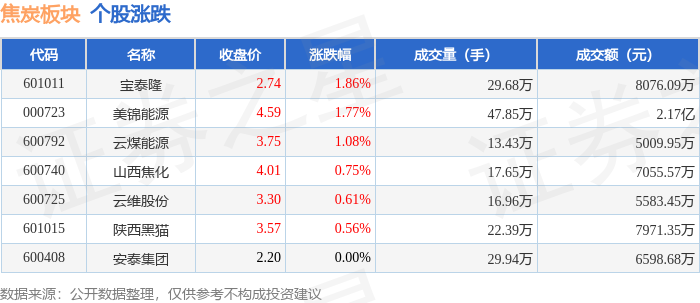
焦炭板块8月15日涨1.2%,宝泰隆领涨,主力资金净流入48.39万元
Zheng Xing Xing Ye Ri Bao· 2025-08-15 08:44
Group 1 - The coke sector experienced a 1.2% increase on August 15, with Baotailong leading the gains [1] - The Shanghai Composite Index closed at 3696.77, up 0.83%, while the Shenzhen Component Index closed at 11634.67, up 1.6% [1] - Key stocks in the coke sector showed varied performance, with Baotailong closing at 2.74, up 1.86%, and Meijin Energy at 4.59, up 1.77% [1] Group 2 - The net inflow of main funds in the coke sector was 483,900 yuan, while retail funds saw a net inflow of 820,350 yuan [1] - Baotailong had a main fund net inflow of 10,283,300 yuan, representing 12.73% of its total, while retail funds saw a net outflow of 180,000 yuan [2] - Meijin Energy experienced a significant main fund net outflow of 9,038,800 yuan, which is -4.16% of its total [2]

广发期货日评-20250815
Guang Fa Qi Huo· 2025-08-15 06:44
1. Report Industry Investment Ratings - Not provided in the given content 2. Core Views of the Report - The Sino - US second - round trade talks extended the tariff exemption clause as scheduled, and the policy tone of the Politburo meeting was basically the same as before. The stock index rose and then fell with heavy volume, and the performance of heavy - weight stocks was strong. The improvement of corporate earnings needs to be verified by mid - report data [2]. - The stock - bond seesaw continues to put pressure on long - term bonds, and the sentiment of the bond market has not recovered [2]. - The fluctuation of gold prices increases due to macro news, but the upward trend remains. Silver prices are expected to continue to rise after short - term range - bound fluctuations [2]. - The container shipping index (European line) is in a weak shock, and the short position of the 10 - contract should be held [2]. - Steel prices are supported by limited inventory in steel mills and upcoming production restrictions. Iron ore prices fluctuate with steel prices. Some coal prices are loosening, and coking plants have a profit recovery and a price increase expectation [2]. - The expectation of interest rate cuts has improved, and the center of copper prices has risen. The short - term silver price is expected to continue to rise after range - bound fluctuations [2]. - The supply - demand situation of some energy and chemical products is complex. Some products are in a weak shock, and some have price support or improvement expectations [2]. - Some agricultural products are in a weak adjustment or waiting for data guidance, and some have price trends affected by supply - demand factors [2]. - Some special and new energy products are in a state of shock or have price trends affected by specific factors [2]. 3. Summary by Relevant Catalogs Financial - **Stock Index**: The stock index rose and then fell with heavy volume. It is recommended to sell put options with an execution price of around 6400 for MO2509 when the price is high, and maintain a moderately bullish view [2]. - **Treasury Bonds**: The stock - bond seesaw puts pressure on long - term bonds, and the sentiment has not recovered. It is recommended to wait and see in the short term, and focus on the tax - period capital situation and new bond issuance pricing [2]. - **Precious Metals**: Gold prices are expected to rise, and a bullish spread portfolio can be constructed through gold call options. Silver prices are expected to continue to rise after short - term range - bound fluctuations, and long positions can be held or a bullish spread strategy can be constructed [2]. Black - **Steel and Iron Ore**: Steel prices are supported, and iron ore prices fluctuate with steel prices. It is recommended to wait and see unilaterally and go long on coking coal and short on iron ore [2]. - **Coking Coal and Coke**: The price of some coking coal is loosening, and coking plants have a profit recovery and a price increase expectation. It is recommended to wait and see unilaterally and go long on coke and short on iron ore [2]. Non - ferrous - **Copper and Aluminum**: The expectation of interest rate cuts has improved, and the center of copper prices has risen. The supply - side benefits for aluminum are limited, and the price has a small increase. It is necessary to pay attention to the pressure level [2]. Energy and Chemical - **Crude Oil and Related Products**: The price of crude oil is affected by geopolitical risks and supply - demand expectations. Some products such as PX, PTA, and styrene are in a weak shock, and some products such as bottle chips have price support [2]. - **Other Chemical Products**: The prices of some chemical products such as PVC, pure benzene, and synthetic rubber are affected by various factors, and different trading strategies are recommended [2]. Agricultural - **Grains and Oilseeds**: The prices of some agricultural products such as soybeans, corn, and oils are affected by supply - demand factors. It is recommended to take corresponding trading strategies such as stopping profit on long positions and shorting on rebounds [2]. - **Other Agricultural Products**: The prices of some agricultural products such as sugar, cotton, and eggs are in a weak adjustment or waiting for data guidance, and different trading strategies are recommended [2]. Special and New Energy - **Special Products**: The prices of some special products such as glass and rubber are affected by specific factors, and different trading strategies are recommended, such as holding short positions and waiting and seeing [2]. - **New Energy Products**: The prices of some new energy products such as polysilicon and lithium carbonate are in a state of shock or have price trends affected by specific factors, and different trading strategies are recommended [2].
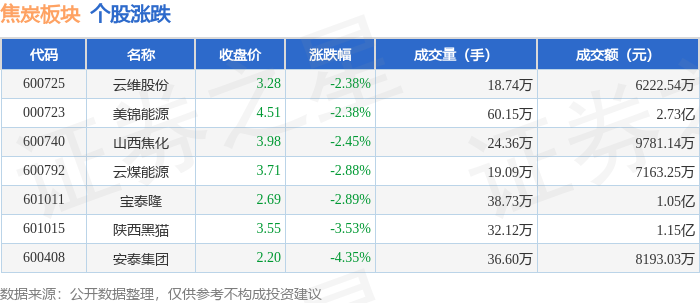
焦炭板块8月14日跌2.73%,安泰集团领跌,主力资金净流出1.06亿元
Zheng Xing Xing Ye Ri Bao· 2025-08-14 08:34
| 代码 | 名称 | 收盘价 | 涨跌幅 | 成交量(手) | 成交额(元) | | --- | --- | --- | --- | --- | --- | | 600725 | 云维股份 | 3.28 | -2.38% | 18.74万 | 6222.54万 | | 000723 | 美锦能源 | 4.51 | -2.38% | 60.15万 | 2.73 Z | | 600740 | 山西焦化 | 3.98 | -2.45% | 24.36万 | 9781.14万 | | 600792 | 云煤能源 | 3.71 | -2.88% | 19.09万 | 7163.25万 | | 601011 | 宝泰隆 | 2.69 | -2.89% | 38.73万 | 1.05亿 | | 601015 | 陕西黑猫 | 3.55 | -3.53% | 32.12万 | 1.15亿 | | 600408 | 安泰集团 | 2.20 | -4.35% | 36.60万 | 8193.03万 | 证券之星消息,8月14日焦炭板块较上一交易日下跌2.73%,安泰集团领跌。当日上证指数报收于 3666.44,下跌0.46%。 ...