人形机器人

Search documents
中信建投证券:A股跨年行情已经启动
Xin Hua Cai Jing· 2025-12-29 05:38
Core Viewpoint - The recent eight consecutive days of gains in the Shanghai Composite Index signal a positive outlook, indicating that the A-share year-end rally has commenced [1] Group 1: Market Drivers - Three main expectations are driving the initiation of the year-end rally: a consensus of optimism among institutional investors, the anticipated early arrival of the spring market, and the conclusion of adjustments in overseas AI models, leading to improved liquidity and risk conditions [1] - Recent announcements of the 15th Five-Year Plan policies and events have heightened investor expectations regarding policy [1] Group 2: Sector Focus - Key sectors to watch for the year-end rally include non-ferrous metals and AI computing power, which are expected to experience significant catalytic growth [1] - The primary market focus remains on commercial aerospace, with secondary themes including the Hainan Free Trade Zone, controllable nuclear fusion, and humanoid robots [1]

直线拉升,涨停潮来了!
中国基金报· 2025-12-29 04:26
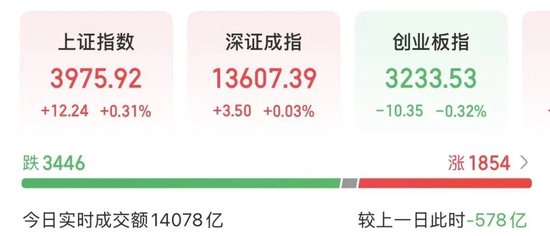
大家好,基金君和你继续关注今天的市场行情! 12 月 29 日上午, A 股三大股指涨跌不一。截至午间收盘,沪指涨 0.31% ,深证成指涨 0.03% ,创业板指跌 0.32% 。 沪深两市半日成交额为 1.4 万亿元,较上个交易日缩量 546 亿元。 个股跌多涨少,全市场 共 1850 只个股上涨, 67 只个股涨停, 3441 只个股下跌。 从板块表现看,化纤行业、石油行业、半导体板块涨幅居前,人形机器人、商业航天概念板 块走高,锂电电解液、零售板块下挫。 【导读】上午三大指数涨跌不一,化纤、石油、半导体板块领涨,人形机器人、商业航天概 念股走高;锂电电解液、零售板块下挫 中国基金报记者 张舟 | | | Wind热门概念指数 | | | | | Wind中国行业指数 | | | | --- | --- | --- | --- | --- | --- | --- | --- | --- | --- | | 化学纤维 | PEEK材料 | 储傢钥墨 | 服务器 | 光模块(CPO) | 化纤行业 | 石油天然气 | 发电设备 | 林木 | 燃气 | | 4.20% | 2.91% | 2.03% | 2. ...


商业航天批量涨停,人形机器人爆发,锋龙股份4连板,上纬新材大涨18%
Xin Lang Cai Jing· 2025-12-29 04:08
炒股就看金麒麟分析师研报,权威,专业,及时,全面,助您挖掘潜力主题机会! 记者丨金珊 12月29日,早盘A股三大指数涨跌不一,创业板指翻红后再度回落,截至午间收盘,沪指涨0.31%,深 成指涨0.03%,创业板指跌0.32%。沪深两市半日成交额1.4万亿,较上个交易日缩量578亿,全市场超 3400只个股下跌。 | 上证指数 | 深证成指 | 创业板指 | | --- | --- | --- | | 3975.92 | 13607.39 | 3233.53 | | +12.24 +0.31% | +3.50 +0.03% | -10.35 -0.32% | | 跌3446 | | 涨1854 > | 具体板块来看,商业航天概念延续强势,10余只成分股涨停,其中神剑股份8连板,金风科技、雷科防 务等涨停。消息面上,12月26日,上交所公布《上海证券交易所发行上市审核规则适用指引第9号—— 商业火箭企业适用科创板第五套上市标准》,支持正处于大规模商业化关键时期的商业火箭企业,适用 第五套上市标准登陆科创板。 | 商业航天 0 | | | | | --- | --- | --- | --- | | 2251.09 ...





商业航天批量涨停,人形机器人爆发,锋龙股份4连板,上纬新材大涨18%
21世纪经济报道· 2025-12-29 04:07
Core Viewpoint - The article discusses the mixed performance of the A-share market, highlighting the strong momentum in the commercial aerospace sector and the significant rise in precious metals, particularly silver, while noting declines in the consumer sector. Group 1: A-share Market Performance - On December 29, the A-share market showed mixed results with the Shanghai Composite Index up by 0.31% and the Shenzhen Component Index up by 0.03%, while the ChiNext Index fell by 0.32% [1] - The total trading volume in the Shanghai and Shenzhen markets reached 1.4 trillion yuan, a decrease of 578 billion yuan compared to the previous trading day, with over 3,400 stocks declining [1] Group 2: Commercial Aerospace Sector - The commercial aerospace sector continued its strong performance, with over ten constituent stocks hitting the daily limit, including Shenjian Co. with eight consecutive limit-ups, and Jin Feng Technology and Leike Defense also reaching the limit [3] - The Shanghai Stock Exchange announced new guidelines supporting commercial rocket companies to list on the Sci-Tech Innovation Board, which is expected to facilitate the growth of the commercial aerospace industry [3] - According to Zhongtai Securities, the global commercial aerospace industry is anticipated to enter a period of explosive growth over the next two years, driven by accelerated technological iteration and increasing demand for launch services and satellite networking [5] Group 3: Precious Metals Sector - The precious metals sector experienced volatility but ultimately strengthened, with silver leading the gains. The main silver futures contract rose over 8% during the day, and spot silver surged by more than 5%, reaching historical highs [6] Group 4: Humanoid Robotics Sector - The humanoid robotics sector saw significant gains, with stocks like Fenglong Co. achieving four consecutive limit-ups, and other companies such as Mould Technology and Wuzhou New Spring also hitting the limit [6] - The Ministry of Industry and Information Technology announced the establishment of a standardization committee for humanoid robots, which will focus on developing industry standards for key technologies and applications [9] - Huajin Securities noted that the commercialization of humanoid robots is expected to accelerate due to a substantial increase in the number of new product releases and growing order volumes [9] Group 5: Consumer Sector Decline - The consumer sector faced declines, particularly in retail and dairy industries, with companies like Baida Group hitting the daily limit down and Huangshi Group experiencing significant drops [10]



2025年度产业经济十大热点事件:“科技叙事”重塑投资逻辑,“反内卷”再造产业生态
Sou Hu Cai Jing· 2025-12-29 03:25
Group 1: AI and Technology - The launch of DeepSeek-R1 in January 2025 injected strong momentum into the capital market, becoming the core investment theme for the year, with its top-tier reasoning performance achieved with minimal computing power [3] - The open-source model of DeepSeek-R1 lowered industry barriers, attracting significant capital attention to the related supply chain, including chips, devices, applications, and cooling systems [3] - The AI sector saw a shift from pure performance competition to a focus on cost, efficiency, and commercialization capabilities, allowing small and medium enterprises to build applications quickly based on open-source weights [3] Group 2: Film Industry - The animated film "Nezha 2," produced by Light Chaser Animation, achieved a box office of 15.4 billion yuan, breaking domestic records and entering the global top five, leading to a significant stock price surge for Light Chaser [5] - The success of "Nezha 2" highlighted the strong market potential of Chinese animation, with several other animated films also performing well in the box office [5] - The overall domestic film box office exceeded 50 billion yuan in 2025, reflecting a 75 billion yuan increase from 2024, with total audience numbers reaching 1.2 billion [5] Group 3: Robotics Industry - The humanoid robot industry entered a commercialized phase in 2025, with significant orders indicating a shift towards scalable applications [7][8] - Major companies like ZhiYuan and UBTECH secured large orders, with the total order amount exceeding 4.6 billion yuan and over 20,000 units ordered throughout the year [7] - The commercial success of humanoid robots attracted capital, technology, and talent, facilitating the industry's transition from an emerging sector to a mature industry [8] Group 4: Stock Market Dynamics - The competition for the title of "stock king" in the A-share market saw AI chip company Cambricon surpassing traditional consumer giant Kweichow Moutai, reflecting a shift in investor preference towards high-growth technology sectors [10] - By the end of 2025, Cambricon's stock experienced volatility, with Kweichow Moutai regaining its position, indicating changing market dynamics and investor sentiment [10] Group 5: Food Delivery Industry - The food delivery industry experienced intense competition in 2025, initiated by JD's entry with an innovative model, leading to significant market disruptions and a series of subsidy wars among major platforms [12] - The competition resulted in financial pressures for platforms, with Meituan reporting a significant loss despite record user numbers, prompting regulatory intervention to curb unhealthy competition [12] - The industry is transitioning towards a phase of high-quality development, moving away from aggressive expansion strategies [12] Group 6: Semiconductor and GPU Industry - The domestic GPU industry marked a significant milestone with the listing of domestic GPU manufacturers, indicating a shift from "usable alternatives" to "self-sufficient and effective" products [15] - The semiconductor sector experienced a wave of mergers and acquisitions, reflecting a strategic shift from "domestic substitution" to "global excellence" [15] - The A-share market saw a record high in cash dividends, with total cash dividends reaching 2.61 trillion yuan, indicating improved corporate profitability and shareholder returns [16]


春季躁动初现!周末迎来两大利好
Mei Ri Jing Ji Xin Wen· 2025-12-29 03:07
Market Performance - The market has shown a rebound, with the Shanghai Composite Index achieving an eight-day consecutive rise, matching the record from April [1] - The CSI 500 Index and the ChiNext Index had the highest weekly gains, both exceeding 3.9%, while the micro-cap index had the smallest gain of only 0.7% [1] Market Outlook - The Shanghai Composite Index is close to the upward trend line from September to October, with a potential breakout expected next week [4] - Despite the recent gains, there is a historical pattern of short-term corrections following five consecutive daily gains [4][5] - The current market is characterized as a bull market with a "slow bull" feature, suggesting a positive outlook for long positions [5] Key Investment Themes - Major investment themes include the AI industry chain, solid-state battery industry, energy storage, commercial aerospace, humanoid robots, innovative pharmaceuticals, and non-ferrous metals [5] - The commercial aerospace sector is highlighted as a hot investment theme, with expectations for continued acceleration despite recent declines in U.S. commercial aerospace stocks [6][7] - AI hardware stocks have shown weakness due to concerns over year-end liquidity and performance, but these concerns are expected to ease after the New Year [7] Sector Analysis - The humanoid robot sector has shown a double-bottom pattern since late August, indicating potential for future growth, although it requires patience due to its current state [8] - Lithium battery and energy storage sectors are linked to AI power, with significant market demand and price increases in lithium carbonate indicating strong future potential [9] - The non-ferrous metals sector is gaining attention due to rising international gold and silver prices, as well as historical highs in copper prices, suggesting a bullish outlook for gold, silver, copper, and lithium-cobalt [9][10] Summary and Strategy - The market is showing signs of a spring rally, with a mid-term bullish outlook and a focus on stable sector stocks [10] - Key sectors to monitor include AI hardware, humanoid robots, commercial aerospace, non-ferrous metals, lithium batteries, and energy storage, with an emphasis on core stocks [10]
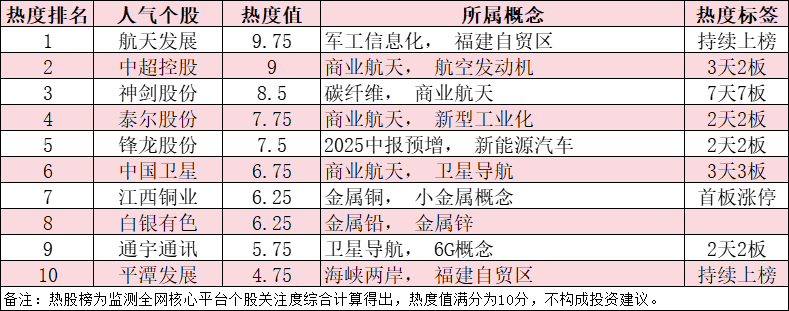
今日十大热股:航天发展、中超控股领衔,神剑股份7天7板,商业航天概念持续爆炒
Jin Rong Jie· 2025-12-29 02:02
Group 1: Aerospace Industry - Aerospace Development is gaining market attention due to the overall increase in the commercial aerospace industry's popularity, driven by external catalysts such as SpaceX's plan to go public in 2026 and the anticipated maiden flight of Long March 12A [1] - The company's business layout aligns well with market hotspots, covering military information technology fields such as electronic countermeasures and information security, while also participating in low-orbit satellite constellation projects, creating a resonance effect in the commercial aerospace sector [1] - China Satellite is recognized for its leading position in the commercial aerospace and satellite internet sectors, serving as a core supplier for the StarNet plan and handling numerous low-orbit communication satellite orders, which positions it uniquely in the industry [2] Group 2: Emerging Industries - Zhongchao Holdings is benefiting from the market's enthusiasm for emerging industries, particularly in commercial aerospace and high-end manufacturing, which has attracted significant funding attention [1] - Tailor Shares is gaining attention due to the combination of multiple hot concepts, including commercial aerospace and industrial robotics, particularly in light of recent policy events such as the New Industrialization Promotion Conference in Shanghai [2] - Jiangxi Copper's market heat is driven by several factors, including plans to acquire overseas quality mineral resources, a 35% year-on-year increase in net profit for the third quarter, and a capital operation plan to spin off its subsidiary Jiang Copper Foil for A-share listing [2] Group 3: Corporate Actions - Fenglong Shares' popularity stems from a significant asset restructuring event, where the leading Hong Kong humanoid robot company, UBTECH, plans to acquire approximately 43% of the company's shares for 1.665 billion yuan, which has sparked discussions about business transformation and value reassessment [2] - Shenjian Shares' heat is attributed to its business layout in the commercial aerospace sector, with a clear indication of supplying related components, which aligns well with the ongoing market interest in commercial aerospace themes [1]

周末| 商业航天又出利好!磷酸铁锂“半壁江山”集体挺价!财政部:2026年继续实施更加积极的财政政策!17大重磅消息影响股市
Xin Lang Cai Jing· 2025-12-29 01:47
Group 1: Fiscal Policy and Economic Support - The Ministry of Finance announced that a more proactive fiscal policy will continue in 2026, expanding fiscal spending and supporting consumption through trade-in subsidies for consumer goods [5] - The government aims to optimize the combination of government bond tools and enhance the effectiveness of transfer payment funds, ensuring necessary expenditure [5] Group 2: Commercial Aerospace Sector - The commercial aerospace sector is experiencing a strong IPO wave, with the Shanghai Stock Exchange releasing guidelines for commercial rocket companies to list on the Sci-Tech Innovation Board [6] - The establishment of a dedicated regulatory body for commercial aerospace and the inclusion of the sector in national strategic plans are expected to enhance industry efficiency and international competitiveness [6] Group 3: Artificial Intelligence in Finance - The People's Bank of China emphasized the need to advance AI applications in finance in a safe and orderly manner, highlighting the importance of AI in the modern financial system [7] Group 4: Raw Material Price Trends - Prices of core raw materials for lithium batteries have surged, leading to price increases in battery products, with companies like Dejia Energy raising prices by 15% [8] - A collective price increase in lithium iron phosphate is anticipated due to production cuts from major suppliers, affecting supply-demand dynamics in January [9] Group 5: Human-Robot Industry Developments - UBTECH Robotics secured contracts worth over 1.3 billion yuan for humanoid robots, aiming for an annual production capacity of 10,000 units by 2026 [10] - The establishment of a standardization committee for humanoid robots and embodied intelligence is expected to enhance industry standards and promote technological advancements [13] Group 6: Precious Metals Market - Precious metals, including gold and silver, have reached record highs, driven by geopolitical tensions and a weak dollar, with silver prices increasing by approximately 18% in the past week [14] - The surge in precious metals is attributed to increased demand for safe-haven assets amid economic uncertainties [14] Group 7: Regulatory Actions - Six listed companies are under investigation or facing penalties from the China Securities Regulatory Commission, indicating a tightening regulatory environment [24]

热点精选:商业航天+金融科技+华为昇腾+人形机器人
Xin Lang Cai Jing· 2025-12-29 01:16
Group 1: Commercial Aerospace - The Shanghai Stock Exchange has issued guidelines for commercial rocket companies to apply for the fifth set of listing standards on the Sci-Tech Innovation Board, providing a clear operational guide for IPO applications [1] - The industry outlook suggests that national support for quality commercial rocket companies will lead to a golden era for commercial aerospace, with valuations transitioning from "policy expectations" to "institutional realization" [1] Group 2: Financial Technology - A new implementation plan for the high-quality development of digital finance in the banking and insurance sectors has been released, outlining 33 tasks across various areas including governance, services, technology application, data development, risk management, and regulatory transformation [3] - The financial industry is identified as a prime candidate for AI application due to its data-intensive nature, making it an excellent testing ground for digital transformation [3] Group 3: Huawei Ascend - Huawei plans to launch its latest AI chip, Ascend 950, in the South Korean market by 2026, along with AI computing cards and overall data center solutions [7] - ByteDance is expected to place orders for Ascend chips totaling over 40 billion yuan by 2026, a significant increase from nearly zero in 2025 [7] Group 4: Humanoid Robots - The establishment of a standardization committee for humanoid robots and embodied intelligence has been announced by the Ministry of Industry and Information Technology [11] - The industry outlook anticipates rapid mass production of humanoid robots by mid-2026, benefiting component manufacturers with strong manufacturing and management capabilities [11]

高测股份:光伏业务市占率持续提升叠加人形机器人业务的潜在新增长动力;重申买入评级
2025-12-29 01:04
abc 2025 年 12 月 24 日 Global Research 高测股份 光伏业务市占率持续提升叠加人形机器人业务 的潜在新增长动力;重申买入评级 光伏业务有望反转;人形机器人业务带来中长期上行空间 受出货量增长推动,Q325公司切片服务业务收入同比增长148%。尽管行业 供应过剩,公司在硅片市场的份额从2024年的4.6%扩大至Q325的10.8%。 叠加公司对电池片厂商和垂直一体化巨头进一步渗透,我们认为公司成本优 势已被广泛认可,这将在行业盈利能力持续承压的情况下为公司带来更多市 占率上行空间。此外,在行业反内卷推动价格企稳的背景下,我们认为公司 通过降本增效或实现利润率回升。我们预计公司2025年实现盈亏平 衡,2026/27年净利润达2.19亿元/3.56亿元,得益于金刚线和硅片切片服务 业务市占率和利润率均进一步提升。 人形机器人业务进展 基于已有技术积累的可拓展性,公司已进军人形机器人零部件/设备领 域:1)自4月产品发布以来,灵巧手用钨丝腱绳业务已确认来自多个国内客 户的收入;2)丝杠磨床设备研发进展顺利推进(拟于春节前后进行内 测);3)公司还与海外一线客户合作开发减速器产品。我们 ...