科技行业

Search documents
全球资产配置每周聚焦(20250919-20250926):美股科技板块资金出现大幅流出-20250928
Shenwan Hongyuan Securities· 2025-09-28 15:23
Economic Indicators - The final annualized quarterly GDP growth rate for the US in Q2 2025 was significantly revised up to 3.8%, from a previous estimate of 3.3%, marking the strongest performance since Q3 2023[6] - The strong GDP growth has cooled global interest rate cut expectations, with the probability of a 25 basis point cut in October now at 89.8%, down from 91.9%[3] Market Performance - The S&P 500 index closed at 6643.70, showing a decline of 0.31% over the week, while the Hang Seng Index and KOSPI led declines in the Asia-Pacific region[8] - The technology sector in the US saw a significant outflow of $4.33 billion, while China's technology sector experienced an inflow of $3.55 billion[3] Fund Flows - In the past week, US equity markets saw inflows of $8.26 billion, while Chinese markets attracted $5.48 billion[15] - Developed markets experienced notable inflows, with US fixed income funds seeing an inflow of $18.85 billion[15] Commodity Prices - Brent crude oil prices increased by 4.60%, and COMEX gold rose by 2.83% during the week, indicating a stronger inflation outlook[3] - The US dollar index rose by 0.55%, currently standing at 98.2, remaining below the 100 mark[9] Valuation Metrics - The risk-adjusted return percentiles for the S&P 500 and NASDAQ decreased to 49% and 45%, respectively, indicating a decline in perceived investment quality[3] - The PE percentile for the S&P 500 and DAX is at 93.0% and 89.5%, respectively, suggesting high valuations compared to historical averages[3]
高波策略承压,看好顺周期红利
2025-09-28 14:57
Summary of Key Points from Conference Call Industry Overview - The conference call discusses the A-share market in China, focusing on high and low volatility strategies, economic recovery, and the impact of global competition on China's economy [1][3][11]. Core Insights and Arguments - **High Volatility Strategy**: Reflects capital expansion and encourages capital expenditure, but has faced pressure since June due to high market sentiment and significant inflows into the technology sector [1][3][6]. - **Low Volatility Strategy**: Associated with supply constraints, consumption expansion, and globalization, benefiting large core enterprises and enhancing their profitability [4][10]. - **Current Bull Market Foundation**: Driven by Price-to-Book (PB) ratios rather than traditional Price-to-Earnings (PE) ratios, indicating a shift in focus towards long-term sustainable growth [5][10]. - **Economic Recovery and Debt Cycle**: The current economic recovery is decoupled from the debt cycle, with asset prices recovering ahead of economic indicators, driven by supply constraints and high actual interest rates [7][12]. - **Supply-Driven Economic Recovery**: Characterized by price expansion through supply constraints, requiring ongoing globalization and parallel development of traditional and high-end manufacturing [8][9]. - **Global Competition Strategy**: China has strategically navigated the U.S. economic cycles, capitalizing on inflation periods for exports and implementing supply constraints during interest rate cuts to mitigate risks [2][11]. Additional Important Content - **Market Dynamics**: The transition from high volatility to low volatility strategies is necessary for focusing on stable long-term returns rather than short-term speculation [10][15]. - **Impact of U.S. Interest Rates**: U.S. interest rate cuts have led to historically low import levels, affecting global export prices, but are expected to improve as inflation pressures build [16]. - **Wealth Effect and Consumer Behavior**: A low volatility environment is crucial for stimulating consumer spending and creating a wealth effect, contrasting with the risks of high volatility leading to market bubbles [12][13]. This summary encapsulates the key points discussed in the conference call, highlighting the strategic shifts in investment approaches and the broader economic context affecting the A-share market in China.
霸权主义再出现?10 万美元天价签证费,大量外籍人才流失
Sou Hu Cai Jing· 2025-09-28 06:14
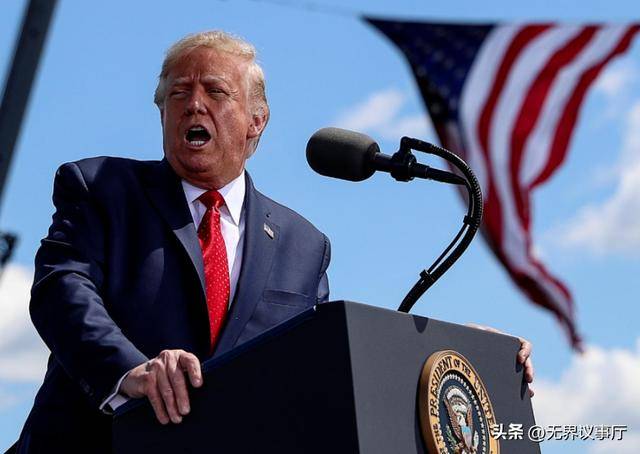
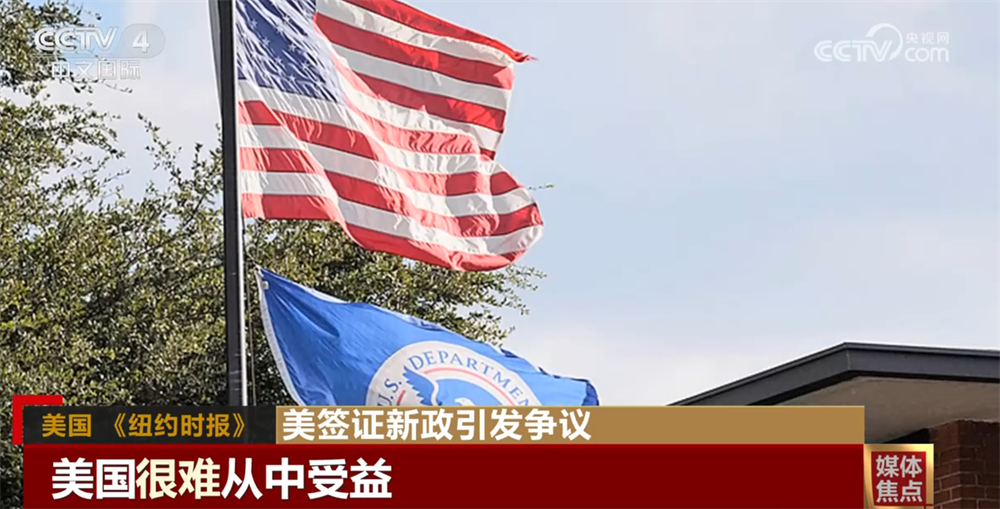
Core Viewpoint - The recent executive order from the Trump administration has significantly increased the H-1B visa application fee from several thousand dollars to $100,000, which poses a substantial financial burden on companies in the tech industry [1][8]. Group 1: H-1B Visa Overview - The H-1B visa is a non-immigrant temporary work visa designed for foreign high-skilled workers, with an initial validity of 3 years and a possible extension for a total of up to 6 years [3]. - Since its introduction in the 1990s, the H-1B visa has been crucial in supplying high-end labor to the U.S., supporting groundbreaking projects like GPT models, SpaceX rockets, and iPhone chips [5]. - The annual quota for H-1B visas is 85,000, with only 25% to 40% of applicants expected to succeed in 2025, highlighting a significant mismatch between demand and supply [5][12]. Group 2: Financial Impact on Companies - The average annual salary for H-1B visa holders is approximately $167,000, making the new $100,000 visa fee equivalent to over half a year’s income for these employees, thus increasing operational costs for companies [7]. - Startups with limited funding have expressed strong opposition to the fee increase, while major companies like Amazon and Meta have quietly delayed key R&D projects [8]. - The U.S. Secretary of Commerce indicated that the fee is calculated annually, meaning a total of $600,000 over a 6-year visa period, further exacerbating financial concerns for companies [8]. Group 3: Talent Shortage and Dependency - Less than half of U.S. students pursue STEM education, leading to a significant talent gap, with international students making up 70% of those earning PhDs in STEM fields from 2000 to 2017 [12]. - By 2030, the U.S. tech sector is expected to create 3.85 million new jobs, with 1.4 million positions likely to remain unfilled due to the talent shortage [12]. - Companies have adopted a strategy of "laying off locals while hiring foreigners" to mitigate costs, as seen in Tesla's recent layoffs where over 2,000 H-1B visa applications were submitted [14][15]. Group 4: Long-term Implications - The high visa fees may disrupt the previously established cycle of attracting global talent, leading to potential challenges in maintaining technological advancements and industry leadership in the U.S. [18].

帮主郑重:央行例会藏玄机!A股这波震荡,钱要往哪儿去?
Sou Hu Cai Jing· 2025-09-27 14:56
Group 1 - The central theme of the recent central bank meeting is to maintain "moderate easing" while emphasizing "strengthening counter-cyclical adjustments" and "increasing the intensity of monetary policy regulation" to support the economy [3] - The central bank aims to ensure that funds flow into the real economy rather than circulate within the financial sector, aligning with the "precise drip irrigation" approach previously discussed [3] - The central bank has expressed a clear intention to "maintain capital market stability" and utilize new tools such as securities fund insurance company swap facilities and stock repurchase loans, which have already seen over 700 listed companies negotiate low-interest loans for stock buybacks [3] Group 2 - There is no specific timeline for interest rate cuts or reserve requirement ratio reductions, as the central bank will flexibly adjust based on domestic and international conditions, with a focus on stabilizing the exchange rate [4] - The current fluctuations around the 3800-point mark in the A-share market are seen as a digestion of expectations, with ongoing policy support and stable capital flows, while investors await more concrete economic data [4] - The central bank's recent statements indicate a commitment to stabilizing the real estate market without introducing major new stimuli, focusing instead on implementing existing policies [5] Group 3 - The signals from the central bank meeting suggest a determination to support the economy and capital markets, with a more precise and rhythmic approach to operations [6] - The current market volatility is viewed as a necessary phase for building momentum for future trends, with a focus on sectors supported by clear policies such as technology and inclusive finance [6] - Companies with reasonable valuations and those whose performance can gradually improve with economic recovery are expected to benefit from the policy dividends [6]

九方金融研究所:多部门最新发声,资本市场需关注的五大信号
Di Yi Cai Jing Zi Xun· 2025-09-26 13:35
Group 1 - The core viewpoint of the article highlights the achievements of China's financial sector during the "14th Five-Year Plan" period, emphasizing the importance of supportive monetary policies and the enhancement of financial services to the real economy [1][5] - The People's Bank of China has adopted a supportive monetary policy stance, which has effectively reduced financing costs and alleviated debt pressure for enterprises and residents, particularly benefiting small and micro enterprises [2][5] - The capital market has seen an increase in technology content, with over 90% of newly listed companies being technology-oriented, and the market capitalization of the technology sector now exceeds 25% of the A-share market [3][5] Group 2 - The willingness of listed companies to return profits to investors has significantly increased, with total distributions through dividends and buybacks reaching 10.6 trillion yuan, an increase of over 80% compared to the "13th Five-Year Plan" period [3][5] - The resilience and risk resistance of the A-share market have improved, with the annualized volatility of the Shanghai Composite Index decreasing by 2.8 percentage points during the "14th Five-Year Plan" [4][5] - Key financial indicators such as non-performing loans and capital adequacy are stable and within a healthy range, indicating that the financial system is well-equipped to handle potential risks [4][5]
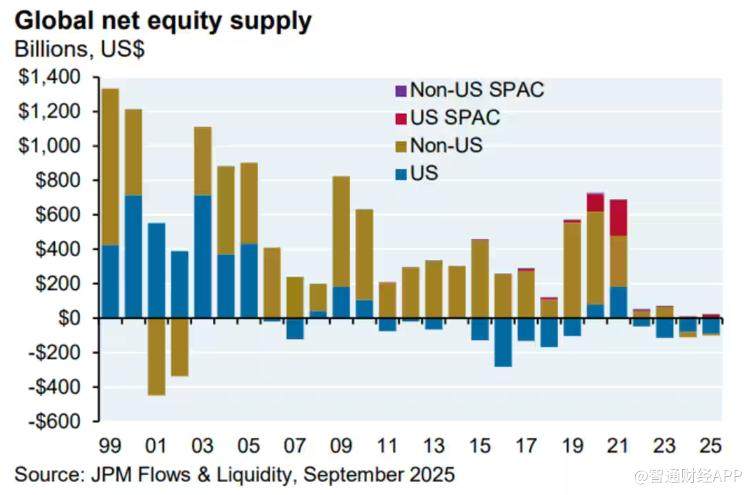
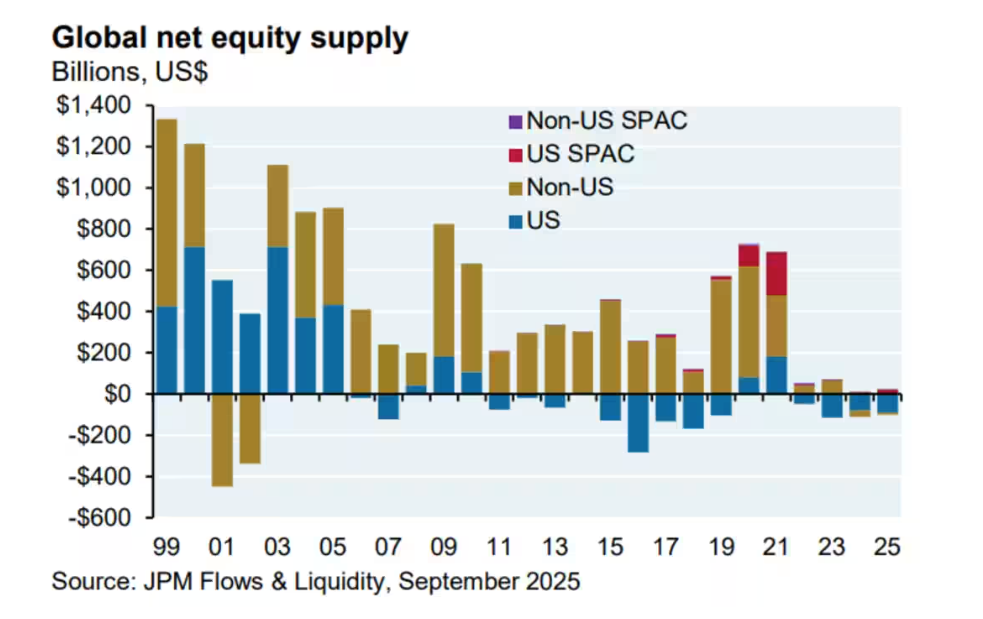
美股15年长牛的背后,有一个关键推手经常被忽视!
Jin Shi Shu Ju· 2025-09-26 09:47
Core Insights - The article discusses the steady rise of the U.S. stock market post-financial crisis, attributing it to various factors including expanding profit margins of large corporations and the significant impact of tech giants like Microsoft and Apple on the global economy [1][3] - A critical point raised is the supply-demand imbalance in the stock market, which is considered a key factor in maintaining market resilience against volatility [1][3] Group 1: Market Dynamics - The supply of U.S. stocks has been on a declining trend since 2011, with a notable exception during the COVID-19 pandemic when IPO activity surged [3] - Corporate stock buybacks have been identified as a significant driver of this declining supply trend [3] - Despite a decrease in the proportion of fixed income pension plan inflows relative to the total market capitalization of the S&P 500, an annual influx of $1.5 trillion still needs to find investment opportunities [3] Group 2: Market Performance - Since 2011, investors have faced multiple stock market sell-offs, but only two have evolved into bear markets: the bear market in 2022, which resulted in the worst annual performance for the S&P 500 since 2008, and the brief sell-off in March 2020 due to the pandemic [3] - The article notes that the U.S. stock market indices, including the S&P 500, Dow Jones, and Nasdaq, experienced a decline, marking the first simultaneous three-day drop since March [3]
10万美元H-1B签证费催生全球人才争夺战 英德韩都在抢先行动
Di Yi Cai Jing· 2025-09-26 06:19
美国特朗普政府的移民政策正在重塑全球人才流动格局。 本周,德国驻印度大使阿克曼(Philipp Ackermann)公开发文向"所有高技能印度人才"呼吁:"德国以 其稳定的移民政策脱颖而出,并为印度人在信息技术、管理、科学和技术领域提供了丰富的就业机 会。" 阿克曼还附上一个专门为印度人提供德国就业、移民与职业发展信息的网站,并鼓励他们"(在这里) 找到通往德国的道路,提升你的职业生涯"。 9月19日,特朗普签署的总统公告推出H-1B签证新规,要求所有新申请者支付高达10万美元的费用,旨 在解决所谓"系统性滥用"问题。值得注意的是,印度人在H-1B项目中历来占据主导地位,近年来占比 超过70%。专家警告,此类政策可能加速高技能人才向加拿大、欧洲及中国等经济体转移。 德国之所以如此积极地吸引全球人才,源于其迫切的劳动力市场需求。德国需要吸纳数万名技术工人以 填补巨大的岗位空缺。根据德国经济研究所的数据,截至今年3月,该国仍有38.7万个职位虚位以待, 且预计这一数字将在未来两年内翻倍。同时,德国社会正面临严峻的人口结构挑战:每五个公民中就有 一人年龄超过67岁,出生于1955年至1970年的"婴儿潮"一代已开始 ...
美签证新政无异于“搬起石头砸了自己的脚” 美国经济将受到哪些冲击?
Yang Shi Wang· 2025-09-26 06:08
Core Viewpoint - The Trump administration's significant increase in H-1B visa fees from several thousand dollars to $100,000 is expected to have substantial impacts on U.S. technology companies and the broader economy [1][3]. Group 1: Economic Impact - The increase in H-1B visa fees is justified by the government as a response to systemic abuse of the visa program, which has led to the displacement of American workers and harmed the economy and national security [3]. - Small and medium-sized enterprises in the U.S. will face a sharp rise in costs, exacerbating their financial burdens [3]. - The policy may lead to a shift of certain jobs overseas, slow down innovation, and limit the ability to attract global high-end talent [5][9]. Group 2: Talent Acquisition and Innovation - The H-1B visa is crucial for U.S. tech companies to hire foreign talent, and the new policy could hinder the ability to attract top talent, ultimately weakening U.S. innovation and economic growth [5][7]. - Major tech companies may absorb some of the increased costs but will still face risks related to delays in hiring key talent [5]. - The policy change is likely to push capable university graduates out of the U.S. to other countries, affecting the talent pool available to American companies [9]. Group 3: Global Talent Flow - The policy change has drawn global attention, with countries like Canada, India, and Germany monitoring the situation closely and potentially adjusting their own immigration policies to attract talent that may be excluded from the U.S. [7]. - Canada plans to enhance its "Global Skills Strategy" to attract technology talent that may be turned away by U.S. policies [7].
A50,突发!两大变数,来袭!
券商中国· 2025-09-26 03:20
Market Overview - A50 index experienced a sudden drop, leading to adjustments in both A-shares and Hong Kong stocks, with the Hang Seng index futures falling over 1% [2][4] - The recent strength of the US dollar, which rebounded above 98, and the concentrated trading in large-cap technology stocks are identified as potential market variables [2][5] A-share Performance - A-shares, particularly the ChiNext and STAR Market indices, showed weakness, with the ChiNext index dropping over 1% and the Shanghai Composite Index down 0.33% [4] - Over 2,700 stocks in the Shanghai and Shenzhen markets were reported to be declining, indicating a broad market pullback [4] Capital Market Dynamics - Despite the drop in indices, the total trading volume in the A-share market remained above 2 trillion, suggesting ongoing structural opportunities [7] - The market is characterized by a concentration of capital in a limited number of stocks, with only about 800 out of over 5,000 stocks in a bullish trend [5][7] Future Outlook - Analysts predict that the A-share market will continue to experience a slow upward trend, supported by structural recovery in earnings and credit [8] - Factors such as liquidity easing, favorable policies, and foreign capital inflow are expected to bolster market performance [8] - The ongoing transformation of China's technology sector from a follower to a leader in various fields is highlighted as a key driver for future growth [7][8]

美股为何涨势不休?摩根大通策略师称这一因素或是关键推手
Zhi Tong Cai Jing· 2025-09-25 22:29
Core Insights - The U.S. stock market has been on a steady rise since the 2008 financial crisis, supported by expanding profit margins and reduced earnings volatility among large corporations [1] - A significant factor driving the long-term increase in U.S. stocks is the imbalance in supply and demand within the stock market, as highlighted by Michael Cembalest from J.P. Morgan Asset Management [4] Group 1: Market Supply Dynamics - Since 2011, the net supply of U.S. stocks has been declining, providing a "buffer" for the market during various shocks [4] - The overall supply of U.S. stocks, measured by market capitalization, has contracted since 2011, with the exception of a temporary increase during the IPO boom in 2020 [4] - Major stock buybacks by companies have been a key factor in the reduction of supply [4] Group 2: Demand Factors - Continuous inflows from pension plans, including fixed income and defined contribution plans, have provided stable buying support for the stock market [4] - Although the proportion of these inflows relative to the total market capitalization of the S&P 500 has decreased in recent years, approximately $1.5 trillion still needs to find investment targets each year [4] Group 3: Market Resilience - The U.S. stock market has shown unexpected resilience despite multiple sell-off periods since 2011, with only two instances evolving into full-blown bear markets: the March 2020 crash due to COVID-19 and the bear market in 2022, which resulted in the worst annual performance for the S&P 500 since 2008 [4] - The recent performance of major U.S. indices indicates a cautious short-term market sentiment, as evidenced by a decline across all three major indices for the first time since March of this year [5]