
装备制造业

Search documents
11月份国民经济延续稳中有进发展良好之态势
Zheng Quan Ri Bao· 2025-12-15 16:16
Economic Performance - In November, the industrial added value above designated size increased by 4.8% year-on-year, maintaining the growth rate from October [1] - The added value of the equipment manufacturing industry grew by 7.7%, contributing 59.4% to the overall industrial growth [1] - The service production index rose by 4.2% year-on-year, with significant growth in information transmission and software services (12.9%) and leasing and business services (8.4%) [1] Market Sales and Consumption - The total retail sales of consumer goods increased by 1.3% year-on-year in November, with cosmetics and gold and silver jewelry retail sales growing by 6.1% and 8.5%, respectively [1] - From January to November, service retail sales grew by 5.4%, with a slight acceleration of 0.1 percentage points compared to the previous ten months [1][2] Foreign Trade - In November, China's total goods import and export value increased by 4.1% year-on-year, with exports growing by 5.7%, reversing the decline seen in October [2] - For the first eleven months, trade with Belt and Road Initiative countries saw a 6% year-on-year increase, outpacing overall foreign trade growth [2] Policy Impact - The implementation of proactive macro policies has significantly contributed to the stable economic growth observed this year [3] - Recent policies aimed at promoting consumption and expanding effective investment are expected to enhance economic growth momentum [3][4] - The Central Economic Work Conference has outlined the direction for economic work in the coming year, emphasizing the need for sustained efforts in domestic circulation and effective demand expansion [4]
11月经济新动能表现强劲,高技术制造业持续领跑
Di Yi Cai Jing· 2025-12-15 14:10
Economic Overview - China's macroeconomic indicators showed a continued slowdown in November, but high-tech manufacturing production and investment growth remained strong, indicating new momentum for the economy [1][2] - The industrial added value for November increased by 4.8% year-on-year, slightly down from October, marking the lowest growth since September 2024 [1][2] - The retail sales of consumer goods grew by 1.3% year-on-year, a significant drop of 1.6 percentage points from October, continuing a six-month trend of slowdown [1][4] High-Tech Manufacturing - In November, the added value of high-tech manufacturing rose by 8.4%, outperforming the overall industrial growth by 3.6 percentage points [2] - From January to November, the cumulative growth of high-tech manufacturing was 9.2%, with smart consumer equipment manufacturing increasing by 7.6% [2] - The development of green and low-carbon industries is advancing, with renewable energy generation increasing by 8.8% year-on-year [2] Consumer Spending - The growth of retail sales of consumer goods has been attributed to a high base from the previous year, but the cumulative growth for the year is better than last year [4][5] - Service consumption is growing rapidly, with service retail sales increasing by 5.4% year-on-year, outpacing goods retail sales [5] - The expansion of consumer spending is linked to rising per capita GDP, ongoing consumption policies, and the emergence of new consumption growth points [5] Investment Trends - Fixed asset investment (excluding rural households) decreased by 2.6% year-on-year in the first eleven months, with a notable decline in real estate investment [7] - Infrastructure investment fell by 1.1%, while manufacturing investment saw a modest increase of 1.9% [7][9] - Despite the overall decline in investment, certain sectors, such as general equipment manufacturing, showed positive growth, with an 8.9% increase [9] Policy and Future Outlook - The Central Economic Work Conference outlined key tasks for the upcoming year, emphasizing the importance of domestic demand and consumption [6] - A series of consumption-boosting policies have been introduced, aiming to enhance the supply of quality goods and services [6] - The government is focusing on stabilizing investment through various measures, including increasing central budget investments and optimizing local government bond usage [10]
11月工业高端化势头明显,3D打印设备产量翻番
2 1 Shi Ji Jing Ji Bao Dao· 2025-12-15 13:16
Core Insights - In November, the industrial added value of enterprises above designated size in China experienced a year-on-year real growth of 4.8%, with a month-on-month increase of 0.44% [5][6] - The growth rate of industrial production showed a slight decline compared to the previous month, influenced by base effects, while the month-on-month growth accelerated [6][7] - High-end manufacturing sectors, particularly equipment manufacturing and high-tech manufacturing, demonstrated significant growth, with respective year-on-year increases of 7.7% and 8.4% [7][8] Industrial Performance - The mining industry saw a year-on-year increase of 6.3%, while manufacturing and electricity, heat, gas, and water production and supply industries grew by 4.6% and 4.3%, respectively [6] - The cumulative industrial added value from January to November grew by 6.0% year-on-year, indicating a stable overall industrial production environment [5][11] High-tech and Equipment Manufacturing - The added value of equipment manufacturing and high-tech manufacturing accounted for 36.4% and 16.9% of the total industrial added value, respectively [7][8] - Notable product growth included 3D printing equipment, industrial robots, and new energy vehicles, with year-on-year production increases of 100.5%, 20.6%, and 17.0% [9][10] Policy Impact - The implementation of policies such as "two highs" and "two new" has effectively stimulated market demand and supported industrial production growth and upgrades [2][8] - The focus on expanding domestic demand and promoting the transformation of traditional industries is crucial for sustaining industrial development [11]

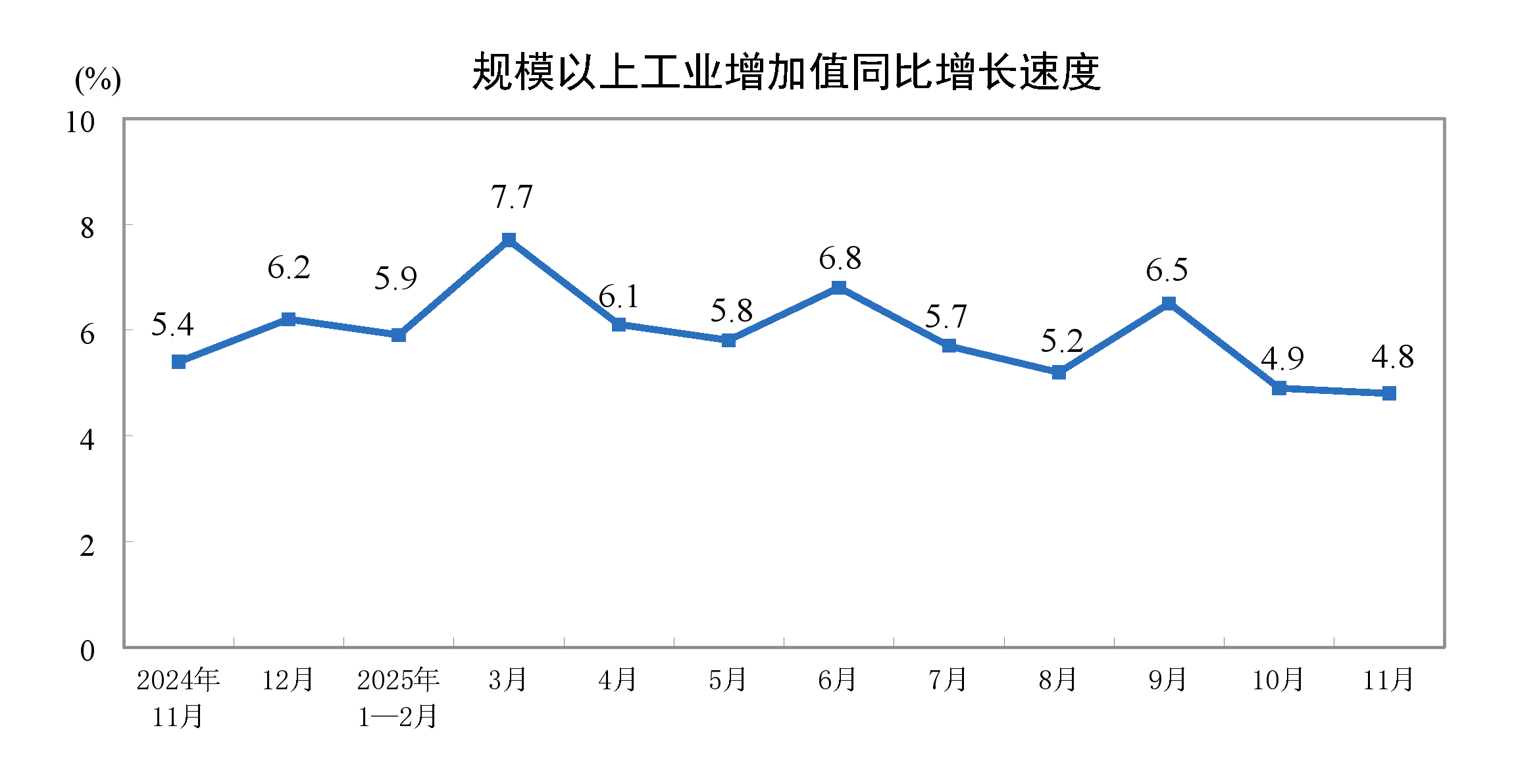
延续稳中有进发展态势 11月份国民经济运行总体平稳
Bei Jing Shang Bao· 2025-12-15 11:54
Economic Overview - In November, the industrial added value above designated size in China increased by 4.8% year-on-year, with manufacturing investment continuing to grow, particularly in high-tech manufacturing [1] - The spokesperson from the National Bureau of Statistics indicated that despite challenges, China's economy shows strong resilience, supported by macro policies, and is on track to meet annual targets [1] High-tech Manufacturing Growth - High-tech manufacturing continues to grow rapidly, with the added value in November increasing by 8.4%, outpacing the overall industrial added value growth by 3.6 percentage points [3] - Key sectors such as integrated circuit manufacturing and smart product production saw significant increases, with added values growing by 32.4% and 30% respectively [3] - The production of 3D printing equipment and industrial robots surged by 100.5% and 20.6% year-on-year [3] Digital Product Manufacturing - The digital product manufacturing sector, a crucial part of high-tech manufacturing, recorded a 7.6% year-on-year increase in added value in November, accelerating from the previous month [4] - Notable growth was observed in smart consumer devices, with smart wristbands and 5G smartphones increasing production by 27.6% and 11.5% respectively [4] Consumer Market Expansion - In November, the total retail sales of consumer goods reached 43.898 billion yuan, marking a 1.3% year-on-year increase [5] - Urban retail sales amounted to 37.684 billion yuan, growing by 1%, while rural retail sales increased by 2.8% to 6.214 billion yuan [5] - Sales of basic living goods and certain upgraded products saw significant growth, with retail sales of grain and oil, communication equipment, and cultural office supplies increasing by 6.1%, 20.6%, and 11.7% respectively [5][6] Consumption Trends - The consumption upgrade trend is evident, with prices for cultural and sports goods rising, and cosmetics and jewelry sales increasing by 6.1% and 8.5% year-on-year [6] - The implementation of consumption promotion policies has effectively stimulated consumer demand, leading to an expansion in consumption scale and structural upgrades [7]

视频丨11月国民经济稳中有进 这场发布会上释放哪些重要信息?
Yang Shi Xin Wen Ke Hu Duan· 2025-12-15 11:52
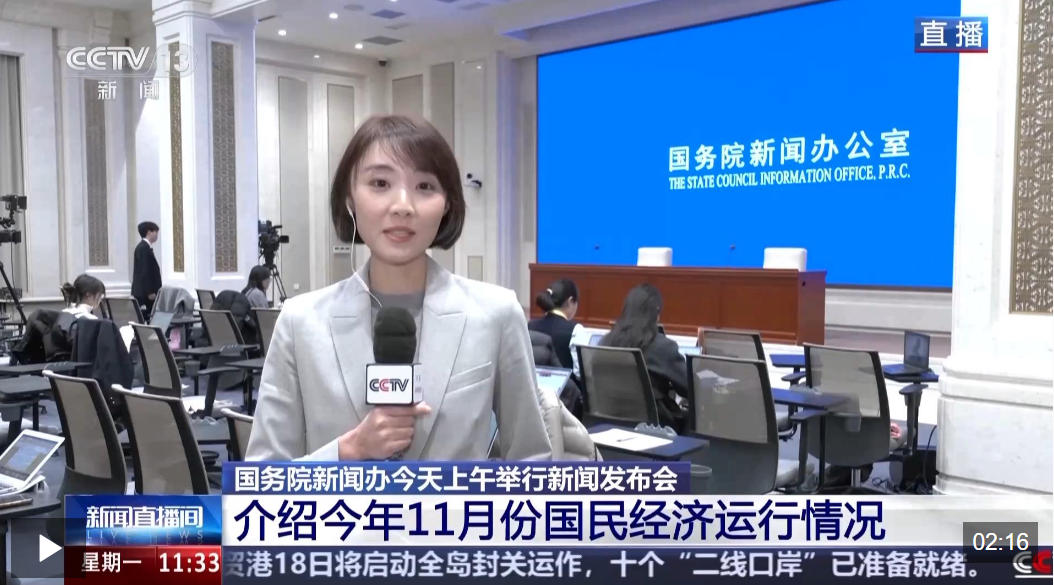
今天(15日)上午10时,国务院新闻办举行新闻发布会,国家统计局相关负责人介绍了今年11月份国民经济的运行情况。会上都释放了哪些重要信息? 总台央视记者 宋菀:这场发布会持续了一个多小时,释放了很多重要信息。在谈到11月份经济运行走势时,国家统计局新闻发言人付凌晖表示,11月份, 国民经济延续稳中有进发展态势。(>>详情) 在工业、消费等领域的数据中有不少亮点。 11月份,工业生产稳定增长,装备制造业和高技术制造业增长较快。 11月份,高技术制造业增加值增长8.4%,分别快于全部规模以上工业增加值2.9和3.6个百分点。 3D打印设备、工业机器人、新能源汽车产品产量都保持较快增长。 (总台央视记者 吴昊 宋菀 李唐 杜雷鸣 张程) 今年以来,我国实施提振消费专项行动,政策效果持续显现,商品和服务零售都保持增长。 11月份,社会消费品零售总额同比增长1.3%,消费品以旧换新相关商品销售保持较快增长。 11月份,限额以上商品零售额中通讯器材类、文化办公用品类商品零售额也保持了两位数增长。 值得一提的是,居民文化休闲网络娱乐等相关服务发展较好,1-11月份,服务零售额同比增长5.4%,快于商品零售额增速。 此外,今 ...
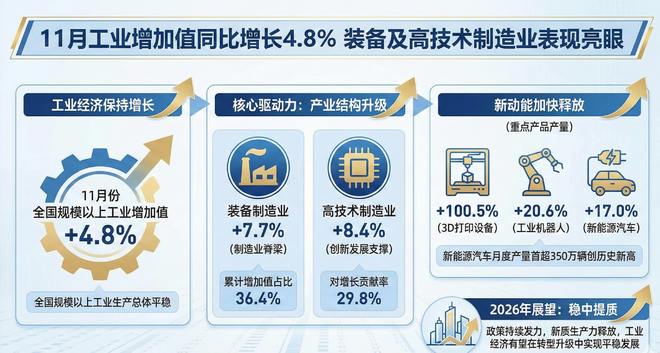
11月工业增加值同比增长4.8% 装备及高技术制造业表现亮眼
Zhong Guo Jing Ying Bao· 2025-12-15 11:11
苏商银行特约研究员武泽伟在接受《中国经营报》记者采访时表示,上述数据表明,当前工业生产保持 了稳健增长的韧性。此次增长的核心驱动力来自产业结构持续升级,尤其是代表先进制造方向的装备制 造业和高技术制造业,其增速明显快于工业整体水平,显示出新质生产力发展的强劲势头。 装备制造业是制造业的脊梁,高技术制造业是创新发展的重要支撑。国家统计局数据显示,11月份,规 模以上装备制造业增加值同比增长7.7%,累计增加值占全部规模以上工业的比重达36.4%,较2024年全 年提高1.8个百分点,已连续33个月保持在30%以上。同时,规模以上高技术制造业增加值同比增长 8.4%,增速较10月份加快1.2个百分点,对全部规模以上工业增长的贡献率达29.8%。 北京市社会科学院副研究员王鹏在接受《中国经营报》记者采访时表示,11月份工业增加值同比增长, 是政策、外需与新动能协同发力的结果。 在王鹏看来,首先,政策引导产业升级。设备更新和消费品以旧换新政策拉动高技术制造业产能释放, 推动产业向高端化转型。其次,外需韧性形成托底。我国制造业全球竞争力较强,出口保持相对稳定, 为工业增长提供外部支撑。再次,新动能加快释放。3D打印、工 ...
11月份主要指标出炉,当前经济运行态势如何?
Xin Hua Wang· 2025-12-15 10:14
Economic Overview - In November, China's national economy continued to show a stable and progressive development trend, with key indicators reflecting a steady performance [2][4] - The industrial added value for large-scale enterprises increased by 4.8% year-on-year, with the equipment manufacturing sector growing by 7.7%, contributing 59.4% to the overall industrial growth [2] - The service sector's production index rose by 4.2% year-on-year, indicating a positive trend in service industry performance [2] Market Sales and Investment - The total retail sales of consumer goods in November grew by 1.3% year-on-year, with a cumulative growth of 4% for the first 11 months, surpassing both the previous year's growth and the annual growth rate [3] - Fixed asset investment (excluding rural households) decreased by 2.6% year-on-year, but investment in key areas remained robust, supported by policies aimed at expanding domestic demand and industrial upgrades [3] - In November, China's total goods import and export volume increased by 4.1% year-on-year, with exports rising by 5.7%, marking a turnaround from previous declines [3] Employment and Prices - The urban surveyed unemployment rate in November was stable at 5.1%, while the Consumer Price Index (CPI) rose by 0.7% year-on-year, reflecting a 0.5 percentage point increase from the previous month [3] Agricultural Production - China's grain production reached 1.42975 trillion jin, a 1.2% increase from the previous year, maintaining stability above 1.4 trillion jin [4] Technological and Industrial Development - From January to November, the added value of high-tech manufacturing increased by 9.2%, with significant growth in smart consumer equipment manufacturing [5] - The digital economy and green low-carbon development are advancing, with renewable energy production increasing by 8.8% year-on-year [6] Policy Support and Future Outlook - Despite challenges, the resilience of the economy and strong macro policy support create favorable conditions for achieving annual targets [7] - Policies promoting consumption and investment are expected to enhance economic growth momentum, with international institutions raising China's economic growth forecasts for 2025 [7]
(经济观察)政策持续显效 中国经济“冲刺”全年发展目标
Zhong Guo Xin Wen Wang· 2025-12-15 09:39
Economic Performance - In November, China's equipment manufacturing industry saw a year-on-year increase in added value of 7.7%, contributing 59.4% to the growth of industrial added value [1] - The production index for information transmission, software, and IT services grew by 12.9%, while leasing and business services increased by 8.4% [1] Consumer Market - The "old-for-new" policy has effectively boosted sales in home appliances and communication products, with retail sales from January to November for home appliances, audio-visual equipment, cultural office supplies, and communication devices increasing by 14.8%, 18.2%, and 20.9% respectively [1] - Service retail sales in cultural, sports, and online entertainment sectors also showed strong growth, with year-on-year increases exceeding 10% [1] Investment Trends - From January to November, investment in equipment and tools rose by 12.2%, contributing 1.8 percentage points to overall investment growth [2] - Investment in the electricity and heat production and supply industry increased by 12.5%, while internet and related services, and water transportation investments grew by 20.7% and 8.9% respectively [2] Price Trends - The Consumer Price Index (CPI) rose by 0.7% year-on-year in November, marking a 0.5 percentage point increase from the previous month, with core CPI also showing a continuous upward trend since May [2] Corporate Performance - From January to October, the operating income of large-scale industrial enterprises grew by 1.8%, with profits increasing by 1.9%, marking three consecutive months of growth [2] - Profits in the equipment manufacturing and high-tech manufacturing sectors rose by 7.8% and 8% respectively, while the service sector saw a 7.6% increase in operating income and a 7.8% rise in profits [2] Economic Outlook - Despite challenges, China's economy is resilient, supported by strong macro policies, with international organizations raising growth forecasts for China [3] - The chief economist of China Minmetals Bank anticipates that the economic and social development goals for the year will be successfully achieved, with policies expected to become more proactive in 2026 [3]
11月份国民经济运行数据出炉
Chang Jiang Shang Bao· 2025-12-15 09:03
Economic Overview - In November, the national economy continued to operate smoothly, with a focus on high-quality development and stable production supply [1][3] - The total grain output for the year reached 14.298 trillion jin, an increase of 167.5 billion jin or 1.2% year-on-year [1] Industrial Performance - The industrial production showed stable growth, with the industrial added value of large-scale enterprises increasing by 4.8% year-on-year in November and 6.0% from January to November [1] - The profit of large-scale industrial enterprises totaled 59,503 billion yuan from January to October, reflecting a year-on-year increase of 1.9% [1] Service Sector - The service sector maintained steady growth, with the service production index rising by 4.2% year-on-year in November and 5.6% from January to November [1] - The revenue of large-scale service enterprises increased by 7.6% year-on-year from January to October [1] Consumer Market - The total retail sales of consumer goods reached 43,898 billion yuan in November, showing a year-on-year growth of 1.3% [2] - Rural retail sales grew by 2.8%, while urban retail sales increased by 1.0% [2] Investment Trends - Fixed asset investment (excluding rural households) decreased by 2.6% year-on-year from January to November, while manufacturing investment grew by 1.9% [2] - Real estate development investment saw a significant decline of 15.9% [2] Trade Performance - The total import and export value in November was 38,987 billion yuan, with a year-on-year growth of 4.1% [2] - Exports increased by 5.7% to 23,456 billion yuan, while imports rose by 1.7% to 15,531 billion yuan [2] Employment and Prices - The urban survey unemployment rate remained stable at 5.1% in November [3] - The Consumer Price Index (CPI) rose by 0.7% year-on-year, with an increase of 0.5 percentage points compared to the previous month [3]
欧克科技:7000万股限售股12月17日解禁
Mei Ri Jing Ji Xin Wen· 2025-12-15 08:44
Group 1 - The core point of the article is that Oke Technology (SZ 001223) announced that 70 million restricted shares will be unlocked and listed for trading on December 17, 2025, which accounts for approximately 74.99% of the company's total share capital [1] - As of the report date, Oke Technology has a market capitalization of 4.7 billion yuan [2] - For the first half of 2025, Oke Technology's revenue composition is as follows: 53.51% from the equipment manufacturing sector and 46.49% from the materials sector [1]