装备制造

Search documents
重磅国家方案发布,激发数十万亿增长新动能
第一财经· 2026-01-11 23:36
Core Viewpoint - The article discusses the implementation of the "Artificial Intelligence + Manufacturing" initiative by the Ministry of Industry and Information Technology (MIIT) and other departments, aiming to accelerate the integration of AI with the manufacturing sector and promote intelligent transformation in the industry [3]. Group 1: Key Tasks and Goals - The initiative outlines seven key tasks including innovation foundation, intelligent upgrade, product breakthroughs, entity cultivation, ecological expansion, safety protection, and international cooperation, with 21 specific measures to enhance the intelligent, green, and integrated development of manufacturing [5]. - By 2027, the goal is to promote the deep application of 3 to 5 general large models in manufacturing, create 100 high-quality industrial data sets, and establish 500 typical application scenarios [5]. Group 2: Industry Transformation Guidelines - The "Guidelines for Key Industry Transformation Empowered by AI" provide direction for sectors such as raw materials, equipment manufacturing, consumer goods, electronic information, and software services [6]. - In the automotive sector, the guidelines emphasize accelerating the intelligent upgrade of the entire supply chain, including the development of automotive large models for design and optimization [6]. Group 3: Industrial Internet and AI Integration - The integration of industrial internet and AI is highlighted as a crucial aspect of the initiative, with plans to enhance the level of integration by 2028, including the deployment of new industrial networks in over 50,000 enterprises [9]. - The article notes that AI is transitioning from being an auxiliary tool to becoming a core engine for industrial internet, enhancing capabilities such as real-time optimization and intelligent scheduling [10]. Group 4: Local Initiatives and Developments - Various local governments are actively promoting AI initiatives, with Shanghai aiming to add 100 manufacturing enterprises with over 1 billion yuan in annual output by 2028 [12]. - The establishment of dedicated AI development agencies in cities like Guangzhou and Zhuhai reflects a growing commitment to fostering AI innovation and integration within local industries [13].


让更多河南制造拥有绿色标签
He Nan Ri Bao· 2026-01-11 23:28
Core Viewpoint - The announcement of the 2025 zero-carbon factories and super-efficient factories in Henan Province highlights the commitment to green transformation and the development of new productive forces in the manufacturing sector [1] Group 1: Zero-Carbon and Super-Efficient Factories - A total of 24 companies, including Zhengzhou Coal Mining Machinery Group and People's Cable Group, have been designated as zero-carbon factories for 2025, while 14 companies, such as Henan Mingtai Aluminum Co., Ltd. and Dengfeng Songji Cement Co., Ltd., have been recognized as super-efficient factories [1] - The inclusion of both traditional manufacturing enterprises and basic industry representatives in the zero-carbon factory list demonstrates that green transformation is not exclusive to emerging industries but is applicable across all sectors [1] Group 2: Industry Distribution and Achievements - Six companies from Changyuan account for a quarter of the zero-carbon factories in the province, with five from the traditional crane machinery industry, challenging the stereotype that high-energy-consuming industries cannot reduce carbon emissions [2] - XJ Electric has achieved a 100% offset of greenhouse gas emissions through its "Five Integrations + Five Pillars Zero-Carbon Technology," showcasing the decarbonization potential in the equipment manufacturing sector [2] - Super-efficient factories like Mingtai Aluminum and Songji Cement have set energy efficiency benchmarks in energy-intensive industries, proving that traditional sectors can achieve both energy savings and efficiency gains through technological innovation [2] Group 3: Green Manufacturing Development - Henan has implemented a three-year action plan for green low-carbon high-quality development in manufacturing, establishing a multi-dimensional support system involving policies, technology, and funding [3] - The province has cultivated a total of 1,210 green factories at the provincial level and above, ranking fifth nationally and first in Central China for the number of national-level green factories [3] - The output value of the energy-saving and environmental protection industry in Henan is projected to reach 286 billion yuan in 2024, with a year-on-year increase of 14.3%, significantly outpacing the overall industrial growth rate [3] Group 4: Future Prospects and Technological Innovation - The "14th Five-Year Plan" period presents favorable conditions for the establishment of more zero-carbon and super-efficient factories, driven by the implementation of national carbon emission control policies and rapid technological advancements in solar energy, energy storage, and carbon capture [4] - The presence of over 27 provincial laboratories and 55 provincial industrial research institutes forms an innovation system that supports green manufacturing in Henan [4] - The focus on green technology innovation, improvement of industrial ecology, and robust policy support is essential for advancing the digital transformation of manufacturing and enhancing the "green" and "low-carbon" attributes of the sector [4]


工业重镇做好开放必答题
Xin Lang Cai Jing· 2026-01-11 22:26
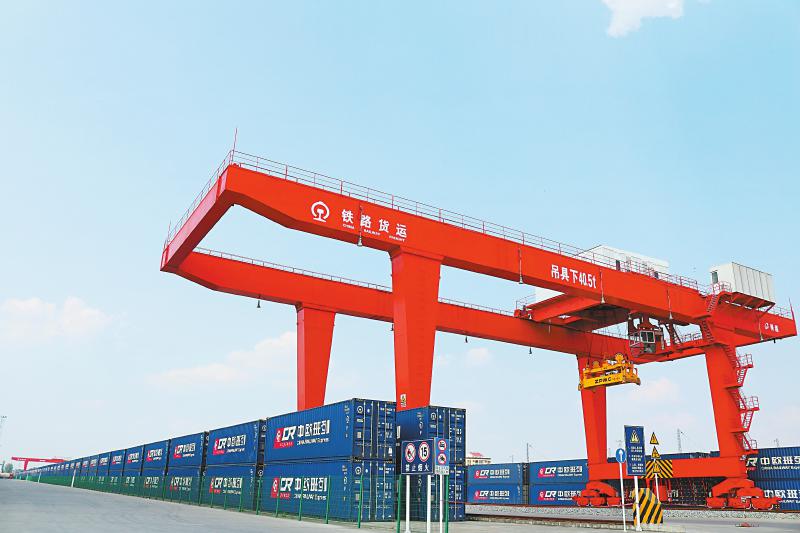
Core Viewpoint - Deyang is enhancing its level of openness by accelerating the construction of logistics ports and creating high-level open platforms to attract foreign investment [2] Group 1: Open Platform Development - The Deyang International Railway Logistics Port Customs Supervision Center has completed its first export business, marking a significant step in enhancing the city's open platform capabilities [2] - Deyang aims to strengthen its open platforms by focusing on the construction of an export processing industry cluster and striving to create a bonded logistics center [7] - The city plans to deepen the construction of various platforms, including free trade zones and cross-border e-commerce pilot zones, to promote trade and industrial integration [7] Group 2: Industry Opportunities - Deyang's high-end energy equipment and chemical materials industries are seizing the opportunity to expand internationally amid global energy transitions and supply chain restructuring [3][4] - Over 160 equipment manufacturing companies in Deyang are engaged in international business, with a cumulative trade volume exceeding 400 billion yuan [4] - The city has established a strong export presence, with significant contributions from companies like Longbai Sichuan Titanium Industry and Sichuan Meifeng, which have successfully penetrated overseas markets [3][4] Group 3: Logistics and Trade Facilitation - The newly operational Deyang International Railway Logistics Port will facilitate efficient connections between rail and sea transport, significantly reducing customs clearance time and logistics costs for local enterprises [5] - Deyang has actively integrated into the Belt and Road Initiative and the Western Land-Sea New Corridor, launching 454 international trains and establishing five international logistics routes [5] - The city has issued 1,464 RCEP certificates, enabling 520 million yuan worth of export goods to benefit from trade agreements [5][6] Group 4: Future Development Strategies - Deyang's strategy for higher openness focuses on enhancing platforms, channels, and the construction of open entities [7][8] - The city plans to host high-level international exhibitions and implement initiatives to promote local products abroad while also attracting foreign investment [8] - Deyang aims to develop a comprehensive transportation network that connects various modes of transport, enhancing its global connectivity [7]
增强制造业对经济大局的支撑力
Xin Lang Cai Jing· 2026-01-11 20:19
Core Viewpoint - The manufacturing industry is essential for national economic stability and security, and its development is crucial for enhancing competitiveness and ensuring economic autonomy [1]. Group 1: Manufacturing Industry's Role in Economic Stability - The stability of the manufacturing sector is vital for maintaining stable investment in the real economy, acting as a key driver for effective investment growth and structural optimization [2]. - In the first eleven months of 2025, despite overall investment pressures, industrial investment in China grew by 4.0% year-on-year, with manufacturing investment increasing by 1.9% [2]. - High-tech manufacturing industries saw a value-added increase of 9.2% year-on-year, indicating strong growth momentum and positioning as a core engine for economic growth [2]. Group 2: Manufacturing's Impact on Foreign Trade - A robust manufacturing sector underpins China's foreign trade competitiveness, with exports of electromechanical products reaching 12.07 trillion yuan in the first three quarters of 2025, a growth of 9.6% [3]. - High-tech product exports, including electronic information and high-end equipment, grew by 8.1% and 22.4% respectively, showcasing the innovation and competitive strength of China's manufacturing [3]. Group 3: Fiscal Stability and Public Spending - Manufacturing contributes approximately 30% to national tax revenue, highlighting its foundational role in supporting fiscal operations [4]. - A healthy manufacturing sector provides stable tax revenue, enabling government capacity for counter-cyclical adjustments and social development initiatives [4]. Group 4: Strategic Directions for Manufacturing - The manufacturing sector is transitioning towards high-end, intelligent, and green development, as emphasized by national leadership [4]. - The "14th Five-Year Plan" calls for promoting intelligent manufacturing and green production, aiming to strengthen the sector's role in the economy [4]. Group 5: High-End Development - Enhancing manufacturing high-end capabilities is crucial for driving investment and export growth, focusing on technology upgrades and product quality [5]. - The shift from price competition to quality competition is essential for strengthening foreign trade competitiveness [5]. Group 6: Intelligent Manufacturing - Promoting intelligent manufacturing can significantly improve operational efficiency and resilience, providing a solid foundation for macroeconomic stability [7]. - Implementing automation and smart systems in traditional manufacturing can enhance production efficiency and resource utilization [7]. Group 7: Green Development - Green development is integral to high-quality growth, with a focus on integrating sustainability into manufacturing processes [8]. - Engaging in international green standards and fostering green technology innovation can create new market demands and growth opportunities [8].
以93项“首台套”勇闯智造新路
Xin Lang Cai Jing· 2026-01-11 18:13
(来源:内蒙古日报) 数字背后,是一场深刻的产业变革。曾以"钢花飞溅"为标志的"草原钢城",正将创新的炉火燃向更广阔 的智造领域,一批突破性的"首台套"产品如同闪耀的新星,勾勒出向"装备智造之都"转型的生动轨迹。 走进国家电投扎哈淖尔煤业公司的露天矿场,传统柴油矿卡轰鸣刺耳、黑烟喷吐的景象正在被改变。数 台身披"北重绿"的巨无霸——由内蒙古北方重型汽车股份有限公司自主研发的NTE130E纯电动矿用自卸 车,正静默而有力地穿梭。它们不再是"油老虎",充电1小时即可持续工作5小时以上,在重载下坡时更 能将高达80%的能耗回收为电能,实现"行驶即充电"。矿卡司机王师傅切身体会到了这种改变。他 说:"以前驾驶室噪声大、柴油味重,现在几乎没噪声、零排放,还有智能系统护航,干活儿更安心 了。"这台"绿色巨人"不仅刷新了行业对新能源重卡的认知,其姊妹车型NTE150E更以136吨级载重,一 举填补了国内大吨位纯电动矿卡的空白。 视线转向包头装备制造产业园区,明阳智慧能源的生产车间内,工人们正在为一个"巨无霸"进行最后的 总装。这正是即将交付的MySE10-233陆上风电机组,其风轮扫风面积相当于6个标准足球场。工艺员李 国 ...
“AI+制造”国家方案发布 激发数十万亿增长新动能
Xin Lang Cai Jing· 2026-01-11 17:16
Core Viewpoint - The Chinese government is accelerating the integration of artificial intelligence (AI) with the manufacturing sector to promote intelligent transformation and drive economic growth through the issuance of the "AI + Manufacturing" implementation opinions and the "Industrial Internet and AI Integration Empowerment Action Plan" [1][2]. Group 1: Key Tasks and Goals - The "Opinions" outline seven key tasks including innovation foundation, intelligence upgrade, product breakthroughs, entity cultivation, ecological expansion, safety protection, and international cooperation, with 21 specific measures to enhance the intelligent, green, and integrated development of manufacturing [2][3]. - By 2027, the plan aims to implement 3 to 5 general large models in manufacturing, create 100 high-quality industrial data sets, and promote 500 typical application scenarios [2][3]. Group 2: Industry Focus and Applications - The focus industries for AI integration include raw materials, equipment manufacturing, consumer goods, electronic information, and software services, with specific guidance provided for each sector [3][4]. - In the automotive sector, the plan emphasizes the intelligent upgrade of the entire supply chain, including the development of large models for automatic design and optimization of vehicle parameters [3][4]. Group 3: Infrastructure and Support - The "Action Plan" emphasizes the need for new industrial networks to support AI applications, targeting the deployment of these networks in over 50,000 enterprises by 2028 [6][7]. - The plan also aims to enhance the quality of industrial data collection and sharing in 20 key industries, establishing a robust data governance framework [6][7]. Group 4: Local Initiatives - Various local governments are launching their own AI initiatives, such as Shanghai's three-year action plan to support advanced manufacturing and Beijing's plan to establish itself as an AI innovation hub [8][9]. - The establishment of dedicated AI development agencies in regions like Guangzhou and Zhuhai signifies a growing commitment to fostering AI-driven economic growth [9].
北京经开区技能大师工作室认定资助申报明日开启
Xin Lang Cai Jing· 2026-01-11 15:08
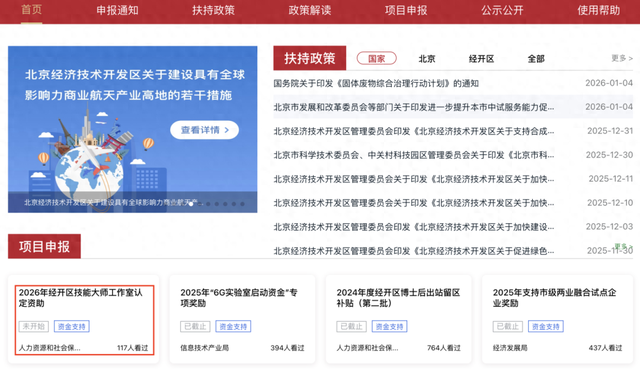
Core Viewpoint - The Beijing Economic-Technological Development Area (经开区) is launching a new policy to support the establishment of high-skill talent teams through the recognition and funding of skill master studios, starting from January 12, 2026 [1]. Group 1: Policy Details - The application period for the skill master studio recognition and funding project is from January 12 to February 11, 2026, with submissions made through the official website [1]. - Eligible units that are recognized as skill master studios for the first time will receive a one-time funding of 200,000 yuan, with additional rewards for those achieving national or municipal recognition [2][3]. Group 2: Progress and Impact - In 2025, the Economic-Technological Development Area recognized 5 new district-level skill master studios, distributing a total of 1 million yuan in one-time funding [3]. - By the end of 2025, there were a total of 15 district-level skill master studios recognized, covering key industries such as integrated circuits and equipment manufacturing [3]. - The annual assessment of 10 studios recognized in 2024 led to the identification of 2 outstanding units, which received an additional 200,000 yuan in rewards, enhancing innovation and creating a positive demonstration effect across the area [3]. Group 3: Future Plans - The Economic-Technological Development Area aims to continue focusing on enterprise development and talent needs, enhancing service response efficiency and building a more systematic and diversified high-skill talent training system [3].
“AI+制造”国家方案发布,激发数十万亿增长新动能
Di Yi Cai Jing· 2026-01-11 13:05
Group 1 - The core viewpoint of the news is the promotion of the integration of artificial intelligence (AI) with the manufacturing industry, aiming to accelerate the intelligent transformation of manufacturing and enhance economic growth through AI technology [1][2][4]. - The Ministry of Industry and Information Technology (MIIT) and eight other departments have issued the "Implementation Opinions on the Special Action of 'AI + Manufacturing'," which outlines seven key tasks to promote the dual empowerment of AI technology and manufacturing applications [1][2]. - By 2028, the goal is to have at least 50,000 enterprises implement "AI + Industrial Internet" upgrades, significantly improving the integration level of industrial internet and AI [1][6]. Group 2 - The "Implementation Opinions" aim to drive the deep application of 3 to 5 general large models in manufacturing by 2027, creating specialized industry models and promoting 500 typical application scenarios [2][3]. - The focus is on fostering 2 to 3 globally influential leading enterprises and a batch of specialized small and medium-sized enterprises, while establishing a global leading open-source ecosystem [2][3]. - Specific measures include promoting the development of intelligent chips, supporting breakthroughs in key technologies, and enhancing the safety governance capabilities of AI [3][4]. Group 3 - The industrial internet is identified as a crucial carrier for the integration of AI and manufacturing, with plans to expand new industrial networks to meet the demands of AI applications [6][7]. - The MIIT emphasizes that AI is transitioning from being an auxiliary tool to becoming a core engine for industrial internet, enhancing real-time optimization and intelligent scheduling capabilities [7][8]. - Local governments are actively formulating their own "AI +" plans to drive high-quality development across various industries, with specific targets for manufacturing enterprises and AI core industry growth [8][9].
华源晨会精粹20260111-20260111
Hua Yuan Zheng Quan· 2026-01-11 12:15
Group 1: Public Utilities and Environmental Protection - The commercial aerospace sector is experiencing robust growth driven by policy support, indicating a critical turning point in the industry cycle [7][8] - Solar photovoltaic (PV) technology is identified as the primary energy source for satellites, with significant market potential projected at 80-120 billion yuan globally, assuming 4,000-6,000 satellites are launched annually [8] - The transition from traditional multi-junction gallium arsenide to P-type HJT and perovskite/silicon tandem technologies is expected to enhance the efficiency and cost-effectiveness of solar panels in space applications [9] - Key recommendations include companies like Maiwei Co., Ltd., Goldwind Technology, and CIMC Anrui Technology, with a focus on related equipment and battery component firms [9] Group 2: North Exchange Market - In 2025, the North Exchange is set to accept 176 companies, accounting for over 64% of the total IPOs in the A-share market, indicating a significant influx of quality enterprises [11][12] - The average net profit for new companies in 2024 is projected at 9.523 million yuan, with 47% of these companies expected to exceed 8 million yuan in net profit [12] - The North Exchange market has shown strong recovery, with the North Index rising by 5.82%, suggesting a stable upward trend in the market [13] Group 3: New Consumption - Recent policies encourage cultural and tourism consumption, including the issuance of vouchers for travel and cinema, aimed at enhancing collective activities among workers [16] - The strategic partnership between Mao Geping and L Catterton Asia Advisors aims to expand global market reach and optimize capital structure, indicating growth potential for high-end cosmetic brands [17] - The report highlights the importance of understanding new consumer narratives, particularly among younger generations, to identify growth opportunities in emerging consumer brands [18] Group 4: CIMC Anrui Technology - CIMC Anrui Technology has achieved record-high orders, with a focus on clean energy, chemical environment, and liquid food sectors, indicating a diversified growth strategy [20][21] - The clean energy segment is expected to benefit from rising LNG demand and the low-carbon transition in the shipping industry, with new orders reaching 169.9 billion yuan in 2025 [22][23] - The company is positioned to leverage its capabilities in commercial aerospace, with anticipated revenues and orders nearing 100 million yuan by 2025 [24]



人民日报刊发第五篇钟才平署名文章|宏观经济
清华金融评论· 2026-01-11 08:38
Group 1 - The core viewpoint emphasizes the importance of improving people's livelihoods as a driving force for economic development, highlighting the need to expand domestic demand and create a strong domestic market as a foundation for economic growth [3][4][5]. - The article discusses the significant potential for high-quality development in the real estate sector, noting that while urban housing stock is substantial, many residents still have unmet housing needs, particularly in terms of quality and location [4][5]. - It highlights the changing consumer preferences towards service consumption, with a notable increase in per capita service consumption expenditure from 5,000 yuan to 13,000 yuan between 2013 and 2024, indicating a shift towards experiential and emotional consumption [5][6]. Group 2 - The article outlines the necessity of creating a virtuous cycle of employment, income, consumption, and investment, emphasizing the importance of stabilizing employment and increasing income to boost consumption [7]. - It stresses the need for coordinated efforts to promote both consumption and investment, suggesting that they are interdependent and should work together to enhance the domestic market's growth and stability [8][9]. - The article calls for increased investment in sectors that align with new consumer demands, such as healthcare and cultural tourism, to better meet the needs of the population [10][11]. Group 3 - The article discusses the implementation of more proactive macroeconomic policies, including fiscal and monetary measures, to support economic stability and growth, with a focus on enhancing the effectiveness of these policies [25][26]. - It emphasizes the importance of precise and effective fiscal policies, advocating for increased government spending on key projects and social welfare to stimulate economic activity [26][27]. - The article also highlights the need for flexible monetary policies that adapt to changing economic conditions, ensuring liquidity and supporting the real economy [28][29].