
宠物

Search documents
吃穿住行皆讲究,宠物年货向“拟人化”演进
Xin Jing Bao· 2026-02-13 09:14
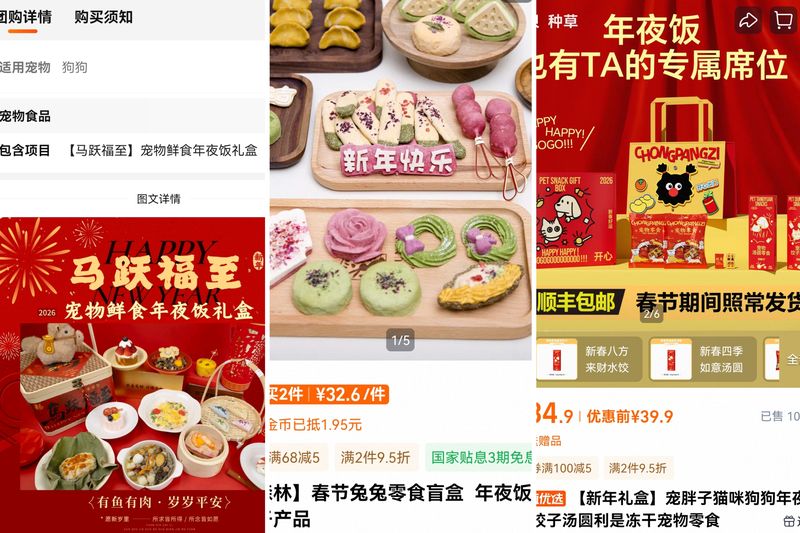
Core Insights - The pet market during the Spring Festival has evolved significantly, with a shift towards "humanized" consumption, focusing on quality and diversity in food, clothing, and services for pets [1] Pet New Year Dinner - Pet New Year dinners have become a standard for many pet-owning families, with social media buzzing with inquiries and recommendations for pet meal options [2] - Prices for pet New Year dinner packages range from 150 to 300 yuan, with some offerings resembling gourmet human meals [2] - The demand for these meals has surged, with many businesses reporting full bookings weeks in advance [2][4] Pet Clothing and Accessories - The trend of dressing pets in new outfits for the New Year has gained popularity, with a reported 330% increase in demand for pet clothing [5] - Pet owners are increasingly purchasing themed accessories and outfits, reflecting a desire to include pets in family celebrations [6][7] Pet Boarding Services - The demand for pet boarding services has increased significantly, with a 46% month-on-month rise in January, particularly for dogs [8] - Many pet boarding facilities are fully booked ahead of the holiday, indicating a strong market for these services [8] Pet Travel and Equipment - There is a growing trend of pet owners wanting to travel with their pets, supported by improvements in transportation services, including pet-friendly train and airline options [11][12] - The market for pet travel equipment has seen substantial growth, with specific products like car seat covers and GPS trackers experiencing significant sales increases [12]


源飞宠物与潮玩品牌达成战略合作 股价近期震荡
Jing Ji Guan Cha Wang· 2026-02-13 06:02
Group 1 - The core viewpoint of the article highlights the strategic partnership between Yuanfei Pet (源飞宠物) and the trendy toy brand Heyone (黑玩), focusing on the "pet + trendy toy" sector to explore new consumer scenarios through supply chain management capabilities [1] Group 2 - In the recent stock performance, Yuanfei Pet's stock price has shown significant fluctuations, with a recent price of 22.13 yuan, reflecting a slight increase of 0.05% after a 0.85% decline over the past five days [2] - The trading volume on February 12 was 33.25 million yuan, indicating a net outflow of main funds, with the technical support level noted at 22.12 yuan [2] Group 3 - For the financial report analysis, Yuanfei Pet reported a revenue of 1.281 billion yuan for the first nine months of 2025, representing a year-on-year growth of 37.66%, while the net profit attributable to the parent company was 130 million yuan, up by 8.75% [3] - The gross profit margin remained stable at 22.99%, with overseas revenue accounting for 85.78% of total revenue, benefiting from the depreciation of the RMB [3] Group 4 - Institutional views suggest a target price of 23.98 yuan for Yuanfei Pet, indicating a potential upside of approximately 7.39% from the current stock price [4] - The forecast for net profit growth in 2025 is projected at 9.33%, with a stable long-term revenue growth expectation, although market sentiment is neutral, necessitating attention to inventory turnover and capacity optimization progress [4]
城事·马上春来︱“毛孩子”们怎么过节?
Xin Lang Cai Jing· 2026-02-13 01:15
春节将至,"宠物家长"做出行规划时,如何安置家中的"毛孩子"?《2026年中国宠物行业白皮书(消费 报告)》显示,2025年城镇宠物(犬猫)数量为1.26亿只,消费市场规模达3126亿元。庞大的"它经 济"市场,催生了宠物行业的新场景、新需求。 2026年1月 31日,在北京市昌平区"北京犬时代宠物公园"内的宠物庙会上,宠物主人与宠物合影。新华社 图 不少养宠人士的理念已从简单的"喂养责任"逐渐转为"情感价值"付费,春节期间对"毛孩子"的安置已不 仅是"居家留守"或"开车带走"的粗放选择。与主人一同乘机、一同拍摄"全家福"、定制年夜饭、定制旅 行——"毛孩子们"过春节的场景愈加多元。 2026年2月2日,在湖北省武汉市,焦思勤出发前与宠物狗"哈尼"互动。焦思勤在湖北武汉工作,老家在 河南漯河,今年她选择带宠物自驾回家过年。新华社 图 宠物托运服务升级 自2025年4月8日起,铁路部门在京沪高铁部分车次试点高铁宠物托运服务。 3日,在深圳北站中铁快运营业部,吴滢安抚她的宠物狗进入宠物托运专用箱。新华社 图 2月6日, 2026年2月 2026年 2月 3日,在深圳北站中铁快运营业部,工作人员展示宠物托运专用箱内 ...

新春走基层|春节宠物经济升温:“毛孩子”的别样“团圆年”
Zhong Guo Xin Wen Wang· 2026-02-13 00:24
Group 1 - The pet boarding market in Ningxia, particularly in Yinchuan, is experiencing unprecedented demand as the Spring Festival approaches, reflecting a unique consumption trend in the pet economy [1][2] - Pet owners are increasingly treating their pets as family members, with many making early reservations for boarding services, indicating a shift in consumer behavior and spending patterns [1][2] - The prices for pet boarding services have seen a tiered increase, with small dogs costing 88 yuan per day and large dogs 138 yuan per day, leading to full bookings well in advance of the holiday [1][2] Group 2 - Pet stores are enhancing service quality to meet the surge in demand, offering standardized services such as daily walks for dogs and attentive care for cats, including real-time updates for pet owners [2][3] - There has been a significant increase in the sales of pet supplies, with pet owners purchasing food, litter, and other essentials in preparation for the holiday, indicating a robust market for pet products [2][3] - The variety and inventory of pet supplies have expanded, ranging from basic food and leashes to high-end smart feeding devices and automatic litter boxes, showcasing the resilience and diversity of the pet economy [3]
波奇宠物股价震荡回落,宠物消费市场热度不减
Jing Ji Guan Cha Wang· 2026-02-12 23:01
近期事件 近期宠物消费市场热度持续,或间接影响行业关注度。依依股份(001206)于2月10日宣布终 止收购高爷家,并聚焦宠物智能用品与医疗赛道,反映行业整合与战略调整。同时,"猫咪语言"APP在 1月底登顶苹果付费榜,单日下载量暴涨,凸显宠物情感消费需求升温;春节期间宠物庙会、旅行及摄 影市场崛起,印证千亿级市场潜力。此外,新瑞鹏集团旗下动物医院频遭投诉,涉及医疗安全隐患,可 能引发对宠物服务行业监管的担忧。 以上内容基于公开资料整理,不构成投资建议。 经济观察网 波奇宠物(BQ.AM)近7天股价波动显著,呈现先扬后抑态势。根据内部数据库,截至2026 年2月12日,最新收盘价为1.29美元,当日微涨0.20%。关键波动包括:2月6日单日大涨12.61%至1.34美 元,但随后震荡回落,2月11日收于1.29美元(单日跌3.01%)。从2月5日至2月12日,区间累计涨跌幅 为-8.51%,振幅达29.08%,交易活跃度先升后降,2月6日成交量峰值达54.92万股,2月12日降至1.67万 股,显示短期投机情绪降温。同期美股零售板块微涨1.43%,大盘指数小幅调整,个股波动可能受流动 性及市场情绪驱动。 ...

行业龙头发公告:终止收购
Nan Fang Du Shi Bao· 2026-02-12 16:12
Core Viewpoint - Yiyi Co., Ltd. has announced the termination of its planned acquisition of 100% equity in Gao Ye Jia, a pet food company, due to discrepancies in operational expectations and valuation agreements with the sellers [3][4]. Group 1: Acquisition Details - The acquisition was initially announced in October 2025, with Yiyi planning to purchase Gao Ye Jia through a combination of share issuance and cash payment, including a goodwill payment of 30 million yuan to the sellers [3]. - After four months of planning, Yiyi decided to terminate the acquisition due to Gao Ye Jia's sales adjustments during the 2025 Double Eleven shopping festival and the impact of new product promotions on its financial performance [3][4]. - Yiyi and the sellers could not reach an agreement on key commercial terms, leading to the decision to terminate the transaction in a mutual and amicable manner [3][4]. Group 2: Company Performance - Yiyi Co., Ltd. reported a revenue of 1.306 billion yuan for the first three quarters of 2025, a slight decline of 0.72% year-on-year, while the net profit attributable to shareholders was 156 million yuan, an increase of 3.82 million yuan [8]. - The company’s revenue from its core pet hygiene business was 417 million yuan, down 4.17% year-on-year, with a net profit of 54 million yuan, a decrease of 2.23% [8]. - Despite being a leader in the pet hygiene sector, Yiyi's revenue and profit figures are relatively small compared to major players in the pet food market, such as Guai Bao Pet and Zhong Chong Co., Ltd., which reported revenues of 4.737 billion yuan and 3.86 billion yuan respectively for the same period [8]. Group 3: Future Outlook - Yiyi Co., Ltd. aims to establish a comprehensive "supplies + food + medical" industry chain, but the termination of the Gao Ye Jia acquisition puts its pet food market expansion plans on hold [9]. - The company has announced a partnership with Beijing Fangyuan Jinding to invest 70.2 million yuan in Ruipai Pet Hospital, a leading pet hospital operator in China, which could enhance Yiyi's distribution channels and brand influence [9]. - The future of Yiyi's investment in the pet medical sector and potential adjustments to its pet food strategy remain uncertain following the acquisition's termination [9].

海通国际发布中宠股份研报:掘金全球宠物经济,品牌与供应链优势打开增量空间
Sou Hu Cai Jing· 2026-02-12 12:51
Group 1 - The core viewpoint of the article is that Haitong International has given Zhongchong Co., Ltd. (002891.SZ) an "outperform" rating based on several factors [1] - The pet industry is expected to benefit from the "silver economy" and "single economy," leading to a continuous increase in the market share of domestic brands [1] - Competition in the pet industry is anticipated to intensify from 2025 onwards, which may pressure profit margins; however, Zhongchong's product upgrades are expected to drive both revenue and profit growth [1] - The scarcity of overseas factory layouts supports high gross margins, and the company is steadily advancing its own brand internationally by leveraging global production capacity [1] Group 2 - Notable investments have been made by prominent investors, with Ge Weidong and Fang Wenyuan each investing 1 billion yuan, resulting in a significant increase in the company's stock price [1] - Historical analysis shows that participation by major investors in private placements has resulted in both gains and losses [1]
经济越来越差,这八大行业越赚爆!
创业家· 2026-02-12 10:52
Core Insights - The article emphasizes that despite the prevailing narrative of economic hardship, certain industries are thriving and generating substantial profits, particularly in the context of Japan's "lost 30 years" and its implications for various sectors [3]. Group 1: Economic Trends and Opportunities - The concept of a "low-desire society" does not equate to a lack of opportunities, as there are still significant business prospects available [4]. - The article identifies "consumption stratification" and "demand migration" as the largest commercial opportunities in the current market [5]. - As consumers shift away from purchasing homes and luxury goods, money is flowing into the second-hand economy, with notable growth in Japan's second-hand luxury market represented by companies like Daikokuya [6]. - In China, platforms like Hongbulin and Panghu are experiencing significant business growth in the second-hand market [7]. Group 2: Emerging Consumer Trends - The article highlights the rise of the pet economy, noting that while young people may not be having children, they are willing to spend on premium pet products [11]. - Companies like Inaba in Japan and Guobao (Zhongchong) in China are seeing strong stock performance due to the growing demand for pet food and related services [12]. - The adult care market is also expanding, with Japan's adult diaper market surpassing $10 billion, indicating a significant growth potential for similar products in China [16][18]. - Health-conscious food and beverage products are gaining traction, with brands like Suntory and Meiji seeing substantial growth due to changing population demographics and rising health awareness [21]. Group 3: Lifestyle and Emotional Spending - The "beauty economy" is thriving, with products like collagen supplements and home beauty devices achieving significant sales, indicating that consumers prioritize beauty even in challenging economic times [23]. - Outdoor leisure activities are becoming popular, with brands like Snow Peak in Japan and various Chinese outdoor brands experiencing rapid sales growth [25][26]. - The emotional economy is also on the rise, with brands like Labubu and Rio catering to consumers' desires for emotional fulfillment and experiences [28][29]. - The "lazy economy" reflects a trend where younger generations prefer convenience, leading to increased demand for frozen foods and smart home appliances that save time [33][35]. Group 4: Market Resilience and Strategic Insights - The article argues that the current economic climate, often perceived as a "winter," presents opportunities for those willing to invest in counter-cyclical sectors [39]. - Companies that can identify and capitalize on these emerging trends are likely to emerge as winners in the low-desire era, as time-saving solutions may hold more commercial value than cost-saving measures [36].

瑞普生物(300119.SZ):拟与专业投资机构共同投资设立并购产业基金
Ge Long Hui A P P· 2026-02-12 09:58
格隆汇2月12日丨瑞普生物(300119.SZ)公布,为推进公司核心战略落地,拓展重点领域业务边界与行业 影响力,充分借助专业机构的资本与资源优势,瑞普生物股份有限公司于2026年2月12日与海通并购 (上海)私募基金管理有限公司(简称"海通并购资本")、海通开元投资有限公司(简称"海通开元投 资")、高邮市产业引导基金(有限合伙)(简称"高邮产业引导基金")及关联方天津瑞晟私募基金管 理有限公司(简称"瑞晟私募")签署《江苏国泰海通瑞普并购产业基金合伙企业(有限合伙)之合伙协 议》,拟共同出资设立江苏国泰海通瑞普并购产业基金合伙企业(有限合伙)(暂定名,以市场监督管 理机关核准的名称为准,简称"合伙企业")。该合伙企业将聚焦动物保健、合成生物、宠物、生物医药 等重点领域开展产业投资。合伙企业认缴出资总额为人民币10亿元,其中,公司作为有限合伙人以自有 资金及自筹资金出资人民币2.95亿元,占合伙企业认缴出资总额的29.50%。 ...

瑞普生物:拟与专业投资机构共同投资设立并购产业基金
Ge Long Hui· 2026-02-12 09:55
格隆汇2月12日丨瑞普生物(300119.SZ)公布,为推进公司核心战略落地,拓展重点领域业务边界与行业 影响力,充分借助专业机构的资本与资源优势,瑞普生物股份有限公司于2026年2月12日与海通并购 (上海)私募基金管理有限公司(简称"海通并购资本")、海通开元投资有限公司(简称"海通开元投 资")、高邮市产业引导基金(有限合伙)(简称"高邮产业引导基金")及关联方天津瑞晟私募基金管 理有限公司(简称"瑞晟私募")签署《江苏国泰海通瑞普并购产业基金合伙企业(有限合伙)之合伙协 议》,拟共同出资设立江苏国泰海通瑞普并购产业基金合伙企业(有限合伙)(暂定名,以市场监督管 理机关核准的名称为准,简称"合伙企业")。该合伙企业将聚焦动物保健、合成生物、宠物、生物医药 等重点领域开展产业投资。合伙企业认缴出资总额为人民币10亿元,其中,公司作为有限合伙人以自有 资金及自筹资金出资人民币2.95亿元,占合伙企业认缴出资总额的29.50%。 ...