
氨纶

Search documents
化工行业2026年度投资策略:周期破晓,关注反内卷政策与国产替代两大主线
Huaan Securities· 2025-12-17 02:53
Investment Strategy Overview - The report emphasizes two main investment themes for the chemical industry: anti-involution policies and domestic substitution, which are expected to drive recovery and growth in the sector [4][5][6] Anti-Involution and Cycle Recovery - The report suggests that the chemical industry is at a turning point, with anti-involution measures leading to a recovery in the cycle. Key areas include the peak of new capacity in organic silicon, the end of PTA capacity expansion, and a rebound in prices for certain chemicals due to supply chain disruptions [4][5] - The China Chemical Product Price Index (CCPI) has decreased significantly, dropping to 3865 points by November 30, 2025, down 16.37% from early 2024 and 10.71% from the beginning of 2025 [4][20] Domestic Substitution as a Growth Driver - Domestic substitution is highlighted as a key growth driver, with significant support from national policies for bio-based materials and advancements in technology leading to a more robust domestic supply chain [4][6] - The report identifies several companies positioned to benefit from these trends, including KaiSai Bio and RuiFeng New Materials, which are making strides in bio-based materials and lubricant additives, respectively [5][6] Market Dynamics and Price Recovery - The report notes that while the chemical market is experiencing a downturn, certain segments are expected to see price recovery due to improved supply-demand dynamics and reduced capacity expansion [4][22] - Specific chemical products have shown varied price movements, with some experiencing significant declines while others are stabilizing or recovering [22] Manufacturing Sector Recovery - The manufacturing sector is showing signs of recovery, which is anticipated to support the chemical industry. The report mentions that the real estate market is stabilizing, and automotive production has increased, indicating a potential uptick in demand for chemical products [25][33] Capital Expenditure Trends - Capital expenditure growth in the chemical industry is slowing, with a notable decline in new projects. The report indicates that the total construction in progress for the chemical sector was 327.57 billion yuan in Q3 2025, down 17.64% year-on-year [34][39] Inventory and Consumption Trends - High inventory levels in the chemical sector are being addressed as consumer demand begins to recover. The report suggests that the inventory-to-revenue ratio for the basic chemical industry was 0.62 in Q3 2025, indicating a slight increase from the previous year [41][42] Profitability and Financial Performance - The report highlights a recovery in profitability for the chemical industry, with gross margins and return on equity (ROE) showing improvement in Q3 2025 compared to previous periods [56][60] - Specific sub-sectors, such as agrochemicals and fluorochemicals, have demonstrated significant profit growth, with some exceeding 100% year-on-year increases [55][56]


氨纶行业更新
2025-12-17 02:27
Summary of the Conference Call on the Spandex Industry Company Overview - **Company**: Huang Hai Company - **Industry**: Spandex Key Points and Arguments 1. **Financial Recovery**: Huang Hai Company faced bankruptcy restructuring due to financial strain, shareholder disputes, and losses from Inner Mongolia projects. Currently, the company is improving its operations through inventory clearance and accounts receivable collection, with an annual production of approximately 130,000 tons and an operating rate of 66% [2][4][12]. 2. **Production and Capacity**: The company has reduced production scale and secured sufficient operating funds through internal shareholder investments and external financing. The total debt ratio is between 65% and 70%, primarily from asset pledges and government-coordinated loans [2][6][10]. 3. **Cost Structure**: The complete cost of spandex production is around 24,000 RMB per ton, which is competitive with market prices. The company can save 1,000 to 1,500 RMB per ton by using self-produced raw materials from its Inner Mongolia PTMEG and BDO projects, which have stable production capabilities [2][7][8]. 4. **Inventory Management**: Current inventory stands at approximately 20,000 tons, equivalent to 60 days of production. The company is prioritizing inventory clearance to improve cash flow and has controlled production to manage high inventory levels [2][11][12]. 5. **Market Dynamics**: The spandex industry is experiencing a divergence in operational performance among companies. For instance, Huafeng has a lower inventory level of about 45 days, while the industry average is around 50 days. Huafeng is expanding production despite high inventory to leverage economies of scale and pressure smaller competitors [3][22]. 6. **Bankruptcy Risks**: Huang Hai Company does not currently have bankruptcy plans, as it has managed to stabilize operations. The company is optimistic about its future, especially if raw material supply remains smooth and inventory levels decrease [14][12]. 7. **Employee Stability**: The company currently employs about 1,500 staff, with a focus on retaining core technical personnel to ensure operational continuity when business recovers [19]. 8. **Industry Challenges**: Other companies in the spandex sector, such as Banglian and Sihai, are facing significant challenges, including high inventory and financial costs, leading to potential market exits. The overall market sentiment is cautious, with many companies considering asset sales for recovery [13][20]. 9. **Future Plans**: Huang Hai Company plans to continue reducing operational scale and producing low-margin products to maintain normal operations. The company is also focusing on collecting accounts receivable to improve cash flow during the year-end period [4][15]. 10. **Competitive Landscape**: Companies like Huafeng and Shultz are expanding their production capacities, with Huafeng investing in new facilities and Shultz acquiring smaller firms to enhance its market position. This competitive strategy aims to consolidate market share and drive smaller players out of the market [26][27]. Additional Important Information - **Government Support**: The local government is actively involved in supporting Huang Hai Company, which is crucial for its operational stability [17][18]. - **Debt Management**: The company is managing its debt through shareholder support and external loans, with a significant portion of funding coming from internal channels [10][12]. - **Market Outlook**: The spandex industry is expected to see further consolidation, with potential exits of weaker players as market conditions evolve [20][22].
兴业证券:化工周期拐点即将到来 新兴需求助力升级
Zhi Tong Cai Jing· 2025-12-16 06:39
Group 1: Chemical Industry - The chemical industry is expected to experience a cyclical recovery and industrial upgrade by 2026, following three years of bottom-range operation for chemical products [1] - The growth rate of ongoing projects in the industry continues to decline, and the new capacity release is nearing its end [1] - Domestic policies aimed at stable growth and the Federal Reserve entering a rate-cutting cycle are anticipated to support a mild recovery in traditional chemical product demand [1] - The "anti-involution" trend is expected to accelerate the cyclical turning point, benefiting core chemical assets with global competitive advantages, leading to profit and valuation recovery [1] - Sub-industries such as organic silicon, PTA, polyester filament, caprolactam, spandex, soda ash, PVC, glyphosate, and urea are expected to see profit recovery due to industry self-discipline and price control measures [1] Group 2: Pesticide Industry - The pesticide industry is entering a phase where inventory reduction is nearing completion, with signs of recovery in market conditions [2] - The global pesticide channel inventory is expected to approach reasonable levels by 2025, with some products already seeing price increases [2] - The industry is anticipated to shift towards capacity reduction in the next two years, favoring companies with cost advantages and strong market channels [2] - The concentration of the industry and the pricing power of leading enterprises are expected to increase [2] - Domestic companies are making significant progress in the research, production, and marketing of innovative pesticides, with leading firms likely to achieve high value-added upgrades [2] Group 3: Tire Industry - The tire industry is facing an upgrade in international trade barriers, which may present opportunities for companies with global layouts [3] - The EU's anti-dumping investigation against Chinese tires is expected to conclude by early 2026, potentially leading to higher tariffs [3] - If high anti-dumping duties are imposed, domestic semi-steel tire exports may be hindered, creating a demand gap in the EU market that could be filled by other regions [3] - This supply-demand mismatch may lead to price increases, benefiting leading tire companies with overseas production bases and expansion plans [3] Group 4: Emerging Industries - The path to carbon reduction is challenging, but the AI industry continues to thrive alongside the development of sustainable aviation fuel (SAF), bio-based materials, carbon capture, utilization, and storage (CCUS), electronic resins, liquid cooling materials, and lithium battery materials [4] - Europe is set to initiate its SAF era in 2025, with mandatory standards for bio-based plastics expected by 2027 [4] - CCUS is a core component of the European Green Deal, and similar policies are anticipated in China under its dual carbon strategy [4] - The demand for AI computing power remains strong, with electronic resins and liquid cooling materials identified as key upgrade directions [4] - AIDC storage is expected to become a significant growth area for lithium battery materials [4]

化工板块震荡盘整!机构高呼板块正处估值盈利双底,中长期买点已现?
Xin Lang Ji Jin· 2025-11-26 05:39
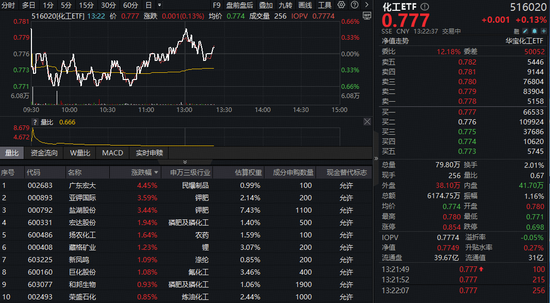
Core Viewpoint - The chemical sector is currently experiencing a phase of consolidation, with the chemical ETF (516020) showing slight upward movement after initial low-level fluctuations, indicating potential investment opportunities in specific sub-sectors like ammonium explosives, potash, and phosphate chemicals [1][4]. Group 1: Market Performance - The chemical ETF (516020) saw a price increase of 0.13% during the trading session, reflecting a slight recovery in the sector [1][2]. - Key stocks in the sector, such as Guangdong Hongda, Yada International, and Salt Lake Co., have shown significant gains, with Guangdong Hongda rising over 4% [1][2]. Group 2: Industry Insights - The chemical industry is positioned at a dual bottom in terms of valuation and profitability, with expectations of demand improvement due to the Federal Reserve's potential interest rate cuts and stabilization in global political conditions [1][3]. - Cost pressures are anticipated to ease, with oil and coal prices expected to remain under pressure, leading to weaker cost support for chemical products [1][3]. - The construction of new projects in the basic chemical sector is projected to decline by 12.4% year-on-year in the first half of 2025, indicating a tightening supply situation [1][3]. Group 3: Investment Recommendations - Analysts suggest focusing on sectors that may benefit from supply-side improvements and have high profitability elasticity, such as pesticides, organic silicon, and polyester filament [3][4]. - The chemical ETF (516020) is recommended for investors looking to capitalize on the sector's rebound, as it tracks a comprehensive index covering various sub-sectors, with significant allocations to leading companies [4].

中国银河证券:化工业供需双底基本确立 2026年或开启“戴维斯双击”
智通财经网· 2025-11-25 09:13
Group 1: Oil and Chemical Industry Outlook - China Galaxy Securities forecasts Brent crude oil prices to range between $60-70 per barrel by 2026, with costs expected to stabilize [1] - The chemical industry is experiencing negative capital expenditure growth since 2024, with supply expected to contract due to the "anti-involution" trend and accelerated elimination of outdated overseas capacity [1] - The "14th Five-Year Plan" draft emphasizes expanding domestic demand, combined with the onset of the US interest rate cut cycle, which is expected to open up demand for chemical products [1] - A dual bottom in supply and demand is anticipated, with strong policy expectations catalyzing a potential cyclical upturn in the chemical industry by 2026, leading to a "Davis Double Play" from valuation recovery to earnings growth [1] Group 2: Specific Chemical Sector Recommendations - PTA industry is operating at low levels, with increasing calls for anti-involution; recommended companies include Hengli Petrochemical, Rongsheng Petrochemical, Xinfon Ming, and Tongkun [1] - Polyester filament capacity is becoming concentrated, with industry self-discipline enhancing cyclical elasticity; recommended companies include Xinfon Ming, Tongkun, and Hengyi Petrochemical [1] - The spandex industry is expected to see increased concentration; recommended companies include Huafeng Chemical and Xinxiang Chemical Fiber [1] - Global demand for pesticides is improving, with bottom-priced varieties likely to rebound; recommended companies include Yangnong Chemical, Runfeng Shares, Jiangshan Shares, Guangxin Shares, and Lier Chemical [1] - Organic silicon capacity expansion is nearing completion, with supply-demand dynamics expected to improve; recommended companies include Hesheng Silicon Industry, Xin'an Shares, and Dongyue Silicon Material [1] - The titanium dioxide industry is facing challenges and opportunities; recommended company is Longbai Group [1] - Refining capacity is being optimized, with a shift from oil to chemicals enhancing effective supply; recommended companies include Sinopec, PetroChina, Rongsheng Petrochemical, and Hengli Petrochemical [1] Group 3: Demand-Supported Chemical Sectors - Strong pricing power from suppliers is expected to sustain high demand for potash fertilizers; recommended companies include Yara International and Dongfang Iron Tower [2] - Phosphate supply and demand remain tight, benefiting resource-based companies; recommended companies include Batian Shares, Yuntianhua, Xingfa Group, and Chuanheng Shares [2] - Strict quota policies are expected to sustain high demand for refrigerants; recommended companies include Juhua Co., Sanmei Co., and Yonghe Co. [2] - Amino acids are expected to maintain their upward trend, with overseas capacity gradually exiting; recommended companies include New Hope Liuhe, Andisu, and Meihua Biological Technology [2] - The chlorinated sugar market is anticipated to see anti-involution, with significant potential for allulose; recommended companies include Jinhui Industrial, Bailong Chuangyuan, and Baolingbao Biology [2] - Vitamins are leading the current round of chemical price increases, entering the second phase; recommended companies include New Hope Liuhe and Zhejiang Medicine [2] - The EU's preliminary anti-dumping ruling is expected to reassess the value of overseas tires; recommended companies include Sailun Tire and Senqilin [2] - The civil explosives industry is developing steadily, with policy guidance likely accelerating industry consolidation; recommended companies include Guangdong Hongda, Yipuli, and Jiangnan Chemical [2] Group 4: New Materials and Technologies - Lightweight humanoid robots may benefit from PEEK as a key solution; recommended companies include Zhongyan Shares, Water Shares, and Guoen Shares [3] - AI is driving global demand for computing power, with electronic-grade PPO expected to grow; recommended companies include Shengquan Group and Dongcai Technology [3] - The domestic substitution of core chip materials, particularly photoresists, is accelerating; recommended companies include Wanrun Shares and Dinglong Shares [3]

中原证券:前三季度盈利增速提升 化工业延续底部复苏
智通财经网· 2025-11-21 07:05
Core Viewpoint - Zhongyuan Securities maintains a "market perform" investment rating for the basic chemical industry, suggesting investment opportunities in sectors benefiting from supply-side improvements and resource attributes under the backdrop of Federal Reserve interest rate cuts [1] Group 1: Industry Performance - In the first three quarters of 2025, the basic chemical industry achieved total revenue of 19,924.77 billion yuan, a year-on-year increase of 5.69%, and a net profit of 1,170.62 billion yuan, up 7.58% year-on-year, indicating a continued recovery in industry profitability [2] - All 18 sub-industries within the basic chemical sector reported year-on-year revenue and profit growth, with significant differentiation among them, driven by improved supply-demand dynamics and demand recovery [3] Group 2: Profitability Trends - The basic chemical industry's gross margin and net margin have shown signs of recovery since early 2024, with gross margin at 17.69% and net margin at 6.17% in the first three quarters of 2025, both reflecting slight year-on-year increases [4] - Sub-industries such as fluorine chemicals, potash fertilizers, synthetic resins, chlor-alkali, and compound fertilizers have experienced notable improvements in profitability [4] Group 3: Financial Indicators - The basic chemical industry maintains a stable financial position, with a slight decrease in the asset-liability ratio, improved operating cash flow, and a decline in construction projects [5] - Inventory turnover days have increased slightly year-on-year, indicating changes in inventory management [5] Group 4: Regional Performance - Chemical enterprises in Henan province underperformed compared to the overall industry, with revenues of 564.21 billion yuan and 188.98 billion yuan in the first three quarters and third quarter respectively, reflecting declines of 2.21% and 1.03% year-on-year [6] - Net profits for Henan's chemical companies also fell significantly, with a year-on-year decrease of 29.33% and 26.70% for the respective periods [6]

化工板块突遇急跌,是风险还是黄金坑?机构:反内卷政策下的周期拐点或悄然临近
Xin Lang Ji Jin· 2025-11-21 05:55
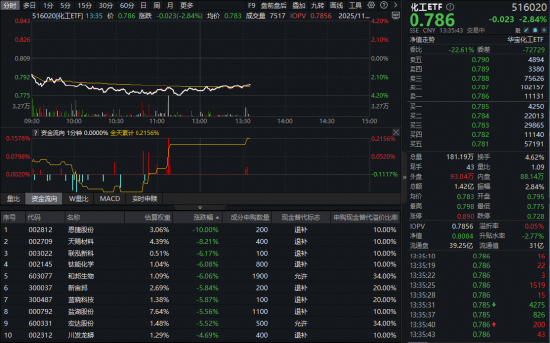
Group 1 - The chemical sector experienced a decline on November 21, with the Chemical ETF (516020) dropping over 4% at one point and closing down 2.84% [1][2] - Key stocks in the sector, such as Enjie Co., Ltd. and Tianqi Lithium, saw significant losses, with Enjie hitting the daily limit down and Tianqi falling over 8% [1][2] - The Chemical ETF has shown a year-to-date increase of 30.5%, outperforming major indices like the Shanghai Composite Index (17.28%) and the CSI 300 Index (16.01%) [1][3] Group 2 - The chemical industry has faced a continuous decline in product prices for four years, but recent policies aimed at reducing competition may signal a turning point [3][4] - The current price-to-book ratio of the Chemical ETF is 2.37, indicating a relatively low valuation compared to the past decade [4] - Analysts suggest that the industry may see improved supply-demand dynamics and profitability due to the "anti-involution" policies, with a focus on sectors like pesticides and organic silicon [5][6] Group 3 - The Chemical ETF (516020) tracks the CSI Sub-Industry Chemical Index, covering various segments of the chemical industry, with nearly 50% of its holdings in large-cap stocks [5][6] - Investors are encouraged to consider the Chemical ETF as a more efficient way to gain exposure to the chemical sector [5][6]




化工行业周报2025年11月第2周:氯甲烷、丙烯酸异辛酯价格涨幅居前,建议关注涨价和反内卷品种-20251117
CMS· 2025-11-17 09:04
Investment Rating - The report maintains a positive outlook on the chemical industry, suggesting a focus on price increases and anti-involution products [1][5]. Core Insights - The chemical sector saw a 2.61% increase in the second week of November, outperforming the Shanghai Composite Index by 2.79 percentage points [2][13]. - Key recommended companies include those benefiting from rising lithium hexafluorophosphate prices and leading firms in the anti-involution trend [5]. Industry Performance - The chemical sector's dynamic PE ratio is 25.60, significantly above the average PE of 13.41 since 2015 [2][13]. - Among 27 sub-industries, five showed declines, with the top gainers being acrylic fiber (+15.18%) and nitrogen fertilizer (+9.19%) [3][18]. Price and Spread Trends - The top five products with the highest weekly price increases include liquid chlorine (+22.93%) and monochloromethane (+19.44%) [4][23]. - The largest price spread increases were seen in organic silicon DMC (+58.87%) and propylene (propane-based) (+45.69%) [4][44]. Inventory Changes - Significant inventory changes were noted, with polyester chips increasing by 8.93% and acetic acid by 6.69% [5][64]. Recommendations - The report suggests focusing on companies like Duofu Duo and Shenzhen New Star, which benefit from the high demand for lithium hexafluorophosphate, and Yun Tianhua, which is poised to gain from the strong phosphate chemical market [5].


中信建投化工行业2026年展望:“反内卷”加速周期拐点到来,新材料仍是长期战略方向
Di Yi Cai Jing· 2025-11-12 00:05
Core Viewpoint - The report from CITIC Construction Investment suggests focusing on sectors that are expected to benefit from the "anti-involution" trend, as the chemical industry faces a slowdown in capital expenditure and an approaching cyclical turning point [1] Group 1: Beneficial Sectors - Recommended sectors include pesticides, urea, soda ash, filament, organic silicon, and spandex, which are likely to benefit from the "anti-involution" trend [1] - In the context of a declining interest rate cycle, China's counter-cyclical policies are expected to boost domestic demand, making sectors like polyurethane, coal chemical, petroleum chemical, and fluorochemical attractive [1] Group 2: New Material Development - The development of new productive forces, self-control, and industrial upgrading are emphasized as key strategies in the context of major power competition, with new materials being a primary development direction for China's chemical industry [1] - Focus areas include semiconductor materials, OLED materials, COC materials, and other high value-added products [1] Group 3: High Shareholder Returns - High-quality companies with substantial shareholder returns are expected to continue their revaluation journey, particularly state-owned enterprises in the oil and gas petrochemical sector, coal chemical, compound fertilizer, phosphorus chemical, and leading companies in the MSG/feed amino acid industry [1]

中信建投化工行业2026年展望:“反内卷”加速周期拐点到来 新材料仍是长期战略方向
Di Yi Cai Jing· 2025-11-11 23:55
Core Viewpoint - The report from CITIC Construction Investment suggests focusing on specific sectors within the chemical industry that are expected to benefit from the "anti-involution" trend and the upcoming economic cycle shift, while also highlighting the importance of new material development in the context of national competition [1] Group 1: Investment Recommendations - Attention is recommended for sectors such as pesticides, urea, soda ash, long fibers, organic silicon, and spandex, which are likely to benefit from the "anti-involution" trend [1] - In the context of a declining interest rate cycle, sectors like polyurethane, coal chemical, petroleum chemical, and fluorochemical are suggested for investment as they may help stimulate domestic demand [1] Group 2: Development Focus - The report emphasizes the development of new productive forces, self-sufficiency, and industrial upgrades as key strategies in the context of major power competition, with new materials being a primary focus for the Chinese chemical industry [1] - Specific attention is drawn to the continuous development of semiconductor materials, OLED materials, COC materials, and other high value-added products [1] Group 3: Quality Enterprises - High shareholder returns from quality enterprises are expected to continue their revaluation journey, with a focus on leading state-owned enterprises in oil and gas, coal chemical, compound fertilizer, phosphorus chemical, and amino acid industries for feed and flavoring [1]