BDO

Search documents
中泰化学(002092):公司事件点评报告:降本增效减亏见效,氯碱龙头逆境突围
Huaxin Securities· 2026-03-31 15:33
2026 年 03 月 31 日 降本增效减亏见效,氯碱龙头逆境突围 买入(首次) 事件 | 分析师:卢昊 | S1050526020001 | | --- | --- | | luhao@cfsc.com.cn | | | 联系人:高铭谦 | S1050124080006 | | gaomq@cfsc.com.cn | | | 基本数据 | 2026-03-31 | | --- | --- | | 当前股价(元) | 6.92 | | 总市值(亿元) | 179 | | 总股本(百万股) | 2590 | | 流通股本(百万股) | 2576 | | 52 周价格范围(元) | 4.15-8.51 | | 日均成交额(百万元) | 325.26 | 市场表现 资料来源:Wind,华鑫证券研究 -20 0 20 40 60 80 100 (%) 中泰化学 沪深300 相关研究 —中泰化学(002092.SZ)公司事件点评报告 中泰化学发布 2025 年年度业绩报告:2025 年公司实现营业 总收入 286.96 亿元,同比减亏 4.74%;实现归母净利润- 2.89 亿元,同比增加 70.43%。其中,公司 ...

三维股份(603033):“反内卷”共同维护市场健康,聚酯化纤盈利有望修复
环球富盛理财· 2026-03-08 06:57
Investment Rating - The report does not explicitly state the investment rating for Sanwei Holding Group (603033.CH) Core Insights - The company is focused on maintaining market health through "anti-involution" strategies, which are expected to restore profitability in the polyester fiber sector [2] - Sanwei Holding Group has established a business structure centered around two main sectors: chemicals and transportation, with significant production capacities in BDO and calcium carbide [2] - The company anticipates a net loss of between 250 million to 380 million yuan for 2025, primarily due to losses from its subsidiary in Inner Mongolia [4] - The polyester fiber industry is expected to turn profitable in 2026, driven by industry self-regulation and supply-demand adjustments [4] - The calcium carbide industry is undergoing capacity clearance, leading to a gradual price recovery since 2026, with prices expected to rise by 5%-8% compared to 2025 [4]

产能预警!巴斯夫,赶紧扩产
DT新材料· 2026-02-18 16:04
Core Viewpoint - The petrochemical industry in China is facing an oversupply risk for 15 products, including epoxy propylene and nylon 66, due to rapid capacity expansion and weak downstream demand [2] Group 1: Industry Overview - The "List of Products Facing Oversupply Risks in the Petrochemical Industry (2025 Edition)" identifies 15 products at risk, including epoxy propylene, PVC, and nylon 66 [2] - The warning is attributed to the concentration of new projects launched since the 13th Five-Year Plan, rapid expansion of low-end capacity, and sluggish demand in traditional sectors like real estate and home appliances [2] Group 2: Nylon 66 Insights - By the end of 2025, domestic nylon 66 capacity is expected to approach 1.5 million tons per year, while the apparent consumption in 2024 is only 750,000 to 800,000 tons, leading to a utilization rate below 60% [4] - The new nylon 66 project by Xinhecheng, with an investment of 10 billion, has garnered significant attention, indicating potential growth in high-end applications [4] Group 3: BDO Market Dynamics - BDO is facing challenges due to the rapid expansion of PBAT capacity, which exceeds downstream demand growth, resulting in low utilization rates and continuous price declines [5] - BDO's applications are diverse, including as a key raw material in THF-PTMEG, which is used in various products like polyurethane and engineering plastics [5] - The overall BDO capacity is projected to reach 5.461 million tons per year by the end of 2025, with an annual output of 3.08 million tons, but the industry utilization rate is only around 56% [6] Group 4: Regulatory and Competitive Landscape - The EU will impose temporary anti-dumping duties on BDO starting February 6, 2026, with rates for Chinese companies ranging from 105.6% to 113.7%, affecting both bio-based and fossil-based BDO [7] - Domestic export tax rebate adjustments for BDO, which is part of the photovoltaic industry chain, will further squeeze profit margins for companies [7] Group 5: International Developments - BASF is increasing BDO production in Germany to provide stable supply amid anti-dumping litigation, focusing on environmentally friendly products [8] - Qore, a joint venture by Cargill, has launched the world's largest bio-based BDO production facility, aiming for an annual output of 66,000 tons [9] Group 6: Domestic Company Initiatives - Major domestic players like Kingfa Technology and Yuanli Chemical Group are expanding their bio-based BDO capacities, with Kingfa planning an integrated project with an investment of 7.89 billion yuan [10] - The demand for bio-based BDO is expected to rise with new projects, such as the 60,000-ton bio-based polyester project by Zhuhai Kingfa [11]


三维股份披露业务布局与业绩预期,股价近期小幅波动
Jing Ji Guan Cha Wang· 2026-02-12 08:26
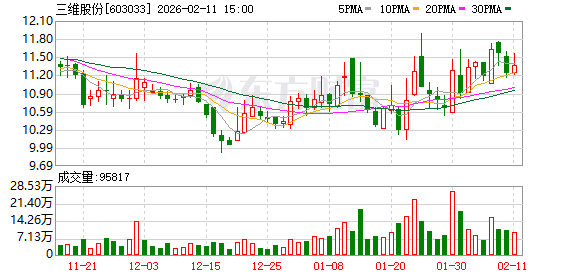
Group 1 - The company has established a business structure focusing on three main sectors: "chemical and transportation," with plans to expand upstream into coal tar and green electricity, and downstream into biodegradable plastics [1] - The new material chemical business is set to produce 300,000 tons/year of BDO and 360,000 tons/year of calcium carbide in Inner Mongolia, aiming to become a global leader in integrated BDO and biodegradable plastics [1] - The rail transportation business is focusing on regions such as the Pearl River Delta, Yangtze River Delta, and provinces along the "Belt and Road," targeting high-speed rail and subway projects [1] Group 2 - The company forecasts a net profit loss of 250 million to 380 million yuan for 2025, primarily due to low BDO prices affecting its subsidiary in Inner Mongolia, although the rail transportation business has recovered to 2023 profit levels [2] - The polyester fiber business has significantly reduced losses through "anti-involution" measures [2] - The demand for biodegradable plastics is expected to grow with the implementation of the new national standard for biodegradable plastic shopping bags in 2027, which will require a biodegradation rate of 90% [2]
三维股份:公司现已形成“化工、交通”两大领域三大主业的业务格局
Zheng Quan Ri Bao· 2026-02-11 13:08
Core Viewpoint - The company is committed to the real economy, focusing on its existing industries and forming a business structure centered around two main fields: chemicals and transportation [2] Group 1: Chemical Industry - The new materials chemical business has a production base located in Wuhai City, Inner Mongolia, with established capacities of 300,000 tons/year for BDO and 360,000 tons/year for calcium carbide [2] - Future plans include expanding production capacities for lanthanum carbon and green electricity, as well as developing new material capacities for PBAT [2] - The company aims to become a leading integrated enterprise in BDO and biodegradable plastics on a global scale [2] Group 2: Transportation Industry - The rail transportation business focuses on key regions such as the Pearl River Delta, Yangtze River Delta, and provinces along the Belt and Road Initiative, including Yunnan and Sichuan [2] - The company is dedicated to the development of high-speed rail construction and urban subway projects [2] Group 3: Rubber and Chemical Fiber Industries - The rubber products and chemical fiber production bases are located in Sanmen County, with main products including rubber conveyor belts, V-belts, polyester chips, and polyester industrial yarns [2] - The company is recognized as one of the leading enterprises in the rubber conveyor belt and V-belt sectors in China [2]
取消出口关税,企业加速“抢出口”!新材料ETF华夏(516710)上涨1.64%,中材科技涨停
Sou Hu Cai Jing· 2026-02-11 06:17
Group 1 - The core viewpoint of the article highlights the significant impact of the cancellation of export VAT rebates on various industries, particularly in the chemical and photovoltaic sectors, which is expected to stimulate short-term export activities and initiate long-term supply-side reforms and concentration in these industries [1] - The New Materials ETF Huaxia (516710) rose by 1.64%, with constituent stocks such as China National Materials and China Jushi hitting the daily limit, and Wanhua Chemical increasing by over 3% [1] - The Ministry of Finance and the State Taxation Administration announced the cancellation of export VAT rebates for 249 products starting from April 1, 2026, affecting over 80 chemical products including methanol, lithium hexafluorophosphate, 1,2-ethanediol, BDO, and PVC [1] Group 2 - The New Materials ETF Huaxia closely tracks the CSI New Materials Theme Index, which selects 50 listed companies involved in advanced steel, non-ferrous metals, chemicals, and inorganic non-metallic materials, reflecting the overall performance of securities in the new materials sector [1] - The new materials content in the index reaches 79.85%, ranking first across all market dimensions [1]



三维股份:公司在内蒙古乌海的BDO一体化项目现已形成36万吨/年电石产能
Zheng Quan Ri Bao Wang· 2026-02-02 11:14
Core Viewpoint - The company has established a 360,000 tons/year calcium carbide production capacity at its BDO integrated project in Ulanqab, Inner Mongolia, primarily to meet the raw material needs for its first phase of 300,000 tons/year BDO production [1] Group 1 - The BDO integrated project aims for a total scale of 900,000 tons/year BDO production, with a supporting calcium carbide facility of 1,200,000 tons/year [1] - Upon completion, the project is expected to rank among the top in domestic production capacity [1]
PBT:多空消息博弈 PBT价格稳定
Sou Hu Cai Jing· 2026-02-02 02:20
Group 1 - The geopolitical situation has eased, leading to a decline in international crude oil prices, which has weakened the cost support for PTA, resulting in a significant drop in PTA prices [1] - BDO lacks recent news guidance, maintaining stable prices, while the comprehensive cost of PBT has decreased [1] - The downstream market for PBT is entering a holiday phase, creating a cautious market sentiment with no significant large transactions reported [1] Group 2 - Some major suppliers are undergoing maintenance before the holiday, providing support for recent PBT prices [1] - As of February 2, the mainstream transaction range for PBT in the East China market is between 7750-7950 yuan/ton, with the average negotiation price remaining stable [1]
陕西黑猫预亏近11亿元,公司回应:产品价格下滑,公司经营压力巨大
Hua Xia Shi Bao· 2026-01-16 09:32
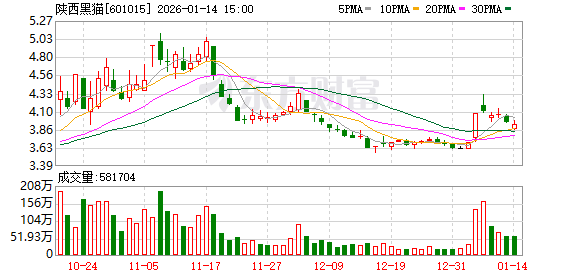
Core Viewpoint - Shaanxi Black Cat (601015.SH) is expected to continue incurring losses in 2025, with projected net losses ranging from 1.19 billion to 1.09 billion yuan, primarily due to declining sales prices of its main products and pressure from both upstream coal and downstream steel industries [2][3] Financial Performance - In 2024, Shaanxi Black Cat reported a loss of 1.158 billion yuan, and the anticipated loss for 2025 is even greater, leading to cumulative losses exceeding 2 billion yuan over the past three years [3] - As of September 30, 2025, the company's total assets decreased by 9% to 19.411 billion yuan, and shareholders' equity fell by 35% to 5.639 billion yuan compared to the end of 2022 [4] - The company's debt ratio increased from 48% at the end of 2022 to approximately 62.02% by September 2025, indicating rising financial pressure [4] Market Conditions - The average selling price of Shaanxi Black Cat's main products, particularly coke, has significantly declined, with the average price dropping by 28.15% year-on-year in Q1 2025 [6] - The price of coke rebounded in the second half of 2025, but this was primarily driven by rising raw material costs rather than increased demand from the steel industry [6][7] Strategic Response - To address the current challenges, the company plans to extend its operations upstream into the coal sector and enhance its chemical product chain, focusing on high-value products [7] - Shaanxi Black Cat is investing heavily in projects such as the Inner Mongolia Black Cat project and Xinjiang coal projects to reduce costs and improve revenue [7] Industry Dynamics - The pricing of coke is heavily influenced by the cost of coking coal and the purchasing demand from steel mills, which hold significant pricing power in the supply chain [9] - Analysts predict that the coke market will remain oversupplied in 2026, with prices continuing to fluctuate based on coking coal costs and steel mill profitability [9]


2025年预亏12亿元,陕西黑猫年末甩卖资产“补血”
2 1 Shi Ji Jing Ji Bao Dao· 2026-01-14 12:12
Core Viewpoint - Shaanxi Black Cat is expected to continue incurring losses in 2025, with a projected net profit attributable to shareholders ranging from -1.19 billion to -1.09 billion yuan, reflecting a year-on-year decline of 2.73% to 5.90% [1][7]. Company Performance - In the first half of 2025, Shaanxi Black Cat reported total operating revenue of 5.234 billion yuan, a decrease of 32.46% year-on-year, and a net loss of 462 million yuan [5]. - By the third quarter, the company faced continued operational pressure, with quarterly revenue of 2.619 billion yuan, down 28.67% year-on-year, leading to a cumulative revenue of 7.852 billion yuan for the first three quarters, a decline of 31.24% [5]. - The third quarter alone saw a loss of 284 million yuan, an increase of 44.32% year-on-year, resulting in a total loss of 746 million yuan for the first three quarters [5]. Industry Context - The coking coal industry is under pressure due to rising upstream raw material prices and a sluggish downstream market, which is expected to persist into 2025 [3]. - Shaanxi Black Cat's performance is heavily influenced by the volatility of coking coal prices, which have declined, leading to reduced gross margins and losses in its main business [2][5]. Financial Management - Despite declining performance, the company has shown positive signals in cash flow management, with a net cash flow from operating activities turning positive at 53 million yuan in the first half of 2025, and a cumulative improvement of 174.58% year-on-year for the first three quarters [6]. - The improvement in cash flow is attributed to a reduction in expenses related to raw material purchases, although this has been accompanied by increased borrowing to maintain operations [6][8]. Strategic Adjustments - To address funding needs amid industry fluctuations, Shaanxi Black Cat has engaged in asset disposals, including a 600 million yuan capital increase to Xinjiang Black Cat Coal Industry and the transfer of production capacity to its subsidiary [9][10]. - The company plans to sell its 100% stake in Hongneng Coal Industry and related debts for a total of 1.137 billion yuan, which is expected to enhance cash flow and alleviate debt burdens [11][13]. - The asset sales are part of a strategic shift to focus resources on key production bases in Shaanxi, Inner Mongolia, and Xinjiang, despite concerns about the long-term viability of its core business amid ongoing losses [12][13].