
煤炭开采和洗选业

Search documents
王有捐:2025年CPI总体平稳 PPI低位回升
Guo Jia Tong Ji Ju· 2026-01-19 03:35
Group 1: Consumer Price Index (CPI) Trends - The overall consumer market in 2025 is stable and gradually improving, with CPI showing monthly fluctuations and a year-on-year increase of 0.8% in December, the highest since March 2023 [2] - Food prices decreased by 1.5% for the year, impacting CPI by approximately 0.27 percentage points, with significant declines in pork and egg prices [3] - Core CPI has been rising since March 2025, maintaining a year-on-year increase of over 1% for four consecutive months, reaching 1.2% in December [4] Group 2: Producer Price Index (PPI) Trends - The PPI for 2025 decreased by 2.6%, but the decline narrowed in the second half of the year, with a year-on-year decrease of only 1.9% in December [5] - The optimization of market competition and capacity management in key industries has led to a recovery in prices, particularly in coal and new energy sectors [6] - External factors, such as rising international metal prices, have contributed to price increases in related domestic industries, with non-ferrous metal mining prices up by 17.2% [7]
国家统计局:2025年电力、热力、燃气及水生产和供应业增加值同比增长2.3%
Guo Jia Tong Ji Ju· 2026-01-19 02:31
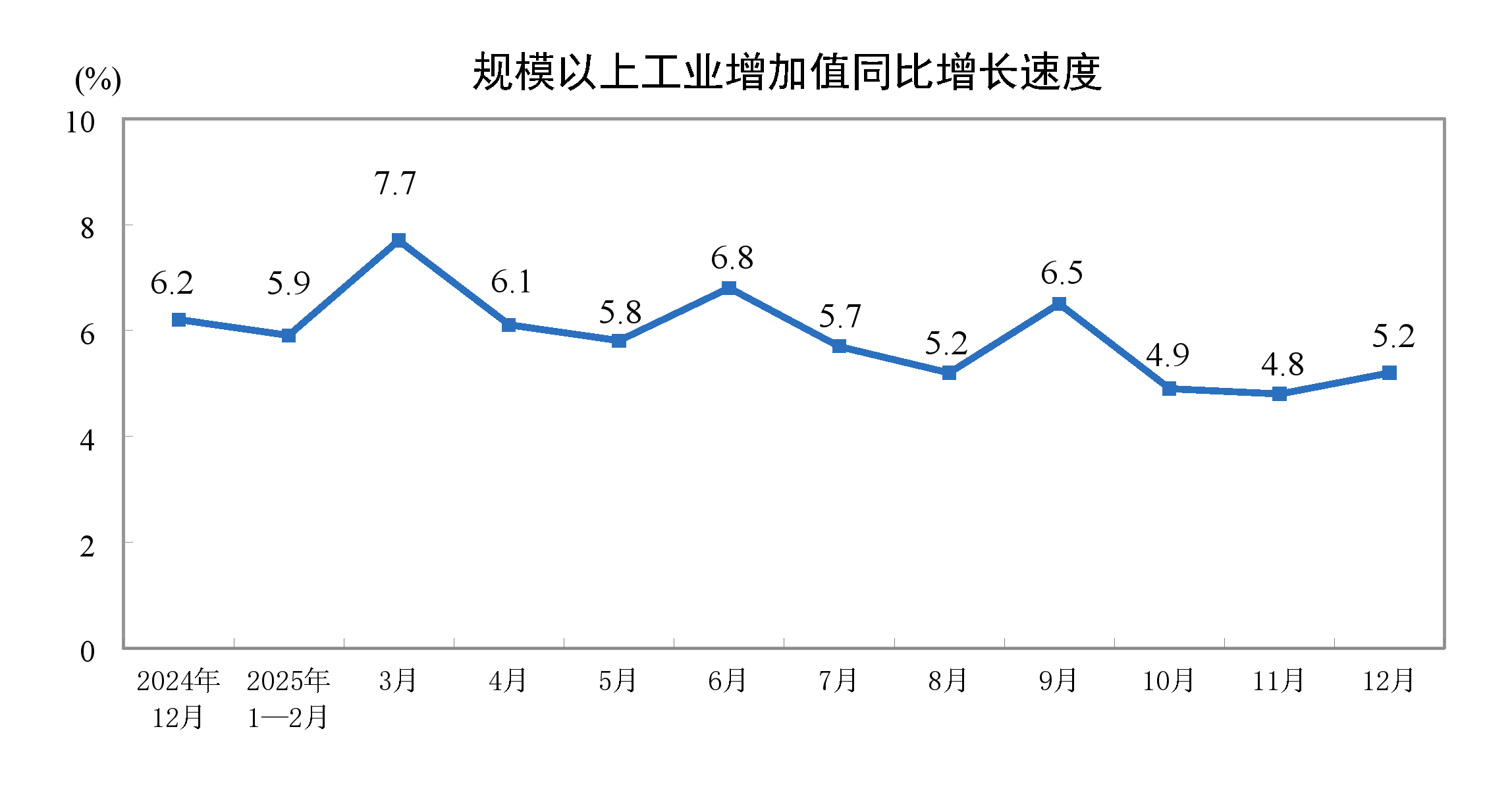
Economic Growth Overview - In December, the industrial added value increased by 5.2% year-on-year, with mining growing by 5.4%, manufacturing by 5.7%, and electricity, heat, gas, and water production and supply by 0.8% [2][5]. Industry Performance - Among 41 major industries, 33 reported year-on-year growth in added value in December. Notable growth sectors included coal mining and washing (6.4%), oil and gas extraction (3.7%), and food processing (3.2%). However, the beverage and refined tea manufacturing sector saw a decline of 0.5% [3][5]. - High-tech manufacturing experienced significant growth at 11.0% year-on-year [5]. Economic Type Analysis - State-owned enterprises saw a 3.9% increase in added value, while joint-stock enterprises grew by 5.8%. Foreign and Hong Kong, Macau, and Taiwan-invested enterprises increased by 2.7%, and private enterprises grew by 4.2% [3][5]. Product Output - In December, out of 623 industrial products, 325 saw year-on-year output growth. Key products included ten types of non-ferrous metals (721 million tons, up 4.9%), ethylene (356 million tons, up 3.0%), and automotive production (341.2 million units, down 2.8%). Notably, new energy vehicles increased by 8.7% to 179.1 million units [4][6]. Sales and Export Performance - The sales rate for industrial enterprises was 98.2%, a decrease of 0.7 percentage points year-on-year. The export delivery value reached 1,493.2 billion yuan, reflecting a nominal growth of 3.2% year-on-year [4][6].

国家统计局:2025年12月原煤产量43703万吨
Guo Jia Tong Ji Ju· 2026-01-19 02:21
(文章来源:国家统计局) 国家统计局:2025年12月原煤产量43703万吨,同比减少1.0%,环比增长2.4%;1-12月产量为483178万 吨,同比增长1.2%。2025年12月焦炭产量4274万吨,同比增长1.9%,环比增长2.5%;1-12月产量为 50412万吨,同比增长2.9%。2025年12月水泥产量14416万吨,同比减少6.6%,环比减少6.6%;1-12月 产量为169314万吨,同比减少6.9%。 ...
2025年四季度全国规模以上工业产能利用率为74.9%
Guo Jia Tong Ji Ju· 2026-01-19 02:01
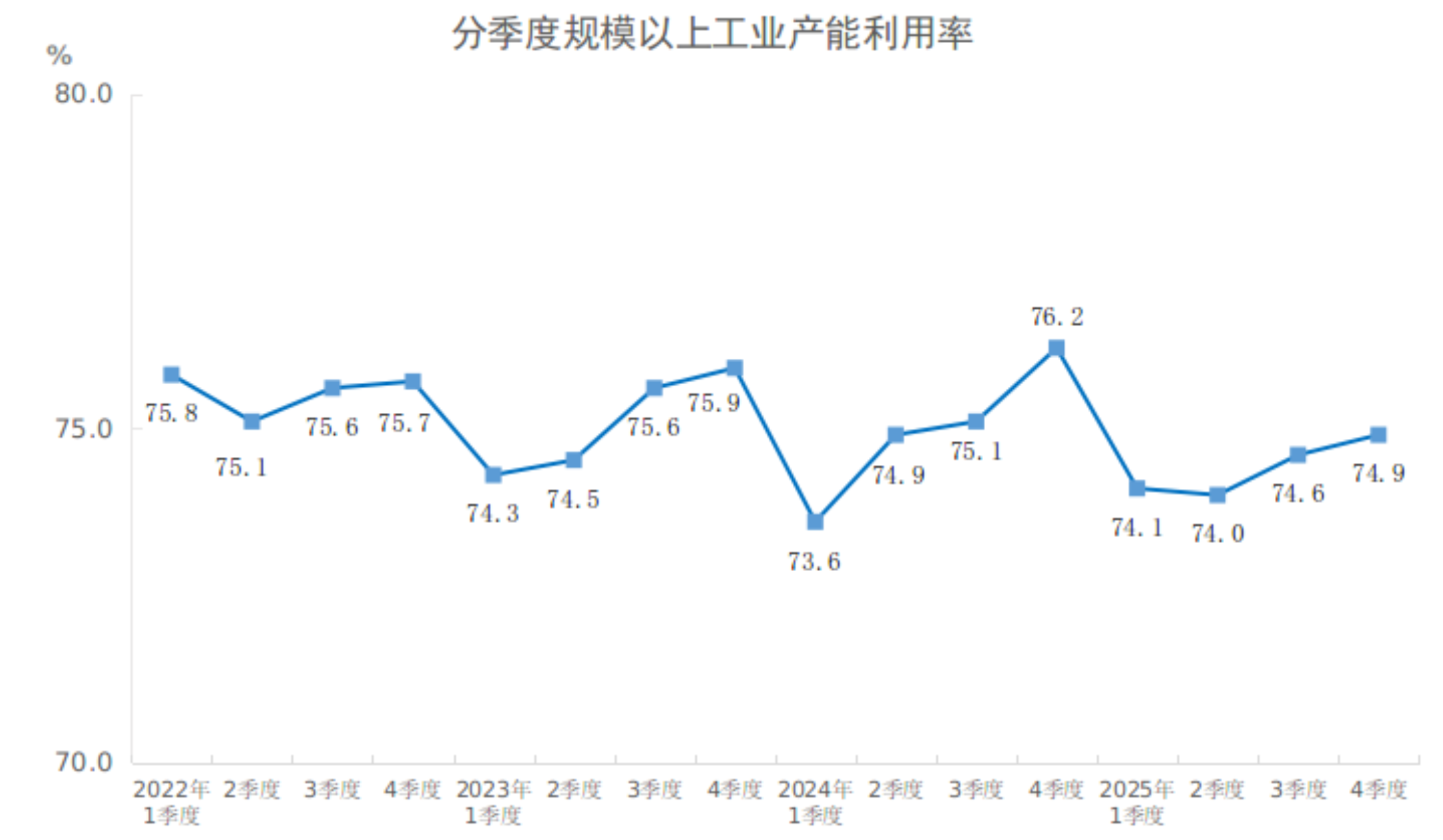
Core Viewpoint - The national industrial capacity utilization rate for large-scale industries in Q4 2025 is reported at 74.9%, showing a 0.3 percentage point increase from Q3 but a 1.3 percentage point decrease compared to the same period last year [1][4]. Group 1: Overall Industrial Capacity Utilization - The overall industrial capacity utilization rate for the entire year of 2025 is 74.4%, which is a decrease of 0.6 percentage points from the previous year [6]. - The Q4 capacity utilization rate reflects a mixed performance across different sectors, with some industries experiencing significant declines [6]. Group 2: Sector-Specific Capacity Utilization - In Q4 2025, the mining industry has a capacity utilization rate of 71.7%, down by 3.9 percentage points year-on-year [6]. - The manufacturing sector's capacity utilization rate stands at 75.2%, a decrease of 1.2 percentage points from the previous year [6]. - The electricity, heat, gas, and water production and supply sector shows a capacity utilization rate of 74.0%, down by 0.8 percentage points year-on-year [6]. Group 3: Detailed Industry Breakdown - Coal mining and washing industry has a capacity utilization rate of 69.1%, down by 4.8 percentage points year-on-year [6]. - The food manufacturing industry reports a capacity utilization rate of 68.5%, a decrease of 2.2 percentage points from the previous year [6]. - The textile industry has a capacity utilization rate of 77.1%, down by 1.7 percentage points year-on-year [6]. - The chemical raw materials and products manufacturing industry shows a capacity utilization rate of 74.1%, down by 2.3 percentage points [6]. - The black metal smelting and rolling industry has a capacity utilization rate of 78.5%, with a slight increase of 0.4 percentage points year-on-year [6]. - The automotive manufacturing industry reports a capacity utilization rate of 76.0%, down by 1.2 percentage points from the previous year [6]. - The computer, communication, and other electronic equipment manufacturing industry has a capacity utilization rate of 79.7%, showing a slight increase of 0.3 percentage points year-on-year [6].
网友举报有黑水排放至湖南耒水,官方回应
Xin Lang Cai Jing· 2026-01-18 07:08
近日,有网友发文称,湖南省衡阳耒阳市黄市镇疑似有污水向耒水排放。视频中,网友指出有一处排污 口位于黄市镇蔡伦竹海牌坊附近,经一段水渠后流向耒水,水体颜色呈黑色。 公开信息显示,耒水是长江流域湘江水系的一级支流。 网友发视频称有黑色的污水排放至湖南耒水 1月18日,智通财经从耒阳权威部门获悉,他们已关注到前述情况。1月13日,衡阳市生态环境局耒阳分 局已前往现场检查。 智通财经记者 廖艳 实习生 林霄 相关人士称,该煤矿公司具备齐全的环保手续。另衡阳市生态环境局耒阳分局在排污口安装了在线监测 设备。1月12日,在网友拍摄视频发出质疑后,该局调取了当日的监测数据以及了解煤矿公司执行排放 废水标准。经查,废水排放符合标准。 针对网友拍到黑色污水与耒水形成鲜明的分界线,其解释:因兴源矿业有限公司伍家冲煤矿已开采几十 年,排放的沟渠底部有不少黑色沉淀物,废水流经后或携带了黑色杂质。"视觉上看起来更黑。"该相关 人士说。 相关人士表示,目前,衡阳市生态环境局耒阳分局已对煤矿废水总排污口再次取样分析,并责令煤矿公 司立即对排放沟渠进行清淤,消除隐患。该局强调,将进一步加强对煤矿公司的监管,确保废水排放严 格执行相关标准。 ...

网友举报有黑水排放至湖南耒水,官方:煤矿废水处理后排放
Xin Lang Cai Jing· 2026-01-18 05:01
近日,有网友发文称,湖南省衡阳耒阳市黄市镇疑似有污水向耒水排放。视频中,网友指出有一处排污 口位于黄市镇蔡伦竹海牌坊附近,经一段水渠后流向耒水,水体颜色呈黑色。 1月18日,智通财经(www.thepaper.cn)从耒阳权威部门获悉,他们已关注到前述情况。1月13日,衡阳 市生态环境局耒阳分局已前往现场检查。 相关人士介绍,经了解,该水系湖南省煤业集团兴源矿业有限公司伍家冲煤矿产生的矿井废水,经处理 后,通过沟渠流向耒水的入河口。 相关人士称,该煤矿公司具备齐全的环保手续。另衡阳市生态环境局耒阳分局在排污口安装了在线监测 设备。1月12日,在网友拍摄视频发出质疑后,该局调取了当日的监测数据以及了解煤矿公司执行排放 废水标准。经查,废水排放符合标准。 网友发视频称有黑色的污水排放至湖南耒水 公开信息显示,耒水是长江流域湘江水系的一级支流。 针对网友拍到黑色污水与耒水形成鲜明的分界线,其解释:因兴源矿业有限公司伍家冲煤矿已开采几十 年,排放的沟渠底部有不少黑色沉淀物,废水流经后或携带了黑色杂质。"视觉上看起来更黑。"该相关 人士说。 相关人士表示,目前,衡阳市生态环境局耒阳分局已对煤矿废水总排污口再次取样分析, ...

华能申请二氧化碳封存潜力综合评估方法专利,提高评估的客观性、准确性和可靠性
Sou Hu Cai Jing· 2026-01-17 12:10
国家知识产权局信息显示,中国华能集团清洁能源技术研究院有限公司;华能庆阳煤电有限责任公司申 请一项名为"一种二氧化碳封存潜力的综合评估方法、装置及设备"的专利,公开号CN121352220A,申 请日期为2025年10月。 声明:市场有风险,投资需谨慎。本文为AI基于第三方数据生成,仅供参考,不构成个人投资建议。 专利摘要显示,本申请提供一种二氧化碳封存潜力的综合评估方法、装置及设备,涉及二氧化碳封存技 术领域,包括:获取目标区域的地质数据、经济数据、设施数据、环境数据和社会数据;基于地质数 据、经济数据、设施数据、环境数据和社会数据,构建目标封存区域的数字孪生体、确定目标区域的初 始封存容量、初始经济评估结果和初始风险评估结果;将初始封存容量、初始经济评估结果和初始风险 评估结果输入到数字孪生体中,得到最优修正系数矩阵;利用最优修正系数矩阵分别修正初始封存容 量、初始经济评估结果、初始风险评估结果,确定目标区域的二氧化碳封存潜力。本申请提高了二氧化 碳封存潜力评估的客观性、准确性和可靠性。 来源:市场资讯 天眼查资料显示,中国华能集团清洁能源技术研究院有限公司,成立于2010年,位于北京市,是一家以 从事研 ...
动力煤:供需矛盾不突出,短期价格窄幅调整
Guo Tai Jun An Qi Huo· 2026-01-13 02:00
商 品 研 究 期货研究 2026 年 1 月 13 日 动力煤:供需矛盾不突出,短期价格窄幅调整 | | 樊园园 | 投资咨询从业资格号:Z0023682 | fanyuanyuan@gtht.com | | --- | --- | --- | --- | | 【基本面跟踪】 1. | | | | | 动力煤基本面数据 | | | | 【宏观及行业新闻】 1. 【国家统计局:2025 年 12 月 PPI 同比降幅收窄,环比涨幅扩大;CPI 同比涨幅扩大,环比转正】 PPI 方面,同比增速为-1.9%,增速提高 0.3 个百分点;环比增速为 0.20%,增速提高 0.10 个百 分点,供需结构改善带动部分行业价格上涨,煤炭开采和洗选业、黑色金属矿采选业环比价格环比 分别上涨 1.3%和 0.0%,均连续 5 个月摆脱负区间。CPI 方面,同比增速为 0.8%,增速提高 0.1 2. 【国内煤炭政策:市场传保供核增产能退出安排】1 月 7 日陕西榆林市政府电煤保供视频会上通 报:根据国家发改委等 6 部委联合印发的文件要求,因 2024-2025 年电煤保供落实不力,52 处核 增产能煤矿中,有 26 处煤矿 ...
2025年12月CPI同比上涨0.8% 物价低位温和回升
Jin Rong Shi Bao· 2026-01-12 03:16
Group 1 - The Consumer Price Index (CPI) in December 2025 increased by 0.8% year-on-year, marking the highest level since March 2023, driven primarily by rising food prices [2][3] - The core CPI, excluding food and energy, rose by 1.2% year-on-year, remaining above 1% for four consecutive months, supported by consumer promotion policies and price improvements in appliances and automobiles [3][4] - The Producer Price Index (PPI) increased by 0.2% month-on-month, marking three consecutive months of growth, while the year-on-year decline narrowed to 1.9%, indicating reduced downward pressure on industrial prices [4][5] Group 2 - The increase in CPI was attributed to a combination of effective consumption policies and seasonal demand during the holiday period, leading to a rise in consumer spending [2][4] - The PPI's month-on-month increase was influenced by improved supply-demand dynamics and rising prices in certain industries, particularly in coal mining and processing [4][5] - Experts suggest that the changes in CPI and PPI reflect a stable and improving economic environment in China, with a gradual recovery in demand and ongoing optimization of supply structures [5]
12月通胀数据解读:2025年通胀回眸
Huachuang Securities· 2026-01-10 07:51
1. Report Industry Investment Rating No information about the industry investment rating is provided in the report. 2. Core Viewpoints of the Report - In 2025, CPI increased by 0.8% year - on - year, with core consumer goods, services, and fresh produce prices improving. PPI's year - on - year decline narrowed to - 1.9%, and prices gradually recovered from upstream to mid - downstream after the "anti - involution" policy [2][3]. - In December 2025, due to the decline in vegetable price growth and the seasonal recovery of consumer goods, CPI's year - on - year increase rebounded to 0.8% under the low - base effect. PPI's month - on - month increase rebounded to 0.2% due to the heating season and the impact of imported non - ferrous metals [29][45]. 3. Summary According to the Directory 2025 Inflation Review CPI - In 2025, CPI increased by 0.8% year - on - year. The factors contributing to the CPI increase from high to low were core consumer goods (0.63 pct), fresh produce (0.4 pct), services (0.25 pct), while livestock and meat (- 0.19 pct) and energy (- 0.3 pct) dragged it down [2][9]. - Core consumer goods: Gold prices contributed half of the increase, and prices of household appliances and daily necessities improved under consumption - promoting policies. Services: Service consumption scenarios mainly related to travel still supported prices, with significant price fluctuations between peak and off - peak seasons. Livestock and meat: Pig production capacity reduction was slow under "large - scale" farming, and terminal demand was weak, leading to a slow decline in prices. Fresh produce: Extreme weather affected production and transportation, tightening supply and driving up prices. Energy: Trade frictions led to weak demand and a downward price trend [2][14][15]. PPI - In 2025, the year - on - year decline of PPI narrowed to - 1.9%. After the "anti - involution" policy in July, mid - stream production materials industries showed positive signals, but the durable consumer goods manufacturing industry related to long - term income expectations and closer to terminal demand was still weak [24]. - Industries with continuous price increases included the imported non - ferrous metal industry chain, which had six consecutive months of price increases. Domestically, industries generally saw price recovery from upstream to mid - downstream, such as coal and black mining in the upstream, the paper - making industry, and then lithium - ion battery manufacturing and non - metallic mineral products industries [27]. December CPI Food Items - CPI food prices increased by 0.3% month - on - month, slightly weaker than the seasonal average, driving CPI up by about 0.05 percentage points. Pork prices decreased slightly due to oversupply, and fresh produce prices were weaker than the seasonal level, with fresh fruit prices rising seasonally and fresh vegetable prices rising less than expected [31]. Non - food Items - The non - food item of CPI increased by 0.1% month - on - month, stronger than the seasonal average, driving CPI up by about 0.12 percentage points. Energy prices decreased slightly, core consumer goods drove CPI up by about 0.16 percentage points (21% contributed by gold price increases), and service prices had limited impact on CPI during the off - travel season [32][37][38]. December PPI Overall - In December, PPI's month - on - month increase rebounded to 0.2% after 19 months, with price increases spreading from the mining industry to raw material and processing industries. Production material prices increased by 0.2%, while downstream living material prices remained flat [45]. By Industry - The number of industries with rising prices among industrial producers remained at 9. Supportive factors included the seasonal increase in demand and prices of coal, gas, and the non - ferrous metal industry chain, as well as the continuous price recovery of the paper - making industry. The drag factor was the imported crude oil industry chain [47][51][59].