
芯片设计

Search documents
联芸科技2月9日获融资买入3711.36万元,融资余额6.53亿元
Xin Lang Cai Jing· 2026-02-10 01:37
机构持仓方面,截止2025年9月30日,联芸科技十大流通股东中,嘉实上证科创板芯片ETF(588200) 位居第二大流通股东,持股156.58万股,为新进股东。诺安积极回报混合A(001706)位居第五大流通 股东,持股85.45万股,为新进股东。泰康新锐成长混合A(014287)位居第六大流通股东,持股67.81 万股,为新进股东。诺安稳健回报混合A(000714)位居第八大流通股东,持股54.94万股,为新进股 东。招商丰盈积极配置混合A(009362)退出十大流通股东之列。 资料显示,联芸科技(杭州)股份有限公司位于浙江省杭州市滨江区西兴街道阡陌路459号C楼C1-604室, 成立日期2014年11月7日,上市日期2024年11月29日,公司主营业务涉及联芸科技是一家提供数据存储 主控芯片、AIoT信号处理及传输芯片的平台型芯片设计企业。主营业务收入构成为:数据存储主控芯 片产品85.68%,AIoT信号处理及传输芯片产品11.77%,其他2.55%。 截至1月30日,联芸科技股东户数2.04万,较上期减少1.83%;人均流通股14394股,较上期增加1.87%。 2025年1月-9月,联芸科技实现营业 ...
澜起科技港股上市首日大涨超50%!科创芯片设计ETF天弘(589070)盘中大涨超3%
Mei Ri Jing Ji Xin Wen· 2026-02-09 05:15
消息面上,澜起科技H股今日在港交所正式挂牌,据中国基金报报道,其暗盘交易阶段已大涨超39%, 上市表现强劲,带动板块关注度提升。同时,据南方财经网消息,英飞凌日前宣布自4月1日起上调部分 功率芯片价格,继德州仪器、ADI后又一家国际大厂提价,行业价格调整信号进一步明确。此外,在AI 算力需求推动下,存储芯片价格持续上行,相关芯片设计环节也受到传导影响。政策方面,国家在"十 五五"规划中继续将高端芯片设计列为关键技术攻关方向,为产业提供持续支持。 国信证券认为,芯片设计是巩固技术和成本护城河的关键环节。通过向上游布局芯片设计能力,企业可 将系统开发从"部件级集成"升级为"芯片级协同",在实现小型化、低成本量产的同时提升产品竞争力, 尤其在民用市场具备更高性价比优势。 盘面上,两市高开高走,芯片设计概念上涨。相关ETF方面,科创芯片设计ETF天弘(589070)标的指 数盘中涨2.88%,产品成交额达7667.79万元。成分股中,国芯科技、芯原股份、帝奥微、灿芯股份、峰 岹科技涨超5%,南芯科技、芯海科技、新相微等多股跟涨。 值得关注的是,Wind显示,科创芯片设计ETF天弘(589070)近5个交易日(2026 ...

澜起科技成功登陆港交所:募资近70亿市值超2000亿 内存互连芯片市占率第一
Xin Lang Cai Jing· 2026-02-09 03:22
来源:独角兽IPO | [编纂]項下的[编纂]數目 | : [編纂]股H股(視乎[編纂]行使與否而定) | | --- | --- | | [编纂]數目 | .. [编纂]股H股(可予重新分配) | | [編纂]數目 | : [编纂]股H股(可予重新分配及視乎[编 | | 纂]行使與否而定) | | | 最高[編纂] : 每股H股[編纂]港元,另加1.0%經紀 | | | 佣金、0.0027%證監會交易徵費、 | | | 0.00015%會財局交易微費及0.00565% | | | 聯交所交易費(須於[編纂]時以港元繳 | | | 足,多繳股款可予退還) | | | 面值 | : 每股H股人民幣1.00元 | | [编纂] : [编纂] | | | 聯席保薦人·[編纂]及[編纂] | | | (按英文首字母排序) | | | CC HAAE | Morgan Stanley 1 TIDC ph ton dr tad | 澜起科技专注于为云计算及AI基础设施提供创新互连解决方案。 作者 | 独角君 澜起科技股份有限公司H股今日在港交所主板开始买卖,股份代码为06809.HK。这家已在A股上市的全 球领先芯片设计 ...

RISC-V第一股要来了!
是说芯语· 2026-02-07 02:23
在全球算力重构与国产芯片突围的浪潮中,奕斯伟计算已然成为中国RISC-V架构芯片领域的标杆性企业。 据其港交所招股书披露,这家专注于RISC-V架构的芯片设计公司,采用无晶圆厂(fabless)模式,深耕芯片、芯片组、板卡及核心软件的研发设计,为 智能终端与具身智能终端产品筑牢"芯"底座,助力各行业实现智能升级。 京东方创始人、前董事长王东升作为公司创始人之一,在2019年6月卸任京东方相关职务后,毅然投身北京奕斯伟,开启了自己的"芯"征程,为公司注入 了深厚的产业资源与战略远见。自成立以来,企业发展势头迅猛,五年内顺利完成四轮融资,IDG资本、众行资本、国鑫创投等知名投资机构先后入局, 累计融资金额超90亿元,彰显了资本市场对其RISC-V布局的高度认可。 奕斯伟计算构建了多元化的产品矩阵,清晰划分出智能终端与具身智能两大核心芯片板块。其中,智能终端芯片涵盖人机交互芯片与多媒体处理芯片,广 泛应用于家居、办公、便携等日常场景,赋能终端设备实现屏幕输入输出管理与多媒体信号高效处理;具身智能芯片则包含互连芯片与计算芯片,聚焦汽 车、机器人、工业等高端场景,让各类智能体具备感知、处理、执行的完整能力,实现对物理环 ...
人工智能投资激增,科技巨头2026年计划投入6500亿美元
Xin Lang Cai Jing· 2026-02-06 17:12
Group 1 - The four major tech giants, Microsoft, Alphabet, Amazon, and Meta, plan to invest over $650 billion in artificial intelligence by 2026 [1][4] - Amazon's capital expenditure for 2026 is projected to be around $200 billion, while Alphabet's is expected to be between $175 billion and $185 billion [1][4] - Meta has disclosed a capital expenditure range of $115 billion to $135 billion for 2026, and Microsoft is expected to spend $145 billion in its fiscal year 2026 [1][5] Group 2 - The total investment from these companies for 2026 is estimated to be approximately $635 billion at the minimum and could reach $665 billion at the maximum, representing a significant increase of about 67% and 74% respectively compared to 2025 [5][6] - The majority of these investments will be directed towards artificial intelligence chips, servers, and data center infrastructure [5][6] Group 3 - Investors have expressed concerns regarding these new capital plans, leading to stock price declines for Amazon (over 8%), Alphabet (3%), and Microsoft (over 11%) following their announcements [2][6] - In contrast, Meta's stock price increased after its quarterly earnings report, which indicated growth in advertising revenue driven by AI technology [2][6] Group 4 - Analyst Gil Luria from DA Davidson noted that the market's cautious attitude towards tech stocks reflects a rational vigilance among investors, especially in light of concerns about a potential AI bubble [2][3] - Investors are expected to remain on the sidelines until companies deliver on performance promises and achieve expected returns [3][7] Group 5 - Despite the cautious sentiment, companies like NVIDIA, Broadcom, and AMD have already benefited from the substantial investments made by tech giants, with their stock prices rising significantly following Amazon's announcement [3][7]




一新股,暗盘大涨39.21%!
Zhong Guo Ji Jin Bao· 2026-02-06 11:21
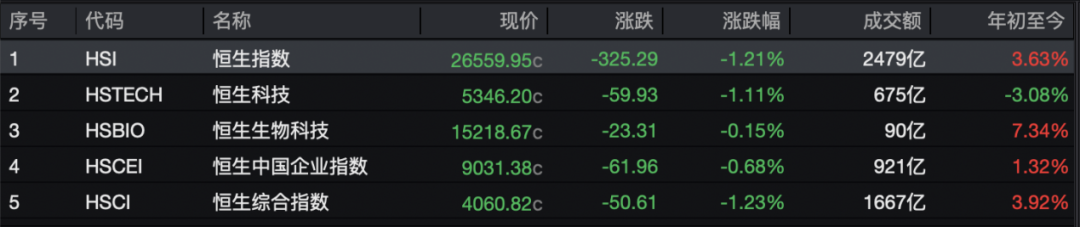
Group 1: Market Overview - The Hong Kong stock market experienced a collective decline on February 6, with the Hang Seng Index falling by 1.21% to 26,559.95 points, and the Hang Seng Technology Index decreasing by 1.11% to 5,346.20 points [1][2] - The total market turnover for the day was HKD 247.9 billion, with net inflows from southbound funds amounting to HKD 14.859 billion, and a cumulative net purchase of HKD 56.069 billion for the week [1] Group 2: Company Performance - The stock of 澜起科技 (Lianqi Technology) surged by 39.21% in dark trading, reaching HKD 148.9 per share ahead of its listing on the Hong Kong stock market on February 9 [9][13] - 澜起科技 is a leading international company in data processing and interconnect chip design, focusing on high-performance, low-power chip solutions for cloud computing and data centers [13] Group 3: Sector Movements - The beverage sector saw gains, with 茶百道 (Cha Bai Dao) rising by 6.08%, 古茗 (Gu Ming) increasing by 3.58%, and 沪上阿姨 (Hu Shang A Yi) up by 1.15%, driven by a promotional campaign from Alibaba's 千问App [3] - The lithium battery sector also performed well, with 彩客新能源 (Cai Ke New Energy) increasing by 6.59% and 中创新航 (Zhong Chuang Xin Hang) rising by 5.57%, attributed to strong demand in the new materials sector [5][7] - In the automotive sector, 蔚来 (NIO) saw a rise of 6.95%, with other companies like 零跑汽车 (Leap Motor) and 理想汽车 (Li Auto) also experiencing gains [8] Group 4: Analyst Insights - UBS has indicated that the Asian market is expected to enter a "super cycle," driven by multiple factors that could lead to long-term growth and profitability, particularly in the technology sector [14]




毫米波旋转助力高可靠互连:德氪微发布无线EtherCAT模块
半导体芯闻· 2026-02-06 10:12
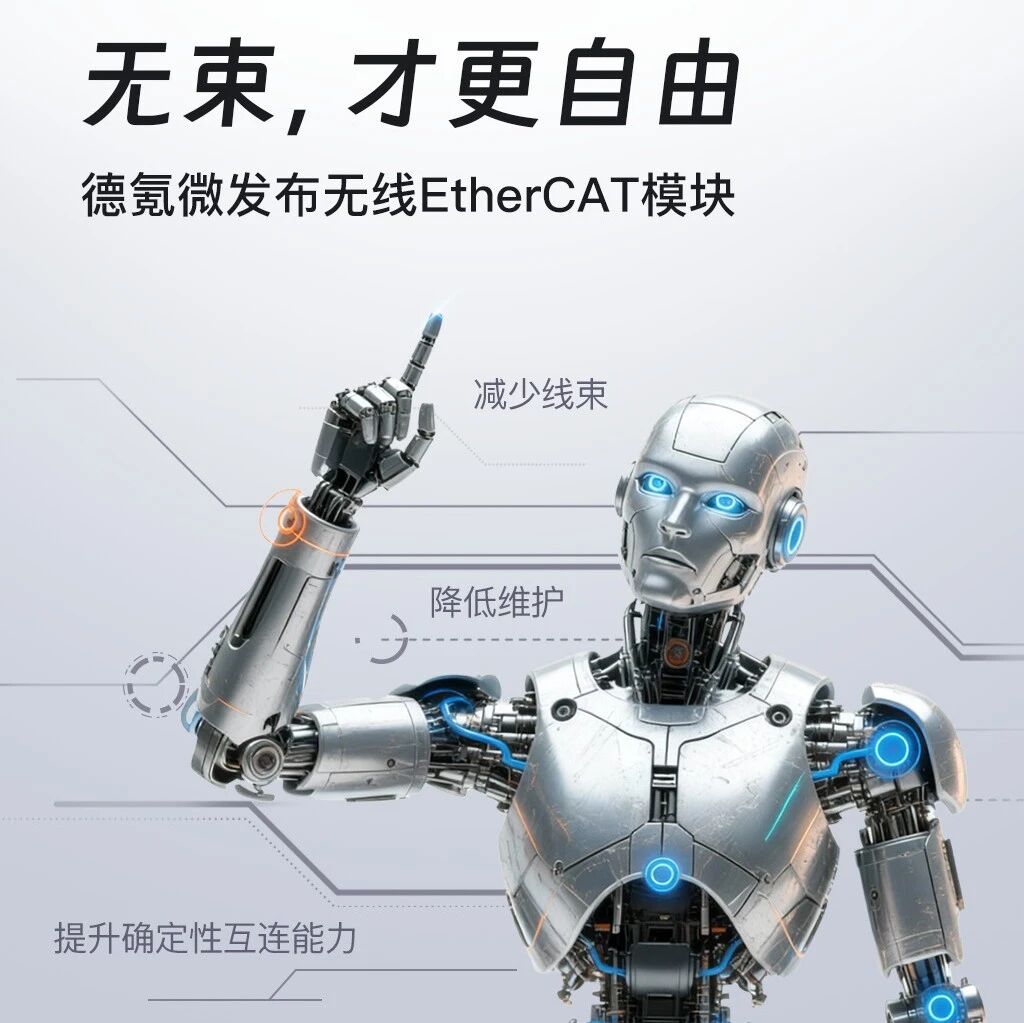
Core Insights - The industry is shifting its focus from "mobility" to "stable delivery" in the context of embodied intelligence and humanoid robots, emphasizing the importance of engineering details that ensure reliability, such as internal joint connections [1] Group 1: Industry Trends - The consensus in the industry is that the real differentiators for robots in practical applications are not just algorithms and structural design, but also the often-overlooked engineering details that affect reliability [1] - Key engineering challenges in humanoid robots include managing multiple "rotational interconnection nodes" in constrained spaces, which require reliable communication and power transmission through rotating interfaces [1] Group 2: Product Development - 德氪微 recently launched a millimeter-wave wireless EtherCAT module (SDKT1020-P020-FETN) designed for the rotational joints in embodied intelligence applications, aiming to enhance reliability and interconnectivity [3] - This module utilizes proprietary millimeter-wave wireless connection chips and full-duplex circularly polarized antennas to achieve non-contact data transmission at rotating interfaces, integrating both data and power transmission [3][4] - The module supports various communication protocols (Ethernet/EtherCAT/CAN) and can achieve data rates up to 3Gbps, catering to high-bandwidth requirements [4] Group 3: Reliability and Performance - The module targets a bit error rate (BER) of less than 10⁻¹², operates in temperatures ranging from -25℃ to 85℃, and supports a maximum rotational speed of 2000 r/min, with a lifespan exceeding 3 years [5] - The design is compact, facilitating installation within joint cavities and allowing for customization to fit different robotic applications [5] - The focus is on reducing wiring, lowering maintenance needs, and enhancing the reliability of interconnections, which is crucial as embodied intelligence robots transition from demonstration to mass delivery [5]
IPO雷达|酷芯微递表港交所,产品生产依赖第三方,资产负债率达419%
Sou Hu Cai Jing· 2026-02-06 08:20
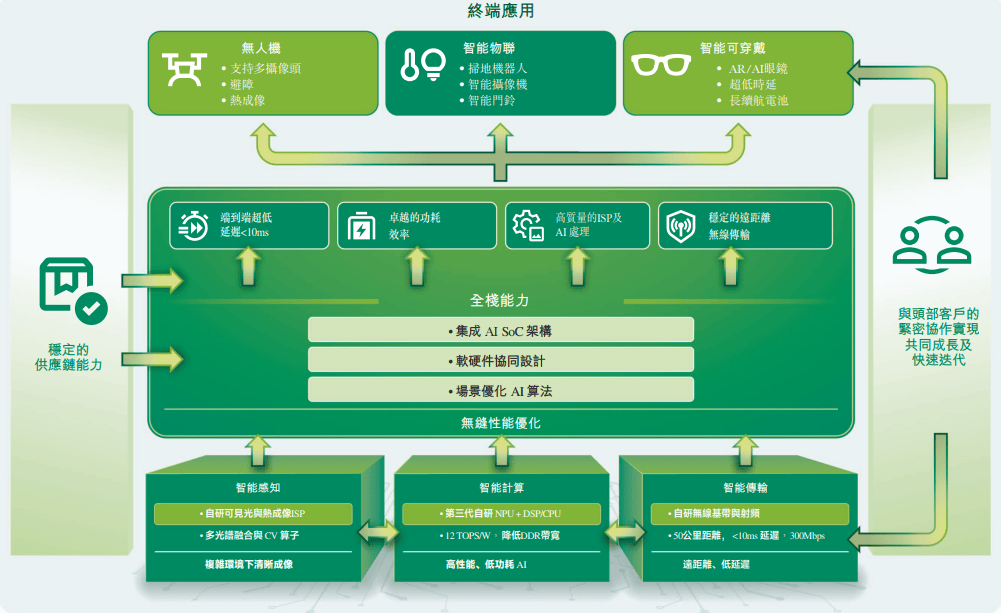
净利润未扭亏 深圳商报·读创客户端记者 梁佳彤 日前,据港交所官网,合肥酷芯微电子股份有限公司(下称"酷芯微")递交主板上市申请。该公司收入增速显著放缓,产品生产依赖第三方代 工厂,15.66亿元赎回负债悬顶。 招股书介绍,酷芯微是一家视觉处理AI SoC供应商,提供以视觉处理AI SoC与无线视频传输SoC为核心的集成化解决方案,产品组合融合芯片 设计、软件工具包、场景优化算法及工程支持服务,协助客户在快速演进的AI应用环境中缩短开发周期并加速产品上市进程。 公司的产品是驱动智能设备的智能引擎,并推动AI加速普及。公司全面的视觉处理AI SoC及视频传输SoC产品及解决方案广泛应用于无人机、 智能物联及智能可穿戴行业。 酷芯微业务架构。来源:招股书 收入增速显著放缓 2023年至2024年及2025年前三季度(下称"报告期"),酷芯微分别实现收入1.05亿元、4.49亿元和3.41亿元;公司2024年和2025年前三季度收 入同比变动327%和-0.6%,增速显著放缓。 | | 截至12月31日止年度 | | 载至9月30日止九個月 | | | --- | --- | --- | --- | --- | | ...
大行评级丨花旗:Arm仍具强劲成长动能与成长股特质,目标价下调至190美元
Ge Long Hui· 2026-02-06 03:01
Group 1 - The core viewpoint of the report is that Arm, a UK chip designer under SoftBank, has slightly exceeded revenue and profit expectations for the third quarter of the fiscal year ending December 2026, indicating strong growth momentum and characteristics of a growth stock [1] - Arm's revenue and earnings per share are projected to have a compound annual growth rate (CAGR) of over 20% and 25% respectively, which supports its premium valuation [1] - The report highlights two short-term concerns for the market: the impact of memory price/supply fluctuations on Arm's patent fees in the mobile segment, and the investment scale required for Arm's entry into the physical chip market [1] Group 2 - Regarding the memory risk, Arm assesses that the impact on patent fees for the fiscal year 2027 will be a low single-digit percentage, which can be offset by its data center business [1] - Based on the growth of the overall potential market for cloud AI (TAM) and the proliferation of CSS technology, the revenue forecasts for Arm for the fiscal years 2026 and 2027 have been raised by 1%, expecting strong growth of 23% and 21% respectively [1] - The target price for Arm has been adjusted from $200 to $190, maintaining a "buy" rating [1]

中金公司港股晨报-20260206
Xin Da Guo Ji Kong Gu· 2026-02-06 01:54
Market Overview - The Hang Seng Index is expected to hold at 26,000 points, influenced by the hawkish stance of the newly appointed Federal Reserve Chair and a rebound in the US dollar index, which has led to profit-taking in the commodity market [2] - The Chinese government is anticipated to focus on expanding domestic demand and technological self-sufficiency in the first quarter of 2026, as it marks the beginning of the 14th Five-Year Plan [2] - There is a projected GDP growth target for China in 2026 set between 4.5% and 5%, lower than the approximately 5% target for 2025, with many provinces lowering their GDP targets ahead of the Two Sessions [2] Sector Focus - Macau gaming stocks are viewed positively due to January's gambling revenue exceeding expectations, with the upcoming Spring Festival serving as a catalyst for growth [3] Corporate News - Syngenta, a subsidiary of China National Chemical Corporation, plans to raise up to $10 billion in an IPO in Hong Kong, potentially becoming one of the largest IPOs globally [5] - Lanke Technology has priced its shares at 106.89 HKD, aiming to raise 7 billion HKD [5] - Meituan is set to acquire a fresh food e-commerce business for $717 million [5] - NIO is expected to report an adjusted operating profit of over 700 million RMB for the last quarter [5] - MGM China anticipates an adjusted EBITDAR increase of nearly 11% by 2025 [5] Macro Focus - The US Federal Reserve maintained interest rates in January, indicating a positive outlook on economic activity, while suggesting a cautious approach to future rate adjustments based on economic data [6] - The European Central Bank and the Bank of England both kept interest rates unchanged, aligning with market expectations [6] - China's logistics industry maintained an expansionary stance with a logistics prosperity index of 51.2 in January [8] - The Chinese commodity price index rose by 6.3% month-on-month in January, marking a three-and-a-half-year high [8] Industry Insights - The Chinese photovoltaic industry is expected to see a significant decline in new installed capacity in 2026, with estimates ranging from 180 to 240 GW, a decrease of 23.8% to 42.9% from the previous year's record [8] - China's gold consumption is projected to decline to 950.1 tons in 2025, a year-on-year decrease of 3.57%, while production is expected to increase by over 1% [8] - The Chinese market is experiencing a significant shortage of memory chips, prompting major PC manufacturers like HP and Dell to consider sourcing from Chinese manufacturers [9]