量化私募

Search documents
百亿量化私募冠军实战录!天演资本:锚定长期主义,以持续迭代穿越牛熊!| 量化私募风云录
私募排排网· 2025-10-28 03:04
Core Viewpoint - The article emphasizes the rapid development of AI and quantitative technology in the investment sector, highlighting the importance of continuous strategy evolution for the long-term success of quantitative private equity firms like Tianyan Capital, which was founded in 2014 and has a strong focus on innovation and adaptation [2]. Company Overview - Tianyan Capital was co-founded by Xie Xiaoyang and Zhang Sen, both of whom have over ten years of industry experience. The company’s name reflects its commitment to change and deep insights into the essence of investment [2]. - The firm has received multiple industry awards, including the "Golden Changjiang Award" and "Yinghua Award," and ranks among the top ten quantitative private equity firms in terms of performance [3][4]. Performance Metrics - As of September 2025, Tianyan Capital's products have achieved impressive returns, with an average return of ***% over the past three years, placing it first in the industry [3][4]. - The firm manages approximately 2.1 billion yuan across 11 products that meet ranking criteria, showcasing its strong long-term performance [3]. Investment Strategy - The core strategy of Tianyan Capital is centered around a multi-factor model for stock selection, which allows for higher alpha returns at a lower cost [8]. - The flagship product, "Tianyan Saineng," has been operational since May 2016 and has demonstrated significant returns, with a focus on maintaining model autonomy and stability in risk control [10][11]. Team and Culture - The investment research team at Tianyan Capital consists of over half PhD holders from prestigious institutions, fostering a culture of free exploration and innovation [12]. - The company emphasizes long-termism in its operations, avoiding arbitrary changes to risk parameters and maintaining a stable risk control model [10][11]. Market Position and Future Outlook - Tianyan Capital has strategically positioned itself to balance scale and performance, understanding that growth in assets under management should align with long-term performance and research capabilities [14]. - The firm has also obtained a Hong Kong license to enhance its global asset allocation capabilities, focusing on capturing unique alpha opportunities in the Chinese market while catering to international investors [16].


上海量化私募地图来啦!头部量化扎堆浦东?稳博、天演、鸣熙、明汯等业绩领衔!
私募排排网· 2025-10-24 03:51
Core Viewpoint - The article highlights the concentration of quantitative private equity firms in Shanghai, which dominates the landscape in China, followed by Beijing and Shenzhen. As of the end of September, there are 851 quantitative private equity firms in China, with 335 located in Shanghai, accounting for 39.37% of the total [2]. Group 1: Regional Distribution - Shanghai has a significant number of quantitative private equity firms, with 335 firms and a total product scale of approximately 4.82 trillion yuan, yielding an average return of 24.90% this year [3]. - Beijing has 145 firms with a total product scale of approximately 1.74 trillion yuan and an average return of 28.45% [3]. - Shenzhen has 125 firms with a total product scale of approximately 1.68 trillion yuan and an average return of 24.43% [3]. - The clustering of quantitative private equity firms in Shanghai is attributed to a combination of favorable national positioning, trading infrastructure, and a talent pool [3][4][5]. Group 2: Performance by District in Shanghai - In Pudong New District, there are 179 quantitative private equity firms, with 22 managing over 5 billion yuan. The average return for 87 firms is 22.01% this year [8][10]. - In Hongkou District, there are 40 firms, with 10 managing over 5 billion yuan. The average return for 21 firms is 23.20% [12][14]. - In Xuhui District, there are 31 firms, with 5 managing over 5 billion yuan. The average return for 16 firms is 25.22% [16][18]. - Other districts collectively have 85 firms, with 3 managing over 5 billion yuan. The average return for 35 firms is 32.86% [19][21]. Group 3: Notable Firms and Strategies - Top firms in Pudong include Weibo Investment, Tianyan Capital, and Jinge Liangrui, with significant returns [10][11]. - In Hongkou, leading firms are Shanghai Taoshan, Mingxi Capital, and Minglong Investment, showcasing strong performance [15]. - Xuhui's top firms are Shanghai Zijie and Yanfeng Investment, with notable returns [18]. - In other districts, Jinwang Investment, Zhixin Rongke, and Quancheng Fund lead in performance [21].

九坤投资:逐理追光——以科学研究的精神打磨投资能力 | 量化私募风云录
私募排排网· 2025-09-24 03:33
Core Viewpoint - Quantitative investment has gained popularity among investors due to its rational, scientific, and emotionally stable characteristics. Jiukun Investment, as one of the earliest quantitative private equity firms in China, has maintained a leading scale and performance competitiveness over the years, winning over 150 industry awards [2]. Group 1: Performance and Products - As of the end of August, Jiukun Investment has 13 products with reported performance, achieving an average return of ***% this year. The "Jiukun Daily Enjoyment CSI 1000 Index Enhanced No. 1" product ranks first in returns this year, with a five-year excess return of ***% and a cumulative return of ***% since inception, showcasing Jiukun's long-term investment capability in the index enhancement sector [2]. - Jiukun Investment has a well-established and mature framework for index enhancement strategies, with a team experienced in various sub-strategies. The firm has 13 products that reached historical highs in August [22][23]. Group 2: AI Integration and Research - Jiukun Investment has positioned itself as a technology company from its inception, establishing an AI team early on and forming an internal laboratory in 2020. Over the past five years, over 90% of the recruited researchers have an AI research background, enabling comprehensive AI capability coverage in quantitative investment [5][19]. - The firm emphasizes the importance of scientific methods and a keen sense of cutting-edge technology, which are core advantages that allow Jiukun to navigate cycles and continuously iterate [7][14]. Group 3: Investment Principles and Talent - Jiukun Investment adheres to three main investment principles: rationality, long-term focus, and scientific approach, which empower every aspect of quantitative investment [6][10]. - Talent organization is considered a core asset in the quantitative field. Jiukun has a diverse team of experts in mathematics, physics, and computer science, and emphasizes nurturing talent through various programs and competitions [20].

“9·24”一周年下的基金经理进化论:市场为师 策略进化
Mei Ri Jing Ji Xin Wen· 2025-09-23 15:38
Core Insights - The A-share market has experienced significant growth since the implementation of a comprehensive financial policy on September 24 last year, with the Shanghai Composite Index reaching above 3800 points twice [1] - A total of 429 mixed equity funds and 112 ordinary equity funds have achieved over 100% performance in this period [1] Investment Value Rediscovery - Prior to the rise of technology growth stocks, the A-share market lacked a clear and sustained investment theme, with traditional cyclical and consumer sectors performing poorly due to weak economic expectations [1] - In uncertain times, many investors prioritized stability and safety, leading to a focus on high-dividend sectors [1] - A public fund manager noted a lack of participation in high-dividend stocks due to unfamiliarity with their business models and a belief that their performance was not aligned with growth investment aesthetics [1] Market Style Rotation - Over the past year, there has been a rapid rotation between high-dividend large-cap value stocks and thematic growth stocks such as AI and new productivity sectors [2] Adjustments in Investment Framework - The public fund manager has adjusted their investment framework, recognizing the need to relax stringent requirements for long-term economic moats in industries experiencing explosive growth [3] - The understanding of value has become more pragmatic and diversified, emphasizing the importance of industry prosperity and explosive growth as attractive value forms [3] - This approach aligns more closely with the characteristics of the A-share market, allowing for a more practical investment framework [3] Sector Performance - The PCB (Printed Circuit Board) sector has shown strong performance, benefiting from the explosive demand in AI computing infrastructure and automotive electronics since 2025 [4] Quantitative Private Equity Strategies - Since September 24 last year, the A-share market has shown a trend of oscillating upward, with significant market events occurring at three key points [5] - The first key point was the release of favorable policies in September 2024, which boosted market sentiment and led to a 20% increase in major indices by the end of that month [5] - The second phase involved a market recovery after external disturbances in April 2025, supported by continuous policy efforts, leading to a resurgence in market confidence and a significant increase in margin trading balances [6] - However, by August 2025, the performance of quantitative private equity strategies began to slow down due to a divergence in market performance, with a significant number of stocks declining despite index increases [6] - Many large private equity firms are focusing on artificial intelligence and exploring diversified strategies to enhance portfolio stability, which is seen as the future direction for quantitative private equity [6]
北上广浙量化巨头和黑马同台争锋!锦望、聚宽、巨量均衡领衔
Sou Hu Cai Jing· 2025-09-17 08:32
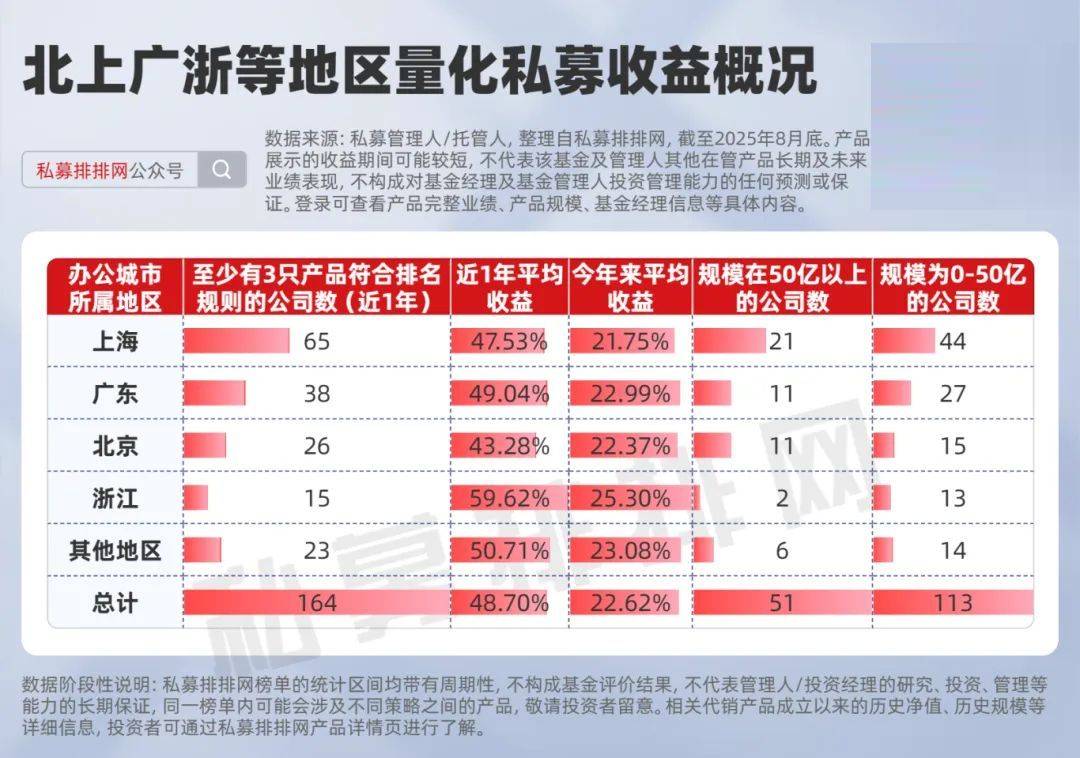
Core Insights - The "9·24" market has significantly improved the excess return environment, with the global tech revolution driven by AI opening new avenues for quantitative investment, leading to a new wave of development in quantitative private equity [1] - As of the end of August this year, there are 164 quantitative private equity firms with at least three products meeting ranking criteria, achieving average returns of 48.7% over the past year and 22.62% year-to-date [1][2] - Shanghai, Guangdong, Beijing, and Zhejiang are the leading regions for private equity firms, with Shanghai having the highest number at 65 firms, while Zhejiang boasts the best performance with average returns of 59.62% over the past year [1][2] Regional Performance Summary Shanghai - Shanghai has 65 private equity firms, with the top 10 firms having a performance threshold of ***%, the highest among all regions [3] - The top three firms in Shanghai are Jinwang Investment, Quancheng Fund, and Shanghai Zijie Private Equity, all with assets under management below 50 billion [3][5] Guangdong - Guangdong's top 10 private equity firms have a performance threshold of ***%, with Shenzhen housing 7 of these firms [11] - The top three firms in Guangdong are Hanrong Investment, Tianzhihui, and Juyuan Balanced Fund, all focusing on stock strategies [11][12] Beijing - In Beijing, the top 10 private equity firms have a performance threshold of ***%, with six of them being leading firms [7] - The top three firms are Huacheng Private Equity, Tiansuan Quantitative, and Beijing Zhengding Private Equity, focusing primarily on stock strategies [7][9] Zhejiang - Zhejiang's top 10 private equity firms have a performance threshold of ***%, with nine firms located in Hangzhou [13] - The top three firms are Liangying Investment, Yunqi Quantitative, and Xiangmu Asset, all with assets under management between 20-50 billion [13][14] Other Regions - The top 10 private equity firms in other regions have a performance threshold of ***%, with a notable presence in Chengmai [16] - The top three firms are Hongtong Investment, Boyi Asset, and Shunyi Cheng Investment, focusing on stock strategies [16][17]
与“星耀领航计划”同行!念空科技:为投资者创造可持续回报
Zhong Guo Zheng Quan Bao· 2025-09-13 00:28
Group 1 - The "Starry Navigation Plan" aims to create the most influential private equity empowerment platform in China, focusing on technology innovation and compliance [1][5] - The plan will invite outstanding representatives from the "Technology Innovation Leadership" and "Integrity Development" awards to share insights and explore high-quality industry development [1] Group 2 - NianKong Technology has established AllMind, a company focused on researching foundational algorithms and engineering technologies related to general large language models (LLM) [2] - AllMind collaborates with several universities in material science and theoretical science for practical exploration, while NianKong Technology operates as a profitable quantitative private equity fund [2] Group 3 - NianKong Technology began utilizing AI algorithms for financial data fitting in late 2018, achieving significant results and gaining a competitive edge in AI algorithm application [3] Group 4 - The "Starry Navigation Plan" serves as a bridge in the private equity industry, technology enterprises, and the real economy, fostering a healthy ecosystem for private equity institutions [4] - NianKong Technology aims to leverage its AI capabilities to contribute to the development of the real economy and seeks like-minded partners through the "Starry Navigation Plan" [4] Group 5 - The "Starry Navigation Plan" emphasizes "empowerment investment" to identify leaders in private equity that support technology innovation and sustainable development [5] - NianKong Technology expresses its commitment to excellent corporate governance and cutting-edge technological innovation to create sustainable returns for investors [5]
“星耀领航计划”走进知名量化私募念空科技 探索科技创新与金融深度融合新范式
Zhong Guo Zheng Quan Bao· 2025-09-12 22:24
Core Viewpoint - The "Starry Navigation Plan" aims to create the most influential private equity empowerment platform in China, focusing on the integration of technology innovation and finance [1][5]. Group 1: Company Initiatives - Nian Kong Technology has established AllMind, a company dedicated to researching foundational algorithms and engineering technologies related to general large language models (LLM) [2]. - Nian Kong Technology's AI team utilizes machine learning and deep learning algorithms to fit financial data, while AllMind focuses on large model training algorithm optimization and engineering research [2]. - The company began using AI algorithms for quantitative models in late 2018, achieving significant results and gaining a competitive edge in AI algorithm application and financial data fitting [3]. Group 2: Industry Impact - The "Starry Navigation Plan" serves as a bridge in the private equity industry, fostering a healthy ecosystem for private equity institutions [4]. - Nian Kong Technology aims to leverage its AI capabilities to contribute to the development of the real economy, seeking like-minded partners through the "Starry Navigation Plan" [4]. - The collaboration between China Securities Journal and China Galaxy Securities emphasizes the importance of empowering innovative companies and supporting the development of the private equity sector [5].
量化私募最新排名揭晓!百亿量化稳如山!中小规模量化大洗牌!
Sou Hu Cai Jing· 2025-09-12 09:13
Core Insights - The A-share market has been active this year, with daily trading volumes consistently above 1 trillion, peaking over 3 trillion in August, and the Shanghai Composite Index reaching a nearly 10-year high [1] - Quantitative private equity funds have performed well, with an average return of approximately 22.36% year-to-date as of August 2025, outperforming the Shanghai Composite Index and Shenzhen Component Index [1] - A total of 173 quantitative private equity firms have reported performance, with the top firms categorized by asset size [1] Group 1: Performance of Quantitative Private Equity - The average return of quantitative private equity funds this year is 22.36%, surpassing the Shanghai Composite Index's 15.10% and Shenzhen Component Index's 21.91% [1] - The top three firms in the 100 billion category are Stable Investment, Abama, and Tianyan Capital, with notable performance improvements for Chengqi and Jinge Liangrui [1][5] - Among the 45 firms in the 100 billion category, 31 have reported performance for three or more products, with their average return exceeding a certain threshold [5] Group 2: Firm Distribution and Strategy - By core strategy, 38 firms focus on stock strategies, accounting for over 80% of the total, while 6 firms employ multi-asset strategies and 1 firm uses futures and derivatives strategies [2] - Shanghai is home to 22 of these firms, nearly half of the total, while Beijing has 10 [2] - There are 9 firms with over 100 employees, including Jiukun Investment and Lingjun Investment [2] Group 3: Rankings and Notable Firms - The top 10 quantitative private equity firms by performance in the 100 billion category include Stable Investment, Abama Investment, and Tianyan Capital, with all products reaching historical highs in August [5][7] - In the 50-100 billion category, the leading firms are Tianxuan Quantitative and Dayan Capital, with their products also achieving historical highs [10][12] - The top firms in the 20-50 billion category are Yunqi Quantitative and Xiangmu Asset, maintaining their positions from previous months [14][16] Group 4: Emerging Firms and Trends - Yunqi Quantitative, established in 2021, has quickly risen to prominence in the 20-50 billion category, with all products reaching historical highs in August [17][16] - Stable Investment, founded in 2014, has developed diverse investment strategies and has received multiple industry awards [9][21] - The 5-10 billion category is led by Jinwang Investment and Juyuan Balanced Fund, indicating a reshuffling in rankings compared to previous months [23][27]

小市值指增产品还能配置吗?蒙玺、念空、世纪前沿、鸣熙、杨湜、巨量均衡等10家量化私募发声!
私募排排网· 2025-09-11 03:43
Core Viewpoint - The recent phenomenon of "beta rising while alpha falls" in the A-share market is attributed to structural market differentiation and the characteristics of quantitative investment strategies, where a few large-cap stocks drive index gains while most stocks lag behind [3][4][5]. Group 1: Market Environment and Performance - Since August, the A-share market has experienced accelerated gains, with trading volumes reaching historical highs, but there is significant differentiation between large-cap and small-cap stocks [2]. - The strong performance of large-cap stocks has raised concerns among investors regarding the allocation to small-cap index-enhanced products [2][9]. - The market's overall upward momentum is primarily driven by a small number of stocks, leading to a decrease in pricing efficiency for individual stocks and making it harder for quantitative models to capture alpha [3][4][5]. Group 2: Challenges for Quantitative Strategies - The concentration of funds into a few large-cap stocks has resulted in a weak performance for the majority of stocks, complicating the ability of quantitative strategies to generate excess returns [4][5][6]. - The recent market structure has led to a situation where the alpha capture becomes more challenging due to the high degree of style concentration [4][5][6]. - Historical experience suggests that extreme structural market conditions are typically unsustainable, and the market will eventually revert to a more balanced state, allowing quantitative strategies to recover their alpha [5][6]. Group 3: Investor Concerns and Strategy Adjustments - Investors are currently worried about the risks associated with style switching, particularly regarding small-cap index-enhanced products [9]. - To mitigate risks, companies suggest diversifying portfolios and focusing on high-quality small-cap stocks with strong earnings capabilities [10][11]. - The emphasis is placed on maintaining a balanced approach to investment, ensuring that strategies are adaptable to changing market conditions [12][13]. Group 4: AI Integration in Investment Strategies - Companies have increasingly integrated AI technologies into their investment processes, enhancing data processing capabilities and improving the efficiency of information extraction [22][24]. - AI is utilized for various functions, including data cleaning, feature extraction, and optimizing investment strategies, which helps in capturing potential signals more effectively [22][23][25]. - The application of AI in investment strategies is seen as a critical factor in enhancing predictive capabilities and optimizing decision-making processes [25][26]. Group 5: Long-term Investment Perspectives - The focus is on long-term investment strategies rather than short-term timing, with an emphasis on building resilient portfolios that can withstand market fluctuations [27][28][29]. - Companies advocate for a diversified approach to asset allocation, which can help mitigate the emotional impact of market volatility on investment decisions [35][36]. - The importance of identifying undervalued assets with high certainty for long-term gains is highlighted as a key strategy for investors [31][32].

量化超额突发回撤,与2024年有什么不同?
私募排排网· 2025-08-20 10:15
Core Viewpoint - The A-share market experienced a broad rally last week, with the Shanghai Composite Index reaching the critical level of 3700, while index-enhanced strategy products significantly underperformed the benchmark indices [2] Group 1: Market Performance - The excess returns of various index-enhanced products were negative, with the Shanghai 300 Index Enhanced, CSI 500 Index Enhanced, and CSI 1000 Index Enhanced showing excess returns of -0.49%, -1.09%, and -1.26% respectively [2] - The performance of individual stocks was relatively weak, with less than 50% of stocks in the quant management pool outperforming the benchmark indices during the week [2][3] - The proportion of stocks outperforming the Shanghai 300 Index was below 40% for most of the week, indicating increased difficulty in achieving excess returns [2] Group 2: Strategy and Market Dynamics - The difficulty in obtaining alpha returns is attributed to rapid convergence of basis, where the short positions in futures are weaker than long positions, leading to a decline in neutral strategy products [3] - Market sentiment was high, but the rapid rotation of sector styles made it challenging for stock selection strategies to generate excess returns [2][3] - Quant managers believe that the recent alpha pullback is within a normal range and is not indicative of issues with stock selection strategies [7] Group 3: Future Expectations - Historical data suggests that after periods of alpha decline, there is a high probability of recovery in subsequent market conditions, even if indices experience profit-taking [7][10] - Investors are encouraged to remain optimistic about the potential for recovery in quant management products despite current challenges [7]