
PC

Search documents
浪人早报 | 曝苹果芯片主管或离职、俞敏洪称写公开信员工正常上班、豆包辟谣手机助手可以直接查余额…
Xin Lang Ke Ji· 2025-12-08 06:14
Group 1 - Apple is experiencing significant personnel changes, with senior executives and core engineers leaving, including hardware technology senior vice president Johny Srouji, who is considering leaving for another company [2] - Apple CEO Tim Cook is actively trying to retain Srouji by offering a lucrative compensation package and potential increased responsibilities [2] Group 2 - Lenovo, Dell, and HP are planning to raise prices due to a continuing surge in storage prices, with increases expected to reach up to 20% [5] - Lenovo has notified customers that all server and computer quotes will expire on January 1, 2026, after which new prices will significantly increase [5] - Dell is considering price hikes of at least 15% to 20% for PC and server products, with potential implementation as early as mid-December [5] - HP's CEO Enrique Lores warned that the second half of 2026 could be particularly challenging, indicating that price increases may be necessary [5] Group 3 - The opening of Apple's sixth retail store in Beijing marks a significant expansion in the Greater China region, featuring a dedicated experience area for the Apple Vision Pro [7] Group 4 - Honor's upcoming ROBOT PHONE is set to enter mass production in the first half of next year, featuring a unique design with a hidden mechanical arm gimbal for automated photography [8] Group 5 - Porsche is investigating a recent incident in Russia where hundreds of vehicles suddenly became inoperable, attributing the issue to a problem with the safety system installed at the factory [9] - Weipai has responded to customer complaints regarding cracks in vehicle dashboard components, stating that the issue is due to improper installation and offering free replacement services [10] Group 6 - The chairman of Hand Capital criticized humanoid robots as a "big bubble" and a "scam," claiming that their autonomous capabilities are not yet at a functional level [12]



财信证券晨会纪要-20251208
Caixin Securities· 2025-12-07 23:31
Market Strategy - The market indices are stabilizing, with a gradual shift towards technology investments [5][9] - The overall A-share market saw a 1.14% increase, with the Shanghai Composite Index rising by 0.70% and the ChiNext Index increasing by 1.36% [8][9] - Small and micro-cap stocks outperformed larger stocks, while the hard technology sector lagged behind [8][9] Economic Insights - The People's Bank of China has increased its gold reserves for the 13th consecutive month, with November reserves reported at 7.412 million ounces [17][18] - Fund managers with performance below the benchmark by over 10% and negative profit margins will face a 30% salary cut [19][20] - The Financial Regulatory Bureau has adjusted risk factors for insurance companies investing in the CSI 300 index and other stocks based on holding periods [21][22][23] Industry Dynamics - Major PC manufacturers like Lenovo, Dell, and HP are planning price increases of up to 20% due to rising storage costs [28][29] - The 2025 National Medical Insurance Drug List has been released, adding 114 new drugs, including 50 innovative drugs, while removing 29 drugs that are no longer clinically relevant [30][31] - The consumption upgrade program has driven over 2.5 trillion yuan in sales from old-for-new exchanges in consumer goods from January to November 2025 [33][34] Company Updates - Beijing Saiwei Electronics plans to reduce its shares by up to 152,172 shares, representing 0.021% of its total share capital, due to personal financial needs [35][36] - Daodaquan's major shareholder has increased its stake, reaching a 1% threshold, with a total investment of approximately 58.23 million yuan [37][38]
每日市场观-20251203
Caida Securities· 2025-12-03 04:23
Market Overview - On December 2, the market experienced a decline, with the Shanghai Composite Index falling by 0.42%, the Shenzhen Component Index by 0.68%, and the ChiNext Index by 0.69%[3] - The total trading volume was 1.6 trillion yuan, a decrease of approximately 290 billion yuan compared to the previous trading day[1] Sector Performance - Most sectors declined, with notable increases in oil, light industry, and home appliances, while media, non-ferrous metals, computer, pharmaceuticals, and electric equipment sectors faced significant declines[1] - The main indices rebounded to the 20 or 60-day moving averages, indicating potential technical pressure and a phase of market balance with limited breakout potential[1] Capital Flow - On December 2, net outflows were recorded at 11.665 billion yuan for the Shanghai Stock Exchange and 4.290 billion yuan for the Shenzhen Stock Exchange[4] - The top three sectors for capital inflow were communication equipment, packaging and printing, and military electronics, while semiconductor, software development, and liquor sectors saw the highest outflows[4] New Accounts and Market Sentiment - In November, 2.38 million new A-share accounts were opened, a 3% increase from October, bringing the total for the year to 24.84 million, a year-on-year increase of 7.95%[7] - Compared to November 2024, the new accounts in November 2025 decreased by 12%[7] Industry Dynamics - The PC market in China saw a 2% year-on-year increase in shipments in Q3 2025, reaching 11.3 million units, driven by strong demand in the commercial sector[8] - The total number of medical consultations in 2024 exceeded 10.15 billion, with a 6 million increase from the previous year, indicating a steady growth in healthcare services[10] Investment Insights - The pharmaceutical sector has seen a slowdown in momentum after a strong rise earlier in the year, with a significant reduction in the number of "doubling funds" remaining[13] - The stock private equity position index reached a new high for the year at 82.97% on November 21, indicating a strong bullish sentiment among private equity investors[14]
PC供应链调查:存储暴涨后的定价博弈 戴尔惠普联想均计划提价
Zhi Tong Cai Jing· 2025-12-02 07:28
Core Viewpoint - The global PC industry is facing significant cost pressures due to rising prices of DRAM and NAND storage chips, prompting major manufacturers to consider price adjustments for their products [1][2][11] Group 1: Price Adjustments and Cost Structure - Major PC brands, including HP and Dell, have warned of a potential shortage of memory chips by 2026, leading to inevitable price increases [1][2] - Lenovo, as the largest PC manufacturer, is exploring price hikes for certain products to address ongoing cost pressures, although specific details are yet to be publicly announced [1][2] - The cost of memory chips currently accounts for 15% to 18% of a typical PC's total cost, indicating a significant impact on profit margins [1][2] Group 2: Market Dynamics and Demand - The demand for high-value storage solutions, driven by AI servers and data centers, has led to a reduction in DRAM and NAND production capacity, exacerbating supply constraints for traditional PC manufacturers [2][6] - Lenovo's strategy of bulk purchasing and supply chain management has been challenged by the unprecedented rise in storage chip prices, necessitating potential price adjustments [2][3] Group 3: Competitive Landscape - Different manufacturers face varying pressures regarding price increases, largely influenced by their customer structures; Lenovo's significant commercial client base allows for greater pricing flexibility compared to retail-focused brands [4][5] - The ability to maintain stable supply and service is crucial for enterprise clients, making them more accepting of price adjustments as long as overall costs remain manageable [5][8] Group 4: Future Implications - The current price increase cycle is expected to reshape the competitive landscape, with manufacturers that can ensure supply stability and maintain service quality likely to gain market share [7][10] - Historical trends suggest that during price hikes, larger manufacturers with robust supply chains tend to benefit, while those reliant on promotional strategies may struggle [9][10] - The ongoing price adjustments may not only help maintain profitability but also strengthen the market position of leading manufacturers like Lenovo [11]

PC供应链调查:存储暴涨后的定价博弈 戴尔惠普联想(00992)均计划提价
智通财经网· 2025-12-02 07:28
Core Insights - The global PC industry is facing significant cost pressures due to rising prices of DRAM and NAND storage chips, prompting major manufacturers to reconsider their pricing strategies for the upcoming quarter [1][2][11] - Companies like HP and Dell have warned of a potential memory chip shortage by 2026, which will inevitably lead to price increases being passed on to end customers [1][2] - Lenovo, as the largest PC manufacturer, is exploring price adjustments for certain products to mitigate ongoing cost pressures, although this has not been publicly announced yet [1][2][3] Pricing Strategies - The price of storage chips has shifted from short-term fluctuations to a systematic upward trend, with some products experiencing price increases of over 100% within a year [2] - Lenovo's CFO indicated that the company has stockpiled memory and other critical components, with current inventory levels approximately 50% higher than usual [3] - Different manufacturers face varying pressures regarding price increases, influenced by their customer structures; Lenovo's significant commercial client base allows for greater flexibility in pricing adjustments [4][5] Market Dynamics - The price increase cycle is expected to impact market dynamics, with consumer-oriented brands like HP and Dell being more sensitive to price changes compared to Lenovo, which has a higher proportion of enterprise clients [7][8] - The demand elasticity for Lenovo is lower due to its strong position in the enterprise market, where clients prioritize stability and service over minor price increases [8][9] - The current supply chain dynamics indicate a bifurcation, where manufacturers with long-term contracts benefit from lower costs, while those without face higher procurement prices [9][10] Future Outlook - The ongoing price increases in storage chips are likely to lead to a restructuring of the PC industry's cost structure, with potential implications for market share and profitability [6][11] - Companies with robust supply chain capabilities and a diversified customer base are expected to emerge stronger from this pricing cycle, as they can maintain stable supply and pricing strategies [10][11] - The anticipated price adjustments may not only help mitigate cost pressures but also serve as a catalyst for improving profit margins and reinforcing market leadership for top manufacturers like Lenovo [11]
Omdia:三季度中国PC市场出货量同比增长2% 达到1130万台
Zhi Tong Cai Jing· 2025-12-02 06:40
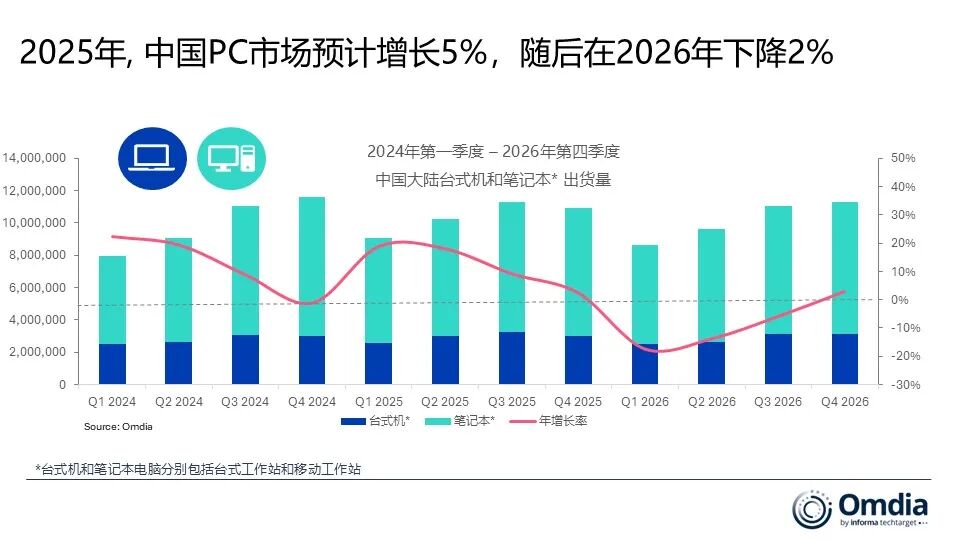
Omdia最新数据显示,2025年第三季度,中国PC市场同比增长2%,达到1130万台。台式机(包括台式工作站)出货量达到330万台,同比增 长8%,主要由商用市场强劲需求推动,该市场出货量增长了9%。笔记本(包括移动工作站)出货量维持在800万台,基本与去年持平,主 要由于本季度消费补贴力度减弱。平板电脑市场继续保持强劲势头,出货量同比增长9%至880万台。 Omdia高级分析师徐颖(Emma Xu)表示:"2024年8月底启动的补贴措施确实在当年下半年推动了出货量增长,但到了2025年第三季度,这 些补贴的覆盖范围和实际拉动效果都已明显减弱。然而,在过去两个季度,大型国有企业和政府机构仍保持较高水平的商用PC采购。随 着信创生态体系内的国产替代加速推进,我们预计未来一年偏向本地供应PC零部件的采购需求将成为新的关键增长动力,特别是在消费 补贴逐渐退坡的背景下。" 展望未来,预计到2025年底,中国PC市场将同比增长5%,达到4150万台。增长动力来自上半年稳健的消费需求和强劲的商用采购,特 别是信创领域的推动。平板电脑市场预计在2025年底增长12%至3500万台,这一增长主要受国内厂商激进的产品发布与定 ...
Omdia:随着消费者国补减弱,2025年第三季度,中国PC市场增长放缓,联想和华为继续领跑PC及平板电脑市场
Canalys· 2025-12-02 06:22
Omdia最新数据显示,2025年第三季度,中国PC市场同比增长2%,达到1130万台。台式机(包括台式工作站)出货量达到330万台,同比增长8%, 主要由商用市场强劲需求推动,该市场出货量增长了9%。笔记本(包括移动工作站)出货量维持在800万台,基本与去年持平,主要由于本季度消 费补贴力度减弱。平板电脑市场继续保持强劲势头,出货量同比增长9%至880万台。 展望未来,预计到2025年底,中国PC市场将同比增长5%,达到4150万台。增长动力来自上半年稳健的消费需求和强劲的商用采购,特别是信创领域的 推动。预计这一趋势将延续至2026年,但由于消费需求进一步走弱,市场预计将小幅下降2%。平板电脑市场预计在2025年底增长12%至3500万台,这 一增长主要受国内厂商激进的产品发布与定价策略带动;但在2026年,随着市场调整,出货量预计将回落9%至3200万台。 文章版权和解释权归微信平台Omdia所有 Omdia高级分析师徐颖(Emma Xu)表示:"2024年8月底启动的补贴措施确实在当年下半年推动了出货量增长,但到了2025年第三季度,这些补贴的覆 盖范围和实际拉动效果都已明显减弱。然而,在过去两个季度 ...

戴尔 DELL:存储涨价添堵?AI 指引再撑腰
3 6 Ke· 2025-11-27 11:27
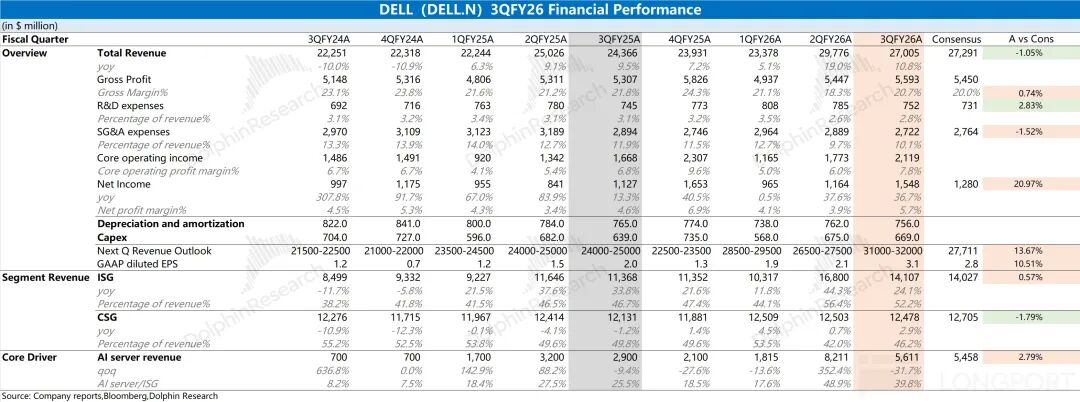
Core Performance - Dell Technologies reported Q3 FY26 revenue of $27 billion, a year-over-year increase of 10.8%, close to market expectations of $27.3 billion, with nearly $2.7 billion of the increase attributed to AI server shipments [1][15] - The gross margin for the quarter was 20.7%, down 1.1 percentage points year-over-year, slightly better than the market expectation of 20% [1][16] - The Infrastructure Solutions Group (ISG) revenue was $14.1 billion, a year-over-year increase of 24%, meeting market expectations [26][29] AI Server Business - AI server revenue for the quarter was approximately $5.6 billion, aligning with market expectations [1][31] - The backlog for AI server orders reached $18.4 billion, with projections for next quarter's AI server revenue to be around $9.4 billion, significantly exceeding market expectations [1][4][29] Client Solutions Group (CSG) - CSG revenue was $12.5 billion, a year-over-year increase of 3%, but below market expectations of $12.7 billion [30] - Commercial customer revenue was $10.6 billion, up 5% year-over-year, while personal consumer revenue fell 7% to $1.86 billion [30][35] Future Guidance - The company raised its Q4 revenue guidance to $31-32 billion, up from previous guidance of below $29 billion, driven by AI business growth [1][4] - The projected GAAP EPS for the next quarter is $3.1, reflecting growth primarily from AI business [1][4] Cost and Profitability - Operating expenses for the quarter were $3.47 billion, down 5% year-over-year, with a reduction in sales and management costs due to the low performance of traditional businesses [18][20] - Core operating income was $2.12 billion, a 27% increase year-over-year, with a core profit margin of 7.8% [20][22] Market Context - The company previously raised its long-term revenue guidance for FY26-30 from 3-4% to 7-9%, which initially boosted stock prices [5] - Concerns over rising storage costs and potential impacts on PC business have led to cautious market expectations [8][10]

卫星物联网进入商用试验,万科债券盘中临时停牌 | 财经日日评
吴晓波频道· 2025-11-27 00:29
Group 1: Satellite IoT Commercial Trials - The Ministry of Industry and Information Technology (MIIT) of China has initiated commercial trials for satellite IoT services to enhance market supply and stimulate industry vitality, aiming for a two-year trial period [2] - The trials are expected to establish a regulatory framework and promote the technology's application in sectors like agriculture and logistics, thereby supporting the development of commercial aerospace and low-altitude economies [2][3] - Current domestic satellite IoT applications are limited, with high costs hindering widespread adoption; the trials may help identify profitable pathways and unify standards [3] Group 2: Credit Repair Management - The National Development and Reform Commission (NDRC) has introduced a credit repair management method that classifies credit information based on severity, with minor infractions generally not being publicly disclosed [4] - The new method allows for a clearer path to credit repair, enabling individuals to rectify minor credit issues after fulfilling their obligations [5] Group 3: U.S. Consumer Confidence and Economic Indicators - U.S. consumer confidence has dropped significantly, with the November index falling to 88.7, the second-lowest in five years, indicating a cautious consumer sentiment amid rising unemployment and persistent inflation [6][7] - Retail sales growth in September was only 0.2%, below expectations, suggesting a cooling consumer market as households become more price-sensitive [6][7] Group 4: Alibaba's Financial Performance - Alibaba reported a 5% year-on-year revenue increase to 247.8 billion yuan for Q2 of fiscal year 2026, exceeding market expectations, with a notable 16% growth in its Chinese e-commerce segment [8] - The company experienced a significant decline in net profit, down 52% to 20.99 billion yuan, attributed to high capital expenditures in AI and cloud infrastructure [8][9] - Alibaba's cloud revenue grew by 34%, driven by strong demand for AI-related products, marking the ninth consecutive quarter of triple-digit growth in this segment [8] Group 5: NIO's Financial Results - NIO reported a 16.7% year-on-year revenue increase to 21.79 billion yuan for Q3 2025, with a gross margin improvement to 13.9%, the highest in nearly three years [10] - The company achieved positive operating cash flow for the first time, with cash reserves reaching 36.7 billion yuan, a significant increase from the previous quarter [10] - NIO anticipates delivering between 120,000 to 125,000 vehicles in Q4, representing a year-on-year growth of 65.1% to 72% [10][11] Group 6: HP's Workforce Reduction - HP announced plans to cut 4,000 to 6,000 jobs by fiscal year 2028 as part of a strategy to streamline operations and enhance productivity, aiming to save $1 billion over three years [12] - The company is also focusing on integrating AI to accelerate product development amid a slowing PC market [12][13] Group 7: Vanke's Bond Market Activity - Vanke's bonds experienced significant declines, with "22 Vanke 02" dropping over 30%, leading to temporary trading halts [14][15] - The company has been relying on loans from Shenzhen Metro Group to address liquidity issues, but this is insufficient to resolve its broader financial challenges [14][15]




HPQ's Q4 Earnings Beat Estimates, Revenues Increase Y/Y
ZACKS· 2025-11-26 16:01
Core Insights - HP Inc. reported fourth-quarter fiscal 2025 earnings of 93 cents per share, exceeding the Zacks Consensus Estimate by 2.2%, but down from 96 cents per share a year ago [1] - The company's revenues for the fourth quarter were $14.64 billion, reflecting a year-over-year increase of 4.2%, but missing the Zacks Consensus Estimate by 2.2% [2] Revenue Breakdown - Personal Systems (PS) revenues, which account for 71% of net revenues, reached $10.4 billion, up 8% year over year, driven by strong demand in both commercial and consumer PC segments [3] - The Printing business, contributing 29% of net revenues, generated $4.27 billion, down 4% year over year, primarily due to declines in Supplies and Commercial Printing [4] Geographic Performance - Revenue growth was observed in all regions, with the Americas rising 1.1%, EMEA up 1.1%, and Asia Pacific & Japan growing 11% year over year [5] Operating Results - Personal Systems' non-GAAP operating margin was 5.8%, down 40 basis points year over year, while the Printing division's non-GAAP operating margin was 18.9%, down 70 basis points [6] - Overall non-GAAP operating margin for HP was 8.0%, contracting 80 basis points from the prior-year quarter [6] Financial Position - At the end of the fiscal fourth quarter, HP had $3.7 billion in cash and cash equivalents, an increase from $2.9 billion in the previous quarter [7] - The company generated $1.6 billion from operating activities and delivered $1.5 billion in free cash flow, returning $0.8 billion to shareholders through dividends and share repurchases [7] Summary of Earnings - HPQ's Q4 earnings beat estimates, with revenues rising 4.2% year over year, while Personal Systems revenues grew 8% due to stronger demand [9]
