
农产品加工

Search documents
综合晨报-20260121
Guo Tou Qi Huo· 2026-01-21 02:29
Report Industry Investment Ratings No relevant content provided. Core Views of the Report - The main tone of the crude oil market is a bearish pattern dominated by loose supply and demand, with limited short - term upside potential for oil prices [2]. - Precious metals remain strong, and a long - position mindset should be maintained [3]. - For various metals, non - ferrous metals such as copper, aluminum, zinc, etc., and energy and chemical products like fuel oil, asphalt, etc., as well as agricultural products including soybeans, corn, etc., each have their own supply - demand situations and price trends, and corresponding investment strategies are proposed [4][22][36]. Summary by Related Categories Energy - **Crude Oil**: Geopolitical tensions are controllable, supply is relatively loose, and inventory is accumulating. The short - term upside of oil prices is limited, and the market is under pressure [2]. - **Fuel Oil & Low - sulfur Fuel Oil**: The fuel oil market is geopolitically driven. High - sulfur fuel oil may be strong in the near - term due to geopolitical uncertainties, while low - sulfur fuel oil faces supply pressure but has some support from the rise in gasoline and diesel cracking spreads [22]. - **Asphalt**: The price fluctuates with crude oil, and the market is in an oscillating pattern. Attention should be paid to the arrival of Venezuelan crude oil [23]. Metals - **Precious Metals**: They continue to be strong, and a long - position mindset should be maintained due to the weakening confidence in US dollar assets [3]. - **Base Metals** - **Copper**: The price dropped overnight. It is recommended to hold an option combination and consider short - selling with a small position [4]. - **Aluminum**: The price continued to adjust. The support level for Shanghai aluminum is at 23,500 yuan after breaking 23,800 yuan [5]. - **Zinc**: The price slightly declined. In the short - term, it is not expected to fall deeply, but there is downward pressure in the medium - term [8]. - **Lead**: The price is in a low - level oscillation pattern, with a price range of 17,000 - 17,800 yuan/ton [9]. - **Nickel and Stainless Steel**: Shanghai nickel is in a high - level oscillation, and a long - position mindset should be maintained [10]. - **Tin**: The price opened high and closed low. Attention should be paid to the substantial reduction in positions of Shanghai tin [11]. - **Carbonate Lithium**: The price is in a high - level oscillation, and risk prevention should be noted [12]. - **Industrial Silicon**: The price is likely to oscillate, and there is hedging pressure above the 9,000 yuan/ton mark [13]. - **Polysilicon**: The futures price rebounds weakly, and the spot price is expected to rise steadily [14]. - **Ferrous Metals** - **Steel (Thread & Hot - rolled Coil)**: The price oscillates in a range. Demand expectations are weak, and attention should be paid to market trends [15]. - **Iron Ore**: The price is expected to oscillate in the short - term, with a relatively loose supply - demand situation [16]. - **Coke**: The price is likely to follow a weak oscillation [17]. - **Coking Coal**: The price is likely to follow a weak oscillation [18]. - **Manganese Silicon**: The price oscillates downward. Attention should be paid to the "anti - involution" impact and cost support [19]. - **Silicon Iron**: The price oscillates downward. The supply decreases significantly, and demand has some resilience [20]. Chemicals - **Urea**: The price is weakly stable. In the short - term, it may decline slightly, while in the long - term, it is likely to oscillate strongly within a range [24]. - **Methanol**: The price is expected to oscillate and remain stalemate [25]. - **Pure Benzene**: The price oscillates strongly in the short - term [26]. - **Styrene**: The supply - demand situation supports the price [27]. - **Polypropylene, Plastic & Propylene**: The supply is tight, but demand support is expected to weaken, and the upward driving force of the supply - demand fundamentals may be insufficient [28]. - **PVC & Caustic Soda**: PVC is expected to increase in the long - term, and a low - buying strategy is recommended. Caustic soda continues to be weak [29]. - **PX & PTA**: In the second quarter, there are opportunities for PX processing margin and positive spreads, and the PTA processing margin is moderately repaired [30]. - **Ethylene Glycol**: The price oscillates at the bottom. In the second quarter, supply - demand may improve, but it is under long - term pressure [31]. - **Short - fiber & Bottle - grade Chip**: Short - fiber follows the cost, and bottle - grade chip has some improvement in processing margin but faces long - term capacity pressure [32]. Building Materials - **Glass**: The price is in a weak situation. In the long - term, it needs to reduce capacity, and low - buying opportunities can be considered when the price drops to around 1,000 yuan [33]. Rubber - **20 - rubber, Natural Rubber & Butadiene Rubber**: The demand is gradually recovering, the supply of natural rubber is decreasing, and a wait - and - see strategy is recommended [34]. Agriculture - **Soybeans & Soybean Meal**: South American weather is improving, and the US soybeans are in a bottom - oscillation trend. Attention should be paid to US soybean exports and South American weather [36]. - **Soybean Oil & Palm Oil**: They are expected to oscillate within a range [37]. - **Rapeseed & Rapeseed Oil**: The prices are expected to bottom - out and oscillate, with rapeseed oil slightly stronger than rapeseed meal [38]. - **Soybean No. 1**: The price drops, and attention should be paid to policies and the spot market [39]. - **Corn**: The price of Dalian corn futures is likely to oscillate weakly in the short - term [40]. - **Pigs**: The short - term rebound of hog futures may end, and the price is expected to reach a low point in the first half of next year [41]. - **Eggs**: In the short - term, the prices of futures and spot are weakening, while in the long - term, a low - buying strategy can be maintained [42]. - **Cotton**: Zhengzhou cotton is in a high - level oscillation. It may continue to adjust, and a wait - and - see strategy is recommended [43]. - **Sugar**: The international and domestic sugar markets have different production situations, and short - term sugar prices face some pressure [44]. - **Apples**: The futures price回调, and the market focus shifts to demand [45]. - **Timber**: The price is at a low level, and a wait - and - see strategy is recommended [46]. - **Pulp**: The price rises slightly. A wait - and - see strategy is recommended, and attention should be paid to the increase in the price of downstream base paper [47]. Financial Products - **Stock Index**: A - shares fell, and short - term attention should be paid to geopolitical situations and the subsequent changes in the sharp fluctuations of US and Japanese bonds [48]. - **Treasury Bonds**: In the short - term, the yield curve may remain steep, and opportunities to flatten the curve can be considered [49].
未知机构:冠农股份加工番茄业务反转在即国投罗钾投资价值有望重估公司2-20260121
未知机构· 2026-01-21 02:20
Summary of Company and Industry Insights Company:冠农股份 (Guannong Co., Ltd.) Financial Performance - For the first three quarters of the year, the company reported revenue of 2.136 billion yuan, a year-on-year decrease of 24.80% [1] - The net profit attributable to shareholders was 347 million yuan, reflecting a year-on-year increase of 4.56% [1] Tomato Processing Business Outlook - The tomato processing business is expected to see a significant recovery by 2026 [1] - Due to a substantial reduction in supply, the supply of tomato sauce is anticipated to tighten this year, with resilient demand in both domestic and overseas markets supporting price stabilization and recovery [1] - Under a neutral scenario, the price of bulk tomato sauce is projected to rise to 1,000 USD/ton, approximately a 40% year-on-year increase; under an optimistic scenario, the price could reach 1,200 USD/ton, about a 70% year-on-year increase [1] - This price increase is expected to enhance the company's profits by 200-300 million yuan, indicating a turning point in the core business operations [1] Investment in 国投罗钾 (Guotou Luojia) - The company's profit growth is currently benefiting significantly from its investment in Guotou Luojia [2] - Guannong Co., Ltd. holds a 20.31% stake in Guotou Luojia [2] - Guotou Luojia specializes in the development of potassium sulfate resources from the salt lake in the Lop Nur region, with an annual production capacity of 1.7 million tons, making it the largest potassium sulfate production base in the country [2] - For the first three quarters of 2025, Guotou Luojia achieved a net profit of approximately 1.9 billion yuan; based on the ownership stake, Guannong Co., Ltd. recognized an investment income of about 386 million yuan during the same period [2]

铜冠金源期货商品日报-20260121
Tong Guan Jin Yuan Qi Huo· 2026-01-21 01:32
1. Report Industry Investment Rating No information provided in the content. 2. Report's Core View - Overseas, concerns about geopolitics and fiscal sustainability triggered a systemic correction in the global bond market, with the US and Japanese bonds leading the decline. The US experienced a triple - kill in stocks, bonds, and the exchange rate, and market risk appetite deteriorated significantly. The market volatility is expected to rise. Domestically, the Ministry of Finance announced an active fiscal policy, and the A - share market is in a phase of shrinking volume and differentiation, but the medium - term trend remains positive [2][3]. - The prices of precious metals reached new highs due to geopolitical tensions and Poland's central bank's large - scale gold purchases. Base metals showed different trends, with copper expected to maintain high - level oscillations, aluminum adjusting, and zinc and lead under pressure. Agricultural products such as palm oil showed a strong oscillation trend, while bean and rapeseed meal were in a low - level oscillation [4][5][22][24]. 3. Summary by Related Catalogs Macroeconomics - Overseas: Geopolitical and fiscal sustainability concerns caused a global bond market correction. The US faced a triple - kill in stocks, bonds, and the exchange rate, with the dollar index falling to 98.5, the 10Y US bond yield reaching 4.3% and then dropping, and the US stock market falling by over 2%. Gold reached a new high of $4783, and market risk preference deteriorated [2]. - Domestic: The Ministry of Finance committed to an "increasing only" active fiscal policy in 2026, with measures to support small and medium - sized enterprises and consumers. The A - share market is in a shrinking and differentiating phase, with short - term adjustments in the upward slope of stock indices but a positive medium - term trend [3]. Precious Metals - On Tuesday, gold and silver reached new highs. Geopolitical tensions and Poland's central bank's large - scale gold purchase plan boosted the prices. The threat of US tariff hikes and EU's response to the Greenland issue increased geopolitical risks. It is expected that precious metals will remain strong in the short term [4][5]. Copper - On Tuesday, the main contract of Shanghai copper showed a weak oscillation, and LME copper slightly corrected. Global copper inventories increased, with LME inventory rising to 156,000 tons and COMEX inventory reaching 547,000 tons. Trump's intervention in the Fed's policy and personnel appointment increased market risk aversion, and the soaring precious metals prices lifted the valuation center of copper. It is expected that copper prices will maintain high - level oscillations in the short term [6][7]. Aluminum - On Tuesday, the main contract of Shanghai aluminum closed at 23,500 yuan/ton, down 0.08%. LME aluminum also fell. Aluminum ingot and aluminum rod inventories increased. Trump's tariff threat on Europe increased political tensions, and in the fundamentals, supply was stable, and it was in the consumption off - season. The Shanghai aluminum market is in an oscillatory adjustment phase [8][10]. Alumina - On Tuesday, the main contract of alumina futures closed at 2,671 yuan/ton, down 2.91%. The supply side had minor changes, with some production resumptions and planned maintenance. The consumption side had stable electrolytic aluminum procurement, and the inventory in the exchange increased rapidly. Alumina prices remained weak [11]. Cast Aluminum - On Tuesday, the main contract of cast aluminum alloy futures closed at 22,765 yuan/ton, up 0.13%. Cast aluminum maintained high - level oscillations based on low supply and cost support. Consumption was weak, and it is expected to remain in an oscillatory state [12]. Zinc - On Tuesday, the main contract of Shanghai zinc showed a narrow - range oscillation during the day and a downward shift at night. LME zinc closed down. The downstream procurement was for rigid demand, and the market was affected by increased risk aversion. It is expected that zinc prices will be under pressure in the short term [13][14]. Lead - On Tuesday, the main contract of Shanghai lead oscillated horizontally during the day and shifted downward at night. LME lead closed down. LME lead inventory increased significantly, and domestic downstream consumption was weak. Although there is cost support, lead prices are expected to be weak in the short term [16][17]. Tin - On Tuesday, the main contract of Shanghai tin oscillated horizontally during the day and fell slightly at night. The rise in the yield of Japanese 40 - year bonds increased market risk aversion, suppressing tin prices. The fundamentals changed little, and tin prices are expected to oscillate weakly in the short term [18]. Steel (Rebar and Hot - Rolled Coil) - On Tuesday, steel futures oscillated and adjusted. Affected by seasonal demand, market transactions weakened. Rebar production slightly decreased, and hot - rolled coil production increased with high inventory. The steel market is in the off - season, and steel prices are expected to continue to oscillate [19]. Iron Ore - On Tuesday, iron ore futures oscillated and adjusted. Spot market transactions were 116 tons. Iron ore supply was high, and demand was weak in the off - season. Although there is a pre - holiday restocking expectation, the overall supply exceeds demand, and the futures price is expected to be under pressure [20]. Coking Coal and Coke - On Tuesday, coking coal and coke futures oscillated and adjusted. The coke spot market initiated the first round of price increases, but steel mills have not responded. Demand was affected by the off - season and steel mill maintenance, and supply was abundant. It is expected that the futures prices will oscillate weakly [21]. Bean and Rapeseed Meal - On Tuesday, the bean and rapeseed meal futures showed mixed trends. Brazil's soybean exports in January are expected to reach 379 tons. As the Brazilian harvest progresses, South American supply is increasing. Domestic soybean arrivals are decreasing, and the market is in a state of de - stocking. It is expected that the futures prices will oscillate at a low level [22]. Palm Oil - On Tuesday, palm oil futures closed up 1.2%. High - frequency data showed an improvement in palm oil exports and a decline in production. The market is affected by geopolitical risks, but the fundamentals of production and demand are improving. It is expected that palm oil will oscillate strongly in the short term [23][24].
全球市场风险偏好走弱
Dong Zheng Qi Huo· 2026-01-21 00:43
Report's Investment Rating The provided content does not mention the industry investment rating. Core Views - Global market risk appetite has weakened, leading to a decline in the US dollar and a stock - bond - exchange triple - kill in the US. Geopolitical risks, such as the issue of Greenland acquisition, are the main drivers of market fluctuations, while the fundamentals and changes in interest - rate cut expectations remain relatively stable [2][15]. - In the stock market, there is a clear seesaw effect between growth stocks and dividend stocks, and the market rotation speed has accelerated. It is not yet possible to determine the end of the spring rally, and attention should be focused on the technological industry trends and the intensity of the Two Sessions' policies [3][23]. - In the commodity market, different commodities show different trends. For example, gold is strong, while some metals and agricultural products are under pressure. The prices of some commodities are affected by factors such as supply - demand relationships, policy regulations, and geopolitical risks [4][11][36]. Summary by Directory 1. Financial News and Comments 1.1 Macro Strategy (Gold) - Poland's central bank plans to increase its gold reserves by up to 150 tons, aiming to rank among the top 10 countries with the largest gold reserves globally. A Danish pension fund will exit the US Treasury market. Gold has risen by about 2% and reached a new high. The market's risk aversion has increased, and the distrust of the US dollar has grown, which supports the price of gold. The silver is weaker than gold, and the gold - silver ratio is expected to rise in the short term. It is recommended to focus on the opportunity to go long on the gold - silver ratio [11]. 1.2 Macro Strategy (Foreign Exchange Futures - US Dollar Index) - Trump stated that if the Supreme Court restricts the federal government's tariff policy, he can use other means. His intention regarding Greenland has not changed, which has led to a weakening of global market risk appetite and a decline in the US dollar. The US dollar index is expected to weaken in the short term [12][15]. 1.3 Macro Strategy (US Stock Index Futures) - Netflix's Q4 performance was excellent, but its Q1 guidance was disappointing. Geopolitical risks have continued to escalate during the long weekend, and the trade dispute between the US and Europe over Greenland has intensified, leading to a significant decline in market risk appetite. The performance of the stock market has been suppressed, and the three major US stock indexes have fallen by more than 2%. It is expected that the US stock market will fluctuate at a high level during the earnings season [17][19][20]. 1.4 Macro Strategy (Stock Index Futures) - The latest LPR quotes remained unchanged. The Ministry of Finance and other departments announced a package of five fiscal - financial policies to promote domestic demand. The stock market continued to adjust, with a clear seesaw effect between growth stocks and dividend stocks. It is not yet possible to determine the end of the spring rally, and it is recommended to continue holding long positions in stock index futures [21][22][23]. 1.5 Macro Strategy (Treasury Bond Futures) - The 1 - month LPR has remained stable for eight consecutive months. The central bank conducted a 324 - billion - yuan 7 - day reverse - repurchase operation, with a net withdrawal of 34.6 billion yuan on the same day. The stock market's upward momentum is weak, and the trading volume of treasury bond futures has increased. The short - term rebound of treasury bond futures is expected to continue, but the medium - to long - term trend remains bearish. It is recommended to short after the market's upward momentum fades [25][26][27]. 2. Commodity News and Comments 2.1 Black Metals (Coking Coal/Coke) - The Mongolian imported coking coal market has shown mixed trends. Coke producers have initiated the first round of price increases, which are still in the negotiation stage. The supply is relatively stable, while the downstream steel and coke enterprises are actively restocking. The inventory has decreased rapidly. In the short term, the spot price is supported by the downstream restocking sentiment, but the upward momentum of the futures price is limited, and it is expected to fluctuate [28][29]. 2.2 Black Metals (Rebar/Hot - Rolled Coil) - Two departments have issued measures to support urban renewal. A steel group has completed a strategic acquisition to build a high - end special - steel production base. Steel prices have continued to decline, and the fundamentals of finished products have faced increasing pressure in January. The seasonal decline in demand is expected to be more obvious, and the export has also weakened marginally. It is recommended to adopt a range - trading strategy before the Spring Festival and hedge inventory when the price rebounds [30][31][32]. 2.3 Agricultural Products (Soybean Meal) - In 2025, China's soybean imports reached a record high of 111.83 million tons, a year - on - year increase of 6.5%. Brazil's soybean exports in the first three weeks of January increased by 145% compared to the same period last year. The prices of domestic and foreign futures have remained weak. Although the soybean imports in the first quarter are expected to be at a low level, the current inventory is at a historical high, and the supply is sufficient. It is expected that the prices of domestic and foreign futures will remain weak under the condition of a bumper harvest in South America [33][34][36]. 2.4 Agricultural Products (Soybean Oil/Rapeseed Oil/Palm Oil) - Malaysia's palm oil exports from January 1 - 20 increased by 8.64% month - on - month. The palm oil price is expected to be supported in the short term due to its cost - effectiveness and the active purchasing attitude of countries such as India. However, the upward space is limited. Attention should be paid to the resistance at the 8800 - 8900 yuan level [38]. 2.5 Agricultural Products (Sugar) - Brazil's sugar exports in the first three weeks of January increased by 39% compared to the average daily exports in January of the previous year. India may raise the minimum selling price of sugar. China's imports of syrup and premixed powder in December 2025 decreased significantly. The domestic sugar market is facing seasonal supply pressure during the peak production period, and the demand during the pre - Spring Festival stocking period is weak. The price is expected to fluctuate weakly in the short term, but the downward space is limited [39][40][42]. 2.6 Non - Ferrous Metals (Alumina) - Ghana is promoting the construction of its first large - scale alumina refinery. The inventory of alumina enterprises has increased, and the futures price is under pressure [43]. 2.7 Non - Ferrous Metals (Lithium Carbonate) - In December 2025, China's lithium ore imports increased by 8.1% month - on - month, and lithium carbonate imports decreased by 14% year - on - year. The price of lithium carbonate has reached the daily limit, which is affected by factors such as mine - end disturbances and demand support. In the short term, it may continue to reduce inventory. The price is expected to be easy to rise and difficult to fall. It is recommended to look for opportunities to go long after the position and volatility stabilize [44][45][46]. 2.8 Non - Ferrous Metals (Lead) - Six departments have issued a management method for the recycling of new - energy vehicle waste power batteries. The prices of domestic and foreign lead have oscillated downward. The macro - level disturbances have increased, and the supply - demand contradiction has eased. The social inventory is expected to continue to rise, which will suppress the lead price. It is recommended to look for opportunities to short on rallies [47][48][49]. 2.9 Non - Ferrous Metals (Zinc) - In December 2025, China's galvanized sheet exports increased both month - on - month and year - on - year, while zinc concentrate imports decreased month - on - month. The zinc price has oscillated weakly, affected by macro - level disturbances. The fundamentals of LME zinc have weakened, and the social inventory has increased slightly. It is recommended to wait and see in the short term and be vigilant against geopolitical risks [50][51][53]. 2.10 Non - Ferrous Metals (Copper) - A company has made progress in high - speed copper cable business. Peru's copper production in November 2025 decreased by 11.2% year - on - year. China's scrap - copper imports in December 2025 increased month - on - month. The short - term macro - level negative factors have relatively increased, and the global visible inventory has risen, which will suppress the copper price. It is expected that the copper price will change from a strong rise to a wide - range oscillation, and it is recommended to wait and see [54][55][57]. 2.11 Non - Ferrous Metals (Tin) - The discount of LME tin has reached 108.01 US dollars per ton. The inventories of both the SHFE and LME have increased significantly. The processing fees of smelters have risen, and the demand remains weak. The price is expected to oscillate widely in the short term, and attention should be paid to the supply recovery and consumption improvement [58]. 2.12 Energy and Chemicals (Crude Oil) - Norway's oil production in December was 1.962 million barrels per day. The oil price has oscillated and rebounded, supported by concerns about geopolitical uncertainties. The market lacks new drivers in the short term, and the oil price is expected to oscillate [59][60]. 2.13 Energy and Chemicals (Liquefied Petroleum Gas) - A company's PP devices have stopped for maintenance. An extreme cold wave warning has been issued in the US, which has raised concerns about the short - term supply and exports of LPG. The outer - market price is expected to be strong in the near term, and the inner - market price may follow passively [61][62]. 2.14 Energy and Chemicals (Carbon Emissions) - On January 20, the closing price of CEA was 73 yuan per ton, a decrease of 9.88% from the previous day. After the 2024 compliance period, the market trading activity has cooled down significantly. The price is expected to oscillate widely, and it is recommended to buy on dips if there is demand [62][63]. 2.15 Energy and Chemicals (LLDPE) - As of January 16, 2026, the social inventory of polyethylene has decreased month - on - month, but the LLDPE inventory is still at a relatively high level compared to the same period last year. The LLDPE price has a large callback space, and the 05 - contract price is expected to decline to the 6550 - 6600 yuan level [64][66]. 2.16 Energy and Chemicals (PTA) - The PTA spot market negotiation was light in the afternoon. The PTA futures price has increased with increased positions. The short - term upward space is limited due to factors such as the relatively abundant supply of PX and the weak speculative demand of downstream industries. It is expected to oscillate in the short term and go long on dips in the medium term [67][68][69].
全市巴渝和美乡村建成率达65%
Xin Lang Cai Jing· 2026-01-20 18:52
Core Viewpoint - The Chongqing Municipal Agricultural and Rural Committee has outlined ten key highlights for promoting comprehensive rural revitalization by 2025, showcasing a positive trend in agricultural and rural development in the region. Group 1: Agricultural Production - Grain production has reached a 20-year high with a total output of 11.125 million tons and a planting area of 30.509 million acres; rapeseed production has increased for 18 consecutive years, reaching 642,000 tons [1] - The "Bayu Good Land" digital supervision system has been fully launched, ensuring high-standard farmland construction through innovative public participation mechanisms [1] Group 2: Poverty Alleviation and Income Growth - The achievements in poverty alleviation are being consolidated, with over 80% of the impoverished population employed and rural residents' per capita disposable income growth outpacing the national average [2] Group 3: Agricultural Innovation - A robust agricultural technology innovation system is taking shape, with significant contributions from institutions like the Yazhou Bay National Laboratory and the China Rice Research Institute, leading to an agricultural technology progress contribution rate of 64% [3] Group 4: Agricultural Industry Development - The establishment of the "36316" modern high-quality ecological agriculture industry cluster is underway, with the first batch of 40 local specialty products being evaluated [4] - The food and agricultural processing industry is expected to achieve a scale output value of 148.88 billion yuan by 2025, with a year-on-year growth of 5.2% [5] Group 5: Environmental Protection - Agricultural environmental protection efforts are yielding results, with a product quality safety monitoring pass rate of 99.51% and effective measures in place for the Yangtze River ecological protection [6] Group 6: Digital Transformation - The pace of agricultural digital transformation is accelerating, with the launch of six industry brain systems and the introduction of the first AI platform for rural leisure tourism [7] Group 7: Rural Construction and Urban-Rural Integration - The construction of beautiful rural areas is progressing, with 2,500 new "Bayu and Beautiful Villages" established, achieving a completion rate of 65% [8][9] - Reforms promoting urban-rural integration are being implemented, aiming to narrow the income gap between urban and rural residents to a ratio of 2.22:1 [10][11]
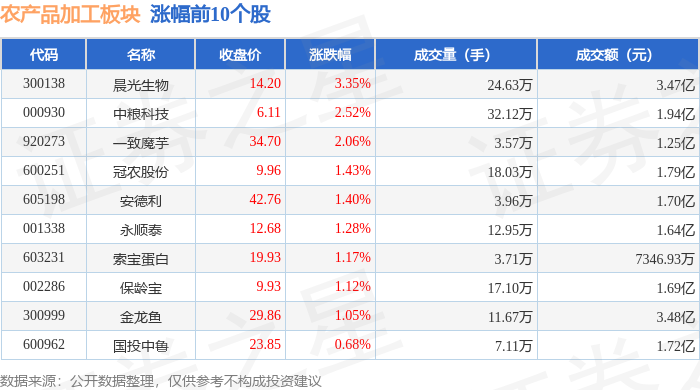
农产品加工板块1月20日涨0.59%,晨光生物领涨,主力资金净流出3979.31万元
Zheng Xing Xing Ye Ri Bao· 2026-01-20 08:51
Core Viewpoint - The agricultural processing sector experienced a rise of 0.59% on January 20, with Morning Glory Biological leading the gains, while the Shanghai Composite Index fell by 0.01% and the Shenzhen Component Index decreased by 0.97% [1]. Group 1: Market Performance - The agricultural processing sector's stocks showed varied performance, with Morning Glory Biological closing at 14.20, up by 3.35%, and a trading volume of 246,300 shares, amounting to 347 million yuan [1]. - Other notable performers included COFCO Technology, which rose by 2.52% to close at 6.11, and Yisheng Biological, which increased by 2.06% to 34.70 [1]. - The overall trading volume for the sector was significant, with Morning Glory Biological and Golden Dragon Fish contributing 347 million yuan and 348 million yuan respectively [1]. Group 2: Fund Flow Analysis - The agricultural processing sector saw a net outflow of 39.79 million yuan from institutional investors and 23.27 million yuan from retail investors, while individual investors contributed a net inflow of 63.07 million yuan [2]. - Specific stocks like COFCO Technology experienced a significant net outflow of 31.50 million yuan from institutional investors, while Golden Dragon Fish had a net inflow of 15.73 million yuan [3]. - The fund flow dynamics indicate a mixed sentiment, with retail investors showing interest in certain stocks despite the overall outflow from larger investors [2][3].





蛋白数据日报-20260120
Guo Mao Qi Huo· 2026-01-20 05:34
Group 1: Report Core View - As of January 10, 2026, Brazil's soybean harvest rate was 0.6%. The dry weather in the next two weeks is conducive to the harvest, and the expected shipment volume in January is higher than last year [8]. - As of January 14, Argentina's soybean sowing progress was 93.9%, slightly behind last year. The proportion of good - rated soybean crops was 60%. The dry weather since January has led to a decline in the excellent - good rate, and the dry weather will continue in the next two weeks [8]. - Domestic soybean and soybean meal inventories are still high, and the de - stocking speed is expected to accelerate before the Spring Festival. Feed enterprises' soybean meal inventory has increased slightly, and the far - month trading volume of soybean meal has increased recently. The提货 performance is normal. Due to the price drop of rapeseed meal caused by the easing of China - Canada relations, the feeding cost - effectiveness of soybean meal has decreased [8]. - Overall, as Brazil's harvest progresses, the Brazilian QR premium is expected to reflect the selling pressure of soybean production. Pay attention to the subsequent weather in Argentina. The NO5 is expected to fluctuate weakly in the short term [8]. Group 2: Market Data Spot Basis - For 43% soybean meal spot basis (against the main contract): In Dalian, it was 493; in Tianjin, 433; in Zhangjiagang, 373; in Dongguan, 373; in Zhanjiang, 423; in Fangcheng, 433. The rapeseed meal spot basis in Guangdong was 193, with a change of 36 [4]. Spread Data - The spot spread between soybean meal and rapeseed meal in Guangdong was 600, and the spread of the main contract was 506 [10]. Inventory and Supply - related Data - The inventory data includes China's port soybean inventory, feed enterprises' soybean meal inventory days, national major oil mills' soybean inventory, and national major oil mills' soybean meal inventory [5][6][9][10]. - The开机 and压榨 situation includes national major oil mills' soybean crushing volume, national major oil mills' startup rate, and downstream提货 volume [7]. International Data - The 2025 soybean CNF premium chart for continuous months and the 2025 imported soybean's gross profit per ton are presented, with details of premiums and exchange rates [10].
金融期货早评-20260120
隆众资讯· 2026-01-20 03:29
Macroeconomic Overview - The Chinese economy is projected to achieve a GDP growth of 5.0% in 2025, with industrial added value increasing by 5.9% year-on-year, while real estate development investment is expected to decline by 17.2% [1][2] - The economic performance shows a clear divergence, with supply and external demand improving while internal demand remains weak, particularly in investment growth [1][2] - The government is expected to focus on expanding domestic demand to stabilize growth, with fiscal and monetary policies already showing signs of support [1][2] Currency Exchange - The onshore RMB against the USD closed at 6.9636, appreciating by 53 basis points, while the central parity rate was adjusted to 7.0051, up by 27 basis points [1][2] - The RMB's appreciation is supported by resilient exports and increased willingness of enterprises to settle in RMB, despite potential pressures from international trade tensions [4] Investment Strategies - Export enterprises are advised to lock in forward exchange rates around 7.01 to mitigate risks from potential currency depreciation, while importers should consider rolling purchases near the 6.93 mark [5] - The bond market is expected to face limited upward potential due to a lack of driving factors, with short-term strategies suggesting a cautious approach [6] Commodity Market Insights - The lithium carbonate futures market shows a slight increase, with prices at 147,260 RMB/ton, while the overall lithium battery supply chain is experiencing weak performance [11][12] - Industrial silicon prices are expected to rise due to anticipated production cuts, with the main contract trading at 8,845 RMB/ton [12][13] - The copper market is experiencing fluctuations, with prices rebounding to 5.9055 USD/pound, driven by external factors and market sentiment [15][17] Agricultural Products - The soybean market is facing a potential supply gap in Q1 2025, with imports expected to be lower than previous years, while domestic soybean meal inventories are decreasing [22][23] - The canola market is showing signs of recovery due to improved trade relations with Canada, which may lead to lower tariffs and increased imports [22][25] Precious Metals - Gold and silver prices are rising, driven by geopolitical tensions and market reactions to U.S. tariff policies, with gold reaching 4,676.7 USD/ounce and silver at 94.28 USD/ounce [29][30] - The outlook for precious metals remains bullish, with expectations of continued demand from central banks and investors amid ongoing geopolitical uncertainties [27][30]
铜冠金源期货商品日报-20260120
Tong Guan Jin Yuan Qi Huo· 2026-01-20 03:19
Group 1: Report Industry Investment Rating - No relevant content found Group 2: Core Viewpoints of the Report - Geopolitical disturbances cause gold and silver to reach new highs, and China's GDP grew by 5% in 2025. The short - term risk appetite may continue to decline overseas, while the A - share market is in a stage of volume contraction and differentiation, with a still positive medium - term trend [2][3] - The risk of a tariff war due to the Greenland issue boosts the prices of precious metals, and they are expected to remain strong in the short term [4][5] - The copper price is expected to maintain a high - level shock in the short term due to rising geopolitical risks and supply shortages [6][7] - The aluminum price is under high - level shock and adjustment due to rising risk aversion and supply pressure [8][9] - The alumina price continues to be weak due to supply surplus and cost decline expectations [11] - The casting aluminum market is in a state of weak supply and demand and is in shock adjustment [12] - The zinc price is in a sideways shock as the long - short situation is in a stalemate [13][14] - The lead price is under pressure due to increased supply and weak demand [15][16] - The tin price will have a high - level wide - range shock in the short term [17] - The steel price is in shock adjustment due to weak fundamentals [18] - The iron ore price is under shock pressure due to high inventory and weak demand [19] - The coking coal and coke prices are expected to be weakly volatile due to large supply pressure [20] - The soybean meal and rapeseed meal prices are expected to be weakly volatile in the short term as the Brazilian harvest progresses and the relationship between China and Canada eases [21][22] - The palm oil price is expected to be in shock operation, considering the changes in production and demand data [23] Group 3: Summaries According to Different Commodities Metals - **Precious Metals**: On Monday, gold and silver prices continued to rise to new highs. Geopolitical unrest and tariff war risks are the main factors. The short - term is expected to remain strong [4][5] - **Copper**: On Monday, the main contract of copper futures fluctuated. Geopolitical risks and supply shortages make the short - term price maintain high - level shock [6][7] - **Aluminum**: On Monday, the main contract of aluminum futures closed at 24090 yuan/ton, down 0.39%. High - level shock adjustment is due to risk aversion and supply pressure [8][9] - **Alumina**: On Monday, the main contract of alumina futures closed at 2733 yuan/ton, down 1.19%. The price continues to be weak due to supply surplus and cost decline expectations [11] - **Cast Aluminum**: On Monday, the main contract of casting aluminum alloy futures closed at 22890 yuan/ton, down 0.11%. It is in a situation of weak supply and demand and shock adjustment [12] - **Zinc**: On Monday, the main contract of zinc futures fluctuated narrowly. The long - short situation is in a stalemate, and the price is in sideways shock [13][14] - **Lead**: On Monday, the main contract of lead futures fluctuated weakly. The price is under pressure due to increased supply and weak demand [15][16] - **Tin**: On Monday, the main contract of tin futures stabilized and fluctuated. It will have a high - level wide - range shock in the short term [17] Steel and Minerals - **Steel (Screw and Coil)**: On Monday, steel futures fluctuated and adjusted. The market is in the off - season of demand, and the fundamentals are weak [18] - **Iron Ore**: On Monday, iron ore futures fluctuated and adjusted. High inventory and weak demand make the price under shock pressure [19] - **Coking Coal and Coke**: On Monday, coking coal and coke futures fluctuated and adjusted. Supply pressure is large, and the price is expected to be weakly volatile [20] Agricultural Products - **Soybean and Rapeseed Meal**: On Monday, the soybean meal 05 contract fell 0.26%, and the rapeseed meal 05 contract fell 2.37%. The Brazilian harvest progresses, and the short - term is expected to be weakly volatile [21][22] - **Palm Oil**: On Monday, the palm oil 05 contract rose 0.35%. Considering production and demand data changes, the short - term is expected to be in shock operation [23]
美豆油价格小幅上涨 1月19日阿根廷豆油(2月船期)C&F价格上调9美元/吨
Jin Tou Wang· 2026-01-20 03:04
Core Viewpoint - The Chicago Board of Trade (CBOT) soybean oil futures prices experienced a slight increase, indicating a stable market trend in the soybean oil sector [1]. Group 1: Market Performance - On January 20, CBOT soybean oil futures opened at 52.65 cents per pound and were reported at 52.55 cents per pound, with a gain of 0.08%. The intraday high reached 52.82 cents per pound, while the low was 52.51 cents per pound [1]. - On January 16, the closing price for soybean oil was 52.63 cents per pound, reflecting a decrease of 0.47% from the previous trading session [2]. Group 2: Trading Volume and Inventory - On January 19, the national first-class soybean oil trading volume was 16,000 tons, which represents a decrease of 5.88% compared to the previous trading day [2]. - As of January 16, 2026, the commercial inventory of soybean oil in key national regions was 963,300 tons, showing a reduction of 61,800 tons, or 6.03%, from the previous week [2]. Group 3: Price Adjustments - On January 19, the C&F price for Argentine soybean oil for February shipment was adjusted to $1,209 per ton, an increase of $9 per ton from the previous trading day. The C&F price for April shipment was set at $1,139 per ton, up by $31 per ton [2].