
债券

Search documents
看股做债专题二:固收专题
China Post Securities· 2026-01-13 09:29
Report Information - Report Type: Fixed Income Report - Release Date: January 13, 2026 - Analyst: Liang Weichao [2] - Research Assistant: Wang Yi [2] Investment Rating No investment rating for the industry is provided in the report. Core Viewpoints - The larger the increase in the spring stock market rally, the higher the probability of pressure on the bond market. When the Shanghai Composite Index rises more than 20% in spring, the 10 - year Treasury bonds are likely to fall during the same period. In the more common 10% - 20% medium - increase range, the bond market is more likely to fluctuate or stage a phased recovery [2]. - A mid - stage acceleration in the spring stock market rally is more likely to suppress the bond market than a bottom - bouncing recovery. When the rally occurs in the mid - stage acceleration of the stock market, it's more likely to be interpreted as a signal of fundamental or policy orientation changes, and inflation and nominal growth expectations enter the core of pricing, putting pressure on the bond market [3]. - A spring rally led by cyclical sectors has a greater impact on the bond market than an independent rally in technology and consumer sectors. When cyclical and stable sectors resonate with growth sectors, the re - pricing of nominal growth and credit expansion is significantly strengthened, and the bond market is under greater pressure [3]. - In 2026, the spring stock market rally is likely to be a combination of "mid - stage acceleration, easing expectations, and growth - led", which will mainly cause short - term disturbances to the bond market rather than being a long - term negative factor. Before the rally spreads to cyclical and stable sectors and forms a resonance, interest rates are more likely to remain volatile at a high level, and the first quarter may be a phased high point [4]. Summary by Directory 1. The Impact of Past Spring Stock Market Rallies on the Bond Market Varies by Increase - **1.1 "Spring Rally" Offers Good Opportunities, Risk Preference Tilts towards the Stock Market**: The spring rally in the A - share market is a high - probability and high - return phased market window. From 2002 to 2026, the probability of a spring rally is over 90%. The average maximum increase in the main rising phase of the spring rally is about 14%, and the average increase remains at about 12% in the past 15 years. In some years, such as 2007, 2009, 2015 and 2019, the increase exceeded 30% [10]. - **1.2 Past Spring Stock Market Rallies Tend to Pressure the Bond Market, with a High Probability of Bond Market Recovery in the Medium - Increase Range**: When the Shanghai Composite Index rises more than 20% during the "spring rally", the 10 - year Treasury bond interest rate is likely to rise significantly. When the increase is less than 20%, the bond market shows different performances, including simultaneous rises in stocks and bonds, and stocks rising while bonds falling. In the medium - increase range, the bond market may either rise or fall, but there is a high probability of recovery even if it falls [13]. 2. Bond Market Performance Varies Depending on the "Stage of the Larger Stock Market Rally" during the Spring Stock Market Rally - **2.1 In the Case of a Low - Level Rebound in the Spring Stock Market Rally, Loose Liquidity May Drive Stocks and Bonds to Rise Together**: When the spring rally starts in the low - level repair stage (i.e., a rebound after an oversold), stocks and bonds often move in the same direction, and the bond market is insensitive to the rise of the stock market. In the past, when the stock market rebounded from a low level in spring and the stage increase did not exceed 20%, the 10 - year Treasury bond yield mostly remained stable or declined during the spring rally. The larger the decline in the Shanghai Composite Index in the two months before the spring rally, the greater the possible decline in interest rates during the spring rally. For example, in 2024, the stock market and the bond market both rose during the spring rally [18][22]. - **2.2 In the Case of a Mid - Stage Acceleration in the Spring Stock Market Rally, the Bond Market Is Likely to Be Pressured First and Then Ease**: When the spring rally occurs in the acceleration stage of the stock market's upward trend, the bond market may face pressure in the short term but is likely to ease later. In this context, the continued rise of the stock market is more likely to be interpreted as a signal of "expected fundamental improvement or policy orientation change", which puts pressure on the bond market [23]. 3. The Impact of Spring Stock Market Rallies Led by Different Styles on the Bond Market Varies - **3.1 Spring Stock Market Rallies Led Solely by Technology, Consumption, or Finance Have Limited Suppression on the Bond Market**: When the spring rally is led by the growth (technology) sector, the rise of the stock market mainly reflects the repair of risk preference and the anticipation of the future development of emerging industries, and has little impact on the bond market. For example, in 2010, 2014, 2024 and 2025, the average change in the 10 - year Treasury bond yield during the spring rally was only - 1.5bp. When the consumer sector leads the rally, the impact on the bond market is also positive. When the financial sector leads the rally, there is a high probability of driving both stocks and bonds up [31]. - **3.2 Spring Stock Market Rallies with Resonance of Cyclical and Stable Styles Shake Expectations and Impact the Bond Market**: When the "growth, stable and cyclical" sectors resonate in the spring rally, the impact on the bond market is more significant. The resonance of these sectors strengthens the market's pricing of the return of nominal growth, credit expansion and policy effects, and puts upward pressure on the risk - free interest rate. For example, in 2007, 2009 and 2015, the bond market was significantly pressured [35]. 4. How to "Invest in Bonds Based on the Stock Market" in the 2026 Spring Stock Market Rally? - In 2026, the spring stock market rally is likely to be a risk - preference repair - type increase, focusing on growth themes. It will mainly cause short - term disturbances to the bond market rather than being a long - term negative factor. After the spring rally, the downward pressure on interest rates may gradually ease. Before the rally spreads to cyclical and stable sectors and forms a resonance, interest rates are more likely to remain volatile at a high level, and the first quarter may be a phased high point [40][44].
汇丰力挺中国资产:超配AH股,“做多人民币”为年度首选宏观策略之一
Hua Er Jie Jian Wen· 2026-01-13 09:08
Group 1 - HSBC expresses a positive outlook on Chinese assets, recommending investors to increase holdings in mainland China and Hong Kong stocks by 2026 and to establish long positions in the renminbi [1] - The bank suggests a shift in investment focus towards assets supported by domestic demand amid potential market volatility, particularly favoring stocks in China, Hong Kong, India, and Indonesia [2] - HSBC advises selling Swiss francs and buying offshore renminbi, anticipating a gradual appreciation of the renminbi due to China's industrial upgrades and technological self-sufficiency [1][3] Group 2 - HSBC recommends an overweight position in stocks from mainland China, Hong Kong, India, and Indonesia, while advising a reduction in exposure to the crowded South Korean market due to concerns over the sustainability of AI-driven growth [2] - The bank highlights the potential for interest rate cuts by some Asian central banks to support local stock markets, although the pace of rate cuts by the Federal Reserve may limit this space [4] - In the fixed income sector, HSBC favors a curve steepening strategy and is optimistic about bonds from India and the Philippines, while being cautious about Thailand and Indonesia [4]
信用利差周报2026年第1期:公募基金销售新规正式落地,利率债与信用债收益率表现分化-20260113
Zhong Cheng Xin Guo Ji· 2026-01-13 06:15
Report Industry Investment Rating No relevant content provided. Core Views - The official release of the new regulations on public - offering fund sales is expected to smooth policy disturbances, ease market sentiment, and guide long - term and value investment, but it may also lead to institutional allocation adjustments and test the demand in the bond market. The bond market may continue to fluctuate in the short term. [3][10][13] - In December 2025, the official manufacturing PMI returned to the expansion range, indicating an improvement in both supply and demand in the manufacturing industry. [4][14] - The central bank maintained a net capital injection last week, leading to a comprehensive decline in capital prices. [5][17] - In the primary market of credit bonds, the issuance scale decreased, and the issuance cost mostly increased. [6][21] - In the secondary market of credit bonds, trading activity cooled down, and the yields of interest - rate bonds and credit bonds showed different trends. [7][32] Summary by Directory Market Hotspots - On December 31, 2025, the new regulations on public - offering fund sales were officially released, with key revisions including relaxed redemption fee requirements for bond funds and an extended transition period from 6 months to 12 months. [10] - Relaxing redemption fee requirements helps stabilize market sentiment and reduce the short - term redemption pressure on bond funds, while the new regulations may also lead to adjustments in institutional allocation and a possible diversion of bond market investment funds. [11][12] Macroeconomic Data - In December 2025, the official manufacturing PMI was 50.1%, up 0.9 percentage points from the previous month, returning to the expansion range after 8 months. The production index and new order index both increased, but only large - scale enterprises' PMI was in the expansion range. [4][14] - China's RatingDog manufacturing PMI in December was 50.1%, up 0.2 percentage points from the previous month, rising above the boom - bust line again. [4][14] Money Market - Last week, the central bank net injected 7374 billion yuan through open - market operations, including 13601 billion yuan of 7 - day reverse repurchases, while 4227 billion yuan of 7 - day and 2000 billion yuan of 14 - day reverse repurchases matured. [5][17] - Due to the central bank's net injection and a decrease in cash demand after the New Year, capital prices declined comprehensively, with the decline of pledged - repo rates ranging from 1bp to 21bp. [5][17] Primary Market of Credit Bonds - Last week, the issuance scale of credit bonds was 634.04 billion yuan, with a daily average of 158.51 billion yuan, showing a decline in all bond types and industries compared to the previous period. [6][21] - In terms of net financing, the infrastructure investment and financing industry had a net outflow of 72.08 billion yuan, and most industries in industrial bonds had net outflows, except for the power production and supply industry with a net inflow of 139 billion yuan. [6][22] - The average issuance cost of credit bonds mostly increased, with the cost of 3 - year bonds changing significantly, while only the average issuance cost of 1 - year AA + and 5 - year AA bonds decreased. [6][30] Secondary Market of Credit Bonds - Last week, the secondary - market trading volume of bonds was 38369.15 billion yuan, a decrease of 46421.76 billion yuan from the previous value, indicating continued cooling in trading activity. [7][32] - Interest - rate bonds: The yields of treasury bonds and policy - bank bonds increased across the board, with the 10 - year treasury bond yield rising slightly by 1bp to 1.84%. [7][32] - Credit bonds: The yields of credit bonds varied by term, with the yields of 1 - year and 5 - year bonds mostly decreasing and those of other - term bonds mostly increasing, with a maximum increase of 6bp. [32][35] - Credit spreads: The credit spreads of AAA - rated bonds of various terms showed mixed trends, with the spreads of 3 - year and 10 - year bonds slightly expanding, and most of the other - term spreads narrowing, with a maximum change of 8bp. [32][39] - Rating spreads: The spreads between different ratings mostly widened, with a maximum increase of 2bp. [32][39] Supplementary Tables - There were several bond credit risk events, including the extension of principal and interest payments for bonds issued by companies such as Guangzhou Fangyuan Real Estate, Fantasia Group, and Rongxin Investment Group. [42] - There were regulatory and market innovation dynamics, such as the launch of the ChinaBond - ICBC Panda Bond Index series and the release of relevant business guidelines by the Shanghai Stock Exchange. [43] - The table shows the monthly net financing amounts of major credit bond types from January 2024 to December 2025. [44]
固收-债市利空加速出尽
2026-01-13 01:10
如何看待当前的市场形态及其对后市的影响? 当前市场形态显示出显著的期限溢价扩张,这主要反映了风险偏好的提升。历 史上类似 13 年和 16 年的熊斗行情最终转为熊平,是由于货币政策收紧导致短 端和长端利率同时上升,但短端上涨更多。然而,目前货币政策仍维持宽松, 因此不支持期限溢价进一步大幅扩张。预计未来曲线陡峭化将维持,但有一定 限度。 固收-债市利空加速出尽?20260112 摘要 当前市场呈现期限溢价扩张,反映风险偏好提升,但货币政策宽松基调 未变,限制了期限溢价的进一步扩张空间。预计收益率曲线将维持陡峭 化,但幅度有限。 年初债市"开门黑"受风险偏好回升、货币宽松预期落空以及前期市场 负面情绪延续等多重因素影响,对债市造成阶段性冲击。 尽管市场对货币宽松预期悲观,央行仍将维持社会融资成本在低位,降 准降息是大概率事件,将对债市形成支撑,缓解当前压力。 风险偏好回升带来的阶段性冲击已被市场充分定价,不会导致收益中枢 系统性抬升。基本面未逆转情况下,收益中枢将回归正常水平。 市场情绪悲观源于货币宽松缺位、地方债发行计划中超长久期债券比例 偏高以及 10 年期国债单只发行规模增大,但供给压力影响仍需观察。 若 ...
华尔街警报:特朗普与美联储“开战”或推高利率,市场面临失控风险
Xin Lang Cai Jing· 2026-01-12 23:48
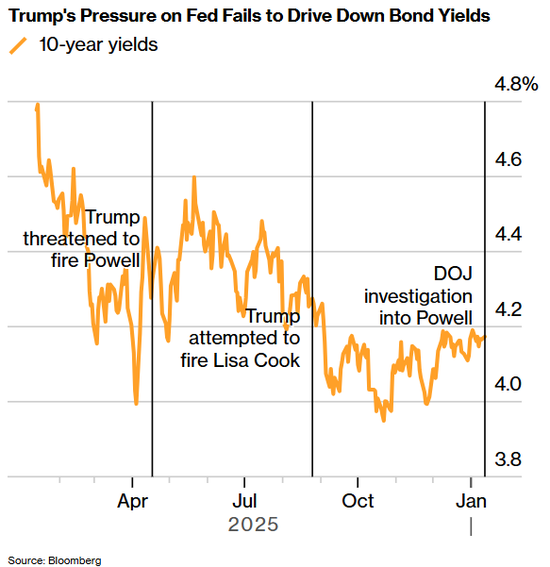
Core Viewpoint - The pressure exerted by Trump on the Federal Reserve threatens its independence, which contradicts his goal of lowering interest rates, injecting significant new risks into the financial markets [1][4][11]. Group 1: Impact on Financial Markets - Investment managers from major bond firms warn that Trump's attacks on the Fed's independence could undermine its credibility in combating inflation, leading to higher U.S. Treasury yields and increased costs for mortgages and corporate loans [1][4]. - The 10-year U.S. Treasury yield has remained around 4.2%, despite the Fed resuming rate cuts, which has become a source of frustration for Trump [4][12]. - The market's reaction indicates a belief that legal and political processes are strong enough to protect the Fed from government pressure, with only a slight increase in long-term yields observed [13][15]. Group 2: Political Dynamics and Fed Independence - Trump's attempts to pressure the Fed include urging more aggressive rate cuts and attempting to dismiss a Fed governor, reflecting a broader strategy to influence monetary policy [12][14]. - The recent threats against Fed Chair Jerome Powell have been viewed as a potential retaliation against the Fed's rate decisions, raising concerns about the Fed's independence [4][14]. - Analysts suggest that any perceived threat to the Fed's independence could lead to unexpected consequences, including higher interest rates in the long run [16][17]. Group 3: Market Sentiment and Future Expectations - Despite the political tensions, investors seem to welcome Powell's commitment to maintaining the Fed's independence, which is seen as crucial for financial stability [13][14]. - Market participants continue to expect only two rate cuts of 25 basis points each this year, indicating a stable outlook despite the political pressures [14]. - The bond market's resilience suggests that buyers are willing to engage at appropriate levels, viewing slight yield increases as constructive rather than alarming [14].

年初债市走出2025年初的镜像
Huafu Securities· 2026-01-12 13:40
1. Report Industry Investment Rating There is no specific industry investment rating provided in the report. 2. Core Viewpoints of the Report - The bond market at the beginning of 2026 seems to mirror the situation at the beginning of 2025. Despite short - term uncertainties, considering the rapid decline in duration and the central bank's supportive attitude, the future adjustment space of the bond market is limited. Once the impacts of factors such as supply, credit, and the A - share market are weaker than expected, the bond market may continue to follow the mirror image of early 2025 and experience a recovery [2][10]. - At present, the A - share and commodity price trends are not sufficient to trigger a reversal in the bond market direction. During the adjustment process, the impact of ultra - long bonds on the net value of public funds has weakened, which helps to mitigate market shocks [8][10]. - It is recommended to maintain a certain leverage, use 2 - 3 - year medium - to - high - grade credit bonds as the bottom - position, focus on 3 - 5 - year secondary perpetual bonds in the short term, and trade long - term bond bands opportunistically according to market conditions [10]. 3. Summary According to the Table of Contents 3.1. The Market Adjustment Since the Beginning of the Year is Due to Traders' Concerns about Supply Rather Than the Supply Shock Itself - The core concern in the market is the supply - demand of ultra - long bonds. The market adjustment is affected by the large issuance scale of key - term treasury bonds in January and the high proportion of ultra - long local bonds in some regions [3][16]. - Although the issuance scale of key - term treasury bonds in January has increased, the net financing scale of treasury bonds in Q1 2026 is only slightly higher than that of the same period last year. The estimated net financing scale of local bonds in Q1 2026 may be lower than that of the same period in 2025 [20][26]. - Local governments may prefer to issue long - term bonds because refinancing bonds cannot fully cover the maturing local debt. However, the national fiscal work conference emphasizes optimizing the government bond tool portfolio, so the issuance term of local bonds may not be further extended compared to 2025 [3][30]. - The recent market adjustment is mainly caused by the large - scale net selling of public funds and securities firms. It is more of an emotional weakening due to supply concerns rather than a substantial impact. As long as the 30 - year treasury bond is the most actively traded, its pricing is still determined by traders, and it has shown higher cost - effectiveness after the recent adjustment [4][31][37]. 3.2. If External Disturbances Are Weaker Than Expected, the Bond Market May Follow the Mirror Image of Early 2025 and Experience a Recovery - Despite the continuous net withdrawal of OMO and the non - excessive renewal of 3M repurchase, the loose capital state continues, which may be related to the year - end fiscal deposit release and the central bank's supportive attitude. The probability of a reserve requirement ratio cut in January has significantly increased, and the central bank's net purchase of treasury bonds is also expected to rise [41][43][45]. - Historically, supply shocks have a greater impact on the bond market in a tight liquidity environment. Currently, the central bank's attitude is supportive, and the bank's liabilities do not show obvious pressure, so the supply shock may be less than expected. The central bank has the motivation to solve the problem of the supply - demand imbalance of government bonds [47][49]. 3.3. Wait for the Impact of Risk Preference Changes to Gradually Fade - The bond market adjustment is also related to the continuous rise of the A - share and commodity prices. However, as the upward slope of the A - share market becomes steeper, its volatility increases, and the impact on the bond market has weakened. The rise in commodity prices may be short - term, and the recovery of CPI still faces challenges [50][51][56]. - During the adjustment process, the impact of ultra - long bonds on the net value of public funds has weakened, which helps to mitigate market shocks. Although short - term uncertainties remain, the future adjustment space of the bond market is limited, and there is no need to be overly pessimistic about the subsequent bond market [64][71].
信用债市场周度回顾 260112:信用债抗跌或有持续性:逻辑和应对-20260112
GUOTAI HAITONG SECURITIES· 2026-01-12 13:27
Group 1 - The core view of the report suggests that the resilience of credit bonds observed at the beginning of the year may continue, with a recommendation to focus on riding opportunities in the 3Y-1Y segment [1] - The net financing for major credit bond varieties turned positive last week, with a total issuance of 2507.8 billion and a net financing of 1280.8 billion, reversing from a negative net financing of -636.4 billion in the previous week [5][6] - The issuance of short-term financing bonds, medium-term notes, and corporate bonds increased compared to the previous week, indicating a growing market activity [5][6] Group 2 - Secondary market transactions saw a significant increase, with total transactions reaching 7959 billion, up from 2964 billion in the previous week, indicating a warming market [8][9] - The yield on medium-term notes showed mixed movements, with the 3-year AAA medium-term note yield rising by 0.03 basis points to 1.89%, while the 3-year AA+ medium-term note yield fell by 0.97 basis points to 1.98% [8][9] - The credit rating adjustments showed no changes in issuer ratings, and there were no reported defaults during the week [5][6]
债市的核心问题不在供给,在需求
Orient Securities· 2026-01-12 10:45
Report Investment Rating The provided content does not mention the industry investment rating. Core Viewpoints - The core issue in the bond market lies in demand rather than supply. In early 2026, the bond market continued to adjust. Although there was a high - volume supply of government bonds and a lengthening trend in local bond issuance terms, the rapid post - New Year loosening of the capital market and the "bear - steep" adjustment of the curve indicated that supply was not the core contradiction. Also, the insurance sector's adjustment of its local bond allocation term structure offset the impact of the change in local bond issuance terms [6][13]. - The root cause is the active contraction of bond investment by institutions. Since 2025, banks have been actively reducing bond investment, similar to the situation in 2016 - 2017, but the current reason is the low interest rate, which makes the return unable to cover the cost. Fund and fixed - income asset management products have been continuously redeemed, leading to large - scale bond sales [6][23]. - To solve the demand - side problem, three aspects can be considered: reigniting the market's expectation of a significant interest rate decline, the central bank taking further steps in directly purchasing long - term bonds, and increasing the necessity of strongly stimulating the economy to promote banks' rapid re - expansion of their balance sheets and spill - over into bond investment [6]. - In the short term, the overall demand problem in the bond market is difficult to solve. It is advisable to focus on structural demand changes, especially in wealth management products. Wealth management products may gradually shift to slightly longer - duration products for returns. Attention can be paid to the riding value of 2 - 3Y urban investment bonds, 1 - 2Y industrial bonds, and appropriate credit picking of high - quality urban and rural commercial banks for sub - perpetual bonds within 3Y, and trading opportunities for 3 - 4Y sub - perpetual bonds [6][27]. Summary by Directory 1. Bond Market Weekly Viewpoint - Some believe the bond market adjustment in 2026 is due to supply expansion, with the first - week government bond net issuance reaching a new high and a lengthening trend in local bond issuance terms [6][10]. - However, the core problem is on the demand side. The post - New Year capital loosening and "bear - steep" curve adjustment show that supply is not the core contradiction. Also, the insurance sector's adjustment of its local bond allocation term structure has kept the spread between local and national bonds stable [13][15]. - Institutions are actively reducing bond investment. Since 2025, banks' bond investment contraction is similar to that in 2016 - 2017, but currently due to low interest rates. Fund and fixed - income asset management products are being redeemed, leading to bond sales [23]. - To solve the demand - side problem, consider reigniting interest rate decline expectations, central bank action on long - bond purchases, and economic stimulus [23]. - In the short term, focus on wealth management products. They may shift to longer - duration products for returns, and attention can be paid to specific bond types [27]. 2. This Week's Focus in the Fixed - Income Market - **Release of December Financial Data**: This week, China will release December financial data, and the US will release December CPI and other data [30]. - **Interest - Rate Bond Issuance**: The expected issuance volume of interest - rate bonds this week is around 427.2 billion yuan, including 207 billion yuan of national bonds, 70.2 billion yuan of local bonds, and about 150 billion yuan of policy - bank financial bonds, which is at a medium level compared to the same period in previous years [30][31]. 3. Review and Outlook of Interest - Rate Bonds - **Reverse Repurchase Net Withdrawal**: Last week, the central bank's open - market operations had a net withdrawal of 165.5 billion yuan. After the New Year, the reverse repurchase maturity volume was high, and the capital market had a seasonal volume increase and price increase, with the increase in price being controllable [34][35]. - **Interest - Rate Adjustment at the Beginning of the Year**: The new fund fee regulations before New Year's Day were beneficial to bond - fund liabilities, but the market quickly took profits after the interest - rate decline. Concerns about government bond supply and the strong start of the equity market suppressed bond - market sentiment. Finally, the yields of most interest - rate bonds increased, with only the 1 - year national bond yield falling by 4.9bp, and the 3 - year national bond yield rising the most, by about 7.8bp [49]. 4. High - Frequency Data - **Production Side**: There was a divergence in operating rates. The blast - furnace and PTA operating rates increased, while the semi - steel tire and asphalt operating rates decreased. In late December, the daily average crude - steel output had a wider year - on - year decline of 14.8% [52]. - **Demand Side**: The year - on - year growth of passenger - car wholesale and retail sales improved rapidly. In the week of December 31, the year - on - year growth of passenger - car wholesale and retail sales were 45% and 17% respectively. The year - on - year decline in the commercial - housing transaction area narrowed. In the week of January 4, the land premium rate of 100 large - and medium - sized cities decreased, and the land transaction area had a seasonal decline and a large year - on - year decline. The commercial - housing sales area of 30 large - and medium - sized cities decreased to 2.75 million square meters, with a narrowed year - on - year decline of 9%. The SCFI and CCFI composite indices changed by - 0.5% and 4.2% respectively [52]. - **Price Side**: Crude - oil prices recovered, copper and aluminum prices increased, coal prices diverged, the mid - stream building - material composite price index increased slightly, and downstream vegetable and fruit prices decreased while pork prices increased. The rebar inventory decreased to a low level of 283 tons, and the futures price increased by 0.6% [53].
公募基金指数跟踪周报(2026.01.05-2026.01.09):权益市场交投活跃,顺势而为避免追高-20260112
HWABAO SECURITIES· 2026-01-12 10:43
Report Industry Investment Rating No relevant content provided in the report. Core Viewpoints of the Report - In the first week of 2026 (01.05 - 01.09), the A - share market continued its upward trend, with the Shanghai Composite Index achieving 16 consecutive positive days and standing above 4100 points. The market trading remained highly active, with Friday's turnover reaching 3 trillion and the margin trading balance exceeding 2.6 trillion. The market was mainly driven by bottom - up growth themes, with technology - related sectors like AI applications, commercial space, and brain - computer interfaces rotating. The small and medium - cap style was dominant [3][12]. - In the short term, the overseas US employment market has resilience but also structural pressure. Inflation data is not expected to have a strong rebound, and the market has digested the possibility of the Fed not cutting interest rates in January. Overseas markets may experience high - level volatility in the short term, with limited impact on the domestic market. The overall supply - demand of market funds is neutral to optimistic, and with the profit - making effect, off - market funds may continue to flow in, and the market is expected to continue its upward trend [3][14]. - Last week (01.05 - 01.09), the bond market showed a "V - shaped reversal", with long - term yields generally weakening. The short - term sentiment in the bond market has stabilized slightly, but the possibility of interest rate cuts in the medium and short term is still low. The bond market lacks positive catalysts, and it may have a short - term rebound but is likely to remain neutral in the medium term, with a dominant wait - and - see sentiment [4][15]. Summary According to Relevant Catalogs 1. Weekly Market Observation 1.1. Equity Market Review and Observation - Market Performance: In the first week of 2026 (01.05 - 01.09), the A - share market continued to rise, with major broad - based indices generally increasing and reaching new stage highs. The trading volume on Friday returned to the peak of 3 trillion, and the margin trading balance exceeded 2.6 trillion. The market was driven by growth themes such as AI applications, commercial space, and brain - computer interfaces, with the small and medium - cap style being dominant [12]. - Sector Analysis: The brain - computer interface sector was active this week. Expectations of Neuralink's mass production, the establishment of Gestalt Technology in China, and market expectations for the "14th Five - Year Plan" drove the sector's sentiment. The sector may maintain its popularity with the upcoming "2026 Brain - Computer Interface Developers Conference" and other positive news. The aerospace sector had a continuous rally, driven by factors such as the IPO boom in the commercial space field, policy support, and satellite constellation plans. The growth of the growth sector was also related to the CES 2026 exhibition, with the intelligent vehicle and robot sectors being catalyzed by the "physical AI" concept and the focus on the autonomous driving ecosystem and mass production plans at the CES 2026 [12][13]. - Outlook: Overseas markets may experience high - level volatility in the short term with limited impact on the domestic market. The market funds' supply - demand is neutral to optimistic, and off - market funds may continue to flow in. However, the establishment of a fundamental one - sided trend still needs the verification of better - than - expected domestic demand. It is recommended that funds that missed the previous rally wait patiently for policy clues during the "Two Sessions" to seek more certain allocation opportunities [14]. 1.2. Pan - Fixed - Income Market Review and Observation - Bond Market: Last week (01.05 - 01.09), the bond market showed a "V - shaped reversal", with the 1 - year Treasury yield falling 4.35BP to 1.29%, the 10 - year yield rising 3.55BP to 1.88%, and the 30 - year yield rising 4.95BP to 2.30%. The short - term sentiment in the bond market has stabilized slightly, but the possibility of interest rate cuts in the medium and short term is low, and it may have a short - term rebound but remain neutral in the medium term [4][15]. - US Treasury Bonds: The US Treasury yield curve flattened last week, with short - term yields rising and long - term yields falling. The 1 - year yield rose 5BP to 3.52%, the 2 - year yield rose 7BP to 3.54%, and the 10 - year yield fell 1BP to 4.18%. The market believes the probability of the Fed cutting interest rates in the short term is small [15][16]. - REITs: The CSI REITs Total Return Index rose 1.89% last week, closing at 1028.93 points. Four new public REITs made progress in the primary market [16]. 2. Fund Index Performance Tracking 2.1. Equity Strategy Theme - Based Index - **Active Stock Fund Selection Index**: The index selects 15 funds in each period, with equal - weight allocation. It selects active equity funds based on performance competitiveness and style stability in value, balanced, and growth styles, and matches the style distribution of the CSI Equity - Oriented Fund Index. The performance benchmark is the CSI Equity - Oriented Fund Index (930950.CSI) [20]. 2.2. Investment Style - Based Index - **Value Stock Fund Selection Index**: It includes both deep - value and quality - value styles. It selects 10 funds of deep - value, quality - value, and balanced - value styles based on multi - period style classification. The performance benchmark is the CSI 800 Value Index (H30356.CSI) [20]. - **Balanced Stock Fund Selection Index**: Balanced - style fund managers balance stock valuation and growth. The index selects 10 relatively balanced, value - growth style funds based on multi - period style classification. The performance benchmark is the CSI 800 (000906.SH) [22]. - **Growth Stock Fund Selection Index**: The growth style aims to capture the double - click opportunities of performance and valuation. It selects 10 funds of active - growth, quality - growth, and balanced - growth styles based on multi - period style classification. The performance benchmark is the 800 Growth Index (H30355.CSI) [24][26]. 2.3. Industry Theme - Based Index - **Pharmaceutical Stock Fund Selection Index**: It selects funds based on the intersection market value of fund equity holdings and the constituent stocks of the representative index (CITIC Pharmaceutical). The average purity in the past 3 years/inception should be no less than 60%. It constructs an evaluation system and selects 15 funds. The performance benchmark is the pharmaceutical theme fund index (fitted by Huabao Securities) [28]. - **Consumer Stock Fund Selection Index**: It selects funds based on the intersection market value of fund equity holdings and the constituent stocks of representative indices (CITIC Automobile, Home Appliances, etc.). The average purity in the past 3 years/inception should be no less than 50%. It constructs an evaluation system and selects 10 funds. The performance benchmark is the consumer theme fund index (fitted by Huabao Securities) [31]. - **Technology Stock Fund Selection Index**: It selects funds based on the intersection market value of fund equity holdings and the constituent stocks of representative indices (CITIC Electronics, etc.). The average purity in the past 3 years/inception should be no less than 60%. It constructs an evaluation system and selects 10 funds. The performance benchmark is the technology theme fund index (fitted by Huabao Securities) [34]. - **High - end Manufacturing Stock Fund Selection Index**: It selects funds based on the intersection market value of fund equity holdings and the constituent stocks of representative indices (CITIC Construction, etc.). The average purity in the past 3 years/inception should be no less than 50%. It constructs an evaluation system and selects 10 funds. The performance benchmark is the high - end manufacturing theme fund index (fitted by Huabao Securities) [37]. - **Cyclical Stock Fund Selection Index**: It selects funds based on the intersection market value of fund equity holdings and the constituent stocks of representative indices (CITIC Petroleum & Chemicals, etc.). The average purity in the past 3 years/inception should be no less than 50%. It constructs an evaluation system and selects 5 funds. The performance benchmark is the cyclical theme fund index (fitted by Huabao Securities) [41]. 2.4. Money - Market Enhancement Index - **Money - Market Enhancement Strategy Index**: It aims at liquidity management, pursuing a curve that exceeds money - market funds and is smooth and upward. It mainly allocates money - market funds with relatively good performance and inter - bank certificate of deposit index funds in passive index - bond funds. The performance benchmark is the CSI Money - Market Fund Index (H11025.CSI) [44]. 2.5. Pure - Bond Index - **Short - Term Bond Fund Selection Index**: It aims at liquidity management, pursuing a smooth and upward curve while ensuring drawdown control. It mainly allocates 5 funds with stable long - term returns, strict drawdown control, and significant absolute - return ability. The performance benchmark is 50% * Short - Term Pure - Bond Fund Index + 50% * Ordinary Money - Market Fund Index [46]. - **Medium - and Long - Term Bond Fund Selection Index**: It invests in medium - and long - term pure - bond funds, pursuing stable returns while controlling drawdowns. It selects 5 funds with both return and drawdown control, and adjusts the duration and the ratio of credit - bond funds and interest - rate - bond funds according to market conditions. [48] 2.6. Fixed - Income + Index - **Low - Volatility Fixed - Income + Selection Index**: The equity center is 10%. It selects 10 funds with an equity center (considering convertible bond and stock holdings) within 15% in the past three years and recently. The performance benchmark is 10% CSI 800 Index+90% ChinaBond New Composite Full - Price Index (CBA00303.CS) [49][52]. - **Medium - Volatility Fixed - Income + Selection Index**: The equity center is 20%. It selects 5 funds with an equity center between 15% - 25% in the past three years and recently. The performance benchmark is 20% CSI 800 Index+80% ChinaBond New Composite Full - Price Index (CBA00303.CS) [52]. - **High - Volatility Fixed - Income + Selection Index**: The equity center is 30%. It selects 5 funds with an equity center between 25% - 35% in the past three years and recently. The performance benchmark is 30% CSI 800 Index+70% ChinaBond New Composite Full - Price Index (CBA00303.CS) [56]. 2.7. Other Pan - Fixed - Income Index - **Convertible Bond Fund Selection Index**: It selects bond - type funds with the average proportion of convertible bond investment in bond market value no less than 60% in the latest period and no less than 80% in the past four quarters as the sample space. It constructs an evaluation system and selects 5 funds [59]. - **QDII Bond Fund Selection Index**: It selects 6 funds with stable returns and good risk control based on credit and duration conditions, with underlying assets being overseas bonds [61]. - **REITs Fund Selection Index**: It selects 10 funds with stable operation, reasonable valuation, and certain elasticity based on the underlying asset type [62].
固收周观:股债跷跷板效应凸显,宽松基调下曲线陡峭(2026年第2期)
Soochow Securities· 2026-01-12 10:42
Report Industry Investment Rating - Not provided in the content Core Viewpoints of the Report - In the first week of 2026, the bond market experienced significant adjustments. The main reasons were that the central bank's open - market bond purchases in December 2025 were only 50 billion yuan, not increasing as expected, and the stock market had a strong start, causing funds to flow from the bond market to the stock market. The "stock - bond seesaw" effect was the more important factor suppressing the bond market. It is expected that the allocation funds in the bond market will be diverted by the stock market. In the next week, the release of December's financial data is expected to have limited impact on the bond market. Short - term interest rates will remain stable, while long - term interest rates are more affected by the stock market, and the yield curve is expected to steepen. When the 10 - year Treasury yield approaches the 1.9% stage high, investors can enter the market at an appropriate time [1][16][17] - Last week, gold in the cross - year market quickly rebounded to the previous high of $4,500 per ounce after a short - term plunge and is about to break through the previous high. The RMB exchange rate also had a short - term correction, but based on the expectation of loose fiscal and monetary policies in major global economies and their higher tendency of fiscal deficit monetization than China, the previous bullish view is continued. Crude oil is marginally bullish in terms of total demand and short - term bullish but long - term bearish in terms of total supply, and is expected to maintain a low - level volatile pattern [2] - In the medium - term thinking framework, the two - sector model of "an overheated technology sector + a cold traditional sector" should be continued. The growth engine shows structural characteristics, with monetary policy supporting the traditional sector and fiscal policy guiding the technology sector. The driving force of investment is greater than that of consumption, and domestic demand is more important than external demand, which is not limited to specific transitional economies [2][20] - The US unemployment rate in December 2026 slightly decreased, but new employment was lower than expected. The number of non - farm payrolls also decreased, and the labor market is gradually entering a low - speed equilibrium stage, which makes the Fed more inclined to maintain the current interest rate level. The probability of the Fed cutting interest rates in January is 24.4%, which is relatively low [4][21][26] Summary According to the Directory 1. One - Week Viewpoints - **Analysis of bond market adjustment in the first week of 2026**: From December 31, 2025, to January 9, 2026, the yield of the 10 - year Treasury active bond rose 1.8bp. Through daily analysis, factors such as the relaxation of bond fund redemption fee regulations, the "stock - bond seesaw" effect, the central bank's bond - buying volume, and market expectations all affected the bond market. The main reasons for the bond market adjustment were the central bank's bond - buying volume in December 2025 not meeting expectations and the strong start of the stock market [1][11][16] - **Analysis of future trends**: The release of December's financial data is expected to have limited impact on the bond market. Short - term interest rates will remain stable, long - term interest rates are more affected by the stock market, and the yield curve is expected to steepen. When the 10 - year Treasury yield approaches 1.9%, investors can enter the market [1][16][17] 2. Summary of Domestic and Foreign Data 2.1 Liquidity Tracking - **Open - market operations**: From January 5 to 9, 2026, the net investment in open - market operations showed a large - scale net withdrawal in the early stage and a net investment in the later stage. The total amount of net investment was - 122.14 billion yuan [36] - **Interest rate data**: The money market interest rate decreased last week compared with the previous week. The issuance volume of interest - rate bonds last week was 918.813 billion yuan, and the total repayment amount was 697.556 billion yuan, with a net financing amount of 221.257 billion yuan [37][38][41] 2.2 Domestic and Foreign Macroeconomic Data Tracking - **Commodity price data**: Steel prices generally rose, and the official prices of LME non - ferrous metal futures all increased. The price of rebar rose by 17 yuan/ton, and the price of hot - rolled coils rose by 20 yuan/ton. The prices of zinc, lead, copper, and aluminum futures all increased to varying degrees [55] 3. One - Week Review of Local Government Bonds 3.1 Primary Market Issuance Overview - **Issuance scale and type**: Last week, 26 local government bonds were issued in the primary market, with a total issuance amount of 117.664 billion yuan, including 29.23 billion yuan of refinancing bonds, 87.434 billion yuan of new special bonds, and 1 billion yuan of new general bonds. The net financing amount was 117.664 billion yuan, mainly invested in comprehensive projects [65] - **Issuing regions**: Three provinces and cities issued local government bonds, and two provinces and cities issued local special refinancing special bonds for replacing hidden debts, with a total issuance amount of 29.23 billion yuan. From January 1 to last week, the total amount of local special refinancing special bonds issued nationwide was 2,202.521 billion yuan [69] - **Early redemption of urban investment bonds**: The total early redemption scale of urban investment bonds last week was 1.33 billion yuan, from Zhejiang and Gansu provinces. From November 15, 2024, to last week, the total early redemption scale of urban investment bonds nationwide was 118.207 billion yuan, with Chongqing having the highest redemption scale [75][79] 3.2 Secondary Market Overview - **Transaction volume and turnover rate**: The stock of local government bonds last week was 54.73 trillion yuan, the trading volume was 310.211 billion yuan, and the turnover rate was 0.57%. The top three provinces in terms of trading activity were Shandong, Guangdong, and Jiangsu, and the top three trading - active maturities were 30Y, 10Y, and 7Y [82] - **Yield to maturity**: The yield to maturity of local government bonds decreased across the board last week [87] 3.3 Local Government Bond Issuance Plan for this Month - Not elaborated in detail, only a chart of the issuance plan is provided [88] 4. One - Week Review of the Credit Bond Market 4.1 Primary Market Issuance Overview - **Total issuance and net financing amount**: Last week, 336 credit bonds were issued in the primary market, with a total issuance amount of 269.892 billion yuan, a total repayment amount of 138.743 billion yuan, and a net financing amount of 131.149 billion yuan, an increase of 192.849 billion yuan compared with the previous week [88] - **Issuance by type**: The net financing amount of urban investment bonds was 28.226 billion yuan, and that of industrial bonds was 102.923 billion yuan. By bond type, the net financing amount of short - term financing bills was 38.817 billion yuan, that of medium - term notes was 47.129 billion yuan, that of enterprise bonds was - 2.881 billion yuan, that of corporate bonds was 45.019 billion yuan, and that of private placement notes was 3.065 billion yuan [90][93] 4.2 Issuance Interest Rates - The actual issuance interest rates of short - term financing bills decreased by 4.43bp, those of medium - term notes increased by 11.93bp, and those of corporate bonds decreased by 58.69bp [103] 4.3 Secondary Market Transaction Overview - The total trading volume of credit bonds last week was 558.53 billion yuan, with short - term financing bills having a trading volume of 159.816 billion yuan, medium - term notes having a trading volume of 294.315 billion yuan, enterprise bonds having a trading volume of 11.128 billion yuan, corporate bonds having a trading volume of 38.844 billion yuan, and private placement notes having a trading volume of 54.428 billion yuan [103] 4.4 Yield to Maturity - The yield to maturity of state - owned development bonds increased across the board. The yields of short - term financing bills and medium - term notes showed a differentiated trend, the yields of enterprise bonds generally increased, and the yields of urban investment bonds showed a differentiated trend [104][105][106] 4.5 Credit Spreads - The credit spreads of short - term financing bills and medium - term notes narrowed across the board, the credit spreads of enterprise bonds generally showed a differentiated trend, and the credit spreads of urban investment bonds narrowed across the board [108][109][113] 4.6 Grade Spreads - The grade spreads of short - term financing bills and medium - term notes showed a differentiated trend, the grade spreads of enterprise bonds showed a differentiated trend, and the grade spreads of urban investment bonds narrowed across the board [115][119][123] 4.7 Trading Activity - The most actively traded credit bonds last week were mainly from large - scale enterprises such as Yili and Huijin. The industrial sector had the largest weekly trading volume of bonds, followed by public utilities, finance, daily consumption, and materials [127] 4.8 Issuer's Rating Changes - Not elaborated in detail, only a table of issuer's rating or outlook improvement is provided [128]