油气

Search documents
异动盘点0116 | 机器人概念股早盘普涨,商业航天概念今早回暖;部分核电概念股走强,英伟达持仓概念股普涨
贝塔投资智库· 2026-01-16 04:01
Group 1: Robotics Sector - The robotics concept stocks experienced a broad increase, with notable gains from companies like XAG (02590) up 5.93%, Yunji (02670) up 5.10%, and Blues Technology (06613) up 4.82%. According to an Omdia report, the global annual installation of humanoid robots is expected to add approximately 16,000 units by 2025, with Zhiyuan Robotics leading the market in installations [1][2] - Tianyue Advanced (02631) surged over 15.8% as a report from Zheshang Securities highlighted its active expansion into silicon carbide applications in emerging fields, indicating long-term growth potential [1] - WeRide (00800) rose over 3.4% as it announced that its global Robotaxi fleet will reach 1,000 vehicles by January 12, 2026, with successful commercial operations in cities like Guangzhou, Beijing, and Abu Dhabi [1] - Cao Cao Mobility (02643) increased nearly 8% following its announcement of two strategic acquisitions, including a full acquisition of Weixing Technology and plans to acquire Geely Business Travel [1] Group 2: Energy and Materials Sector - Oil and gas stocks saw significant declines, with Shandong Molong (00568) dropping over 8.1% due to a sharp decrease in international oil prices, with Brent crude futures falling by $2.76 or 4.15% to $63.76 per barrel [2] - Innovation Industry (02788) rose nearly 8% as aluminum prices have surged significantly since 2026, with Huatai Securities indicating that the overall supply-demand tightness will continue, supporting a long-term profit increase in the aluminum sector [2] Group 3: Aerospace and Technology Sector - The commercial aerospace sector showed signs of recovery, with companies like Asia Pacific Satellite (01045) and JunDa Co. (02865) both rising by 5.02%. This follows Elon Musk's announcement that SpaceX aims to increase Starship launch frequency to over once per hour within three years [2] - Weichai Power (02338) increased over 4.9% as it announced advancements in solid-state battery research and strong demand for its power generation products [3] - Zhaoyi Innovation (03986) rose over 6.2% as a Counterpoint Research report indicated that the memory market has entered a "super bull market," surpassing historical highs from 2018 [4] Group 4: US Market Highlights - Nuclear power stocks strengthened, with Talen Energy (TLN.US) up 11.8% and Vistra Energy (VST.US) up 6.63%, following news of a new bipartisan bill proposing a $2.5 billion Strategic Resilience Reserve to secure key minerals domestically [5] - Morgan Stanley (MS.US) rose 5.78% after reporting Q4 revenue growth of 10% to $17.89 billion, exceeding market expectations [5] - The weight loss drug sector faced pressure, with Eli Lilly (LLY.US) down 3.76% as its weight loss drug was placed under FDA review, delaying a decision until April 2026 [6] - Dell Technologies (DELL.US) increased by 0.82% as Omdia reported a significant recovery in the global PC market, with a projected 9.2% increase in total shipments for 2025 [8]






石油ETF(561360)连续5日资金净流入超2亿元,原油供需格局仍具备景气基础
Sou Hu Cai Jing· 2026-01-16 02:57
Group 1 - The oil ETF (561360) has seen a net inflow of over 200 million yuan for five consecutive days, indicating a favorable supply-demand balance in the oil market [1] - As of January 11, 2026, the weekly spot price of Brent crude oil is $66.01 per barrel, reflecting a week-on-week increase of 7.67% [1] - The operating rate of China's asphalt production facilities is reported at 25.4%, showing a week-on-week decrease of 2.0 percentage points [1] Group 2 - Global oil demand for the 12th quarter is 106.6 million barrels per day, with a quarter-on-quarter increase of 1.04% [1] - The number of active drilling rigs globally in December is 1,783, representing a month-on-month decrease of 1.65% [1] - The wholesale price of gasoline in China is 7,367 yuan per ton, which is a week-on-week decrease of 0.97% [1] Group 3 - The oil ETF (561360) tracks the oil and gas industry index (H30198), which focuses on listed companies across the entire oil and gas industry chain, including exploration, extraction, refining, and sales [1] - The index exhibits high cyclical characteristics and is significantly influenced by fluctuations in international oil prices [1]
油气ETF汇添富(159309)开盘跌1.69%,重仓股杰瑞股份涨1.04%,中国海油跌1.46%
Xin Lang Cai Jing· 2026-01-16 01:41
Core Viewpoint - The oil and gas ETF Huatai Fuhua (159309) opened down by 1.69% at 1.220 yuan, reflecting a mixed performance among its major holdings [1] Group 1: ETF Performance - The performance benchmark for the oil and gas ETF Huatai Fuhua (159309) is the CSI Oil and Gas Resource Index return rate [1] - Since its establishment on May 31, 2024, the fund has achieved a return of 24.34%, with a monthly return of 11.03% [1] Group 2: Major Holdings Performance - Major holdings include: - Jereh Group opened up by 1.04% - China National Offshore Oil Corporation (CNOOC) down by 1.46% - China Petroleum down by 0.70% - China Petrochemical down by 0.34% - China Merchants Energy down by 2.02% - Guanghui Energy unchanged at 0.00% - COSCO Shipping Energy down by 2.03% - China Merchants South Oil down by 0.89% - CNOOC Engineering down by 1.30% - Intercontinental Oil and Gas down by 1.97% [1]





LPG早报-20260116
Yong An Qi Huo· 2026-01-16 01:04
或储存上的错误、或遭第三人侵入系统篡改或伪造变造资料等,我们均不承担任何责任。 LPG = FA 台H 研究中心能化团队 2026/01/16 -P G 丙烷CIF日| CP预测合 山东烷基 丙烷CFR华南 纸面进口利润 日期 华南液化气 华东液化 山东液化气 山东醚后碳四 主力基差 k 同价 化油 4467 2026/01/09 4840 4400 595 541 523 4390 7100 69 346 2026/01/12 538 523 4350 4890 4483 4390 . 596 7100 115 344 2026/01/13 4950 4500 4420 548 528 4350 7150 ୧୦୧ 103 287 2026/01/14 4542 4440 529 5045 606 559 4380 7180 193 415 4440 530 4380 2026/01/15 5045 4543 612 222 7180 151 407 1 日度变化 ogift 0 ( 6 -4 0 張思 0 -42 -8 1 ]周四,盘后地缘风险有所缩小,油价回落,PG夜盘下跌。02-03月差65(+う),0 ...
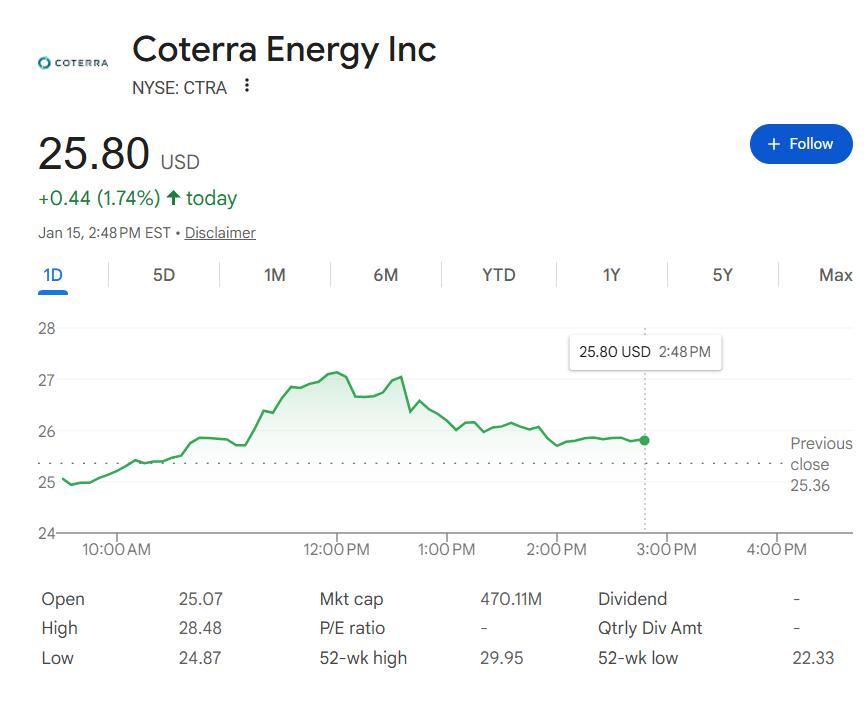
页岩油巨无霸呼之欲出!Coterra密谈Devon合并,全股票交易能否成行?
Jin Rong Jie· 2026-01-16 00:11
Core Viewpoint - The U.S. shale oil industry may witness a new wave of large-scale mergers and acquisitions, with Coterra Energy negotiating a potential merger with Devon Energy, both holding significant assets in the oil-rich Permian Basin [1] Group 1: Potential Merger Details - Coterra Energy and Devon Energy are discussing options for a potential merger, which may include an all-stock transaction [1] - Current negotiations have not yet resulted in a definitive outcome, and there is a possibility that no merger agreement will be reached, as well as the potential for other bidders to emerge [1] - If the merger is finalized, it would represent one of the largest oil and gas transactions in recent years, enhancing the market competitiveness of the combined entity in the Permian Basin [1] Group 2: Industry Context - This potential merger highlights the demand for accelerated industry consolidation among oil and gas companies following a relatively calm integration period until 2025 [1] - With oil prices remaining stable, major industry players like Chevron and ExxonMobil are advancing the integration of previously completed large acquisitions, indicating a resurgence in industry consolidation activity [1]


隔夜美股 | 台积电财报为市场注入“强心针” 三大指数收涨 芯片、银行板块领涨
Zhi Tong Cai Jing· 2026-01-15 22:40
Market Overview - Major indices in the US closed higher, with the Dow Jones up 292.81 points (0.6%) at 49442.44, the Nasdaq up 58.27 points (0.25%) at 23530.02, and the S&P 500 up 17.87 points (0.26%) at 6944.47, driven by gains in the chip and banking sectors following TSMC's earnings report [1] - In Europe, the DAX30 rose 46.15 points (0.18%) to 25361.02, the FTSE 100 increased by 50.11 points (0.49%) to 10234.46, while the CAC40 fell by 17.85 points (0.21%) to 8313.12 [2] Cryptocurrency - Bitcoin fell over 1.4% to $95,563, while Ethereum dropped more than 1.6% to $3,298.18 [3] Commodities - Spot gold decreased by 0.22% to $4,615.72, and silver saw a significant drop of 7.3% before closing at $92.428 [4] - Oil prices fell over 4%, with Brent crude down $2.76 (4.15%) to $63.76 per barrel, and WTI down $2.83 (4.56%) to $59.19 per barrel [5] Macro News - Mortgage rates fell to a three-year low at 6.06%, down from 6.16%, following Trump's $200 billion bond purchase plan aimed at improving housing affordability [6] - Federal Reserve's Schmied warned against rate cuts, emphasizing the need for restrictive rates to combat inflation and structural labor market issues [7][8] Corporate News - Goldman Sachs and Morgan Stanley reported record revenues in their stock trading divisions, with Goldman earning $16.5 billion, a $3 billion increase from 2024, and Morgan Stanley's stock business growing by 28% to $15.6 billion [8] - Coterra Energy is exploring a merger with Devon Energy, which could be one of the largest oil and gas deals in years, with discussions currently ongoing [9] - Citigroup raised Micron Technology's target price from $330 to $385 while lowering Ideal Automotive's target price from $20.2 to $18.5 [10]
页岩油超级并购来了?Coterra考虑联姻Devon Energy,股价一度涨超10%
Hua Er Jie Jian Wen· 2026-01-15 21:10
Group 1 - The core focus of the article is the potential merger between Coterra Energy and Devon Energy, which could lead to one of the largest oil and gas transactions in recent years, enhancing their competitive position in the Permian Basin against major players like ExxonMobil [1][2] - Coterra and Devon both hold significant oil and gas assets in the Delaware Basin, with Devon owning approximately 400,000 net acres and Coterra holding 346,000 acres, which would allow the combined entity to better compete with industry giants [2][3] - The merger discussions are ongoing, with no certainty of an agreement, and Coterra has also been in talks with at least one other company regarding potential acquisitions [1][4] Group 2 - The trend of mid-sized companies consolidating continues, as seen in the potential deal, which is reminiscent of Civitas Resources' $12 billion acquisition of SM Energy, both involving companies with substantial assets in the Permian Basin [5] - Coterra was formed from the merger of Cimarex Energy and Cabot Oil & Gas in 2021, and there has been pressure from investors like Kimmeridge Energy Management for Coterra to undergo changes, including leadership adjustments [5]
阿拉伯官员研判:美伊紧张局势已经“缓和”!
Jin Shi Shu Ju· 2026-01-15 13:50
Group 1 - The core viewpoint of the article highlights that diplomatic efforts, including communications between Iran and the U.S., have led to a de-escalation of tensions in the Gulf region, with regional countries urging restraint from the U.S. government [2][3] - There is an increasing hope that communication between Tehran and Washington, possibly facilitated by third parties like Russia or Oman, could lead to further negotiations in the coming days [4] - Following President Trump's assurance that Iran has stopped executing protesters, global oil prices fell as traders became less concerned about military actions affecting Iran's output or retaliatory actions against shipping routes [5][6] Group 2 - The U.S. military has begun withdrawing personnel and aircraft from the Al Udeid air base, which had approximately 10,000 soldiers stationed, raising speculation about potential military action against Tehran [4] - Despite the apparent de-escalation, military options remain on the table, with indications that President Trump desires a swift and clear outcome similar to previous military interventions [6]
两大央企“历史性握手”!中石化+中航油,意味着什么?
Jing Ji Ri Bao· 2026-01-15 08:27
Core Viewpoint - The restructuring of China Petroleum & Chemical Corporation (Sinopec) and China National Aviation Fuel Group (CNAF) marks a significant event in the context of state-owned enterprise (SOE) reforms, aimed at enhancing energy security and seizing opportunities in green transformation amid complex international circumstances [1][2]. Group 1: Impact on Aviation Fuel Industry - The restructuring is expected to enhance the competitiveness of the aviation fuel industry, as aviation kerosene is projected to be the only growth area in China's oil consumption, which is nearing its peak [1][2]. - The merger addresses the historical separation between production and sales in China's aviation fuel sector, improving overall competitiveness against international giants [1][2]. Group 2: Synergistic Advantages - Sinopec, as the largest refined oil and aviation fuel producer in China, complements CNAF's extensive logistics network, creating a complete industry chain from crude oil refining to airport fueling [2][3]. - This integrated model is expected to enhance global bargaining power and risk resilience, positioning the merged entity as a competitive player on the international stage [2][3]. Group 3: Green Transition in Aviation - The restructuring supports the aviation industry's green transition, with Sustainable Aviation Fuel (SAF) recognized as a key pathway for low-carbon development [2][3]. - Sinopec's leadership in SAF technology and production, combined with CNAF's logistics capabilities, facilitates the market entry of SAF, reducing costs and accelerating its adoption [3]. Group 4: Economic Stability and Supply Security - The merger aims to stabilize aviation fuel prices by internalizing transactions and optimizing resource allocation, which could alleviate cost pressures for consumers and airlines [3]. - Strengthening domestic aviation fuel supply capabilities is crucial for ensuring stable operations of civil aviation networks, especially in extreme international situations [3]. Group 5: Challenges and Governance - The success of the merger depends on achieving deep integration between the two large SOEs, which may have differing values and management styles [4]. - Concerns regarding market competition and potential monopolistic practices post-restructuring highlight the need for effective governance and regulatory oversight to ensure fair market participation [4].
聚焦全球能源 | 石油消亡论言过于实 大型油企将受益于需求继续增长
彭博Bloomberg· 2026-01-15 06:05
Core Viewpoint - The oil and gas industry has a promising long-term outlook, but faces short-term challenges due to increased supply from OPEC+ and non-OPEC producers [3]. Group 1: Oil and Gas Demand - Oil and natural gas remain central to the global energy structure, accounting for approximately 60% of primary energy consumption, with a gradual and uneven transition to alternative energy sources expected [4]. - Oil demand growth is projected to slow down and may stagnate by the 2030s, but high consumption levels are anticipated to persist until after 2040 [4]. - Short-term pressures from macroeconomic weakness may impact the profitability of oil and gas producers, but demand from emerging markets, aviation, and petrochemicals is expected to support production [4]. Group 2: Future Projections - OPEC maintains a more optimistic outlook for global oil demand growth by 2026 compared to the International Energy Agency (IEA), predicting consumption to exceed 106 million barrels per day, driven by emerging market demand [6]. - The IEA has revised its forecasts downward, particularly regarding demand in China, highlighting the growing uncertainty surrounding structural changes in the transportation sector [6]. - Both IEA and OPEC expect primary energy demand to continue growing until 2035, influenced by population growth, rising incomes, and increased energy use in emerging markets [9]. Group 3: Fossil Fuel Dependency - Fossil fuels are projected to maintain a share of over 50% in global primary energy demand for many years, despite a gradual decline in their proportion [11]. - In most scenarios, fossil fuel share is expected to decrease from around 80% currently to over 50% by 2040, with the IEA's net-zero emissions scenario being the most aggressive in assuming fossil fuel phase-out [11]. - The relationship between energy consumption growth and continued reliance on oil and gas is emphasized, with stronger demand forecasts often correlating with higher assumptions about fossil fuel shares [11].