云计算

Search documents
谷歌翻倍注资猛攻AI
21世纪经济报道· 2026-02-06 09:48
Core Viewpoint - 2025 is a landmark year for Google, with significant revenue growth driven by AI investments, but high capital expenditures raise concerns about future profitability [1][3][8]. Financial Performance - Alphabet reported a total revenue of $402.84 billion for 2025, a 15% year-over-year increase, with a net profit of $132.17 billion, up 32% [3]. - In Q4 2025, revenue reached $113.83 billion, growing 18% year-over-year, and net profit was $34.46 billion, a 29.8% increase, exceeding market expectations [3]. Cloud Business Growth - Google Cloud revenue grew by 48% year-over-year in Q4, reaching $17.664 billion, surpassing analyst expectations by over 9% [2][3]. - By the end of 2025, Google Cloud's annualized revenue exceeded $70 billion, with unfulfilled orders amounting to $240 billion, more than doubling year-over-year [3]. Search Business Performance - Search revenue increased by 17% year-over-year to $63.1 billion, exceeding analyst expectations [4]. - AI has significantly enhanced search business performance, with usage hitting historical highs due to AI-driven business expansion [4]. AI Product Commercialization - Key metrics for AI product commercialization include over 8 million paid seats for Gemini Enterprise services and over 1 billion tokens processed per minute through API calls [4][5]. - Gemini 3 has become the fastest adopted model in Google's history, with over 750 million monthly active users [4]. Capital Expenditure and Investment Strategy - Capital expenditures surged to $27.9 billion in Q4 2025, nearly doubling from $14.3 billion in the same period last year, and are expected to reach $175 billion to $185 billion in 2026 [1][7]. - The company is focusing on expanding data center capacity and procuring NVIDIA chips, while also investing in self-developed TPU to enhance supply chain resilience [7][9]. Market Reactions and Future Outlook - Following the earnings report, Alphabet's stock initially dropped over 7.5% but later fluctuated, reflecting investor concerns about high capital expenditures impacting short-term profitability [8]. - Analysts express that while high capital spending is necessary to compete with rivals like Microsoft Azure and Amazon AWS, it may compress short-term profit margins [8]. - Google's long-term strategy involves reallocating resources to AI-related growth areas and optimizing internal processes through AI, aiming to balance investment with profitability [8][9].



亚马逊押注AI,但市场不买账
Guo Ji Jin Rong Bao· 2026-02-06 09:45
Core Viewpoint - Amazon announced a nearly 60% increase in capital expenditures related to artificial intelligence (AI) to $200 billion by 2026, exceeding Wall Street expectations, which led to a 10% drop in the company's stock price in after-hours trading. The market is reassessing the balance between massive capital investments in the AI era and long-term returns [1][3]. Group 1: Financial Performance - Amazon's net profit for the current period reached $21.2 billion, aligning with analyst expectations, while the first-quarter operating profit guidance is set between $16.5 billion and $21.5 billion [3]. - Amazon Web Services (AWS) revenue grew by 24% year-over-year to $35.6 billion, although this growth rate lags behind competitors like Microsoft Azure (39%) and Google Cloud (nearly 48%) [3]. Group 2: AI Investment and Market Dynamics - Amazon, along with tech giants like Microsoft, Meta, Google, and Oracle, is accelerating the construction of data centers and financing for computing power to meet the explosive growth in AI computing demand. The combined spending of these companies is projected to exceed $700 billion by 2026, comparable to Japan's annual budget and surpassing government spending levels in Germany and Mexico [3]. - The market reaction to these investments has been polarized, with Meta and Google seeing stock price support due to improvements in advertising and other businesses, while Microsoft and Amazon face pressure due to AI-related business growth not meeting market expectations [3]. Group 3: Organizational Adjustments and Cost Control - To support high-intensity AI investments, Amazon is simultaneously implementing cost control measures and organizational adjustments, including layoffs of approximately 30,000 employees, or about 10% of its workforce, since October of the previous year [4]. - Amazon has restructured its AI department, appointing Peter DeSantis, who has nearly 30 years of experience at Amazon, to accelerate the launch of AI services and custom chips [4]. - The company is closing Fresh and Go grocery stores and reducing the application of Amazon One palm payment in retail, focusing resources on expanding Whole Foods, same-day grocery delivery, and data center construction [4]. - Amazon is reportedly negotiating a potential investment of up to $50 billion in OpenAI, which would further strengthen its position in the AI ecosystem [4].

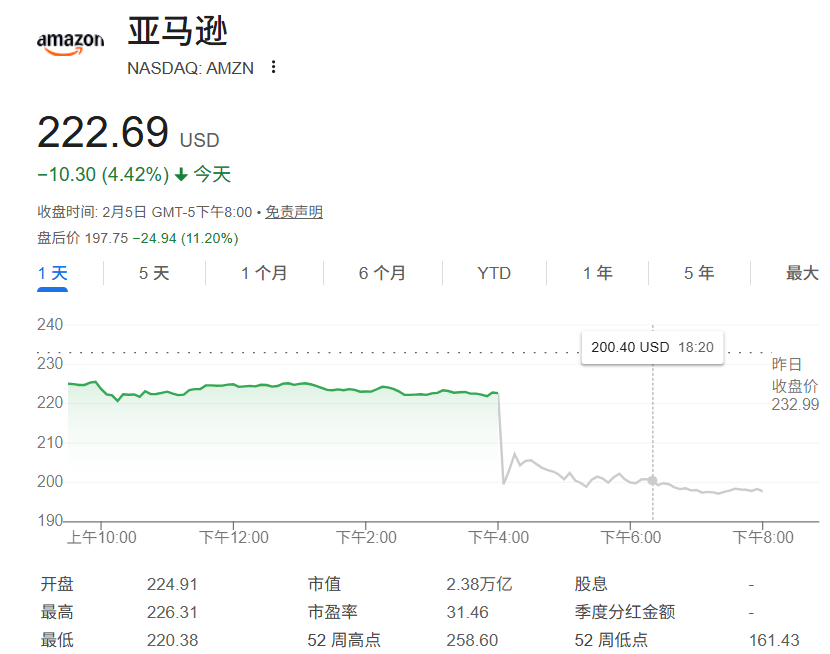
华尔街评亚马逊财报:2000亿资本开支太吓人,将对利润造成压力
Hua Er Jie Jian Wen· 2026-02-06 09:34
Core Insights - Amazon's AWS business drove better-than-expected Q4 performance, but the weak Q1 operating profit guidance and a capital expenditure plan of up to $200 billion by 2026 are shifting market focus from growth to the sustainability of profits and free cash flow [1] Group 1: Q4 Performance - The company reported Q4 net sales of $213.4 billion, a 14% year-over-year increase, with a GAAP operating profit of $25 billion [1] - AWS revenue reached $35.6 billion, growing 24% year-over-year, marking the fastest growth rate in 13 quarters [1][2] - Adjusted operating profit for Q4 was $27.4 billion, a 29.2% increase year-over-year, exceeding market expectations by approximately 10% [2] Group 2: Q1 Guidance - For Q1, the company expects net sales between $173.5 billion and $178.5 billion, a year-over-year growth of 11% to 15%, with a midpoint of $176 billion, aligning with market expectations [3] - The operating profit guidance is significantly lower than market consensus, ranging from $16.5 billion to $21.5 billion, with a midpoint of $19 billion, about 15% below market expectations [3] Group 3: Capital Expenditure - The company anticipates capital expenditures to reach $200 billion by 2026, a 52% year-over-year increase, significantly higher than the market's previous expectation of $146 billion to $149 billion [4] - The increase in capital expenditure is attributed to growing demand for AWS and AI, with AWS order commitments rising 40% year-over-year to $240 billion [4] Group 4: Analyst Perspectives - Analysts have mixed views; HSBC lowered its target price from $300 to $280 due to Q1 guidance and Leo project costs, maintaining a Buy rating [5] - UBS also maintains a Buy rating with a target price of $311, indicating about 40% upside potential, while Citigroup believes AWS growth and retail efficiency justify a premium valuation, maintaining a Buy rating with a target price of $320 [5] Group 5: Market Focus - Investors are expected to focus on disclosures regarding performance obligations and AWS capacity utilization in upcoming communications [6] - The key question for Amazon will shift from "Can it grow?" to "At what cost can it grow?" and when the high levels of investment will translate into more certain profit and cash flow improvements [6]
亚马逊2000亿美元投资计划“炸场”,折叠着AI时代资本逻辑的惊天变局
Sou Hu Cai Jing· 2026-02-06 09:26
Core Viewpoint - Amazon reported a significant increase in revenue for Q4 2025, reaching $213.39 billion, exceeding market expectations, while announcing a massive investment plan of approximately $200 billion for 2026, primarily focused on AI infrastructure and logistics upgrades [1][3]. Group 1: Financial Performance - Amazon's AWS business generated $35.58 billion in revenue for Q4 2025, marking a 24% year-over-year growth and achieving a new high in 13 quarters [1]. - The company's operating cash flow for the past year was $139.5 billion, a 20% increase, while free cash flow dropped to $11.2 billion, a significant decline of 70.7% year-over-year [9]. Group 2: Investment Plans - The $200 billion investment plan will focus on four key areas: AI infrastructure, proprietary chip development, logistics and robotics, and low Earth orbit satellite networks [3][4]. - Amazon aims to deploy over 100,000 new robots to reduce order processing time by 30% and expand its same-day and next-day delivery capabilities [3]. Group 3: AI Strategy - Amazon is advancing its AI infrastructure project "Rainier," with nearly 500,000 proprietary Trainium2 chips deployed, targeting 30% of AI computing tasks to be handled by in-house chips by the end of 2026 [3]. - The company’s proprietary AI chip portfolio, including Trainium and Graviton, has generated over $10 billion in annual revenue, reflecting a growth of over 300% [5]. Group 4: Workforce Changes - Amazon announced a layoff of 16,000 employees as part of a restructuring effort to enhance organizational efficiency and redirect resources towards AI-related fields, with total layoffs expected to reach around 30,000 [5]. - The layoffs are seen as a strategic move to optimize traditional business structures while investing in future AI capabilities [5]. Group 5: Market Reactions - Following the announcement of the aggressive investment plan, Amazon's stock fell nearly 10% in after-hours trading, indicating market concerns over the sustainability of such high capital expenditures [1][8]. - Analysts suggest that the tech industry may be entering a "over-investment" phase as capital expenditures outpace revenue growth [8].

亚马逊(AMZN.US)FY25Q4电话会:2026年资本支出将达2000亿美元 大部分投向AWS
智通财经网· 2026-02-06 08:53
Core Insights - Amazon plans to invest approximately $200 billion in capital expenditures by 2026, primarily focusing on AWS to support customer core businesses and AI workloads, aiming to quickly convert new computing power into revenue [1] - The backlog of orders for AWS has reached $244 billion, representing a 40% year-over-year increase and a 22% quarter-over-quarter increase, indicating strong demand for AWS services [1][11] AWS Performance - AWS reported a fourth-quarter operating profit margin of 35%, up 40 basis points year-over-year, with expectations of fluctuations due to AI investments and capital expenditure depreciation [2][3] - The company has delivered over 1.4 million Trainium chips, which offer a cost advantage of 30%-40% over comparable GPUs, generating annual revenues in the billions [2][6] AI and Chip Development - Trainium3 has started shipping and offers a 40% better cost-performance ratio compared to Trainium2, with strong market interest and nearly all supply expected to be pre-ordered by mid-2023 [2][6] - The company is developing Trainium4, planned for release in 2027, and discussions for Trainium5 are underway, indicating a robust pipeline for chip development [6] Retail Business Insights - By 2025, approximately 300 million customers are expected to use the shopping assistant Rufus, which increases the likelihood of purchase completion by about 60% [3][8] - The company aims to enhance customer experience through AI, believing that existing customer experiences will be transformed by AI, leading to new opportunities [4] Operational Efficiency and Growth - The company has increased its power capacity by 3.9 gigawatts over the past 12 months, which is double the capacity during the previous year when revenues were $80 billion, with expectations to double again by the end of 2027 [12] - The fulfillment network has seen significant improvements in delivery speed, which is crucial for capturing more business in essential goods and groceries [10]
资本开支超GDP,硅谷巨头6600亿美元押注AI,市场却越烧钱越恐慌
3 6 Ke· 2026-02-06 08:40
Group 1 - The core point of the article highlights that major US tech companies plan to invest a total of $660 billion in AI infrastructure by 2026, a figure that exceeds Israel's GDP and represents a 60% increase from the previous year's $410 billion [1][2] - Amazon, Microsoft, and Google have collectively seen their market value drop by $900 billion following their quarterly earnings reports, despite strong revenue growth in their cloud businesses [1][2] - Apple's strategy of minimal capital expenditure has allowed it to achieve record sales, making it the only major tech company to avoid the recent market sell-off [1][5] Group 2 - Amazon's capital expenditure for the year is projected to reach $200 billion, exceeding expectations by $50 billion, which has led to an 11% drop in its stock price [2] - Microsoft has experienced the most significant decline, with its stock price falling 18% after revealing a 66% increase in data center spending, raising concerns among investors [2] - Despite Google's record revenue of over $400 billion, its stock has also been negatively impacted by plans to double its capital expenditure to $185 billion [2] Group 3 - The rising capital expenditures signal that the realization of AI commitments may require more time and resources, testing investor confidence in long-term returns [3] - Analysts express concerns that the increased capital spending may not yield attractive returns, leading to a cautious market sentiment towards tech stocks [3] - The Nasdaq index has dropped 4% over the past five days, reflecting a shift in market sentiment towards AI investments [3] Group 4 - The failure of a $100 billion investment and infrastructure deal between OpenAI and Nvidia has contributed to market volatility, with Oracle's stock dropping 18% due to its heavy reliance on OpenAI [4] Group 5 - Apple's minimal capital expenditure strategy, with a reported $2.4 billion in Q4 and a total of approximately $12 billion for the year, contrasts sharply with the massive investments of its competitors [5] - Apple's collaboration with Google to enhance its AI capabilities through a pay-as-you-go model has allowed it to benefit from AI advancements without significant capital outlay [5] Group 6 - Nvidia is set to report earnings amid a turbulent market, with investors looking for signs that the escalating capital expenditures will soon translate into revenue growth [6] - Meta has announced plans to double its capital expenditure to $135 billion, but its stock gains have been reversed in the broader market sell-off [6] - Despite a 14% increase in combined annual revenue to $1.6 trillion for the four companies, market pessimism continues to overshadow positive financial results [6]


亚马逊CEO:AWS未完成订单达2440亿美元 AI需求旺盛
Xin Lang Cai Jing· 2026-02-06 08:35
免责声明:本文内容与数据由观点根据公开信息整理,不构成投资建议,使用前请核实。 观点网讯:2月6日,亚马逊首席执行官安迪·贾西在2025年第四季度财务业绩电话会议上对外表示, AWS未完成订单高达2440亿美元,AI需求旺盛,外界无需过分担忧公司加速扩产的计划。 根据公开资料整理,AWS当前年化营收达1420亿美元,13个季度来增速首次达24%;未完成订单额同比 增长40%。亚马逊2026年预计将投入2000亿美元资本支出,主要投向AWS的AI基础设施、定制芯片等 领域。 ...
核心伙伴收入年增长超100%,百度智能云做对了什么?
雷峰网· 2026-02-06 06:50
Core Viewpoint - The article discusses the transformation of the cloud computing ecosystem in the AI era, emphasizing the need for cloud vendors to redefine their relationships with partners to foster trust and create new value networks [2][4][21]. Group 1: Challenges in Traditional Cloud Ecosystem - The previous cloud ecosystem relied on a clear division of roles, where partners acted primarily as sales channels and integrators, leading to a "growth anxiety" due to reliance on narrow revenue streams [2][3]. - Partners expressed concerns about being easily replaced by competitors with similar capabilities, leading to a trust crisis within the ecosystem [3][4]. - The ongoing price wars in cloud computing have further compressed profit margins, challenging the sustainability of traditional revenue models [2][3]. Group 2: New Opportunities with AI - The rapid development of AI technologies and the emergence of large models present an opportunity to rewrite the rules of the ecosystem, moving towards a model that emphasizes deep understanding, scenario innovation, and operational services [3][4]. - Cloud vendors are encouraged to shift from traditional metrics to a focus on providing powerful AI tools and validated solution prototypes, allowing partners to leverage their industry expertise [6][21]. Group 3: Case Studies of Transformation - The case of Taiyue Satellite illustrates a proactive approach to transformation, where the company invested in a pilot project with Baidu Smart Cloud, leading to significant improvements in traffic management and establishing a new market role [9][10][12]. - The partnership allowed Taiyue Satellite to transition from a project executor to a core delivery partner, enhancing their market position and reducing project timelines from six months to three [13][14]. - Similarly, Rui Lian Kang Da's collaboration with Baidu Smart Cloud in the elderly care sector highlights the potential for co-creating new service paradigms, transforming traditional service delivery into a more efficient and user-friendly model [15][18]. Group 4: Strategic Insights and Future Directions - Baidu Smart Cloud's comprehensive AI infrastructure enables partners to integrate their unique strengths into a scalable business model, fostering a collaborative ecosystem [21][22]. - The article emphasizes the importance of readiness and adaptability for both partners and cloud vendors to seize emerging opportunities in the AI-driven market [24][25]. - The success of the new collaborative models is evidenced by significant growth in partner revenues and project participation, indicating a shift from resource aggregation to capability fusion [23][24].


资本开支超GDP!硅谷巨头6600亿美元押注AI,市场却越烧钱越恐慌
硬AI· 2026-02-06 06:44
Group 1 - The core viewpoint of the article highlights that major US tech companies plan to invest a record $660 billion in AI infrastructure by 2026, which exceeds Israel's GDP and represents a 60% increase from $410 billion in 2025 and 165% from $245 billion in 2024 [2][3][6] - The massive capital expenditure plans have led to a significant market reaction, with Amazon, Google, and Microsoft collectively losing $900 billion in market value following their quarterly earnings reports [3][4][6] - Apple's strategy of minimal capital expenditure has allowed it to avoid the sell-off, reporting record revenue of $144 billion, while its capital spending decreased by 17% to $2.4 billion in the last quarter [10][11] Group 2 - Investors are increasingly anxious about the long-term return on investment from AI, as rising capital expenditures suggest that achieving AI's full potential may require more time and resources [8][9] - The market sentiment has shifted, with the Nasdaq index dropping 4% over five days, reflecting concerns about the sustainability of tech stocks amid rising capital expenditures [9][13] - Despite strong revenue growth, companies like Microsoft and Amazon face pressure to demonstrate that their significant spending will yield attractive returns, as investor patience wanes [9][10] Group 3 - Nvidia, as the highest-valued public company, is expected to face a turbulent market when it releases its earnings report, with investors looking for signs that the escalating capital expenditures will translate into revenue growth [13][14] - Meta has also announced plans to double its capital expenditures to $135 billion, but its stock gains were short-lived amid broader market sell-offs [13][14] - Overall, the combined annual revenue growth of the four companies reached 14% to $1.6 trillion, which is insufficient to alleviate the prevailing market pessimism [13]

亚马逊电话会:2000亿开支吓崩股价!卫星项目单季烧10亿,CEO辩护“产能即变现”,AWS订单激增40%
硬AI· 2026-02-06 06:44
Core Viewpoint - Despite a 40% surge in AWS backlog orders to $244 billion, the market reacted negatively to Amazon's projected capital expenditure of $200 billion for 2026, leading to an 11% drop in stock price. The CFO warned of an additional $1 billion cost from the low Earth orbit satellite project, which would significantly impact profit guidance. However, the CEO defended the substantial investment, asserting that AI capacity can be monetized quickly and betting on AI agents to transform the e-commerce experience [2][5][14]. Group 1: Capital Expenditure and AWS Growth - The projected $200 billion capital expenditure for 2026 is primarily allocated to AWS, especially for AI infrastructure, with the CEO stating that demand far exceeds supply, alleviating concerns about overcapacity [6][34]. - AWS reported a 24% year-over-year revenue growth in Q4, reaching $35.6 billion, with an annualized run rate of $142 billion. The backlog of orders surged to $244 billion, indicating high revenue certainty for the future [22][56]. - The CEO emphasized that the investment in AWS is not a reckless pursuit of revenue but is based on years of experience in forecasting demand signals, ensuring strong capital returns [6][63]. Group 2: AI and Chip Development - The CEO highlighted the high costs of AI chips in the market, indirectly criticizing competitors for their lack of urgency in reducing prices, which justifies Amazon's push for its custom chips, Trainium and Graviton, which have seen significant revenue growth [7][8]. - Amazon's self-developed chips have surpassed $10 billion in annual revenue, growing at triple-digit percentages, with Trainium 2 being the fastest ramping chip in Amazon's history [8][40]. - The CEO introduced the concept of "agentic shopping," suggesting that consumers will prefer retailers' AI agents over general AI models, as they provide better selection, pricing, and delivery [23][25]. Group 3: Satellite Project and Cost Implications - The CFO disclosed that costs associated with the Amazon Leo satellite project are expected to increase by approximately $1 billion year-over-year, impacting Q1 profit guidance [15][57]. - Amazon plans over 20 satellite launches in 2026 and 30 in 2027, with costs primarily expensed as incurred, leading to immediate profit pressure [15][57]. Group 4: Workforce and Legal Expenses - The CFO confirmed that a total of $2.4 billion in special expenses, including $730 million for severance costs, impacted operating profit, reflecting ongoing workforce restructuring [16][52]. - Additional costs include $1.1 billion related to tax disputes and litigation settlements, further straining profitability [18][52]. Group 5: E-commerce and Customer Experience - The CEO praised the AI shopping assistant Rufus, which has been used by over 300 million customers, resulting in a 60% higher conversion rate for users [24][47]. - Amazon's grocery business has become a significant revenue driver, with daily essentials growing at nearly double the rate of other categories, making Amazon a leading grocery destination for over 150 million Americans [43][54]. - The company continues to innovate in delivery services, achieving record speeds and expanding same-day delivery options, which have significantly increased customer shopping frequency [44][46].