
天然气

Search documents
胜通能源:2025年全年预计净利润1500万元—1950万元
2 1 Shi Ji Jing Ji Bao Dao· 2026-01-30 09:46
南财智讯1月30日电,胜通能源发布2025年度业绩预告,预计2025年全年归属于上市公司股东的净利润 为1500万元—1950万元;预计2025年全年归属于上市公司股东的扣除非经常性损益的净利润为-2150万 元—-1550万元。归属于上市公司股东的净利润同比预减亏;原因:1.非经营性损益的影响:2025年归 属于上市公司股东的非经常性损益增加,主要系报告期内公司到期资产处置收益、收到的政府补偿款及 投资收益增加所致。2.主营业务的影响:报告期内,国际天然气市场供需基本面整体宽松,天然气价格 低位震荡,需求恢复不及预期,国产气增量显著,国内市场整体延续"供强需弱"的格局,竞争加剧导致 价格和利润空间承压,同时公司受执行"进口LNG窗口一站通"5年期长期协议影响,主营业务业绩下 滑。 ...
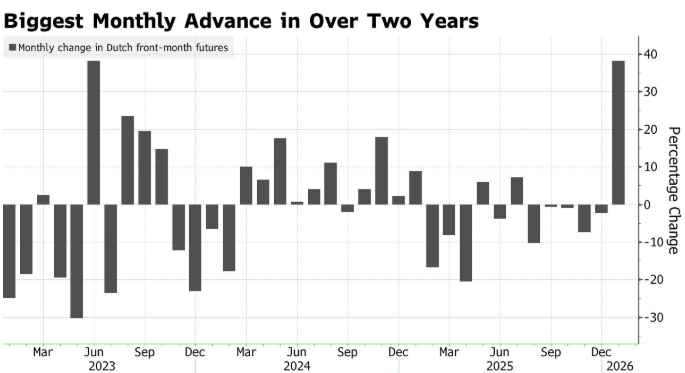
一月狂飙38%!寒潮与库存下降共振,欧洲天然气价格势将创下2年多来最大月度涨幅
Zhi Tong Cai Jing· 2026-01-30 09:17
Group 1 - The core viewpoint of the articles highlights the significant increase in European natural gas prices, which are expected to reach the largest monthly gain in at least two years due to cold weather and rapidly depleting fuel inventories [1][4] - As of the report, the Dutch benchmark natural gas futures for March delivery rose slightly by 0.5% to €38.77 per megawatt-hour, with a cumulative increase of approximately 38% for the month, marking the largest rise since the summer of 2023 [1] - Concerns over supply have eased somewhat with a rebound in U.S. exports, but expectations of severe cold weather in parts of Europe in early February are likely to increase demand [1] Group 2 - Energy analysis firm Energy Aspects noted that due to abnormally low inventories, price risks remain skewed to the upside, and unstable weather models have contributed to increased volatility in natural gas prices [4] - Traders are closely monitoring the situation in Iran, as escalating threats from U.S. President Trump have kept the energy market tense [4] - Additionally, Trump announced an agreement with Russia to pause airstrikes in Ukraine for a week, coinciding with the impending extreme cold weather [4]

天然气2月报-20260130
Yin He Qi Huo· 2026-01-30 07:09
1. Report's Industry Investment Rating No information provided regarding the industry investment rating. 2. Core Viewpoints of the Report - International LNG: In the short - term, supply disruptions and strong heating demand support prices, but further upside is limited. Long - term supply will increase, and prices will decline after winter. In February, it maintains the view of near - term strength and long - term weakness, with Europe stronger than Asia [6][53]. - US HH: Short - term price surges are due to cold snaps. After the cold snap, supply and demand will ease. Prices are closely related to temperature. In February, it maintains the view of near - term strength and long - term weakness [6][54]. 3. Summary by Relevant Catalogs 3.1 First Part: Preface Summary 3.1.1 Market Review - International LNG: Prices rebounded sharply in January. TTF rose nearly 35% from $9.7 per MMBTU to over $13 per MMBTU, driven by cold weather and geopolitical tensions [5]. - US HH: Prices had a roller - coaster ride. In early January, they dropped to around $3 per MMBTU due to warm weather and high production. Then, they soared to $7.46 per MMBTU on January 19th due to cold snap expectations [5]. 3.1.2 Market Outlook - International LNG: Short - term supply disruptions and strong heating demand support prices, but further upside is restricted. Long - term supply growth and reduced demand after winter will lead to price declines [6]. - US HH: Cold snaps cause short - term price spikes. After the cold snap, supply and demand will improve. Prices are temperature - dependent, and in February, the market is expected to be near - strong and far - weak [6]. 3.1.3 Strategy Recommendation - Unilateral: Short HH second - quarter contracts; short TTF or JKM third - quarter contracts. - Arbitrage: Wait and see. - Options: Wait and see [7]. 3.2 Second Part: Fundamental Situation 3.2.1 Market Review - International LNG: Prices rebounded in January due to cold expectations, low inventory, and geopolitical concerns. The first - line price rose from about $9.3 per MMBTU to a maximum of $15 per MMBTU [11]. - US HH: Prices had a V - shaped reversal in January. They fell in the first half due to mild weather and high production, then soared in the last two weeks due to cold snap expectations and a short - squeeze [11]. 3.2.2 US Market Fundamentals - Supply: As of January 28th, the average daily dry - gas production in January was about 110.6 billion cubic feet, down 2.6% from the previous month but up 6.6% year - on - year. After the cold snap on January's end, supply dropped to about 96 billion cubic feet per day, a nearly 16% decline from the monthly high [15][17]. - Demand: As of January 28th, the average daily domestic consumption in January was about 109.3 billion cubic feet, down 5.2% year - on - year. After the cold snap, daily demand reached about 140 billion cubic feet [15]. - Inventory: As of January 23rd, the total natural - gas inventory was 2823 billion cubic feet, up 9.8% year - on - year and 5.3% higher than the five - year average [16]. 3.2.3 International LNG Market Fundamentals - Europe: As of January 26th, the inventory level was 513.6 TWh, down 20.3% year - on - year, only 44.9%. The inventory consumption was faster in January. Local production decreased slightly, while imports reached a record high. Industrial demand did not recover, and gas - power demand growth was not obvious. The 2 - month cold expectation is strong, and there is no obvious expectation of wind - power expansion [25][27]. - China: In 2025, production increased 6.3% year - on - year, and imports decreased 2.9%. In December, production and imports increased year - on - year. As of January 23rd, LNG receiving - station and storage - reservoir inventory levels were higher than last year [31]. - Japan and South Korea: Japan's average daily imports in January were expected to be about 204,300 tons, up 2.3% month - on - month but down 4.7% year - on - year. As of January 23rd, the utility LNG inventory was 2.26 million tons. South Korea's average daily imports in January were expected to be about 142,100 tons, down 5.6% month - on - month and flat year - on - year. As of December, the LNG inventory was about 3.3 million tons, close to last year's level [32]. 3.2.4 Weather Forecast - China: North China will warm up slightly and then cool down, with overall temperatures lower than average in the next month. East China will be warm in early February and slightly cooler than normal in late February. South China's temperatures will be slightly higher than average in February [41]. - Japan and South Korea: They will warm up in early February and then cool down again, with overall temperatures slightly colder than average in the next month [41]. - US: It will remain cold in early February, and temperatures will be significantly lower than average after the cold snap. The cold expectation is strong in February [41]. - Europe: Northwest Europe will be slightly colder than average in the next two weeks and extremely cold in mid - February. Central Europe will cool down sharply in early February, warm up briefly but still be colder than normal. Italy's wind power will be strong in the short - term, and Germany's will be weak in February [41]. 3.2.5 Market Outlook - International LNG Market: In the short - term, supply disruptions and strong demand support prices, but further upside is limited. Long - term supply will increase, and prices will decline after winter. In February, it maintains the view of near - term strength and long - term weakness, with Europe stronger than Asia [53]. - US Market: Short - term price spikes are due to cold snaps. After the cold snap, supply and demand will ease. Prices are temperature - dependent. In the second quarter, the market situation depends on post - winter inventory levels [54].
指数还是绷不住了,个股要小心!题材轮动快,还有哪些投资机会?
Sou Hu Cai Jing· 2026-01-30 07:00
Group 1: AI and Technology Sector - The current technology market is expected to continue its upward trend after a short-term correction, driven by the low likelihood of a fundamental reversal in the AI industry in the US stock market, which provides significant valuation growth potential for A-share companies [1] - In the US market, AI leaders are still experiencing strong earnings growth, and large-scale stock buybacks are mitigating institutional selling pressure, indicating that while there may be high volatility and internal clearing among individual stocks, a systemic collapse similar to the 2000 tech bubble is unlikely [1] - The current stage of the AI sector in A-shares corresponds to the period in the US market from 2023 to 2024, where funds are shifting from hardware to applications, suggesting that the AI market is far from reaching its peak [1] Group 2: Tesla and Physical AI Industry - Tesla is leading the global "physical AI" industry transformation, with humanoid robots as a core pillar, sharing technology foundations with smart driving, thus initiating a closed-loop iteration of "data-algorithm-hardware" [3] - The sentiment in the sector is recovering, driven by the upcoming release of Tesla's Optimus V3 and clear production plans for Gen3, with the market speculating on Tesla's potential to establish a million-unit production line by the end of 2026 [3] Group 3: Commodities and Precious Metals - Precious metals, particularly silver, are experiencing a strong upward trend, becoming the leader in the commodities market, with ongoing high volatility and strong bullish pressure [5] - The market is closely monitoring whether the Chicago Mercantile Exchange's increase in margin requirements can curb the bullish trend in silver; if not, silver may continue to exhibit unexpected price movements [5] - The rise in precious metal prices is positively impacting the performance of non-ferrous metal companies and innovative pharmaceutical firms, while some traditional industries are facing cyclical pressures and declining performance [5] Group 4: Market Sentiment and Investment Opportunities - The Shanghai Composite Index is showing signs of weakness, indicating a drop in market sentiment to a new low, influenced by ongoing risk events in the commodities market [9] - Despite the volatility, there is an increase in capital inflow, with significant investments in A500 ETF and a rise in margin financing, suggesting a potential for structural investment opportunities [9] - The sentiment indices for A-shares and Hong Kong stocks are rising, with a bullish outlook on A-shares and a cautious approach to Hong Kong stocks, while institutional interest in the defense and military industry remains high [9]

今年迎峰度冬我国能源保供情况如何?国家能源局详解
Xin Hua Cai Jing· 2026-01-30 05:12
在成品油方面,记者从会上了解到,2025年,我国成品油市场需求整体维持疲弱态势,据行业监测,全 年成品油消费量3.78亿吨,同比减少2.9%;成品油产量4.14亿吨,同比减少2.4%。 新华财经北京1月30日电(记者安娜)今年入冬以来,我国"冷暖转换"频繁,北方地区冷空气活跃度加 剧,出现多轮阶段性强寒潮天气,能源保供情况如何?国家能源局电力司副司长刘明阳30日在国家能源 局新闻发布会上给出详细解答。 他在会上提供的数据显示,2026年1月4日,全国最大电力负荷达到13.51亿千瓦,今冬首创冬季负荷历 史新高;1月19日、20日、21日,受大范围寒潮天气影响,全国最大电力负荷连续三天创冬季新高,首 次突破14亿千瓦,1月21日最高达14.33亿千瓦。今年入冬以来,华北、西北、东北3个区域电网和新 疆、西藏等14个省级电网负荷累计86次创历史新高。 "国家能源局认真贯彻落实党中央、国务院决策部署,督促指导各地、有关能源企业全力确保能源电力 供应平稳有序。"刘明阳说,目前,全国燃料储备充足、电力供应平稳,东北等重点保暖地区电厂存煤 超25天。 他在会上提供的数据还显示,1月27日,全国统调电厂电煤库存2.2亿吨, ...
国家能源局:2025年我国可再生能源发电量超欧盟27国用电量之和
中国能源报· 2026-01-30 03:20
2025年我国可再生能源发电量达到约4.0万亿千瓦时,超过欧盟27国用电量之和。 文丨本报记者 王林 国家能源局发展规划司副司长邢翼腾介绍,能源安全保障有力有效。202 5年是"十四五"以来能源保供成效最好的一年。原煤生产保持 稳定,规上工业原煤产量同比增长1.2%。油、气产量双创历史新高,规上工业原油产量同比增长1.5%,规上工业天然气产量同比增长 6.2%。电力供应平稳有序,一批特高压直流输电工程投产送电,电力系统互补互济水平持续提升。 End 欢迎分享给你的朋友! 出品 | 中国能源报(c ne ne rgy) 责编丨李慧颖 1月3 0日,国家能源局召开新闻发布会,《中国能源报》记者在会上了解到,2025年,我国能源供应保障能力有效提升,供需总体宽 松,多项重要政策举措密集出台,行业健康有序发展,新型能源体系建设基础持续夯实,助力我国经济持续回升向好。 绿色低碳转型步伐加快。 制定出台新能源集成融合发展、促进新能源消纳和调控等一系列政策措施,助力新能源发展提质增效。全年 风电光伏新增装机超过4.3亿千瓦、累计装机规模突破18亿千瓦,可再生能源发电装机占比超过六成。 可再生能源发电量达到约4 .0万 亿千 ...

欧盟官员:警惕欧洲对美国能源日益增长的依赖
Yang Shi Xin Wen· 2026-01-30 03:17
Core Viewpoint - The European Union's reliance on liquefied natural gas (LNG) imports from the United States is significantly increasing, with projections indicating that by 2025, 58% of the EU's total LNG imports will come from the U.S. This shift, while reducing dependence on Russian gas, highlights the need for continued diversification of LNG sources and the development of renewable energy within member states [1]. Group 1 - The EU's dependence on U.S. LNG is projected to reach 58% of total imports by 2025 [1] - This increase in U.S. LNG imports is helping the EU reduce its reliance on Russian gas [1] - The EU is encouraged to diversify its LNG imports and utilize internal resources for renewable energy development [1]
今年迎峰度冬我国燃料储备充足、电力供应平稳
Yang Guang Wang· 2026-01-30 03:05
Core Viewpoint - The National Energy Administration reports that fuel supply for power plants is stable, ensuring energy security during the peak winter season, particularly with the upcoming Spring Festival [1] Group 1: Fuel Supply and Energy Security - Nationally, the fuel supply for power plants is solid and reliable, with coal reserves in key heating regions exceeding 25 days [1] - The domestic refined oil market is well-supplied, with stable inventories, maintaining a balance between supply and demand during the peak winter season [1] - As of January 27, the cumulative natural gas consumption during the heating season reached 119.52 billion cubic meters, a year-on-year increase of 4.6% [1] Group 2: Natural Gas Supply - Both domestic and imported pipeline gas are operating at relatively high and stable levels [1] - Underground gas storage facilities and coastal LNG receiving stations have sufficient adjustment capacity to ensure natural gas supply during the peak winter season [1] Group 3: Preparedness for Adverse Weather - The National Energy Administration will collaborate with relevant provinces and energy companies to enhance monitoring and response to adverse weather conditions, such as low temperatures and snow [1] - The aim is to ensure a stable and orderly energy supply, providing strong support for citizens to have a warm winter and a peaceful New Year [1]
【环球财经】2025年前11个月阿塞拜疆向意大利出口87.75亿立方米天然气
Xin Hua Cai Jing· 2026-01-30 00:55
新华财经巴库1月30日电(记者周良)阿塞拜疆趋势网站29日援引阿塞拜疆国家统计委员会的数据报 道,2025年1月至11月,阿塞拜疆向意大利出口87.75亿立方米天然气,出口金额为42.34亿美元。 数据显示,2024年1月至11月,阿塞拜疆向意大利出口了89.31亿立方米天然气,出口金额为36.37亿美 元。和2024年同期相比,2025年前11个月阿塞拜疆出口意大利的天然气金额增加5.97亿美元,增幅达 16.4%。如果按照天然气出口量计算,去年前11个月阿塞拜疆出口意大利的天然气则减少了1.56亿立方 米,降幅为1.8%。 2025年前11个月,阿塞拜疆天然气出口总量达228.04亿立方米,出口金额为81.17亿美元。与2024年同期 相比,出口额增加5.133亿美元,增幅为6.7%;出口量则减少7.18亿立方米,降幅为3%。与此同时, 2025年前11个月,阿塞拜疆进口了2.52亿立方米天然气,价值3915.1万美元。 (文章来源:新华财经) ...
新奥天然气股份有限公司关于反担保事项的进展公告
Shang Hai Zheng Quan Bao· 2026-01-29 20:05
Core Viewpoint - The company is providing a counter-guarantee of 21.7 million yuan to its controlling shareholder, Fuling Energy, for a financing application made by its associate company, Chongqing Longran Energy Technology Co., Ltd., which is seeking 155 million yuan in bank financing [2][3]. Group 1: Counter-Guarantee Details - Chongqing Longran is applying for 155 million yuan in financing, with its controlling shareholder, Fuling Energy, providing a full joint liability guarantee [2][3]. - The company will provide a counter-guarantee of 21.7 million yuan, corresponding to its 14% equity stake in Chongqing Longran [2][3]. - The counter-guarantee agreement was signed on January 29, 2026, between the company and Fuling Energy [2][3]. Group 2: Internal Decision-Making Process - The counter-guarantee matter was approved by the company's board of directors on December 10, 2025, and subsequently by the shareholders' meeting on December 26, 2025 [4]. Group 3: Necessity and Reasonableness of the Guarantee - The counter-guarantee is considered a normal business practice that supports the stable development and operations of Chongqing Longran, positively impacting its growth and profitability [12]. - Both Chongqing Longran and Fuling Energy have good credit ratings and repayment capabilities, making the guarantee risk manageable [12]. Group 4: Board of Directors' Opinion - The board of directors has approved the counter-guarantee based on the operational needs of Chongqing Longran, which is currently stable, and the risks associated with the guarantee are deemed controllable [13]. Group 5: Cumulative External Guarantee Situation - As of the announcement date, the company and its subsidiaries have provided external guarantees totaling 23.274 billion yuan, with no overdue guarantees [14]. - The counter-guarantee to Fuling Energy amounts to 2.3 million yuan, and the company has also provided guarantees to other associated entities [14].
