
电子信息

Search documents
多领域组建合作联盟,长江中游城市群冲刺“第五极”
Di Yi Cai Jing· 2025-12-15 05:35
Core Viewpoint - The Yangtze River Middle Reaches Urban Agglomeration is striving to become the "fifth pole" of China's economy through collaborative efforts in various sectors such as transportation, technology innovation, healthcare, and public safety [2][4]. Group 1: Intellectual Property and Innovation - In the past five years, the Yangtze River Middle Reaches Urban Agglomeration has achieved over 337,500 effective invention patents [1][5]. - A cooperation agreement was signed among the intellectual property offices of Wuhan, Changsha, Nanchang, and Hefei to establish a collaborative development framework for intellectual property protection [2]. - The agreement includes the creation of a strategic research base for intellectual property, a cross-regional enforcement mechanism, and a one-stop service for patent pre-examination and rights protection [2]. Group 2: Transportation and Logistics - A multi-modal transport enterprise alliance was established to enhance collaboration among key ports and logistics companies, aiming to improve shipping efficiency and reduce logistics costs [3]. - The alliance will focus on tailored logistics solutions for key industries such as automotive, chemicals, and grain, promoting a modernized port cluster [3]. - Future plans include optimizing intercity container services and creating a "water bus" network to facilitate better connectivity among ports [3]. Group 3: Regional Economic Development - The Yangtze River Middle Reaches Urban Agglomeration spans Hubei, Hunan, and Jiangxi provinces, contributing over 12 trillion yuan to the national economy, with GDP expected to exceed 14 trillion yuan this year [5]. - The region is characterized by a multi-center, multi-level spatial structure that supports collaborative development among cities, enhancing its position in the national economic landscape [5]. - The agglomeration is expected to develop new growth poles in advanced manufacturing, green energy, and modern logistics, further strengthening its innovation capabilities [5].
7200+优质岗位!“百万英才汇南粤”赴湖大、湖师大揽才
2 1 Shi Ji Jing Ji Bao Dao· 2025-12-15 04:08
Core Insights - The "Million Talents Gather in South Guangdong" 2025 N City Linked Autumn Recruitment Event attracted 174 employers, offering over 7,200 quality job positions across Hunan University and Hunan Normal University [1][2]. Group 1: Hunan University Recruitment - The recruitment event at Hunan University featured 104 employers, providing nearly 6,000 job positions across various educational levels, including PhD, Master's, Bachelor's, and Associate degrees [2]. - Competitive salary offerings included 3,445 positions with annual salaries ranging from 80,000 to 200,000 yuan, 2,051 positions with salaries between 200,000 and 500,000 yuan, and 171 positions with salaries from 500,000 to 1,000,000 yuan [2]. - Participating companies were primarily from key sectors such as new-generation electronic information, renewable energy, and high-end equipment manufacturing, aligning well with the university's strengths in materials science, semiconductor (integrated circuit), and electrical and information engineering [2]. Group 2: Hunan Normal University Recruitment - The recruitment event at Hunan Normal University included 70 participating employers, with 31 from the education sector, offering 1,273 job positions, including 1,111 positions with formal employment contracts [3]. - The Zhuhai education system specifically provided 216 formal employment positions during this recruitment [3]. - Notable institutions such as Sun Yat-sen University and Beijing Institute of Technology (Zhuhai) participated, with the latter offering 100 positions with annual salaries of one million yuan [3]. - The event created a vibrant atmosphere, with students expressing increased confidence in pursuing employment opportunities in Guangdong, particularly in Zhuhai, due to its favorable development environment and talent policies [3].
三城变一城!升级版强省会,开始了
3 6 Ke· 2025-12-15 03:12
Core Viewpoint - The recent meeting emphasized the goal of "building a city together" to accelerate the development of the Changsha-Zhuzhou-Xiangtan (Chang-Zhu-Tan) area into a significant growth pole in China [1][2]. Group 1: Development Goals - The concept of treating Changsha, Zhuzhou, and Xiangtan as a single city has been reiterated multiple times by officials, aiming to enhance the level of integration in the region [2][3]. - The "14th Five-Year Plan" for Hunan also stresses the "one city" approach to elevate the integration of Chang-Zhu-Tan [2]. Group 2: Economic Contribution - In 2024, the combined GDP of the Chang-Zhu-Tan area is projected to reach 2.21 trillion yuan, accounting for 41.6% of Hunan's total GDP [3]. - When measured as a single city, Chang-Zhu-Tan ranks just below cities like Yinchuan and Changchun in terms of provincial contribution, significantly higher than other major provincial capitals like Xi'an and Chengdu [4]. Group 3: Population and Resource Challenges - Hunan faces challenges in attracting and retaining population, with a net outflow of 179,000 residents in 2024, highlighting the need for a more attractive central city [6][8]. - The phenomenon of a "second provincial capital" is noted, with Shenzhen being informally recognized as such due to its significant draw for Hunan residents [6][8]. Group 4: Strategic Integration - The integration of Chang-Zhu-Tan aims to leverage the existing close ties among the three cities to enhance resource allocation and overall competitiveness [8][12]. - The transportation network is already close to a "half-hour commuting circle," facilitating economic interactions among the cities [11]. Group 5: Future Opportunities - The successful bid for the 2029 National Games is seen as a significant opportunity to boost the integration and development of the Chang-Zhu-Tan area [13]. - The shift from a "strong provincial capital" strategy to a more integrated urban area model may represent a new trend in regional development [14][17].


读懂城市丨除了“龙虾之都”,盱眙还是产业发展新热土、都市生态后花园
Xin Lang Cai Jing· 2025-12-15 02:34
Core Viewpoint - The city of Xuyi, known for its lobster industry, is transforming into a diversified economy by enhancing industrial competitiveness and developing tourism, aiming for high-quality county-level development [1][3]. Industry Development - Xuyi has established a comprehensive lobster industry chain involving research, breeding, processing, dining, and e-commerce, employing over 200,000 people, which is more than one-third of the county's permanent population [1]. - The city is actively increasing investment attraction to develop new industrial engines, focusing on electronic information and new energy sectors, with significant projects like the Zhongcheng Caihong project, which has a total investment of 5.5 billion yuan [3][4]. - The Zhongcheng Caihong project is expected to achieve annual sales of 7 billion yuan and create over 700 jobs, addressing high-end copper foil demand in various advanced technology sectors [4]. - Another major project by TBEA in Xuyi involves a total investment of 5.1 billion yuan, aimed at producing energy storage devices and solar inverters, projected to generate annual sales of 6.2 billion yuan and create 500 jobs [5]. Investment Environment - Xuyi has established a supportive investment environment, with a project management system that allows for rapid project initiation, achieving a turnaround from land acquisition to construction in as little as 35 days [12][13]. - The local government emphasizes a "101% service" philosophy, ensuring that investor needs are met while providing additional support [12]. - The region has a significant amount of available land for development, with 3,000 acres reserved in provincial development zones and an additional 10,000 acres for future projects [13][14]. Tourism Development - Xuyi is enhancing its tourism appeal by developing night-time activities and cultural experiences, aiming to convert visitors from short-term lobster diners to longer-term tourists exploring the city [17][21]. - The city has been recognized for its natural beauty and environmental quality, with awards for being a top tourist destination and maintaining excellent air quality [21][23]. - New attractions and events, such as the "Mystery of First Mountain" night tours, are being introduced to engage visitors and promote local culture [19][21].
高质量高标准推进郑州市 要素市场化配置综合改革试点
Zheng Zhou Ri Bao· 2025-12-15 00:40
Core Viewpoint - The State Council has approved a comprehensive reform pilot for market-oriented allocation of factors in Zhengzhou and nine other regions, aiming to enhance the quality and efficiency of resource allocation through 70 specific measures outlined in the reform plan [1] Group 1: Technological Innovation and Market Development - The reform plan emphasizes the importance of technological factors in driving innovation and proposes reforms in the management of scientific achievements in universities and research institutions [2] - It aims to establish a resource library for scientific achievements and promote the transformation of these achievements to support small and medium-sized enterprises [2] - The plan includes the construction of 30 concept verification centers and pilot bases in high-end equipment, new materials, and biomedicine [2] Group 2: Land Resource Optimization - The plan seeks to improve the efficiency of industrial land use by implementing standardized land transfer and ensuring immediate project commencement upon land acquisition [4] - It proposes measures to revitalize existing land resources and establish a unified urban-rural construction land market [4] - The plan includes policies to support the transformation of old industrial areas into cultural industries [4] Group 3: Talent Attraction and Management - The reform plan aims to relax household registration conditions to facilitate the settlement of agricultural migrants and other residents in Zhengzhou [5] - It proposes the establishment of a digital ecosystem for skilled talent and the development of a talent evaluation system linked to public services [6] - The plan includes initiatives to attract high-end talent and support innovation and entrepreneurship through various programs [6] Group 4: Data and Computing Infrastructure - The plan outlines the establishment of a comprehensive data registration and trading system, along with a national supercomputing center in Zhengzhou [7] - It aims to create benchmark data application scenarios in key sectors such as transportation, healthcare, and education [7] - The plan emphasizes the importance of data asset evaluation and the development of a data-driven economy [7] Group 5: Financial Services for Innovation - The reform plan introduces "Technology Talent Loans" to provide comprehensive financial services for technology-driven enterprises [8][9] - It aims to enhance the capital market's vitality and support the development of various financial products for small and medium-sized enterprises [8] - The plan includes measures to increase the proportion of RMB settlements in foreign trade [9] Group 6: Resource Market Mechanisms - The plan proposes improvements to the market mechanisms for resource allocation, particularly in the electricity and water sectors [10] - It emphasizes the need for a green trading mechanism and participation in national carbon trading [10] - The plan aims to facilitate market-oriented water rights trading to support industrial development [10] Group 7: Advanced Production Factors - The reform plan focuses on the innovative allocation of production factors in emerging industries such as healthcare, artificial intelligence, and low-altitude economy [11] - It aims to establish a comprehensive analysis system for various production factors to enhance decision-making and resource allocation [11] - The plan includes measures to ensure fair distribution of benefits from land use changes to various stakeholders [11]
河南省人民政府正式印发《郑州市要素市场化配置综合改革试点工作方案》 给土地“松绑” 为人才铺路
He Nan Ri Bao· 2025-12-14 23:41
Core Viewpoint - The Zhengzhou government has officially issued a comprehensive reform pilot plan for market-oriented allocation of factors, aiming to enhance the efficiency of resource allocation and promote high-quality development in the region [2][4]. Group 1: Reform Initiatives - The plan includes 70 reform measures focusing on key factors such as technology, land, human resources, data, capital, and environmental resources [2]. - Zhengzhou will establish 30 concept verification centers and pilot bases, along with over 100 provincial-level technology innovation platforms to facilitate the commercialization of research outcomes [2][3]. Group 2: Land and Human Resource Policies - The plan promotes long-term leasing of industrial land, a "standard land" transfer system, and a "land acquisition upon commencement" policy to reduce costs for enterprises [4]. - It aims to attract talent by relaxing household registration conditions for agricultural migrants and improving public service access for all residents [4][5]. Group 3: Data and Technology Development - The plan emphasizes the establishment of a data asset evaluation system and aims to cultivate over 50 benchmark data application scenarios in sectors like transportation, healthcare, and education [6]. - Zhengzhou will build a national supercomputing center and a core hub for supercomputing internet [6]. Group 4: Talent Development - The plan includes reforms in the salary system for public institutions and the establishment of a talent-sharing mechanism to meet the demands of emerging industries [5]. - It aims to attract top talent by adding 20 leading talents and over 200 technology leaders [5].
第一个20万亿大省,呼之欲出
虎嗅APP· 2025-12-14 13:13
Core Viewpoint - Guangdong Province aims to achieve a GDP of over 25 trillion yuan by 2035, effectively doubling its current economic output and reaching the level of a moderately developed country in terms of per capita GDP [6][9][11]. Group 1: Economic Growth Targets - The "14th Five-Year Plan" suggests that Guangdong's GDP should reach approximately 25 trillion yuan by 2035, with a nominal annual growth rate of over 5% [6][11]. - As of 2022, Guangdong's GDP was around 13 trillion yuan, and it surpassed 14 trillion yuan in the previous year, maintaining its position as the top province in China for 36 consecutive years [8][11]. - The target of 22 trillion yuan by 2035 would require a lower annual growth rate of about 3.5% [11]. Group 2: Economic Structure and Key Cities - The economic structure of Guangdong is heavily concentrated in the Pearl River Delta, with nine cities contributing over 80% of the province's GDP [19]. - Major cities like Guangzhou, Shenzhen, and the newly recognized Huizhou are expected to play pivotal roles in driving economic growth, with Huizhou's GDP already exceeding 600 billion yuan [20]. - The province plans to enhance the roles of secondary cities and urban clusters, including Zhuhai, Shantou, and Zhanjiang, to support overall economic development [22]. Group 3: Regional Development Disparities - The economic disparity between the Pearl River Delta and the less developed regions of East and West Guangdong is significant, with the latter contributing only about 20% of the province's GDP despite covering over 70% of its area [28][29]. - The "14th Five-Year Plan" emphasizes the need for coordinated development across the province, promoting industrial transfer and support for underdeveloped areas [30][31]. Group 4: High-Tech Industry Development - Guangdong aims to leverage national strategies to develop high-tech industries, focusing on sectors like new energy, aerospace, and advanced manufacturing [43][46]. - The province is home to nine trillion-yuan industrial clusters and has been recognized as the leading province in technological innovation for nine consecutive years [46][48]. - Guangdong's R&D expenditure is projected to reach approximately 509.96 billion yuan in 2024, with over 90% coming from enterprises, surpassing the total of 12 western provinces [48].

工行四川省分行积极助力成渝地区国家先进制造业集群“强链融圈”
Zhong Guo Jin Rong Xin Xi Wang· 2025-12-14 08:55
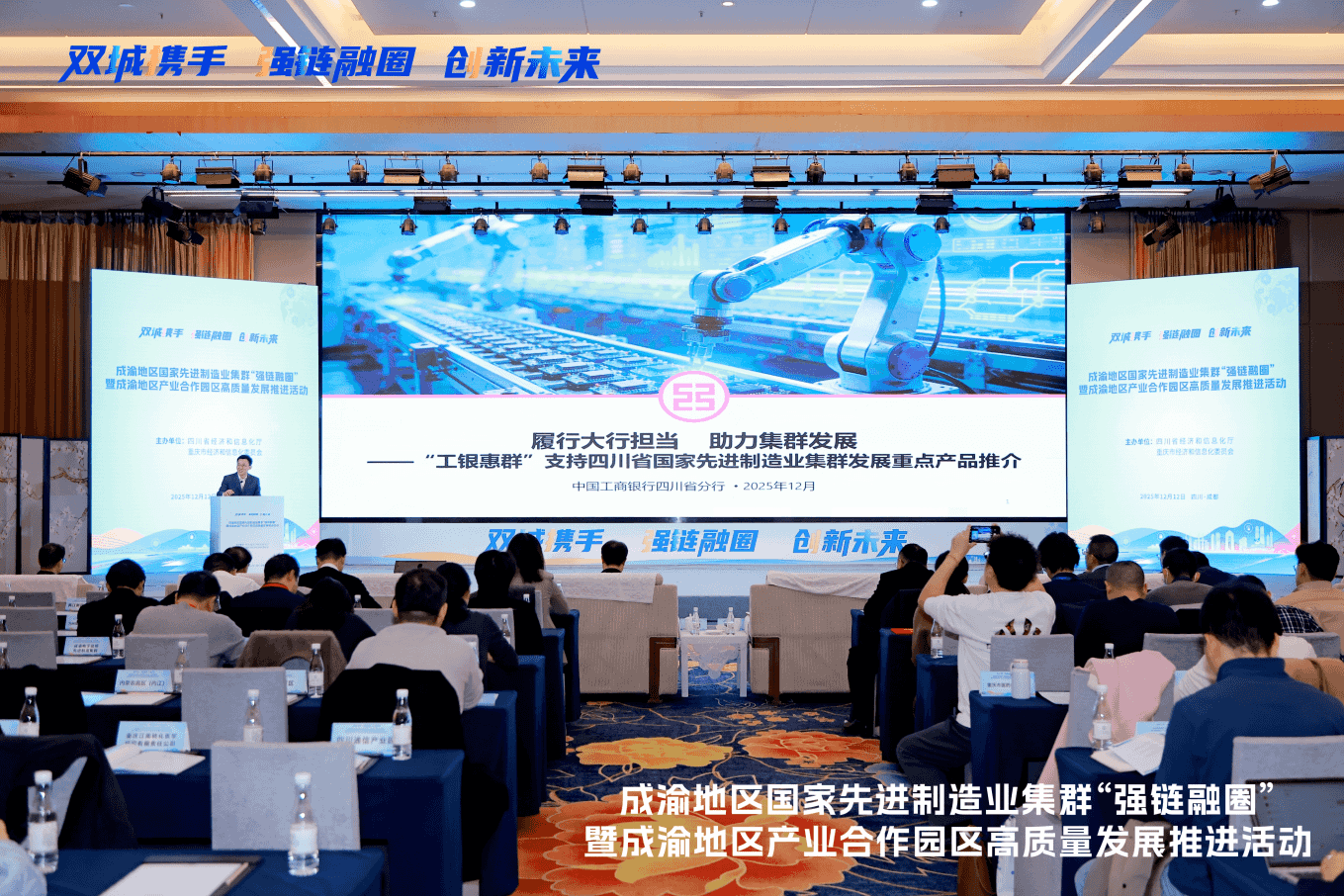
转自:新华财经 12月12日,工行四川省分行受邀参加成渝地区国家先进制造业集群"强链融圈"暨成渝地区产业合作园区高质量发展推进活动。活动中,该行作"工银惠群"服 务先进制造业集群的专题推介,并发布支持集群发展的创新服务措施及产品。 此外,工行四川省分行还参加了成渝地区电子信息先进制造业集群和成渝地区生物医药先进制造业集群的活动,并作服务方案宣讲和产品推介。 编辑:张震 图为工行四川省分行作重点产品推介 近年来,四川将先进制造业集群培育作为推动产业向中高端迈进、提升产业链供应链韧性、培育经济发展新动能的重要抓手。全省5大国家先进制造业集群 具有技术含量高、配套产业多、资本聚集密、发展前景好等特点,但也存在客群分布广、需求多样化的特征,对银行服务适配性提出更高要求。 经过持续稳健发展,中国工商银行已经建立了"贷+债+股+代+租+顾"的投融资体系,不仅可以做表内贷款,还可以联动海内外分支机构,以及工银理财、工 银金租、工银国际、工银投资、工银安盛等集团子公司为企业提供综合服务。工行四川省分行整合表内外融资资源,充分发挥综合化服务优势,不断帮助企 业提高资金使用效能,截至今年9月末,该行制造业贷款余额已超1200亿元 ...

古鳌科技:实际控制人拟变更为徐迎辉
Mei Ri Jing Ji Xin Wen· 2025-12-14 07:57
Group 1 - The core point of the news is the change in control of Guao Technology, with Xu Yinghui gaining significant voting rights through a delegation agreement with the current actual controller, Chen Chongjun [1] - Chen Chongjun has delegated the voting rights of 67,693,537 shares, representing 19.91% of the company's total equity, to Xu Yinghui [1] - After the agreement takes effect, Xu Yinghui's total voting rights in the company will increase to 24.41%, resulting in a change of the actual controller to Xu Yinghui [1] Group 2 - For the first half of 2025, Guao Technology's revenue composition shows that financial products in electronic information account for 91.72%, while other businesses account for 8.28% [1] - As of the latest report, Guao Technology has a market capitalization of 4.7 billion yuan [2]
古鳌科技:拟向特定对象增发募资不超过人民币4.32亿元
Mei Ri Jing Ji Xin Wen· 2025-12-14 07:57
Group 1 - The core point of the article is that Guao Technology (SZ 300551) has announced a stock issuance plan approved by its board, aiming to raise up to 432 million RMB to supplement working capital [1] - The stock issuance will involve a maximum of 40 million shares, which does not exceed 30% of the company's total share capital prior to the issuance, complying with the regulations of the China Securities Regulatory Commission [1] - The issuance price is set at 10.8 RMB per share, and the company reported a market capitalization of 4.7 billion RMB as of the announcement [1] Group 2 - For the first half of 2025, Guao Technology's revenue composition shows that 91.72% comes from electronic information and financial products, while other businesses account for 8.28% [1]