
装备制造

Search documents
21个市州前三季度经济“成绩单”出炉 服务业逐步回暖成为重要动力源
Si Chuan Ri Bao· 2026-01-04 03:58
Economic Performance Overview - Sichuan's 21 cities have released their economic performance for the first three quarters, with Chengdu continuing to shine and the South Sichuan Economic Zone showing rapid development [1] - Chengdu's GDP reached 14,438.75 billion yuan, growing by 10.0% year-on-year, maintaining a 37% share of the provincial total [2] - Yibin and Mianyang have surpassed the 200 billion yuan mark in GDP, while Deyang is close to achieving this milestone [2] Growth Rates and Economic Zones - Nine cities outperformed the provincial GDP growth rate of 9.3%, with Yibin leading at 10.3% [2] - The South Sichuan Economic Zone, including cities like Ziyang and Yibin, showed strong growth, while the Northeast Sichuan Economic Zone lagged behind [2] Emerging Industries and New Growth Drivers - Yibin's economic growth is significantly driven by emerging industries, with new energy and smart vehicles growing by 82.2% and smart terminals by 49.9% [4] - Mianyang's strategic emerging industries and high-tech sectors also maintained rapid growth, outpacing overall industrial growth [4] - Deyang's new industries, including general aviation and advanced materials, contributed significantly to industrial growth [4] Service Sector Recovery - The service sector is gradually recovering, contributing to economic growth in several cities, with the third industry in the province growing by 9.8% [4] - In Bazhong, the third industry's contribution to economic growth reached nearly 60%, driven by tourism [4] Investment, Consumption, and Export Dynamics - Investment, consumption, and exports are the three main drivers of economic development [5] - Deyang's fixed asset investment grew by 13.8%, exceeding both national and provincial averages [5] - Chengdu led in retail sales, with significant growth in smart and energy-efficient products, and a remarkable 55.9% increase in restaurant revenue [7][8] - Chengdu's total import and export volume reached 586.13 billion yuan, accounting for 87.6% of the provincial total, with notable growth in machinery and electronics exports [8]

“链”上发力 “创”见未来
Sou Hu Cai Jing· 2026-01-04 02:18
Core Viewpoint - Ningxia has made significant strides in nurturing specialized and innovative small and medium-sized enterprises (SMEs), with 29 national-level "little giant" enterprises and 579 specialized and innovative SMEs by 2025, reflecting a robust foundation for high-quality economic development [1][2]. Group 1: Industrial Development - By 2025, Ningxia's industrial sector has successfully cultivated 29 national-level specialized and innovative "little giant" enterprises and 579 specialized and innovative SMEs, indicating a solid step in nurturing quality SMEs [1]. - The region's approach involves a clear path of "policy guidance—gradual cultivation—innovation-driven—ecological empowerment," leading to the emergence of numerous enterprises that excel in niche markets and possess strong innovation capabilities [1][3]. Group 2: Policy Framework - The strategic plan for fostering specialized and innovative SMEs includes an implementation opinion set to be released in 2024, aiming to cultivate 100 innovative SMEs, 50 specialized and innovative SMEs, and 1-3 "little giant" enterprises annually by 2027 [2]. - A series of supportive measures have been introduced to assist enterprises in key areas such as R&D, finance, and transformation, creating a comprehensive support system for climbing the specialized and innovative ladder [3][4]. Group 3: Financial Support and Services - Since 2025, Ningxia has issued 1.1 billion yuan in fixed asset loan interest subsidies for 61 projects, secured 2.3 billion yuan in national bond funding for 23 projects, and provided tax reductions totaling 9.6 billion yuan for 335 enterprises [4]. - The online public service platform for enterprises has been continuously upgraded, facilitating the dissemination of 3,958 policy-related announcements and 959,000 policy information pieces to over 10,000 enterprises [4]. Group 4: Innovation and Technology - The region's innovation efforts have led to significant breakthroughs, such as the near-complete recovery of waste materials in the photovoltaic industry, enhancing material recovery rates from around 70% to nearly 100% [5][6]. - Ningxia's specialized and innovative enterprises have achieved an average R&D intensity exceeding 5%, contributing over 70% of the region's innovation outcomes [7]. Group 5: Collaborative Ecosystem - The establishment of a collaborative ecosystem has enabled specialized and innovative enterprises to effectively address critical challenges in their respective fields, fostering a network of innovation that integrates technology, industry, talent, and policy [6][7]. - The "chain master" model has been successfully implemented, allowing SMEs to integrate into supply chains of major enterprises, enhancing market stability and technological advancement [8][9]. Group 6: Industrial Clusters - Ningxia has developed seven distinctive industrial clusters, including new materials and fine chemicals, with the fine chemical industry cluster in Zhongwei successfully advancing to a national level [9]. - Within these clusters, enterprises benefit from shared resources and knowledge, reducing innovation costs and risks while enhancing overall competitiveness [9].

苏州加速竞逐“智造之城”
Su Zhou Ri Bao· 2026-01-04 00:54
Core Insights - The integration of AI into manufacturing processes in Suzhou is transforming the industry, enhancing efficiency and quality control across various sectors [1][4][5] Group 1: AI Applications in Manufacturing - AI technologies are being implemented in real-time quality control, such as detecting fabric defects and optimizing battery production processes [1][4] - Suzhou's MegalaxyLab3.0 has reduced the development cycle for complex biological tasks from 6-10 months to 6-8 weeks through AI-driven solutions [2] - The AI data center at Kunshan Huguang Automotive Electric has improved production scheduling efficiency, reducing planning time from 4 hours to 1 hour [3] Group 2: Industry Transformation and Efficiency Gains - AI applications have led to significant efficiency improvements, such as a 90% reduction in new material creation time and a 35% increase in production capacity for Tesla's harness lines [3] - The implementation of AI in quality inspection processes has increased detection speed by 30% and improved product quality rates to over 98% [5] - AI technologies are reshaping production processes, enabling a shift from manual inspections to automated quality checks, thus establishing consistent quality standards [5] Group 3: Policy and Ecosystem Support - Suzhou has established a comprehensive policy framework to support the integration of AI in manufacturing, including the creation of an AI application pilot base [6][7] - The city is focusing on building a collaborative AI industry ecosystem, emphasizing data resource development and the establishment of high-quality data sets [7] - Continuous policy support aims to enhance the synergy between AI technology development and its application in manufacturing, fostering a conducive environment for innovation [6][7]
天凝与浙大智慧绿洲共育发展新动能
Xin Lang Cai Jing· 2026-01-03 23:22
Group 1 - The strategic cooperation between Tian Ning Town and Zhejiang University’s Yangtze River Delta Smart Oasis Innovation Center marks a new phase in local collaboration, focusing on precise alignment of demand and supply [1] - Tian Ning Town aims to develop a "3+2" industrial structure, which includes three leading industries: high-end equipment manufacturing, fashion textiles, and modern construction, along with two emerging industries: new energy materials and electronic information [1] - The first batch of signed projects includes joint investment promotion, digital twin factory construction, transparent factory construction, and snow vegetable color protection technology development [1][2] Group 2 - The digital twin factory and transparent factory projects will leverage laboratory digital twin and smart production line control technology to facilitate the digital and intelligent transformation of the traditional textile and dyeing industry [2]

2025年中国31省GDP预测:四川远超福建,江西第15,内蒙古第20
Sou Hu Cai Jing· 2026-01-03 22:56
Core Insights - The economic landscape of China is transitioning from a phase of "catching up" to one of "coordinated development," reflecting profound structural adjustments and strategic transformations across regions [1] Group 1: Regional Economic Performance - Sichuan leads with a GDP of 68,033.11 billion, benefiting from a fundamental shift in development momentum and its strategic position as a hub for the "Belt and Road" initiative and the Yangtze River Economic Belt [3] - Jiangxi, with a GDP of 35,838.69 billion and a growth rate of 4.78%, demonstrates the vitality of central provinces through clear industrial strategies and integration into major regional economic chains [4] - Inner Mongolia ranks 20th with a GDP of 27,141.88 billion and a low growth rate of 3.14%, highlighting the challenges faced by resource-dependent economies amid the dual carbon goals and price volatility [6] Group 2: National Economic Trends - The total predicted GDP for 2025 is 1,409,234.56 billion, with a growth rate of 4.46%, indicating a shift from simple scale competition to a focus on quality and coordination [8][10] - Regions like Tibet (8.65%), Hubei (6.09%), and Xinjiang (5.63%) are leading in growth, benefiting from policy support, industrial upgrades, and resource value enhancement [8] - The overall trend shows that central and western provinces are generally experiencing higher growth rates, reflecting the effectiveness of national regional coordination strategies [8]

超级工程 重塑四川经济地理
Xin Lang Cai Jing· 2026-01-03 22:19
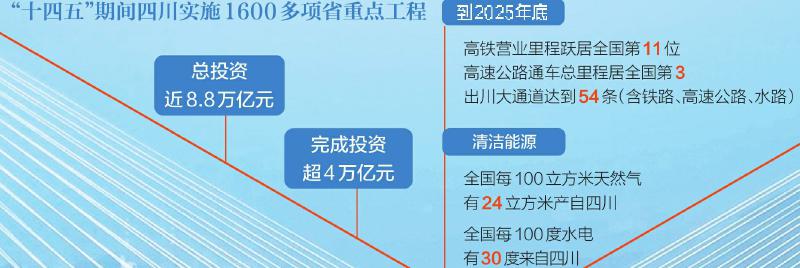
Core Viewpoint - Sichuan is undergoing a significant transformation through the implementation of over 1,600 key projects during the "14th Five-Year Plan" period, with a total investment of nearly 8.8 trillion yuan, reshaping its economic geography and enhancing its infrastructure capabilities [4][16]. Infrastructure Development - The completion of the Jinshajiang-Hubei ±800 kV UHVDC project allows clean energy to be transmitted over 1,900 kilometers in just 0.006 seconds, marking a milestone in energy transmission [3]. - The Leshan to Xichang expressway, which opened on December 31, 2025, features a high bridge-tunnel ratio of 82% and incorporates innovative snow-melting technology for high-altitude sections [3]. - Sichuan has built over 3,000 kilometers of new expressways in the past five years, connecting 15 previously isolated counties to national transport networks [7]. Transportation Achievements - The province's railway network has expanded significantly, with over 7,000 kilometers of operational railways, including the newly opened Chengdu-Yibin high-speed railway, which has transported over 29 million passengers in two years [6][8]. - The total length of highways in Sichuan has surpassed 11,000 kilometers, ranking third nationally, while the overall transportation network reaches 443,000 kilometers, the largest in the country [7]. Energy Sector Advancements - Sichuan has become the first province in China to exceed 100 million kilowatts in hydropower installed capacity, equivalent to 4.5 Three Gorges dams, capable of supplying electricity to approximately 500 million people [11]. - The province's clean energy initiatives include the completion of major hydropower projects and the establishment of new energy transmission corridors, enhancing its role in national energy security [11][12]. Economic Impact - The construction of these mega-projects has stimulated the development of Sichuan's equipment manufacturing and construction industries, with local firms expanding their operations internationally [16]. - Sichuan's strategic location and infrastructure improvements are expected to facilitate greater integration into national and international markets, enhancing its economic competitiveness [9][10].
兵团工业经济增长动能持续增强
Xin Lang Cai Jing· 2026-01-03 19:18
Group 1 - The industrial added value of the Xinjiang Production and Construction Corps (XPCC) increased by 7.6% from January to November 2025, surpassing the national average growth rate by 1.6 percentage points [1] - The seven major leading industries of the XPCC achieved comprehensive growth, contributing 7.4 percentage points to the overall industrial growth [1] - The manufacturing sector showed significant support, with an added value growth of 8.8%, exceeding the national average by 2.4 percentage points, contributing 85.2% to industrial growth [1] Group 2 - The total industrial output value of 19 key economic development zones monitored by the XPCC grew by 8.2%, with 13 zones exceeding a growth rate of 10% [1] - The XPCC saw the establishment of 95 new industrial enterprises, bringing the total to 1,481, with new enterprises contributing 43.7% to industrial growth [2] - The XPCC's industrial and information system is focused on promoting the seven major leading industries and 21 key industrial chains, implementing various projects to enhance industrial economic stability [2]
“制造+服务”赋能老工业基地焕新前行
Xin Hua Wang· 2026-01-03 04:51
当新一轮科技革命和产业变革的浪潮席卷而来,服务型制造正成为老工业基地焕发新生的"金钥 匙"。黑龙江省紧扣"4567"现代化产业体系建设蓝图,以政策为帆、以创新为桨、以企业为舵,全力推 进服务型制造发展专项行动,让"制造+服务"的融合之力穿透产业链条,推动"龙江制造"在高质量发展 的航道上加速前行,为培育新质生产力注入澎湃动能。 政策领航 擘画转型发展"施工图" 产业转型,政策先行;发展破局,机制为要。省委省政府将服务型制造作为制造业转型升级的核心 抓手,按下产业发展"快进键"。2022年7月,全省服务型制造产业工作专班正式成立,构建起"省委省政 府统筹、专班牵头、部门协同、市县落实"的工作格局。 顶层设计精准发力,行动方案落地有声。专班以省政府办公厅名义印发《黑龙江省服务型制造发展 专项行动方案(2022—2026年)》,明确提出"示范企业服务收入占比超30%"的刚性目标。 在政策"组合拳"加持下,要素保障持续升级:修订数字化车间奖补政策,7639万元专项资金精准投 向31个关键技术攻关项目;哈银金租开辟农机租赁绿色通道,累计投放55亿元惠及1.87万户农户;131 个质量基础设施"一站式"服务站、4个国家顶 ...
新一批31家总部企业认定
Xin Lang Cai Jing· 2026-01-02 22:39
Core Insights - The number of headquarters enterprises in Sichuan has expanded, with 31 companies recognized, bringing the total to 128 [1] - Headquarters enterprises are defined as those registered in Sichuan that conduct cross-regional operations and contribute significantly to local taxes and the economy [1] Group 1: Enterprise Distribution - The newly recognized 31 enterprises are primarily located in six cities, with a majority being private enterprises (48.4%), followed by state-owned enterprises (41.9%), foreign enterprises (6.5%), and mixed-ownership enterprises (3.2%) [2] - The main sectors represented are manufacturing (51.6%), services (32.3%), and construction (9.7%), aligning with Sichuan's modern industrial development [2] - Among these enterprises, seven have annual revenues exceeding 10 billion, and one exceeds 100 billion [2] Group 2: Classification of Headquarters - Sichuan classifies headquarters enterprises into three categories: comprehensive headquarters, functional headquarters, and growth headquarters [2] - Comprehensive headquarters must meet large enterprise standards in terms of revenue, total assets, and workforce [2] - Five functional headquarters are controlled by large enterprises from outside the province or abroad, requiring a minimum registered capital of 50 million [2] Group 3: Support Policies - Sichuan will utilize various policy tools, including fiscal, financial, technological, and talent support, to promote the development of headquarters enterprises [3] - There is an emphasis on policy coordination across provincial, municipal, and county levels to enhance the effectiveness of support measures [3]


以梦为马 坦途万里
Xin Lang Cai Jing· 2026-01-02 22:39
Core Insights - The article emphasizes the dynamic evolution of Shenyang, highlighting the interplay between tradition and innovation in shaping the city's future [1][2][3][4][5][6]. Group 1: Industrial Development - Shenyang's manufacturing sector is undergoing a transformation, moving from traditional heavy industries to advanced technologies, with companies like ShenGu and Northern Heavy Industries leading this shift [2]. - The focus is on enhancing technological density and innovation energy, indicating a shift in the definition of "heavy equipment" from physical weight to technological advancement [2]. - The growth in biomedicine and new energy sectors reflects the necessity for collaborative innovation within a supportive ecosystem [2]. Group 2: Cultural and Social Dynamics - The article illustrates the coexistence of tradition and modernity in Shenyang's urban life, where daily activities and cultural heritage intertwine [3]. - The community's evolution includes improvements in public services, such as new elevators in old neighborhoods and integrated community services, enhancing the quality of life [4]. - The narrative emphasizes the importance of citizen engagement in urban development, highlighting the role of individuals in shaping their community [4][5]. Group 3: Urban Planning and Infrastructure - Shenyang's urban planning is characterized by a focus on efficiency and trust, with infrastructure developments like an extended subway network enhancing connectivity [4]. - The integration of green spaces and community parks signifies a shift towards a more holistic approach to urban design, prioritizing quality of life [4]. - The city's strategic vision combines long-term planning with immediate needs, reflecting a balance between growth and community well-being [4]. Group 4: Human Element - The article underscores the central role of individuals in the city's narrative, portraying various community members as integral to Shenyang's identity and progress [5][6]. - The relationship between the city and its inhabitants is described as a mutual creation, where both influence and shape each other [6]. - The vision for Shenyang in 2026 is framed as a collective effort, with every citizen contributing to the city's story through their daily endeavors [6].