高端装备

Search documents
A股公司借力重组转型升级
Jing Ji Ri Bao· 2025-10-22 22:03
当前,我国经济处于转型升级与产业结构优化的关键时期,上市公司通过并购重组谋求产业升级和战略 转型的趋势明显。并购重组作为资源优化配置的重要机制,加速推动要素向科技创新和新兴产业集聚, 成为培育新质生产力的重要路径。 并购市场活跃度提升 今年以来,A股并购重组市场活跃。万得资讯(Wind)数据显示,今年前三季度A股市场并购交易3470 件,同比增长7.93%;重大资产重组事件134件,同比增长83.56%。其中,多家上市公司以彻底转型为 核心目标,或通过并购来寻找新增长点。特别是沪市,"并购六条"实施以来新增的重大并购方案中,有 近三成是转型升级案例。 从转型领域来看,上市公司重组转型主要朝向国家政策鼓励、具有成长性的领域。一些公司通过并购强 化产业链协同,提升对核心环节的自主可控能力。例如,赛力斯收购龙盛新能源,加强了对新能源汽车 生产环节的把控。 从转型主体来看,来自地产、纺织、化工等传统行业的企业转型需求迫切。这些传统行业企业通过并购 重组切入半导体、高端装备、新能源、人工智能等战略性新兴产业,出清落后产能,培育新的增长点。 川财证券研究所所长陈雳表示,产业转型升级是我国经济发展的大趋势,上市公司通过并购 ...
动能新 消费新 结构新 5.5%!上海前三季度经济表现超预期
Shang Hai Zheng Quan Bao· 2025-10-22 18:10
Core Insights - Shanghai's GDP for the first three quarters reached 40,721.17 billion yuan, with a year-on-year growth of 5.5%, surpassing the national growth rate of 5.2% [1] Group 1: New Momentum - The industrial added value in Shanghai increased by 5.2% year-on-year, with the total industrial output value growing by 5.7% [2] - The three leading industries, namely artificial intelligence, integrated circuits, and biomedicine, saw a manufacturing output value growth of 8.5%, significantly contributing to industrial growth [2] - Artificial intelligence manufacturing output grew by 12.8%, while integrated circuits and biomedicine grew by 11.3% and 3.6%, respectively [2][3] Group 2: Structural Changes - Shanghai's total import and export value reached 3.34 trillion yuan, with a year-on-year growth of 5.4%, and exports alone grew by 11.3% [4] - Private enterprises became the main force in foreign trade, achieving an import and export total of 1.32 trillion yuan, a growth of 27.1% [4] - The share of private enterprises in Shanghai's total foreign trade rose to 39.5%, marking a significant structural change [4] Group 3: New Consumption - The total retail sales of consumer goods in Shanghai increased by 4.3% year-on-year, driven by the "old-for-new" consumption policy [6] - Retail sales in categories such as sports and entertainment, furniture, and home appliances saw significant growth, with increases of 27.7%, 22.1%, and 28.2%, respectively [6] - Investment in urban infrastructure grew by 11.7%, with notable increases in power construction and transportation infrastructure investments of 42.1% and 26.5% [6]
河南开封加速优势主导产业转型升级
Zhong Guo Jing Ji Wang· 2025-10-22 15:04
Core Insights - The automotive industry in Kaifeng is undergoing a transformation, with companies like Quansheng Automotive Parts leveraging automation and high-quality production to serve both domestic and international markets [1][2] - Kaifeng is focusing on high-quality manufacturing, aiming to develop three trillion-level industrial chains in automotive manufacturing, new chemical materials, and modern food, along with four five-hundred-billion-level chains [2][3] Group 1: Automotive Industry Development - Quansheng Automotive Parts has implemented advanced robotic welding lines and automated assembly processes, producing high-quality metal components for automotive seats that are integrated into global supply chains [1] - The city has attracted nearly a hundred related enterprises, forming a trillion-level automotive manufacturing cluster, with significant contributions from leading companies like Chery, Haima, and BYD [1][2] - From January to August, Chery's production reached 175,600 vehicles, marking a 30.16% increase, with exports totaling 90,500 vehicles, a remarkable growth of 109.98% [1] Group 2: Industrial Chain and Investment - During the 14th Five-Year Plan, Kaifeng has prioritized high-quality development in manufacturing, successfully signing 56 projects with a total investment of 32.2 billion yuan in key industries [2] - The modern food sector in Kaifeng is thriving, with 36 nationally recognized agricultural products and significant investments from well-known food companies, aiming for a total industry output value exceeding 6 billion yuan by 2024 [2] - The fine chemical park in Kaifeng has become the only development zone in Henan focused on fine chemicals, with leading production capacities in various chemical products [2] Group 3: Technological Advancements and Support - Kaifeng is actively updating equipment and undergoing technological transformations, with 24 projects included in the Ministry of Industry and Information Technology's special relending project list [3] - The city is enhancing its business environment and supporting enterprises, focusing on key projects like Chery's passenger vehicle upgrades and the expansion of the chemical park [3] - High-tech and strategic emerging industries in Kaifeng are experiencing over 10% growth in added value, indicating a robust industrial development trajectory [3]
(经济观察)前三季度经济数据展现上海经济韧性
Zhong Guo Xin Wen Wang· 2025-10-22 14:08
与此同时,改革开放深化、制度型开放红利不断扩大。今年前三季度,上海在金融市场与枢纽功能、贸 易优化与能级提升、产业升级与创新驱动方面都有很好的表现。如金融市场成交额同比增长12.7%,货 物出口额同比增长11.3%,离岸经贸业务规模较2020年翻番。"这说明上海更好地以制度型开放引领高质 量发展,将区位优势、政策优势和产业基础优势转化为难以复制的国际竞争新优势。"沈开艳说。 中新社上海10月22日电 (范宇斌)上海22日发布今年前三季度经济数据,全市生产总值达40721.17亿元人 民币,同比增长5.5%,增速较上半年提高0.4个百分点,高于全国水平0.3个百分点。 今年前三季度,特别是第三季度,上海外贸"V型"反转,货物进出口总额同比增长5.4%,其中出口增长 11.3%。沈开艳认为:"这不是旧的贸易模式的复苏,而是新赛道、新主体、新市场、新平台同频共振的 "上海的这一成绩是在复杂多变的国际环境和国内结构调整压力下取得的,是在政策精准性、创新驱动 与开放红利共同作用下取得的。它不仅体现了上海经济的韧性,更揭示了通过创新驱动、政策协同与产 业升级实现高质量发展的内在必然。"上海社会科学院经济研究所所长、研究员 ...

突破四万亿!上海GDP增长5.5%!
天天基金网· 2025-10-22 10:41
Core Viewpoint - Shanghai's GDP growth for the first three quarters of 2025 reached 5.5%, indicating a positive economic trend and industrial growth, particularly in key sectors like manufacturing and emerging industries [4][5]. Economic Performance - Shanghai's GDP for the first three quarters was 40,721.17 billion, with a year-on-year growth of 5.5%, an increase of 0.4 percentage points from the first half of the year [4]. - Industrial production showed a growth of 5.2% year-on-year, with leading manufacturing sectors such as artificial intelligence, integrated circuits, and biomedicine growing by 12.8%, 11.3%, and 3.6% respectively [4]. - The total retail sales of consumer goods reached 12,302.77 billion, growing by 4.3% year-on-year, with a significant increase in the sales of trade-in products [4]. Financial Market Activity - The financial sector's added value was 6,965.27 billion, growing by 9.8%. Major financial markets in Shanghai saw a year-on-year increase in trading volume, with the Shanghai Stock Exchange's securities trading volume up by 38.4% [5]. - The overall trading volume in the two markets was approximately 16,679 billion, a decrease of over 2,000 billion compared to the previous day [10]. Stock Market Insights - Goldman Sachs predicts a 30% upside potential for the MSCI China Index over the next two years, suggesting a shift in investor strategy from "selling high" to "buying low" as a bull market develops [6]. - The market experienced a notable decline in trading volume, with a drop from 25,000 billion to 20,000 billion since the National Day holiday, indicating caution among investors at the current index level of 3,900 [16][17]. Sector Performance - In the stock market, sectors such as oil and petrochemicals, banking, and household appliances showed positive performance, while sectors like non-ferrous metals, electric power equipment, and agriculture faced declines [13]. - The overall market sentiment reflects a rotation of funds, with a focus on low-position stocks and technology stocks that are due for a rebound [17][18].


上海前三季度GDP同比增长5.5%,金融市场活跃财政收支增长
Bei Ke Cai Jing· 2025-10-22 06:02
Economic Overview - Shanghai's GDP for the first three quarters reached 40,721.17 billion yuan, with a year-on-year growth of 5.5% at constant prices [1] - The primary industry added value was 64.26 billion yuan, growing by 0.9%; the secondary industry added value was 8,448.67 billion yuan, growing by 3.9%; and the tertiary industry added value was 32,208.24 billion yuan, growing by 5.9% [1] Industrial Performance - The industrial added value in Shanghai increased by 5.2% year-on-year, with the total output value of industrial enterprises above designated size growing by 5.7% [2] - Key manufacturing sectors showed significant growth: railway, shipbuilding, aerospace, and other transport equipment manufacturing grew by 15.9%; electrical machinery and equipment manufacturing grew by 14.3%; and computer, communication, and other electronic equipment manufacturing grew by 12.1% [2] - The three leading manufacturing industries saw an 8.5% increase in output value, outpacing the overall industrial growth by 2.8 percentage points [2] - Strategic emerging industries in manufacturing grew by 7.3%, with the new energy sector growing by 19.6% and the new generation information technology sector growing by 10.9% [2] Tertiary Sector Growth - The tertiary sector's added value increased by 5.9%, with information transmission, software, and IT services growing by 15.5% [2] - The financial sector's added value was 6,965.27 billion yuan, reflecting a growth of 9.8% [2] - The transportation, warehousing, and postal services sector grew by 5.2%, while leasing and business services grew by 3.2% [2] Investment Trends - Fixed asset investment in Shanghai grew by 6.0%, with industrial investment surging by 20.3% [3] - Urban infrastructure investment increased by 11.7%, while real estate development investment grew by 2.2% [3] Consumer Market - The total retail sales of consumer goods reached 12,302.77 billion yuan, with a year-on-year growth of 4.3% [3] - Categories such as sports and entertainment goods, furniture, and home appliances saw significant retail growth, with increases of 27.7%, 22.1%, and 28.2% respectively [3] Financial Market Activity - Major financial market transaction volumes increased by 12.7%, with the Shanghai Stock Exchange's securities transaction volume growing by 38.4% [3] - By the end of September, the balance of deposits in financial institutions reached 23.84 trillion yuan, growing by 8.4% year-on-year [3] Consumer Prices and Income - The consumer price index (CPI) remained stable year-on-year, with a slight decrease of 0.1% in September [4] - The average disposable income per capita in Shanghai was 69,220 yuan, reflecting a year-on-year growth of 4.3% [5] - The average urban unemployment rate was 4.2% [5]
“AI+制造”深度融合,广东发布三年行动方案
Huan Qiu Wang Zi Xun· 2025-10-22 05:51
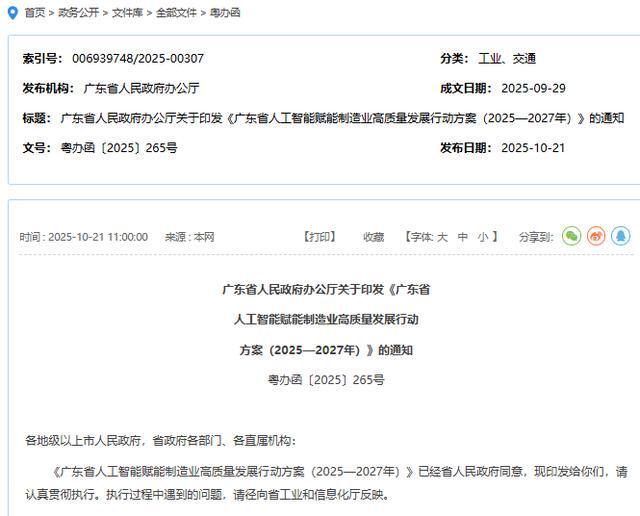
Core Insights - Guangdong Province has officially launched the "Action Plan for High-Quality Development of Manufacturing Empowered by Artificial Intelligence (2025-2027)" with 16 specific measures aimed at integrating AI into the manufacturing sector and accelerating digital transformation [1] Group 1: Innovation Focus - The plan emphasizes the innovation of industrial models, proposing a "Hundred Industries, Thousand Models" approach, particularly in key sectors like electronic information, smart home appliances, automotive, and robotics [2] - To lower the entry barriers for enterprises, Guangdong encourages local governments to establish "model vouchers" to support the purchase of industrial model services, alongside policies like "computing power vouchers" and "training vouchers" to reduce computing costs [2] - The plan supports the construction of high-quality industry data sets and industrial knowledge databases, including the establishment of a Guangdong branch of the National Industrial Internet Big Data Center [2] Group 2: Benchmarking and Application - The plan includes a "Benchmark Construction Action" for "AI + Manufacturing" to demonstrate and lead the integration of AI in sectors such as consumer electronics, high-end equipment, automotive, home furnishings, and biomedicine [3] - It supports enterprises in enhancing the application of "industry models + specialized models + intelligent agents" and will provide funding for selected exemplary projects [3] Group 3: Smart Factory Development - Guangdong will implement a gradient cultivation action for smart factories, supporting enterprises in upgrading from individual equipment to full workshop automation [4] - The plan aims to build advanced, excellent, and leading smart factories while promoting deep integration of AI with core industrial software and high-end equipment [4] Group 4: Empowering SMEs - The plan aims to ensure that the benefits of AI empowerment reach small and medium-sized enterprises (SMEs) by accelerating digital transformation pilot projects in cities like Guangzhou, Shenzhen, and Foshan [5] - It focuses on sectors such as smart terminals, new energy vehicles, and textiles, promoting the application of model algorithms in key scenarios like R&D design, visual inspection, and energy management [5] - Financial support will be provided through provincial industrial development investment funds, encouraging local governments to assist enterprises in digital transformation through loan interest subsidies and risk compensation [5]
广东将实施“人工智能+制造业”标杆建设行动,涉及汽车等领域
2 1 Shi Ji Jing Ji Bao Dao· 2025-10-22 04:05
Core Insights - Guangdong Province is launching an action plan to enhance the high-quality development of manufacturing through artificial intelligence from 2025 to 2027 [1] - The plan aims to leverage Guangdong's extensive market and diverse scenarios to promote the intelligent upgrade of manufacturing enterprises across all processes [1] Group 1: AI Integration in Manufacturing - Artificial intelligence is accelerating its penetration and application in various manufacturing sectors, including R&D, production, sales, service, and management [1] - The initiative will focus on several key industries such as consumer electronics, high-end equipment, automotive, petrochemicals, home furnishings, and biomedicine [1] - The plan includes the establishment of demonstration factories that integrate multiple scenarios and operate efficiently with industrial AI models [1] Group 2: Smart Supply Chain Transformation - Guangdong will promote a "smart chain transformation" model, encouraging leading enterprises to build intelligent supply chains based on industrial AI models [2] - The initiative aims to facilitate collaborative manufacturing, procurement, and distribution among upstream and downstream enterprises [2] - Support will be provided for local governments that successfully implement AI-integrated industrial internet platforms and smart supply chain collaboration platforms [2] Group 3: Support for SMEs - The plan targets small and medium-sized enterprises (SMEs) by focusing on over 30 pilot industries, including smart terminals and new energy vehicles [2] - Funding will be available for eligible SMEs to implement AI-driven projects in areas such as R&D design, visual inspection, and energy management [2] - The establishment of core software service platforms will be supported to enhance the AI application capabilities of SMEs [2]
报告称中国经济正进入供需再平衡关键期
Zhong Guo Xin Wen Wang· 2025-10-22 02:31
Core Viewpoint - The report indicates that China's economy is entering a critical period of supply-demand rebalancing, with a need for policy support to promote structural transformation and maintain stable growth [1][2]. Economic Indicators - In September, the core CPI rose by 1.0%, marking the first increase back to 1% in 19 months and showing a continuous upward trend over five months [1]. - The manufacturing PMI production index reached 51.9% in September, up 1.1 percentage points from the previous month, indicating accelerated production expansion [1]. - The industrial added value for large-scale enterprises grew by 6.5% year-on-year in September, with 36 out of 41 major industries showing positive growth, reflecting a healthy production and sales environment [1]. Export Performance - In September, China's exports increased by 8.3% year-on-year in USD terms, with electromechanical products accounting for 60.5% of total exports in the first three quarters [2]. - High-tech products such as electronic information and high-end equipment showed significant growth, highlighting the impact of China's industrial structure transformation [2]. Policy Recommendations - The report suggests prioritizing reasonable price recovery as a macro policy goal, continuing to implement consumption encouragement measures, and enhancing support for employment stability [2][3]. - It recommends considering moderate interest rate cuts in the fourth quarter to lower financing costs for businesses and suggests early implementation of fiscal policies to support local government debt management [2]. - Emphasis is placed on optimizing the business environment and supporting innovation to foster a long-term system that encourages enterprise focus and innovation [3].
GDP增长5.5%!人工智能、半导体等产业快速增长 上海经济实现奋力一跳
财联社· 2025-10-22 01:54
Core Viewpoint - Shanghai's economy shows a steady improvement with increasing internal momentum, characterized by stable production growth, orderly market demand release, and the continuous development of new industrial drivers [1] Economic Performance - GDP growth reached 5.5% year-on-year, an increase of 0.4 percentage points compared to the first half of the year [3] - Industrial production maintained a growth trend, with industrial added value increasing by 5.2% year-on-year and total industrial output value for large-scale enterprises growing by 5.7%, up by 0.1 percentage points from the first half [4] Leading Industries - The three leading manufacturing industries experienced a significant growth of 8.5% year-on-year, outpacing the overall industrial output growth by 2.8 percentage points. Notably, artificial intelligence manufacturing grew by 12.8%, integrated circuit manufacturing by 11.3%, and biopharmaceutical manufacturing by 3.6% [6] Emerging Industries - Strategic emerging industries in manufacturing saw a total output value increase of 7.3% year-on-year. The new energy sector grew by 19.6%, next-generation information technology by 10.9%, and high-end equipment manufacturing by 10.3% [7] Consumer Market - The retail market showed signs of recovery, with total retail sales of consumer goods reaching 12,302.77 billion yuan, a year-on-year increase of 4.3%, which is 2.6 percentage points higher than the first half of the year. Categories such as sports and entertainment goods, furniture, and home appliances saw significant growth rates of 27.7%, 22.1%, and 28.2% respectively [9] Financial Market - The financial sector remained active, with added value reaching 6,965.27 billion yuan, growing by 9.8%. Major financial market transaction volumes increased by 12.7% year-on-year, with the Shanghai Stock Exchange's transaction volume growing by 38.4%, the Shanghai Futures Exchange by 11.5%, and the Shanghai Gold Exchange by 40.2% [11][12]