
AI

Search documents
商业航天再掀涨停潮,MiniMax港股上市首日飙升65%,白银持续下挫
21世纪经济报道· 2026-01-09 03:56
Market Overview - The A-share market saw all three major indices rise, with the Shanghai Composite Index breaking the 4100-point mark for the first time in 10 years, closing at 4095.33, up 0.3% [1][2] - The Shenzhen Component Index increased by 0.57% to 14038.46, while the ChiNext Index rose by 0.1% to 3305.48 [2] - The total trading volume in the Shanghai and Shenzhen markets reached 2.08 trillion yuan, an increase of 296.3 billion yuan compared to the previous trading day [1][2] Sector Performance - Active sectors included energy metals, commercial aerospace, healthcare payment reform, AI applications, and computing hardware, while solar energy, semiconductors, and insurance sectors showed weakness [2] - The commercial aerospace sector experienced a surge, with multiple stocks hitting the daily limit, including Lushin Investment, which achieved 9 limit-ups in 11 days [2] AI and Technology Stocks - The AI application concept continued to strengthen, with stocks like Yuel Media and Easy Point Technology hitting the daily limit [3] - MiniMax, an AI model company, saw its stock price soar by 81% on its debut, later stabilizing at a 65% increase, with a market capitalization of 83.4 billion HKD [3] Precious Metals - Gold prices turned from gains to losses, with spot gold falling below 4470 USD, down nearly 0.3% [5][6] - Silver prices also declined, with spot silver dropping nearly 2% at one point, and futures contracts falling over 1% [5][6] Future Outlook - Guosen Securities predicts that with increased retail investor participation, the total incremental funds for the year could reach 2 trillion yuan [6] - The gold-silver ratio has dropped significantly, indicating potential profit-taking in the silver market, although there is speculation that silver prices may reach new highs around the Lunar New Year [6]


超2900只个股下跌
第一财经· 2026-01-09 03:48
2026.01. 09 本文字数:1506,阅读时长大约3分钟 作者 | 一财阿驴 11:31 A股午盘丨沪指半日涨0.3% 截至午盘,沪指涨0.3%,盘中一度站上4100点;深成指涨0.57%,创业板指涨0.1%,科创综指涨 0.56%。 | 代码 | 名称 | 两日图 | 现价 | 涨跌 | 涨跌幅 | | --- | --- | --- | --- | --- | --- | | 000001 | 上证指数 | win | 4095.33 | 12.35 | 0.30% | | 399001 | 深证成指 | may | 14038.46 | 78.98 | 0.57% | | 399006 | 创业板指 | Mark | 3305.48 | 3.18 | 0.10% | | 000680 | 科创综指 | port | 1776.42 | 9.85 | 0.56% | 盘面上,能源金属、商业航天、医保支付改革、AI应用、算力硬件题材活跃,光伏、半导体、保险板 块走弱。 | 板块名称 | 张鸣 | 涨速 | 涨停数 | | --- | --- | --- | --- | | 小金属 | +3.89% | ...


第二十届私募基金发展论坛举行 共探行业高质量发展新路径
Zheng Quan Shi Bao Wang· 2026-01-09 03:37
Group 1 - The core viewpoint of the articles highlights that by 2025, China's private securities asset management scale will historically exceed 7 trillion yuan, driven by steady market growth and strategic innovation [1] - The private equity industry is experiencing significant vitality, with the number of hundred-billion yuan private equity firms steadily increasing and the profitability of the industry showing notable enhancement [1] - The 20th Private Fund Development Forum held in Shenzhen focused on core topics such as AI-enabled investment paradigms, investment opportunities in the equity market, and the value of CTA strategy allocation [1] Group 2 - Looking ahead, the private equity industry is expected to develop in a more diversified and mature direction, demonstrating a more stable and sustainable growth trend [2] - Current investment opportunities in the AI sector may need to shift from hardware to software, as the value ratio between hardware and software in traditional IT architecture is approximately 1:4, while in AI, hardware currently outweighs software [2] - The AI era is anticipated to be as significant as the internet boom in 1998 or the new energy vehicle surge in 2007-2008, with the trend of AI industry development expected to be vast and forward-moving [2] Group 3 - The "AI+" wave is sweeping through the financial sector, leading quantitative investment into a new stage of strategy iteration, with high expectations for its development prospects [3] - AI is expected to enhance existing quantitative frameworks and optimize them, bringing more multimodal and non-institutional data into semantic factors, thereby improving strategy development efficiency [3] - The transformation in quantitative research paradigms is anticipated, shifting from "manual research" to "intelligent experimental systems," significantly reducing human assumptions [3]
今天,A股又见4100点!
Zhong Guo Zheng Quan Bao· 2026-01-09 02:40
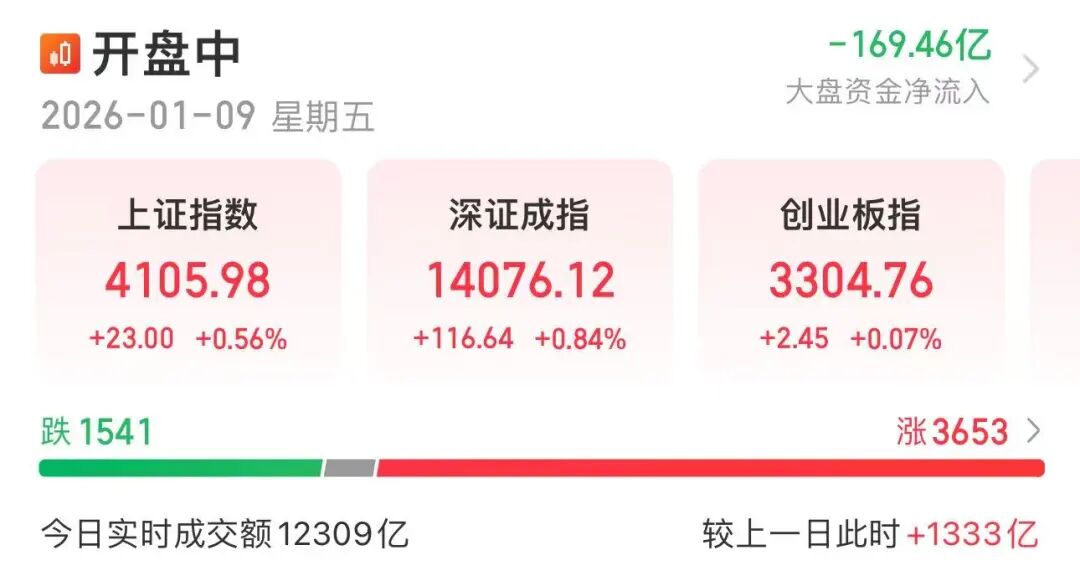
Market Overview - The Shanghai Composite Index has reached 4100 points for the first time since July 24, 2015, with a current increase of 0.56% to 4105.98 points [1] - The Shenzhen Component Index rose by 0.84%, while the ChiNext Index saw a slight increase of 0.07% [1] AI Applications - The AI application sector has experienced significant gains, particularly in areas such as "AI + Doctor," Sora concept, and Zhipu AI, which have shown notable increases [3] - Beijing Zhipu Huazhang Technology Co., Ltd. was listed on the Hong Kong Stock Exchange on January 8, and another unicorn company, MiniMax, has also debuted on the Hong Kong market [3] Commercial Aerospace - The commercial aerospace sector has seen substantial growth, with stocks like Fujida and Shaoyang Hydraulic (301079) performing well [4] - On January 7, China commenced construction of its first offshore reusable rocket recovery base in Hangzhou, with a total investment of 5.2 billion yuan, expected to achieve an annual production capacity of 25 rockets [4] - The Guangzhou Municipal Government has issued a plan to accelerate the construction of a strong advanced manufacturing city from 2024 to 2035, focusing on reusable rocket technology and establishing testing bases for large and medium-sized liquid rockets [4] Diverse Financial Sector - The diverse financial sector has also seen significant stock increases, with companies like Luxin Venture Capital (600783) and Yuexiu Capital (000987) showing strong performance [5]
763亿港元,大模型公司最大规模IPO!MiniMax登陆港交所,开盘前大涨50%
量子位· 2026-01-09 02:38
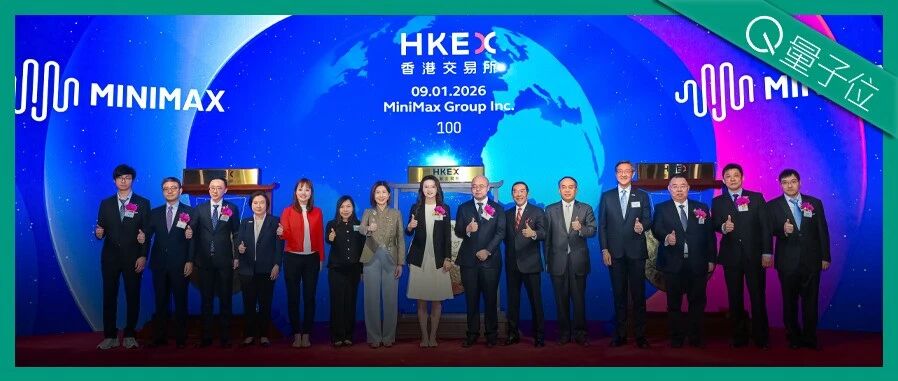
Core Viewpoint - MiniMax has successfully completed its IPO on the Hong Kong Stock Exchange, raising approximately 55.4 billion HKD (around 49.65 billion RMB) with a strong market response, including a 1837 times oversubscription in the public offering and 37 times in the international offering [4][5][45]. Group 1: IPO Details - MiniMax's IPO involved the issuance of approximately 33.58 million shares at a maximum price of 165 HKD per share, with a total fundraising amount of about 55.4 billion HKD [4]. - The stock code "00100" reflects the company's name, where "0" represents "Mini" and "100" corresponds to "Max" in binary, symbolizing the minimum solution that meets the conditions [2]. - The stock experienced significant price increases post-IPO, reaching a peak of 299 HKD per share, representing an over 80% increase [7]. Group 2: Company Background and Strategy - Founded less than four years ago, MiniMax has attracted significant investments from notable institutions, raising over 1.5 billion USD in total [7]. - The company emphasizes "extreme efficiency" and has developed a dual business model targeting both B2B and B2C markets, with a user base exceeding 210 million [17][19]. - MiniMax's strategic focus is on achieving AGI (Artificial General Intelligence) through a full-modal approach, integrating voice, video, and text capabilities [10][22]. Group 3: Technological Advancements - MiniMax has made significant breakthroughs in various AI modalities, including achieving industry-leading performance in real-time speech interaction and video generation [13][14]. - The M2.1 model has excelled in coding tasks and multi-language logical reasoning, enhancing productivity in real-world applications [15]. - The company's full-modal strategy allows it to leverage vast amounts of video and audio data, addressing the "data exhaustion crisis" faced by many AI firms [26]. Group 4: Organizational Efficiency - MiniMax's organizational structure is designed for high efficiency, with over 80% of its code generated by AI, allowing for a significant reduction in marginal costs [33][34]. - The company maintains a flat organizational hierarchy with a youthful workforce, where 73.8% of employees are in R&D roles, averaging 29 years of age [36]. - This innovative structure has enabled MiniMax to achieve a competitive R&D efficiency, spending approximately 500 million USD, which is only 1% of OpenAI's expenditure during the same period [38]. Group 5: Market Position and Future Outlook - MiniMax's successful IPO and the strong interest from institutional investors reflect a market recognition of its technological barriers and engineering efficiency [29][45]. - The company aims to continue its rapid growth over the next four years, emphasizing the importance of attracting top talent to maintain its competitive edge in the evolving AI landscape [46][49]. - The focus on scalability and the ability to convert resources into intelligence will be critical for MiniMax's long-term success in the AGI race [44][50].
沪指突破4100点,AI应用、商业航天活跃,恒指震荡走高,大模型企业MiniMax上市首日涨超50%,商品期货大面积下跌
Sou Hu Cai Jing· 2026-01-09 02:15
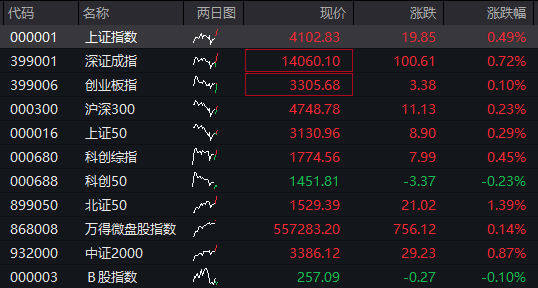
Market Overview - A-shares experienced a rebound, with the Shanghai Composite Index surpassing 4100 points, marking the highest level since July 2015. The ChiNext Index initially fell nearly 1% but turned positive later. AI application sectors showed strong activity, and commercial aerospace stocks gained momentum [1] - Hong Kong stocks saw a slight increase, with tech stocks recovering. The debut of MiniMax saw its shares rise over 50% on the first trading day [1][11] A-shares Performance - As of the latest update, the Shanghai Composite Index rose by 0.49% to 4102.83, the Shenzhen Component Index increased by 0.72% to 14060.10, and the ChiNext Index saw a minor rise of 0.10% to 3305.68 [1] - The performance of major indices includes: - Shanghai Composite Index: 4102.83 (+0.49%) - Shenzhen Component Index: 14060.10 (+0.72%) - ChiNext Index: 3305.68 (+0.10%) [1] Hong Kong Market Performance - The Hang Seng Index rose by 0.27% to 26219.99, while the Hang Seng Tech Index increased by 0.33% to 5697.03 [2][3] - Notable movements in tech stocks included Alibaba and JD Group rising over 3%, while Bilibili and Tencent Music increased by over 2% [11] Bond Market - The bond market saw a decline, with government bond futures dropping across the board. The 30-year main contract fell by 0.23%, the 10-year contract decreased by 0.05%, and the 5-year contract dropped by 0.07% [3][4] Commodity Market - Domestic commodity futures experienced widespread declines, with polysilicon dropping over 9% and nickel falling over 4%. Other metals like silver, copper, and aluminum also saw declines of over 2% [4][5] - In contrast, low-sulfur fuel oil rose over 3%, and SC crude oil increased by over 2% [5] AI and Commercial Aerospace Sectors - The AI application sector remained active, with companies like Inertia Media and Yidian Tianxia seeing gains of over 10%. Other notable performers included Bo Rui Media and Blue Light Marker [6][9] - The commercial aerospace sector also showed strong activity, with stocks like Luxin Investment and Hangxiao Steel Structure hitting the daily limit, and companies like Xinke Mobile and Shaoyang Hydraulic rising over 10% [9][10]
核心机会在中盘蓝筹!东方证券黄燕铭最新观点出炉
券商中国· 2026-01-08 23:29
Core Viewpoint - The A-share market is expected to experience a "sideways fluctuation with slight strengthening" in the first half of 2026, with core opportunities focusing on mid-cap blue chips, particularly in the cyclical (chemicals, non-ferrous) and manufacturing (new energy, robotics) sectors [2][3][4]. Market Outlook - The market is currently in an adjustment phase following the bull market of 2025, requiring three key tasks: transitioning from old to new driving forces, switching market hotspots to find new breakthrough directions, and redistributing stock chips to form a trading foundation [3]. - The previous bull market was driven by rising expectations rather than improvements in the real economy, indicating a need to return to observing the real economy for new expectations to form [3][4]. Investment Strategy - The focus for investment should be on mid-cap blue chips, which are characterized by moderate risk, solid performance, and potential for growth. Key sectors include cyclical industries (chemicals, non-ferrous) and manufacturing (new energy, robotics) [4][5]. - The market has shown a polarization trend from April 2023 to November 2025, with funds either flowing into low-risk, high-dividend stocks or chasing high-risk, high-growth tech stocks. This trend is beginning to change, indicating a return of risk appetite towards mid-cap blue chips [4][5]. Sector Insights - In the technology sector, while it remains a long-term focus, a short-term correction is necessary due to previous rapid increases in stock prices [6]. - The A-share market's selection strategy has shifted from performance-based to style-based, focusing on factors like EPS, ROE, and growth potential [6]. Economic Context - The macroeconomic environment is expected to show a "front low, back high" trend in GDP growth, estimated between 4.5% and 5.0% for the first half of 2026, with support from consumption, investment, and exports [7]. - The geopolitical landscape, particularly the U.S.-China dynamics, is anticipated to influence market stability and investment flows, with China positioned as a relatively stable market amid global uncertainties [7]. Industry Opportunities - In the AI sector, there is a genuine and sustained demand for domestic AI solutions, with a focus on advanced processing and chip technologies [8]. - The copper market is expected to see continued price increases due to strong demand and supply shortages, while lithium carbonate is projected to remain tight in supply [8][9]. - The new energy sector is focusing on storage, lithium battery materials, nuclear fusion, and solid-state batteries, with significant growth anticipated in storage solutions [8]. - The robotics industry is transitioning to a mid-stage focus, with key components like joint assemblies and dexterous hands being highlighted as important areas for investment [9].


德意志银行邓智杰:2026年AI、高科技或继续主导股市走势
2 1 Shi Ji Jing Ji Bao Dao· 2026-01-08 10:50
Group 1 - The core viewpoint of the article highlights the increasing interest of domestic and foreign investors in Chinese assets, with expectations for emerging markets to benefit from a "weak dollar environment" and a desire for broader diversification in global investment portfolios [2][3] - Deutsche Bank's Chief Investment Officer for Emerging Markets, Deng Zhijie, predicts that after a valuation recovery in 2025, the Chinese capital market is expected to continue performing positively in 2026, driven by structural opportunities in sectors like new energy, photovoltaics, robotics, automation, and high-end manufacturing [2][3][4] - The article emphasizes the importance of maintaining a diversified investment portfolio to reduce risk and enhance returns, especially in the context of ongoing global market volatility and geopolitical uncertainties [3][4] Group 2 - In 2025, many investors began to shift their focus from high-valued developed markets to lower-valued emerging markets, with China showing strong performance compared to expectations, while India's market underperformed [4][5] - The article notes that the investment landscape has been significantly influenced by AI and high-tech sectors, which are expected to continue their upward trend into 2026, with a strong belief in the sustainability of AI investments compared to the tech bubble of the early 2000s [5][11] - The article discusses the resilience of emerging markets, emphasizing the need for robust domestic economic policies to support consumption and growth, particularly in countries like India and China [7][8] Group 3 - There is a notable increase in foreign investment interest in Chinese assets, driven by the realization of the volatility associated with concentrated investments in U.S. assets, leading to a desire for diversification [8][9] - The "14th Five-Year Plan" suggests a steady expansion of institutional openness in China, which is expected to enhance the attractiveness of the Chinese market for foreign investors through improved access and investment opportunities [9][10] - The article highlights the ongoing importance of gold as a safe-haven asset, with expectations for its price to continue rising due to persistent geopolitical uncertainties and central banks reducing their dollar holdings in favor of gold [10][11] Group 4 - The AI industry and related sectors, as well as the banking sector, are identified as key areas of focus for investors in 2026, with expectations of benefiting from economic growth and supportive fiscal and monetary policies [11][12][13] - The banking sector is anticipated to perform well due to favorable macroeconomic conditions, including higher long-term bond yields and the potential for interest rate cuts, which could support bank profitability [12][13]
4年半亏了165亿,百亿基金经理被告上法庭
Xin Lang Cai Jing· 2026-01-08 10:40
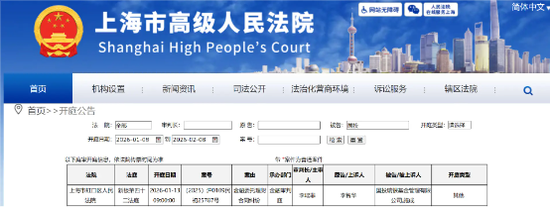
Core Viewpoint - The upcoming court case involving investor Li Zhihua suing Guotou Ruijin Fund and its star fund manager Shi Cheng highlights significant concerns regarding fund management practices and the responsibilities of fund managers in adhering to investment contracts [1][3][12] Group 1: Legal Case and Allegations - The case is centered around a "financial entrusted management contract dispute," which is notable as it includes the fund manager as a co-defendant, a rare occurrence in the industry [3][13] - Key points of contention are expected to focus on whether the suitability obligations were adequately fulfilled and whether the fund manager significantly deviated from the agreed investment style [4][14] - The Guotou Ruijin New Energy Fund, managed by Shi Cheng, is alleged to have strayed from its contractual commitment to invest at least 80% in new energy themes, with current holdings in this area dropping to 5.95% as of Q3 2025 [4][14] Group 2: Performance and Investment Strategy - Shi Cheng's investment strategy has shifted dramatically, moving from a focus on new energy to sectors like AI and robotics, which has raised questions about the appropriateness of this "style drift" [5][16] - Despite the significant shift in investment focus, the fund achieved a return of 72.24% in 2025, contrasting sharply with its previous three years of losses in the new energy sector [4][10] - The performance of the Guotou Ruijin New Energy Mixed A fund has been poor, with returns of -27.89%, -33.39%, and -16.62% from 2022 to 2024 [9][18] Group 3: Industry Implications - The case serves as a warning for the industry regarding the boundaries of fund managers' "diligence and responsibility," particularly in relation to adhering to investment mandates [12][21] - The recent issuance of the "Theme Investment Style Management Guidelines" by the fund industry association aims to curb style drift, making the outcome of this case particularly significant for future compliance standards [12][21] - Guotou Ruijin Fund has shifted its focus towards fixed-income products, with over 85% of its portfolio in this area by 2024, reflecting a broader trend in the industry amid declining performance in equity funds [11][20]
“时光骏驰行 骧首赴新程”——浦银安盛基金2026年度投资投资策略会成功举办
Xin Lang Cai Jing· 2026-01-08 09:07
Core Insights - The investment landscape in 2025 has seen significant changes, with Chinese technology leading equity gains and the Shanghai Composite Index surpassing 4000 points for the first time in a decade [1][9] - Long-term capital, including insurance funds, is entering the market, enhancing value investment opportunities [1][9] - The trend of index-based investment is rising, with index funds becoming a primary tool for market allocation [1][9] - The complexity of bond investments is increasing, prompting a broader asset allocation strategy [1][9] Policy and Economic Outlook - The 20th National Congress and the Central Economic Work Conference have set a framework for the "14th Five-Year Plan," indicating a proactive fiscal and monetary policy for 2026 [2][10] - The fiscal policy is expected to maintain necessary deficits, while monetary policy will focus on flexibility and efficiency, likely continuing a low-interest-rate environment [2][10] - The equity risk premium (ERP) has decreased from 90% to around 50% since April 2025, indicating that equity assets still have upward potential [2][10] Market Structure and Capital Flow - The capital market's institutional framework has strengthened since 2025, supporting long-term investment policies and enhancing market stability [3][11] - The acceleration of medium to long-term capital inflows is anticipated, fostering a friendly policy environment for the capital market [3][11] Sector-Specific Insights - The technology sector has gained significant attention, with notable events highlighting China's advancements in technology and innovation [4][12] - The AI industry is expected to drive market growth, with a focus on performance and profitability of major tech companies [5][12] - The domestic innovative pharmaceutical sector has seen rapid growth, with 76 new drugs approved in 2025 and record-high licensing deals exceeding $130 billion [5][12] Multi-Asset Investment Strategy - The investment strategy is shifting towards a broader multi-asset approach, utilizing FOF strategies and index investment tools [6][13] - The outlook for global risk assets is positive, with expectations of a "slow bull" market in domestic equities and rising prices for major commodities [6][13] - Index funds are increasingly becoming a vital tool for multi-asset allocation, with a focus on structural opportunities in A-shares and Hong Kong stocks [6][14] Future Development Plans - The company aims to advance its three major business strategies: "Global Tech Innovators," "Index Specialists," and "Fixed Income Experts," to establish itself as a multi-asset management expert [7][14]