
商业银行

Search documents
LSEG:2025年前三季度中国大陆企业全球IPO总额达155亿美元 同比增长83%
智通财经网· 2025-10-30 06:35
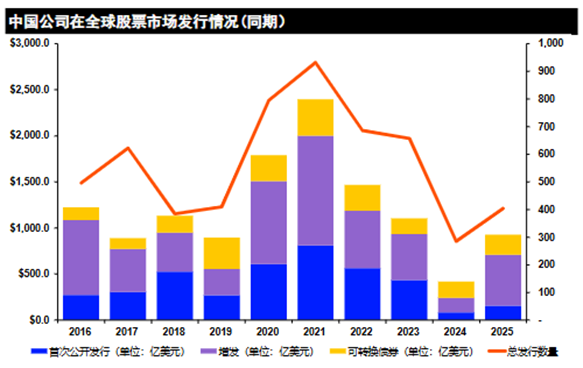
Key Insights - The total financing amount raised by companies in mainland China in the global capital markets reached $92.62 billion in the first three quarters of 2025, representing a year-on-year increase of 120% and a quarter-on-quarter increase of 11% [1] - The number of issuances increased by 42% compared to the same period in 2024, totaling 404 transactions, with a quarter-on-quarter growth of 16% in Q3 2025 [1] - The total amount raised from Initial Public Offerings (IPOs) was $15.5 billion, marking an 83% year-on-year increase and a 47% quarter-on-quarter increase [1] - The total amount raised from follow-on offerings reached $55.32 billion, showing a significant year-on-year increase of 250%, although it decreased by 6% quarter-on-quarter [1] - The issuance of convertible bonds and equity-linked securities totaled $21.8 billion, reflecting a 23% year-on-year increase and a 39% quarter-on-quarter increase [1] Industry Performance - The industrial sector led the market with a 23% share, raising a total of $21.09 billion, which is a 98% increase compared to the same period last year [3] - Following the industrial sector, the high-tech, energy and power, healthcare, and telecommunications sectors also contributed significantly to the capital raised [3] Underwriter Rankings - Morgan Stanley ranked first among underwriters for Chinese stocks and equity-linked securities in 2025 [4] - CITIC Securities and Gao Hua ranked second and third, respectively, with total underwriting amounts of $10.43 billion and $9.47 billion [5] Legal Advisory Rankings - Jingtian & Gongcheng ranked first among legal advisors for Chinese stock and equity-linked issuers [5] - In the underwriting legal advisor rankings, Jingtian & Gongcheng also held the top position [6] Bond Market Insights - The issuance of RMB bonds increased by 23% year-on-year, while the issuance of Panda bonds decreased by 18% compared to 2024 [8] - Government and institutional bond issuances accounted for approximately 12.1 trillion RMB, representing 52% of the market share, with a year-on-year growth of 32% [10] - CITIC led the RMB bond underwriting rankings, while the Bank of China ranked first in Panda bond underwriting [12] Syndicated Loan Market - The Bank of China led the syndicated and club loan rankings across all currencies, with a total amount of 22.065 billion RMB, holding a market share of 43.3% [16] - The overall syndicated loan market saw a significant decline, with a 51% decrease in loan amounts compared to the previous year [16]

每分钟1人死于高温!《柳叶刀》报告揭气候危机已成健康浩劫
Xin Lang Cai Jing· 2025-10-29 06:58
Core Insights - Extreme weather events, including heatwaves, heavy rainfall, floods, and droughts, are becoming the new normal globally, significantly threatening human health and well-being [2] - The 2025 report from UCL and WHO indicates that global temperature rise leads to approximately one death per minute from heat-related diseases, with an average of 546,000 deaths annually from 2012 to 2021 [2] - The report criticizes the U.S. for its climate commitments, particularly after former President Trump withdrew from climate agreements, exacerbating the health impacts of climate change [2] Group 1 - The top 100 fossil fuel companies have raised their production forecasts, potentially tripling CO2 emissions beyond the Paris Agreement's 1.5°C target [3] - In 2024, commercial banks are projected to invest a record $611 billion in the fossil fuel sector, compared to $532 billion in green sectors [3] - Governments are providing $2.5 billion daily in direct subsidies to fossil fuel companies, while extreme heat is causing significant economic losses due to reduced labor capacity [3] Group 2 - The average global exposure to lethal heat has increased, with individuals facing 19 days per year of extreme heat, 16 of which are attributed to human-induced climate change [3] - In 2024, extreme heat is expected to result in a loss of 639 billion hours of labor, with the least developed countries experiencing economic losses equivalent to 6% of their GDP [3] - Air pollution from fossil fuel combustion is responsible for millions of deaths annually, and the dry climate is contributing to wildfires, with smoke-related deaths projected to reach 154,000 in 2024 [3] Group 3 - The CEO of ClientEarth emphasizes that humanity is in an era of "climate consequences," shifting the focus from "if" to "when" accountability for climate impacts will occur [4] - There is a call for an immediate end to fossil fuel subsidies and increased investment in clean energy to safeguard future health [5]

南京银行(601009):2025年三季报点评:利息净收入大幅增长29%,个人贷款不良率环比下降10bp
GUOTAI HAITONG SECURITIES· 2025-10-28 12:09
Investment Rating - The report maintains a "Buy" rating for Nanjing Bank with a target price of 13.40 CNY [2][6]. Core Insights - Nanjing Bank is experiencing strong asset expansion and improved interest margins, which significantly support its performance. The volatility in the bond market has limited impact, and profitability continues to enhance [2]. - The bank's net interest income has increased by 29%, and the non-performing loan ratio for personal loans has decreased by 10 basis points [1]. Financial Summary - **Revenue and Profit Forecasts**: - Revenue is projected to grow from 45,160 million CNY in 2023 to 61,488 million CNY by 2027, with a CAGR of approximately 7.9% [4]. - Net profit attributable to the parent company is expected to rise from 18,502 million CNY in 2023 to 27,456 million CNY in 2027, reflecting a CAGR of about 11.5% [4]. - **Key Financial Ratios**: - The bank's net asset value per share is forecasted to increase from 13.34 CNY in 2023 to 17.81 CNY in 2027 [4]. - The return on equity (ROE) is expected to stabilize around 11.2% by 2027 [4]. Performance Metrics - **Interest Income**: - Net interest income growth is projected at 28.52%, significantly supporting overall performance [12]. - **Fee Income**: - Net fee and commission income is expected to grow by 8.52%, with notable performance in agency commissions, which increased by 47.2% year-on-year [12]. - **Cost Efficiency**: - The cost-to-income ratio has improved, decreasing by 2.0 percentage points to 23.27% [12]. Asset Quality - As of Q3 2025, the non-performing loan ratio stands at 0.83%, with a marginal improvement in retail asset quality [12]. - The bank's provisioning coverage ratio is reported at 313.22%, indicating a strong buffer against potential loan losses [12].

美股开盘三大股指集体高开
Xin Lang Cai Jing· 2025-10-15 14:06
Core Points - The U.S. stock market opened with all three major indices rising, with the Dow Jones up 0.4%, S&P 500 up 0.7%, and Nasdaq up 1.0% [1] Company Performance - Morgan Stanley's Q3 net revenue exceeded expectations, resulting in a 4.4% increase in stock price [1] - Bank of America's Q3 performance also surpassed expectations, leading to a 4.1% rise in its stock [1] - Dollar Tree's stock rose by 4.9%, with a forecast of 12-15% annual growth in earnings per share over the next three years [1] - ASML's stock increased by 5.0% after reporting Q3 net profit above expectations and forecasting strong performance for the next year [1]


瑞银财富管理吕子杰,最新发声
Zhong Guo Ji Jin Bao· 2025-10-12 12:33
Core Viewpoint - UBS Wealth Management emphasizes the importance of being a "super connector" between Chinese and global entrepreneurs, leveraging its extensive experience and network to facilitate wealth management and investment opportunities [1][4]. Group 1: Wealth Management Strategy - UBS has over 160 years of history, focusing on wealth management, which accounts for over 50% of its total revenue [3]. - The firm adopts a "banking integration" strategy, where it first establishes long-term relationships with entrepreneurs, then extends services to investment banking and asset management as their needs grow [3][4]. - UBS has been active in the Chinese market for over 35 years, with a strong presence in Hong Kong and the broader Asia-Pacific region for over 60 years [3]. Group 2: Family Wealth Management - Many overseas families view family offices as a "school" for nurturing the next generation, with younger family members increasingly interested in entrepreneurship rather than traditional family businesses [6]. - Family offices are also seen as platforms for social impact, with younger generations preferring to invest in socially valuable projects rather than merely donating [6]. - The core demand from high-net-worth clients in China is shifting towards stability and diversification, with a growing interest in alternative investments such as private equity and hedge funds [6]. Group 3: Opportunities in the Greater Bay Area - UBS manages one-third of its assets in the Greater Bay Area, highlighting its significance to the firm [8]. - The number of trips between Hong Kong and cities in the Greater Bay Area has increased by 25% compared to last year, with related meetings rising by over 20% [8]. - The firm plans to relocate its Hong Kong office to a more efficient location by the end of 2026, enhancing its service capabilities for clients in the Greater Bay Area [9].

瑞银财富管理吕子杰,最新发声
中国基金报· 2025-10-12 12:19
Core Insights - UBS Wealth Management emphasizes the importance of being a "super connector" between Chinese and global entrepreneurs, leveraging its extensive experience and network to facilitate wealth management and investment opportunities [2][7]. Group 1: Wealth Management Strategy - UBS has over 160 years of history, focusing on wealth management, which constitutes over 50% of its total revenue [6]. - The firm adopts a "banking integration" strategy, where it first establishes long-term relationships with entrepreneurs, then extends services to investment banking and asset management as their needs evolve [6][7]. - UBS has been active in the Chinese market for over 35 years, with a strong presence in Hong Kong and the broader Asia-Pacific region [6]. Group 2: Family Wealth Management - Many overseas families view family offices as a "school" for nurturing the next generation, with younger family members increasingly interested in entrepreneurship rather than traditional family businesses [9]. - Family offices are also seen as platforms for social impact, with younger generations preferring to invest in projects that create social value rather than merely donating [9]. - Current high-net-worth clients in China are maturing and becoming more rational, focusing on "stability" and diversifying investments into alternatives like private equity and hedge funds [9]. Group 3: Opportunities in the Greater Bay Area - UBS manages one-third of its assets in the Greater Bay Area, highlighting its significance to the firm [11]. - The number of trips between Hong Kong and cities in the Greater Bay Area has increased by 25% compared to last year, with related meetings up by over 20% [12]. - UBS plans to relocate its Hong Kong office to a more strategic location by the end of 2026, enhancing its ability to serve clients in the Greater Bay Area [12].

金工定期报告20250902:预期高股息组合跟踪
Soochow Securities· 2025-09-02 09:04
Quantitative Models and Construction Methods - **Model Name**: Expected High Dividend Portfolio **Model Construction Idea**: The model aims to construct a portfolio with high expected dividend yield by leveraging historical dividend data, fundamental indicators, and short-term factors like reversal and profitability[5][10][16] **Model Construction Process**: 1. **Dividend Yield Calculation**: - Phase 1: Calculate dividend yield based on annual report profit distribution announcements - Phase 2: Predict and calculate dividend yield using historical dividend data and fundamental indicators[5][10] 2. **Screening Process**: - Exclude suspended and limit-up stocks from the CSI 300 constituents[15] - Remove the top 20% of stocks with the highest short-term momentum (21-day cumulative return)[15] - Exclude stocks with declining profitability (quarterly net profit YoY growth < 0)[15] 3. **Final Selection**: - Rank the remaining stocks by expected dividend yield - Select the top 30 stocks with the highest expected dividend yield and construct an equally weighted portfolio[11] **Model Evaluation**: The model demonstrates strong historical performance with significant excess returns and controlled drawdowns, making it a robust strategy for high-dividend stock selection[13] Model Backtesting Results - **Expected High Dividend Portfolio**: - Cumulative Return: 358.90% - Cumulative Excess Return (vs CSI 300 Total Return Index): 107.44% - Annualized Excess Return: 8.87% - Maximum Rolling 1-Year Drawdown of Excess Return: 12.26% - Monthly Excess Win Rate: 60.19%[13] Quantitative Factors and Construction Methods - **Factor Name**: Expected Dividend Yield Factor **Factor Construction Idea**: Predict future dividend yield by combining historical dividend data, fundamental indicators, and short-term influencing factors[5][16] **Factor Construction Process**: 1. Calculate historical dividend yield based on profit distribution announcements[5][10] 2. Predict future dividend yield using fundamental indicators and historical dividend patterns[5][10] 3. Incorporate two short-term factors: - **Reversal Factor**: Accounts for short-term price reversals - **Profitability Factor**: Reflects the company's earnings performance[5][16] **Factor Evaluation**: The factor effectively identifies high-dividend stocks and serves as a reliable input for portfolio construction[16] - **Factor Name**: Red Dividend Timing Framework (Composite Signal) **Factor Construction Idea**: Combines multiple single-factor signals to assess the market's outlook on dividend stocks[25][28] **Factor Construction Process**: 1. Evaluate five single-factor signals: - **Inflation**: PPI YoY (High/Low) - **Liquidity**: M2 YoY (High/Low) - **M1-M2 Gap**: Scissors Difference (High/Low) - **Interest Rate**: US 10-Year Treasury Yield (High/Low) - **Market Sentiment**: Dividend Stock Turnover Ratio (Up/Down)[28] 2. Assign binary signals (1 for bullish, 0 for bearish) to each factor 3. Aggregate the signals into a composite indicator[28] **Factor Evaluation**: The framework provides a systematic approach to timing dividend stock investments, though the September 2025 signal suggests a cautious stance[25][28] Factor Backtesting Results - **Expected Dividend Yield Factor**: - August 2025 Portfolio Average Return: 5.69% - Excess Return (vs CSI 300 Index): -4.80% - Excess Return (vs CSI Dividend Index): +4.70%[5][16] - **Red Dividend Timing Framework (Composite Signal)**: - Latest Signal (September 2025): 0 (Neutral)[25][28]






【环球财经】特朗普“罢免”理事 美联储“独立性”受质疑
Xin Hua She· 2025-08-26 15:20
Core Viewpoint - The dismissal of Federal Reserve Board member Lisa Cook by President Trump marks an unprecedented attack on the independence of the Federal Reserve, escalating pressure on monetary policy decisions [1][2]. Group 1: Impact on Federal Reserve Independence - Trump's action is seen as a direct assault on the Federal Reserve's independence, with market analysts suggesting it could increase uncertainty regarding future policy directions [1]. - Edward Mills from Raymond James highlighted that this move signifies the White House's growing pressure on monetary policy [1]. - David Zervos from Jefferies Group argued that the Federal Reserve has never been truly independent and has faced increasing political pressure over the years [1]. Group 2: Market Reactions - Following the news of Cook's dismissal, spot gold prices reached a two-week high, while the U.S. dollar index experienced a temporary decline [1]. Group 3: Responses from Key Figures - Lisa Cook responded to her dismissal by stating that there was no legal basis for Trump's claims and that she would continue her role in supporting the U.S. economy [3]. - Zervos noted that Fed Chair Jerome Powell has resisted many "outrageous" policy calls during Biden's presidency but failed to address fiscal issues during a critical period of rising government spending [2].
重庆银行(601963):区域动能强劲,扩表提速、风险趋良
GUOTAI HAITONG SECURITIES· 2025-08-26 11:16
Investment Rating - The report maintains a "Buy" rating for Chongqing Bank with a target price of 12.30 CNY [6][2] Core Views - Chongqing Bank's revenue and net profit attributable to shareholders showed a slight increase compared to Q1 2025, with asset quality continuing to improve. The bank benefits from strong regional dynamics and robust credit demand, supported by strategic initiatives in the Chengdu-Chongqing economic circle and other major projects [2][13] - The bank's management is actively enhancing pricing management and asset quality, leading to an upward cycle in profitability. The expected net profit growth rates for 2025-2027 are adjusted to 5.5%, 8.9%, and 9.0% respectively [13][2] Financial Summary - Revenue for 2023 is projected at 13,211 million CNY, with a growth forecast of 3.5% for 2024 and 7.0% for 2025 [4] - Net profit attributable to shareholders is expected to reach 4,930 million CNY in 2023, with growth rates of 3.8% in 2024 and 5.5% in 2025 [4] - The bank's net asset value per share is projected to be 14.37 CNY in 2023, increasing to 16.41 CNY by 2025 [4] Asset and Liability Overview - Total assets are expected to reach 856,642 million CNY in 2023, with a significant increase anticipated in subsequent years [8] - The bank's loan total is projected to be 438,295 million CNY in 2023, with a steady growth trajectory [8] - The core Tier 1 capital adequacy ratio is reported at 13.36%, indicating a strong capital position to support future growth [8] Performance Metrics - The bank's net interest margin for the first half of 2025 is reported at 1.39%, showing a slight recovery compared to the previous year [15] - The non-performing loan ratio decreased to 1.17% by the end of Q2 2025, reflecting improved asset quality [15] - The bank's profitability indicators, such as return on equity (ROE) and return on assets (ROA), are projected to remain stable, with ROE at 9.14% for 2025 [14]

“股牛”已至,未来如何演绎?
2025-08-18 01:00
Summary of Conference Call Records Industry or Company Involved - The discussion primarily revolves around the Chinese stock market, macroeconomic policies, and the impact of U.S.-China relations on investment strategies. Core Points and Arguments 1. **Market Confidence and Economic Transition** - China adopts a non-concessional strategy while the U.S. gradually concedes, leading to a gradual establishment of market confidence. The economy is transitioning away from real estate dependency towards manufacturing and high-tech industries, fostering optimism about future economic growth models [1][2] 2. **Stock Market Outlook** - The current stock market is characterized as a structural slow bull market, driven by two macro factors: U.S.-China relations and economic restructuring. The focus should be on dividend assets in the context of U.S.-China confrontation and technology assets in the context of cooperation [2][10] 3. **Bond Market Characteristics** - The bond market does not exhibit bear market characteristics despite stock market gains. A phase adjustment is normal due to prior accumulated gains, with interest rates at low levels and a long-term downward trend expected [3] 4. **Monetary Policy Direction** - The central bank's second-quarter monetary policy report emphasizes stabilizing employment, maintaining economic growth, and promoting reasonable price recovery, indicating a loosening monetary policy direction [4] 5. **Macro-Prudential Management** - Focus on financial stability and prevention of systemic financial risks is crucial. Non-bank institutions are now included in the assessment of systemically important financial institutions, enhancing oversight [5] 6. **Central Bank Re-lending Support** - The central bank's re-lending support focuses on inclusive finance, green projects, and technology, with a balance of 3.8 trillion yuan. The loan growth rate for the elderly care industry is the highest, reflecting changes in credit allocation due to economic restructuring [6] 7. **Financial Support for Technological Innovation** - Financial support for technology innovation is vital, involving various stakeholders such as financial institutions and private equity firms, which help leverage more equity capital for future fundraising [7][8] 8. **Financial Stability Risk Prevention Tools** - Various tools for assessing financial stability risks include equity pledge financing and liquidity management for public funds, which help mitigate systemic risks [9] 9. **U.S.-China Trade Relations** - Recent developments in U.S.-China trade relations include a 90-day extension of a 24% reciprocal tariff suspension, with expectations for a meeting between leaders at the APEC conference. This has improved market risk appetite [11][12] 10. **Potential Risks in U.S.-China Negotiations** - China faces risks from U.S. negotiation tactics, particularly regarding secondary tariffs on energy, which could extend to other countries, including China [14] 11. **U.S. Tariff Policy Changes** - The U.S. has announced significant tariffs on copper and semiconductors, with potential expansions to other industries, which could impact market dynamics [15][16] 12. **Potential Sanction Risks in Financial Sector** - Risks of sanctions primarily affect Chinese concept stocks, although the actual impact is expected to be limited due to preparations for domestic companies to return [17] 13. **Federal Reserve Decision-Making Adjustments** - The Federal Reserve is expected to announce the cancellation of the average inflation target at the 2025 Jackson Hole meeting, although the marginal impact is considered minimal [18] 14. **U.S. Treasury Financing Report Highlights** - The U.S. Treasury plans to replenish the TGA account to $850 billion, which may lead to a liquidity siphoning effect and increased volatility in overseas markets, affecting A-share risk appetite [19] 15. **Importance of Bank Reserves** - The U.S. banking system's reserve ratio must maintain at least 9% of GDP. A potential drop in reserves due to TGA withdrawals could impact market stability, necessitating close monitoring of liquidity conditions [20] Other Important but Possibly Overlooked Content - The emphasis on macro-prudential management and the inclusion of non-bank institutions in systemic risk assessments highlight a shift towards a more comprehensive approach to financial stability [5] - The ongoing transition in credit allocation towards sectors like elderly care and green finance reflects broader economic restructuring trends [6]