
消费品

Search documents
专访粤开证券罗志恒:加大国资收益上缴,用于提高居民养老金
Nan Fang Du Shi Bao· 2026-01-25 04:49
Group 1 - The core focus of the article is on China's economic outlook for 2026, emphasizing the importance of "resident income increase" and "investment in people" as key strategies to boost domestic demand and enhance economic growth [2][7] - The article highlights that in 2025, China's economy is expected to surpass 140 trillion yuan, with a growth rate of 5%, driven by strong exports, a robust capital market, and ongoing structural optimization [5][6] - It notes that the real estate market is still undergoing significant adjustments, with a projected 17.2% decline in real estate investment in 2025, indicating challenges in the housing sector [6] Group 2 - The article discusses the need for income distribution reform to address weak consumer demand, suggesting measures such as establishing a "special fund for urban and rural resident income increase" and adjusting pension policies to improve income for low-income groups [8][9] - It emphasizes the importance of "investment in people" to enhance human capital, advocating for increased public service investment and improved access to education and training [10][11] - The article outlines the expected continuation of the A-share bull market in 2026, driven by macroeconomic policies, industry transformation, and capital market reforms, with a focus on technology and industrial metals as key investment opportunities [12][13]

尼尔森IQ:2026中国消费者趋势前瞻报告
Sou Hu Cai Jing· 2026-01-25 03:49
报告概要 《通往2026:中国消费者趋势前瞻报告》由尼尔森IQ发布,深入剖析了中国消费市场在未来几年的演变路径与核心动力。报告指出,中国经济呈现稳中有 进态势,消费对GDP增长的贡献持续提升,但消费者信心仍需加强。尽管在政策推动下经济逐步复苏,仍有约四成消费者持谨慎支出态度,显示出对个人财 务状况"乐观但审慎"的复杂心态。 当前,中国消费者的核心诉求已从单纯物质满足,转向对"经济繁荣"与"内心幸福"的双重追求,"过好自己的日子"成为普遍心声。在消费行为上,呈现"功 能质量奠基、健康便捷乘势、体验终成归途"三位一体的特征。消费者不仅关注产品基础功能与价格促销,更愿意为健康、便捷及优质体验支付溢价,这标 志着消费决策正向更综合的价值评价体系演进。 报告特别聚焦不同世代的消费差异,描绘出一幅清晰的代际消费图景: 报告预览 婴儿潮一代正从"基础型养老"迈向"享受型养老",乐于为丰富生活体验、科技适老产品买单。品牌需以针对性、专业化产品与其建立信任,赋予其"魅 力化"的晚年生活定义。 X世代作为"务实担当",崇尚精简高效与长期主义。他们青睐品质扎实、回归本质的产品,并注重品牌文化内涵与本土情怀,例如百雀羚的"科技新草 ...
死在黎明前的100个品牌,都有一个不给公关预算的老板
新消费智库· 2026-01-23 13:00
Core Viewpoint - The importance of public relations (PR) in consumer goods companies has surpassed that of direct advertising spending, as neglecting PR can lead to severe brand crises and losses [6][9][32] Group 1: The Shift in Consumer Goods Management - Many consumer goods executives believe that having a good product is sufficient, but this mindset is outdated in the current media environment [2][4] - Companies face rapid backlash from the public due to minor issues, such as packaging or labor disputes, which can lead to significant financial losses [5][9] - The lack of respect for public opinion and inadequate communication strategies can result in catastrophic consequences for brands [5][9] Group 2: Financial Implications of PR - A budget of 10 million yuan in advertising may yield 100 million yuan in gross merchandise value (GMV), but a PR crisis can incur losses far exceeding that amount [7][9] - Direct sales losses from a crisis can include returns, consumer boycotts, and platform delistings, while indirect losses can affect brand trust and employee morale [9] - Investing in PR builds long-term consumer trust, which is more valuable than short-term advertising gains [9][10] Group 3: Media Relations and Budgeting - Many executives mistakenly view media spending as a form of extortion rather than a necessary investment for professional services [10][13] - Proper media investment should focus on reputable outlets that provide in-depth analysis and have a strong audience trust [13][20] - Establishing good relationships with influential media can be crucial during a crisis, as they are more likely to provide fair coverage [22][30] Group 4: The Role of Content in Crisis Management - Long-form media, such as articles on public platforms, can provide deeper analysis and context during crises, unlike short videos that may oversimplify issues [14][15] - Companies should balance their media strategies by using short videos for daily engagement while relying on in-depth articles for brand building and crisis management [16] Group 5: Building Relationships Before Crises - Companies often prioritize immediate sales over building long-term media relationships, which can leave them vulnerable during crises [18][20] - Establishing genuine connections with media and KOLs (Key Opinion Leaders) is essential for effective crisis management [25][26] - Companies should invest time and resources in nurturing these relationships to ensure support during challenging times [21][26] Group 6: Leadership's Role in PR - The involvement of company leadership in PR is critical for understanding media dynamics and ensuring that PR is prioritized within the organization [28][30] - Leaders should elevate PR to a strategic priority, enabling quick decision-making during crises and fostering a culture of awareness among all employees [30][31] - Every employee's actions can impact the brand's reputation, making it essential for leadership to instill a collective responsibility for public relations [31]

报告称2025年中国出国展项目数量延续增长态势
Zhong Guo Xin Wen Wang· 2026-01-23 08:03
Core Insights - The report indicates that the number of outbound exhibition projects from China will continue to grow, with 1,259 projects planned for 2025, covering 57 countries and regions [1] Group 1: Growth in Outbound Exhibitions - In 2025, China will participate in 520 exhibition projects in Asia, representing a year-on-year increase of 16.07% [1] - The number of projects in Africa is expected to reach 59, showing the fastest growth at 31.11% [1] - Latin America and the Caribbean will see 124 projects, with a growth rate of 21.57% [1] Group 2: Stability in Traditional Markets - Traditional markets such as Germany, the United States, and Russia will remain the top three destinations for Chinese outbound exhibitions [1] Group 3: Industry Trends - The number of professional exhibition projects and participating companies from China is expected to increase [1] - The top three industries for outbound exhibitions will be machinery, transportation and logistics, and textiles and apparel [1] - There is a notable increase in participation from consumer goods and hardware tools industries, while new trends are emerging in sectors like renewable energy, healthcare, and automotive parts [1] Group 4: Differentiated Industry Layout - Different industries are focusing on specific countries for exhibitions: machinery and hardware tools are targeting Germany, the U.S., Russia, and Mexico; textiles and consumer goods are focusing on the U.S., Japan, and Europe, as well as markets with demographic advantages like Vietnam and Indonesia [2] - The transportation and logistics, as well as construction and decoration industries, are prioritizing countries with strong logistics hubs or infrastructure needs, such as Turkey, Kazakhstan, and the UAE [2] - High-tech industries like healthcare and information communications are focusing on advanced technology countries, including Germany, the U.S., and Japan [2]
香港IPO惊天翻盘:前3名,全是中国律所!
Xin Lang Cai Jing· 2026-01-23 04:27
来源:法律先生 哪个律所,坐上了2025年香港IPO的头把交椅? 不是魔圈所,也不是白鞋所,而是一家中国律所。 截至2026年1月19日,港交所手里压着331宗仍在排队的IPO申请。 按在手项目量算,竞天公诚以161宗断层领先,几乎是第二名的两倍;金杜约82 宗位列第二;通商紧随其后。 前十名里,只有一家外资所,总部在英国的Clifford Chance(高伟绅律师事务所)。 香港IPO,已经是中资律所的主场,可放在三年前,这几乎是不可想象的画面。 | | 2025年 | 2024年 | A股证券交易所 | 香港联合交易所 20% | | --- | --- | --- | --- | --- | | | | | 15% | | | 第1位 | 香港联合交易所 | 印度国家证券交易所 | (2024:15%) | (2024:10%) | | | 343亿美元 | 203亿美元 | | | | 第2位 | 纽约证券交易所 | 纳斯达克证券交易所 | 2025年 | | | | 203亿美元 | 175亿美元 | | | | | | | | 全球 | | | 纳斯达克证券交易所 | 纽约证券交易所 | | 量资 ...

Wall Street thinks the bull market could go higher, plus Strategy CEO talks bitcoin rally in 2026
Youtube· 2026-01-22 23:52
Group 1: Market Dynamics and AI Influence - The current bull market is characterized by a focus on whether it is primarily driven by a few mega-cap stocks or if broader market participation is occurring [1][6] - The MAG7 companies have significantly outperformed in the past few years due to their advancements in AI capabilities, but the next phase will involve integrating AI across the broader economy [7][8] - The relative strength of the S&P 500 indicates that if the ratio of market cap-weighted to equal-weighted stocks rises, it suggests that larger stocks are dominating the market [5][10] Group 2: Earnings and Economic Outlook - Analysts expect S&P 500 earnings growth to be around 8.2% for the fourth quarter, with potential for it to exceed 14% based on strong fundamentals [14][16] - The economic backdrop is favorable for earnings growth, supported by declining inflation and a robust job market [16] - There is an expectation for a broadening of market participation beyond the top 10 stocks, with cyclical sectors like industrials, retail, and banks likely to benefit from economic growth [12][16] Group 3: Consumer Behavior and Company Performance - Procter & Gamble reported growth outside the U.S., with Latin America growing at 8% and China at 3%, while U.S. growth has been slower due to inventory adjustments [92][94] - The U.S. consumer is currently more cautious, with spending growth in P&G categories between 1% and 2%, which is below the typical growth rate of 3% to 4% [108][111] - The company is focused on innovation and performance to drive category growth back to historical levels [111] Group 4: Tariffs and Economic Headwinds - Tariffs are expected to impact Procter & Gamble's business by approximately $400 million after tax, down from $1 billion earlier in the year [114] - The company has managed tariff exposure through productivity improvements and sourcing changes, indicating a proactive approach to cost management [114][116] - The broader economic environment is facing headwinds from delocalization and tariffs, which are expected to continue affecting growth in 2026 [66][67]


第一财经、应帆科技首发《中国消费品牌智能创新白皮书》
第一财经· 2026-01-21 12:59
1 月 21 日,第一财经、应帆科技正式发布 "2025 中国消费品牌智能创新大调查 " 研究成果,重 磅首发 《 2025 中国消费品牌智能创新白皮书》 ,并同步揭晓 " Growth50·2025 中国消费年度 智能创新领导品牌 " 及各项代表案例,全景式展现中国创新消费新潮。上海广播电视台(上海文广 集团)副台长、副总裁,第一财经党委书记、董事长,应帆科技董事长李蓉表示, " 当前,千行百 业都已进入 ' 智能驱动 ' 阶段,本次大调查为消费品牌的智能创新提供切实的参照系与行动指南, 是第一财经消费生态圈建设的关键举措。 " 2025 中国消费品牌 智能创新大调查 Growth50-2025 中国消费 年度智能创新领导品牌 注:按首字母排序 安克创新 A 安琪 霸王茶姬 B 珀菜雅 波司登 回望过去几年,消费市场数度变迁。应帆科技旗下第一财经商业数据中心( CBNData )作为消费 领域的长期观察者,已连续四年发起 " 中国消费品牌增长力大调查 " ,从新消费元年的 " 看长 " 到震荡时期的 " 向真 " ,从不确定环境下的 " 应变 " 到审视初衷的 " 塑心 " ,持续探寻中国消费 的发展脉络。 ...

我国已启动第二阶段6G技术试验!工信部最新发布会,信息量超大→
证券时报· 2026-01-21 08:00
Core Insights - The article highlights the achievements and future plans of China's industrial and information technology sectors, emphasizing growth in manufacturing, technological innovation, and the development of emerging industries. Group 1: Industrial Growth and Achievements - In 2025, the industrial added value of large-scale industries is expected to grow by 5.9% year-on-year, with the manufacturing sector maintaining a stable GDP share, aiming for 16 consecutive years as the world's largest manufacturing nation [1] - The production of industrial robots increased by 28% year-on-year, while new energy vehicle sales reached 16.49 million units, also up by 28.2% [1] - Investment in emerging fields such as aerospace and equipment manufacturing has shown double-digit growth [1] Group 2: Technological Innovation - The first phase of 6G technology trials has resulted in over 300 key technology reserves, with the second phase recently initiated [1] - 5G and gigabit optical networks have been integrated into 91 out of 97 national economic categories, with industrial internet achieving full coverage across 41 industrial categories [1] Group 3: Future Industry Development - The Ministry of Industry and Information Technology (MIIT) plans to support local governments in developing future industries and increase government investment fund efforts [2] - By 2025, the number of humanoid robot manufacturers in China is expected to exceed 140, with over 330 humanoid robot products released [4] - The digital industry revenue is projected to reach approximately 38.3 trillion yuan by the end of 2025, with profits of 3.1 trillion yuan, marking increases of about 39.5% and 48.4% respectively compared to the end of the 13th Five-Year Plan [5] Group 4: Artificial Intelligence and Employment - The core scale of China's artificial intelligence industry is expected to exceed 1.2 trillion yuan by 2025, with over 6,000 AI companies anticipated [7] - AI has penetrated over 70% of business scenarios in leading smart factories, facilitating the evolution of intelligent manufacturing from automation to autonomy [8] - The MIIT emphasizes the importance of addressing employment restructuring due to technological advancements, advocating for the cultivation of talent that understands both AI and manufacturing [9] Group 5: Consumer Goods and Material Innovation - The consumer goods industry is projected to grow by 3.7% year-on-year in 2025, accounting for 26.1% of all large-scale industries [10] - The MIIT aims to promote coordinated innovation in advanced materials, focusing on key strategic materials and the integration of AI in material development [11]
《2025胡润未来独角兽:全球瞪羚企业榜》发布 三家长沙企业入选
Xin Lang Cai Jing· 2026-01-21 03:07
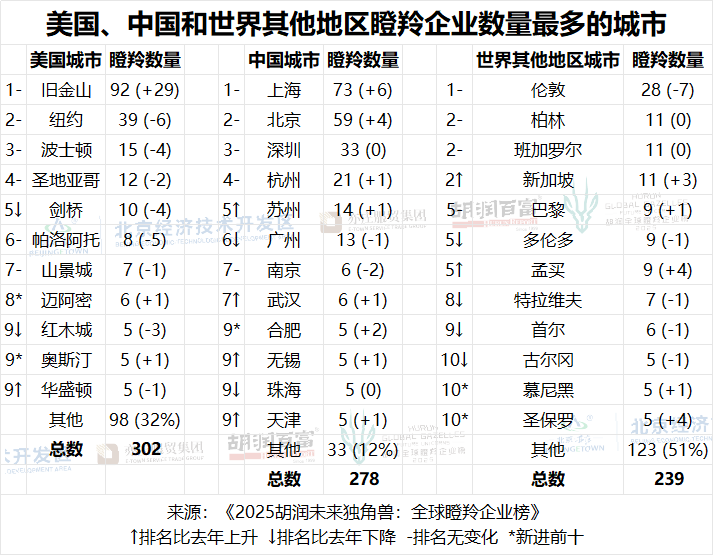
Group 1 - The HuRun Research Institute released the "2025 HuRun Future Unicorn: Global Gazelle Enterprises List," identifying 819 high-growth companies likely to reach a $1 billion valuation by the end of 2028, an increase of 19% from 688 companies two years ago [1] - Among the 819 gazelle companies, 146 upgraded to unicorn status, 42 downgraded, and 613 remained eligible, with 206 new entrants, including 29 in fintech and 28 in artificial intelligence [1][2] - The leading industries for the gazelle companies are biotechnology, fintech, and SaaS, with 63% selling software and services, while 66% target businesses and 34% target consumers [2][3] Group 2 - The distribution of gazelle companies spans 43 countries and 220 cities, with the United States and China leading with 302 and 278 companies, respectively, accounting for 71% of the global total [3] - San Francisco is identified as the global hub for gazelle companies, followed by Shanghai, Beijing, New York, Shenzhen, and London [3] - Three companies from Changsha made the list: VisionBit Robotics (industry: robotics), Sandunhan (industry: food and beverage), and Meimai Technology (industry: consumer goods) [4]
一揽子政策公布后,财政部重磅定调:2026年财政总体支出力度“只增不减”
Hua Xia Shi Bao· 2026-01-20 08:39
Core Viewpoint - The Chinese government is implementing a series of proactive fiscal policies aimed at promoting high-quality economic and social development, with a focus on increasing overall fiscal expenditure and optimizing its structure for better efficiency and stronger economic momentum [2][14]. Fiscal Policy and Expenditure - In 2026, the overall fiscal expenditure will continue to increase, ensuring that the fiscal deficit, total debt scale, and expenditure remain at necessary levels, with a commitment to "only increase, not decrease" [2][14]. - The fiscal deficit rate for 2025 is set at around 4%, an increase of one percentage point from the previous year, with new government debt reaching 11.86 trillion yuan, up by 2.9 trillion yuan from the previous year [3][4]. Debt Management - The government maintains a relatively low debt-to-GDP ratio compared to the average of G20 countries, despite increasing deficits and debt issuance [4]. - In 2025, measures will be taken to replace 2 trillion yuan of hidden debt and allocate 800 billion yuan in new special bonds to support local government finances, thereby reducing the average interest cost of local debts by over 2.5 percentage points [6][7]. Support for Consumption and Investment - A special long-term government bond issuance of 1.3 trillion yuan in 2025 will support consumption and promote the sale of green, low-carbon, and intelligent products, with an expected sales boost of approximately 2.6 trillion yuan [5]. - Policies will be introduced to stimulate consumption through personal consumption loans and support for new consumption models, as well as adjustments to tax refund policies for duty-free shops [5]. Support for SMEs and Innovation - A new loan interest subsidy policy for small and micro enterprises will focus on 14 key industrial chains, including new energy, automotive, and medical equipment [8][9]. - The government will provide risk-sharing funds to support bond issuance for private enterprises and private equity investment institutions, mitigating investor losses [10]. Pension and Social Security - In 2025, the central government will allocate approximately 1.2 trillion yuan for basic pension insurance subsidies, with a 2% increase in pension levels for retirees [11]. Tax System and Market Development - The government aims to improve the local tax system to support the construction of a unified national market, including clarifying fiscal responsibilities and enhancing tax regulations [12]. Technological Innovation and Investment - The government will support the National Venture Capital Guidance Fund to invest in early-stage, small, long-term, and hard technology projects, promoting innovation in key industries [19]. - Financial support will be provided for technology innovation loans, with the central bank offering re-loan support to facilitate the transformation of manufacturing and digitalization of SMEs [20][21]. Export Tax Policy Changes - The cancellation of export tax rebates for solar and electronic products starting April 1, 2026, is expected to promote efficient resource utilization and address "involution" in competition [17].