
财富管理

Search documents
AI淘金热变成AI恐慌潮!华尔街新共识:躲开一切可能被颠覆的公司
Hua Er Jie Jian Wen· 2026-02-11 05:58
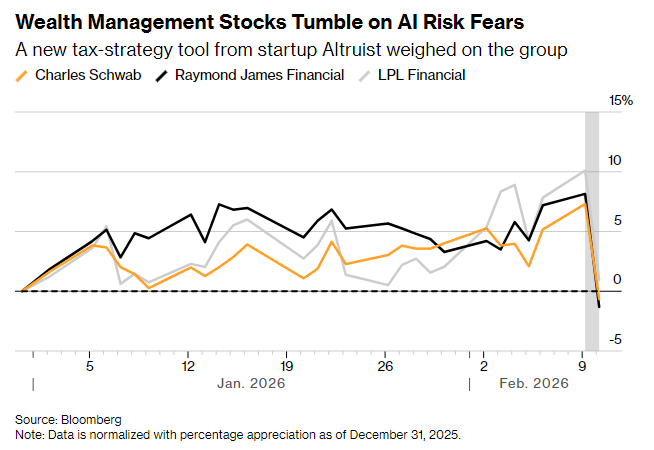
Core Viewpoint - Wall Street is experiencing a significant shift in investment logic, with investors rapidly selling stocks of companies that may be disrupted by AI, leading to widespread panic and sell-offs across various sectors [1][2]. Group 1: Impact on Wealth Management - The recent sell-off was triggered by Altruist Corp.'s launch of the AI tax strategy tool Hazel, which caused major wealth management firms like Charles Schwab and Raymond James to see stock declines of over 7%, marking the largest drop since April [1][2]. - Altruist's CEO Jason Wenk noted that the market reaction was surprising, erasing billions in market value for several investment firms, and emphasized that the architecture used to build Hazel could replace many roles in wealth management that typically require entire teams [2][3]. Group 2: Broader Industry Concerns - The fear of AI disruption has expanded from the software industry to financial services, asset management, and legal services, particularly after new tools from companies like Anthropic and Insurify were introduced [1][3]. - Insurify's launch of a ChatGPT-based application for comparing auto insurance rates led to significant stock declines among U.S. insurance brokers, reflecting investor concerns about the survival of intermediary services that could be replaced by AI [3]. Group 3: Market Sentiment and Valuation Sensitivity - Despite the prevailing panic, some market participants question the speed and extent of AI disruption, suggesting that technological upheaval often takes longer to materialize than anticipated [4]. - The current sell-off also highlights a general anxiety regarding high valuations in the market, where even minor negative signals can lead to significant stock price declines, indicating a highly sensitive investment environment [5].
AI“淘汰焦虑”愈演愈烈!华尔街如今的交易逻辑:只要怕被AI替代,先抛了再说
美股IPO· 2026-02-11 04:01
Core Viewpoint - The market is experiencing heightened anxiety regarding the potential disruption caused by artificial intelligence (AI), leading to significant stock sell-offs across various sectors, particularly those perceived to be at risk of being replaced by AI technologies [1][3][4]. Group 1: Market Reactions - A recent sell-off was triggered by the launch of a tax strategy tool by Altruist Corp, resulting in stock price declines of over 7% for major firms like Charles Schwab, Raymond James, and LPL Financial, marking some of the largest single-day drops since last April [3]. - The market sentiment has shifted from seeking AI winners to rapidly withdrawing from any companies that exhibit even a slight risk of being replaced by AI [8]. - The introduction of AI products has led to widespread panic, with significant declines in stock prices across software, financial services, asset management, and legal services sectors [9][10]. Group 2: Industry Perspectives - Gabelli Funds manager John Belton noted that companies facing potential disruption are experiencing indiscriminate sell-offs, reflecting a broader market fear [4]. - The software industry is particularly affected, with AI companies like Anthropic launching new tools that have caused stock prices to plummet across multiple sectors [9]. - There is skepticism regarding the market's rapid shift from fearing an AI bubble to fearing its disruptive potential, with some experts suggesting that the actual impact of technological disruption often unfolds more slowly than anticipated [11][12]. Group 3: Future Outlook - The future of AI technology adoption remains uncertain, with historical challenges in the banking sector from cryptocurrencies and electronic services failing to disrupt its dominance [10]. - Experts caution against premature conclusions about AI's impact, emphasizing that the AI revolution is still in its early stages and that the market is eager to make judgments without sufficient evidence [13].


周一保险经纪崩了、周二财富管理崩了,美股遍寻“下一个AI受害者”
华尔街见闻· 2026-02-11 03:38
Core Viewpoint - The launch of Altruist Corp.'s AI tool for tax strategy planning has raised concerns about the future of traditional wealth management firms, indicating a potential disruption in their core business model [1][2][4]. Group 1: Market Reaction - Following the announcement of Altruist's AI tool, shares of major wealth management firms experienced significant declines, with Charles Schwab (SCHW) dropping 9.5% intraday and closing down 7.4%, while Raymond James Financial Inc. (RJF) and LPL Financial Holdings Inc. (LPLA) saw declines of over 9% and 11% respectively [2]. - The sell-off in wealth management stocks reflects broader market anxieties regarding AI's potential to disrupt financial advisory and wealth management services, leading to fears of efficiency gains being eroded by competition and long-term fee compression [4][6]. Group 2: Broader Industry Impact - The threat posed by AI to traditional business models is spreading across various sectors, with wealth management stocks being the latest to feel the impact [5]. - Prior to the wealth management stock declines, insurance brokerage stocks had already faced significant losses, with the S&P 500 Insurance Index dropping 3.9%, marking its largest single-day decline since October 2025 [7]. - The introduction of new AI tools by companies like Insurify has raised concerns about the potential threat to the consulting business of insurance brokers, although some analysts view these tools as efficiency enhancers rather than existential threats [9]. Group 3: Market Trends and Analyst Insights - The recent sell-off in stocks across software, financial services, and asset management sectors resulted in a combined market value loss of $611 billion [10]. - Since the launch of OpenAI's ChatGPT, the potential for AI disruption has been a hot topic, with investors previously focusing on beneficiaries of AI advancements, such as semiconductor and network equipment companies [12]. - Despite the current market turmoil, analysts project a 19% growth in earnings for S&P 500 software and services constituents by 2026, indicating a potential recovery in the sector [14].




【真灼财经】美国零售数据疲软;中国CPI料放缓
Sou Hu Cai Jing· 2026-02-11 03:30
Group 1 - U.S. retail sales unexpectedly stagnated in December, indicating weak consumer spending at the end of the year, leading to increased bets on interest rate cuts for this year [4] - The U.S. economy is showing signs of slowing down, which has weakened the dollar against major currencies and provided more room for the Federal Reserve to consider rate cuts [2][4] - The upcoming U.S. non-farm payroll report is anticipated to provide further insights into the labor market and potential economic direction [4] Group 2 - The S&P 500 and Nasdaq indices fell, while the Dow Jones Industrial Average rose slightly, marking a new closing high for the third consecutive trading day [2] - U.S. Treasury yields declined, with the 2-year, 5-year, and 10-year yields reported at 3.4520%, 3.7012%, and 4.1427% respectively, reflecting a downward trend [3] - Gold prices dropped over 1% as the market consolidated ahead of the U.S. employment and inflation data releases [2] Group 3 - Alphabet (GOOGL.US) raised nearly $32 billion in debt within 24 hours, with a 100-year pound bond receiving nearly ten times the oversubscription [5] - Barclays (BCS.US) reported better-than-expected earnings for 2025 and plans to return at least £15 billion to shareholders by the end of 2028, with an expanded bonus pool benefiting all employees [6] - Wealth management firms, including Charles Schwab, experienced significant declines due to concerns over a new AI tool developed by Altruist for tax strategy formulation [6] Group 4 - China's January CPI is expected to slow to a 0.4% year-on-year increase, while PPI is projected to narrow its decline to 1.5%, driven by rising material prices [7] - The People's Bank of China committed to maintaining a "moderately loose" monetary policy and will regularly conduct government bond trading operations [8] - Chinese President Xi Jinping emphasized the need for enhanced collaboration in the Beijing-Tianjin-Hebei region, focusing on deep integration of technological and industrial innovation [9]
永安期货股指期货早报
Xin Yong An Guo Ji Zheng Quan· 2026-02-11 02:50
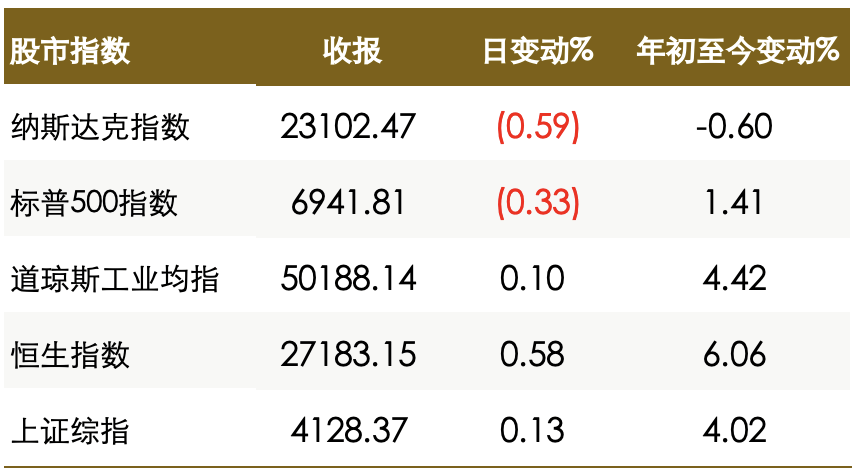
➢ 美国零售数据疲软;中国将常态化国债 买卖操作。A股窄幅震荡。上证指数收 涨0.13%报4128.37点,录得6连阳;深证 成指涨0.02%,创业板指跌0.37%。光伏 涨幅居前。恒指冲高回落,香港恒生指 数收涨0.58%报27183.15点,恒生科技指 数涨0.62%,恒生中国企业指数涨0.81%。 AI应用股、创新药大涨。大市成交额 2340.4亿港元。外盘方面,欧洲三大股 指收盘涨跌不一,美国三大股指收盘涨 跌不一,道指涨0.1%,标普500指数跌 0.33%报6941.81点,纳指跌0.59%。美国 零售销售意外停滞,市场提高今年降息 押注,关注周三发布的非农就业报告。 中国央行称将常态化开展国债买卖操作。 资料来源:彭博 2026年2月11日星期三 | 27183.15 | 0.58 | 6.06 | | --- | --- | --- | | 9242.75 | 0.81 | 3.69 | | 5451.03 | 0.62 | -1.18 | | 118.25 | -0.39 | -4.22 | | 4128.37 | 0.13 | 4.02 | | 14210.63 | 0.02 | 5.07 ...
AI“淘汰焦虑”愈演愈烈!华尔街如今的交易逻辑:只要怕被AI替代,先抛了再说
智通财经网· 2026-02-11 02:49
Core Viewpoint - The market is experiencing heightened fear regarding the potential disruption caused by artificial intelligence (AI), leading to significant stock price declines across various sectors, particularly in wealth management and software companies [1][3]. Group 1: Market Reaction - A recent sell-off was triggered by the launch of a tax strategy tool by Altruist Corp, resulting in stock price drops of over 7% for major firms like Charles Schwab, Raymond James, and LPL Financial [1]. - This sell-off reflects a broader market sentiment of "sell first, ask questions later," as concerns grow over the potential for AI to disrupt entire industries [1][3]. - The stock market has seen significant volatility, with companies facing indiscriminate selling if they are perceived to have any risk of being replaced by AI [3][4]. Group 2: Industry Impact - The introduction of AI products has shifted investor focus from identifying AI winners to quickly exiting any companies that may face replacement risks [3]. - The software industry is particularly affected, with stock prices plummeting across various sectors, including financial services and legal services, following the launch of new AI tools [3][4]. - Altruist's CEO highlighted that the technology used in their product could potentially replace many roles in wealth management, emphasizing the competitive threat posed by AI [4]. Group 3: Market Sentiment and Future Outlook - There is skepticism among analysts regarding the rapid shift from concern over an AI bubble to fear of its disruptive potential, with some suggesting that technological disruption often takes longer to materialize than anticipated [4][5]. - The current market reaction indicates a heightened sensitivity to any negative signals, with stock prices dropping significantly on minor adverse news [5]. - Experts caution against making premature conclusions about the long-term impact of AI, noting that the AI revolution is still in its early stages [5].
A股盘前播报 | MSCI中国指数调整!新纳入白银有色(601212.SH)等37只股票
智通财经网· 2026-02-11 00:46
Group 1: Industry Insights - Premier Li Qiang emphasized the need for rational development of rare earth resources and the expansion of rare earth technology applications in new energy and new materials [1] - The central bank plans to continue implementing a moderately loose monetary policy, utilizing tools like reserve requirement ratio cuts and interest rate reductions to maintain ample liquidity and relatively loose social financing conditions [3] - The AI threat to traditional business models is spreading to wealth management stocks, with significant market reactions observed, such as Charles Schwab's stock dropping over 9% due to concerns about AI tools targeting core business areas [4] Group 2: Company Updates - MSCI announced its quarterly index adjustments, including the addition of 37 stocks such as Liou Co., Silver Nonferrous, and Anji Technology to the MSCI China Index, while removing 16 stocks including Great Wall Motors [2] - China Railway Construction recently won major projects totaling 451.42 billion yuan [14] - Tian Shun Wind Power signed or won new offshore orders amounting to approximately 870 million yuan [14]

2月11日早餐 | 离岸人民币续创近三年新高;低空经济迎来催化
Xuan Gu Bao· 2026-02-11 00:14
大家早上壕! 先看海外要闻: 重磅就业报告公布前AI担忧重燃,标普纳指回落,但道指三日连创新高;收盘标普500跌0.33%,道指涨0.10%,纳指跌0.59%。 新AI工具引发行业前景忧虑,财富管理类股暴跌,嘉信理财收跌超7%;"科技七巨头"中,特斯拉涨近2%独涨、谷歌跌近2%领跌;存储芯片股大 幅回落,闪迪跌超7%。 纳斯达克金龙中国指数收涨0.87%,九紫新能收涨将近90%,禾赛、再鼎医药涨超6%。 美国零售数据逊色,美债价格加速上涨、收益率降幅扩大,十年期美债收益率创近一个月新低,美元指数盘中跌幅扩大、再创逾一周新低。 今日券商策略前瞻: 方正证券指出,技术面来看,沪指收出一根缩量小阳线,指数在4110点(20日均线)附近获得支撑,但上方4130-4140点区域构成短期压力。目 前指数处于上有压力、下有支撑的箱体震荡区间。成交额近期显示交投活跃度一般,资金观望情绪浓厚。节前资金观望情绪浓厚,春季行情继续 向节后演绎,没有只涨不退的潮水,4100点反复夯实为后续行情打下基础。 今日题材方面: 离岸人民币又创将近三年新高,近三年来首次盘中涨破6.91;比特币盘中跌破6.8万美元、较日高跌近4%。 金银铜和原 ...



财富管理公司全线暴跌 新AI工具引发对行业前景忧虑
Xin Lang Cai Jing· 2026-02-10 18:22
Core Viewpoint - The launch of an AI tool by Altruist Corp. for tax strategy formulation has raised concerns in the market about the potential disruption to traditional financial advisors, leading to a significant drop in tax planning and wealth management stocks [1][2]. Group 1: Market Reaction - Charles Schwab experienced a decline of 8.1%, while other wealth management stocks also suffered losses, including Raymond James Financial Inc. down 8.5%, LPL Financial Holdings Inc. down 8.4%, and Stifel Financial Corp. down 7.2% [1][2]. - The sell-off appears to be linked to market fears regarding the disruption of financial consulting and wealth management models by artificial intelligence [1][2]. Group 2: Investor Concerns - Investors are primarily worried about the potential erosion of efficiency gains due to increased competition, long-term fee compression, and possible shifts in market share [1][2]. - Similar concerns were observed in the insurance brokerage sector, which faced significant declines following the introduction of a rate comparison AI tool by Insurify [1][2].
AI税务工具冲击财富管理板块 相关股票集体大跌
Jin Rong Jie· 2026-02-10 17:53
在 金融软件公司Altruist推出一款用于制定税务策略的 人工智能工具后,税务规划和 财富管理类股票周 二大幅下挫,市场担忧传统机构的商业模式可能面临冲击。嘉信理财股价一度下跌8.1%,其他财富管 理公司同样承压,雷蒙德詹姆斯金融下跌8.5%,LPL Financial Holdings下挫8.4%,Stifel Financial Corp. 下跌7.2%。Altruist周二发布的新工具可帮助理财顾问为客户量身定制策略,并生成工资单、账户对账 单等文件。分析师表示,此轮抛售似乎源于市场对人工智能可能颠覆金融顾问和财富管理模式的更广泛 担忧。投资者当前很可能聚焦于效率优势被竞争削弱、长期费用压缩以及潜在市场份额变化等问题。 ...