
贵金属

Search documents
金价突然暴跌,贝森特却将矛头直指中国,指责交易“失序”
Sou Hu Cai Jing· 2026-02-10 06:16
Group 1 - The article discusses a significant drop in international gold prices, which fell sharply after nearing a historical high of $5,600, resulting in the evaporation of trillions of dollars in market value within hours [1][4] - U.S. Treasury Secretary Besant blamed China for the market turmoil, claiming that disorderly trading by Chinese investors disrupted the global precious metals market [8][10] - The article suggests that the extreme volatility in gold and silver prices is not merely a market reaction but rather a politically motivated intervention by the U.S. to maintain dollar hegemony [10][12] Group 2 - Data from the World Gold Council indicates that global central banks have net purchased over 1,000 tons of gold for three consecutive years, with China's central bank increasing its reserves to over 2,300 tons [14][34] - The article highlights a broader trend of countries repatriating gold reserves, with nations like Germany and Poland also participating in this "gold repatriation movement" [25] - The narrative emphasizes that the U.S. is losing its absolute pricing power over gold, as evidenced by the need for administrative measures to stabilize the market [12][36] Group 3 - The article posits that the current financial landscape is characterized by a separation of pricing power and ownership, where the prices set by Wall Street are increasingly disconnected from the physical assets held by global central banks [36][41] - It argues that the ongoing volatility in gold prices serves as a warning signal about the weakening of the once-mythologized dollar system, indicating a shift towards a new financial order based on tangible assets [39][43] - The conclusion suggests that the rise in gold prices reflects a growing distrust in the dollar's credibility, with a new financial order centered around physical assets rapidly taking shape [43]

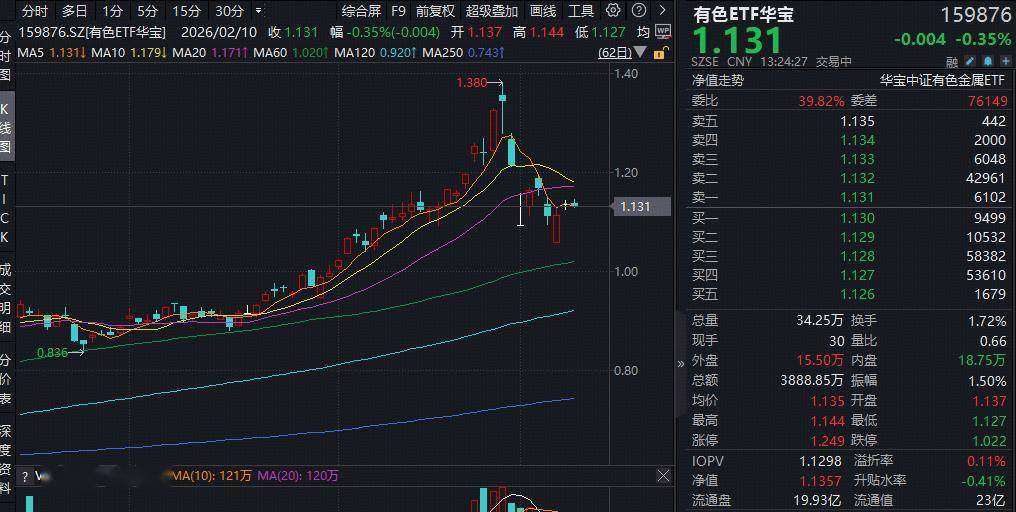
ETF盘中资讯|稀土产品价格加速上涨,钨价中枢再度上移!有色ETF(159876)摸高0.79%!机构:维持对有色金属的乐观预期
Sou Hu Cai Jing· 2026-02-10 05:53
Core Viewpoint - The performance of the non-ferrous metal ETF, Huabao (159876), has shown fluctuations, with a morning high of 0.79% but currently down by 0.35% [1]. Market Performance - The current trading price of Huabao ETF is 1.131, with a decrease of 0.35% (-0.004) from the previous close [2]. - The ETF opened at 1.137, reached a high of 1.144, and a low of 1.127 during the trading session [2]. - The total trading volume is 342,500, with a turnover rate of 1.72% [2]. Sector Performance - Key stocks in the non-ferrous metal sector include Shenghe Resources and Bowei Alloys, which rose over 2%, while Zhongfu Industrial and Xiamen Tungsten also saw gains exceeding 1% [2][3]. - The macroeconomic outlook suggests potential interest rate cuts by the Federal Reserve, which may influence commodity prices [3]. Industry Trends - Prices for rare earth products are accelerating, with significant increases in praseodymium and neodymium oxide prices, which rose by 7.59% and 6.27% respectively [4]. - The demand for rare earth materials is shifting from just-in-time purchasing to stockpiling, supporting higher prices [4]. - The non-ferrous metal industry is expected to experience a resource supercycle, with prices for metals like gold, copper, aluminum, tin, and rare earths anticipated to rise [4]. Investment Opportunities - The Huabao ETF provides comprehensive exposure to various metals, including copper, aluminum, gold, rare earths, and lithium, making it an efficient tool for investors looking to capitalize on the non-ferrous metal sector [5].
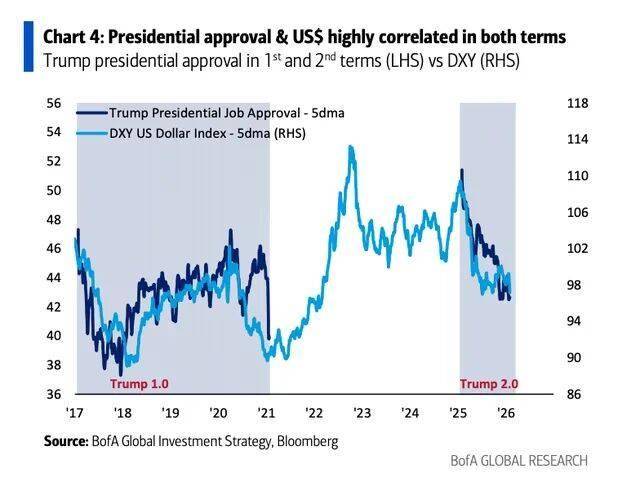
美银报告:特朗普支持率与美元走势罕见 “同频”,“懂王” 支持率回升前市场难获支撑
Sou Hu Cai Jing· 2026-02-10 05:37
Core Viewpoint - The current performance of the US dollar and the pressure in the US financial markets are significantly correlated with President Trump's approval ratings, which have both declined by approximately 10% since he took office [1][3]. Group 1: Market Dynamics - Theoretically, a weaker dollar should boost manufacturing in key swing states like Pennsylvania, Michigan, and Wisconsin, enhancing economic vitality. However, Trump's approval ratings and the dollar index have shown a "highly positive correlation" during his presidency [3]. - The recent market logic indicates a reassessment of the "Trump policy premium," with expectations of aggressive tax cuts and fiscal expansion post-2024 elections driving a strong dollar and elevated stock values [4]. - The market is currently experiencing a painful adjustment phase characterized by "peak positions and peak policies," with political support being a direct measure of market confidence [5][6]. Group 2: Investor Sentiment and Capital Flows - Investors are closely monitoring how the Trump administration balances strong dollar policies with tariffs and industrial revitalization plans, making political approval ratings a key indicator of market sentiment [5]. - A shift in market sentiment is occurring, with a transition towards "longing the real economy and shorting Wall Street assets," indicating that financial market confidence in the "American exceptionalism" narrative may rebound only when policy directions effectively enhance public support [5]. - Recent fund flows show significant movements, with $87.2 billion flowing into one-year market funds, $34.6 billion into equity funds, and $23 billion into bond funds, while gold and cryptocurrency funds experienced outflows [7][8]. Group 3: Sector Analysis - In terms of sector performance, technology funds saw inflows of $6 billion, while energy funds attracted $4.2 billion, contrasting with significant outflows from utility funds [8]. - The report highlights key technical support levels for "bubble assets," including technology ETFs at $133, Bitcoin at $58,000, and gold at $4,550 per ounce, suggesting potential stabilization points for these assets [6].
越跌越买!1月黄金ETF净流入创历史,亚洲扛起全球避险大旗,金价反弹站上5000美元
Sou Hu Cai Jing· 2026-02-10 05:20
Core Insights - The global gold market experienced a significant "reverse operation" in January 2026, with gold prices suffering their worst monthly drop in decades, while simultaneously, investors rushed to buy, leading to record inflows into gold ETFs [1][3] - The World Gold Council reported that global gold ETF net inflows reached 120 tons in January 2026, equivalent to nearly $19 billion, marking the strongest monthly performance in history [1][3] Market Dynamics - The primary reason for the surge in gold ETF investments despite falling prices is the increasing global uncertainty, which enhances gold's role as a "safe haven" asset [3] - The January price drop was attributed to multiple short-term factors, including the appointment of a hawkish Federal Reserve chair, leading to a rebound in the dollar and a temporary decrease in gold's attractiveness [3] - The global debt reached $345.7 trillion, 3.1 times the global GDP, alongside rising geopolitical tensions, which continue to amplify economic risks, reinforcing the long-term demand for gold as a risk hedge [3] Regional Insights - Asia emerged as the dominant force in the global gold accumulation trend, with January inflows into Asian gold ETFs reaching 62 tons, valued at approximately $10 billion, accounting for 51.7% of global inflows [4][5] - China and India were the main contributors to this trend, with China leading at around $6 billion in inflows, driven by high gold prices and geopolitical risks, while India saw about $2.5 billion due to asset diversification needs amid stock market weaknesses [4][5] Price Recovery - Following the significant inflows, gold prices rebounded, with spot gold reaching $5,064.10 per ounce by February 9, 2026, marking a strong recovery from the January lows [6] - The rebound was supported by ongoing geopolitical tensions, central banks accumulating gold, a weaker dollar, and technical corrections following the January price drop [6] Investment Strategy - The historical net inflows into gold ETFs and the subsequent price rebound signal that gold remains an essential asset in the current complex economic environment [7] - Investors are advised to adopt a rational approach to gold investment, focusing on low-cost options like gold ETFs and avoiding high leverage and chasing prices [7] Future Outlook - The Asian market is expected to continue playing a pivotal role in the global gold landscape, driven by its economic growth and capital liquidity, further solidifying gold's status as a reliable asset in uncertain times [8]

2300吨黄金运抵回国,丢失定价权,美财长甩锅中国,美元没救了
Sou Hu Cai Jing· 2026-02-10 04:50
Group 1 - The article discusses a significant drop in gold and silver prices, with silver losing half its value and gold futures dropping over 10% in a matter of hours, leading to massive losses for investors [3][5][10] - The Chicago Mercantile Exchange raised margin requirements for gold and silver futures, increasing the gold margin from 6% to 8% and silver from 11% to 15%, which drained market liquidity [7][8] - The U.S. Treasury Secretary pointed fingers at Chinese traders for the volatility, claiming their speculative actions disrupted global order, reflecting a narrative anxiety in the U.S. regarding its financial dominance [12][15][21] Group 2 - The article highlights that U.S. control over gold pricing is diminishing, as evidenced by the need for high-profile political interventions to stabilize market sentiment [17][19] - China has been increasing its gold reserves for 15 consecutive months, with a total surpassing 2300 tons, indicating a shift towards physical assets as a hedge against financial instability [23][26] - The U.S. is facing challenges in its manufacturing sector due to reliance on Chinese rare earth supplies, which are critical for high-end manufacturing, showcasing the interconnectedness of financial and industrial strategies [34][36] Group 3 - The narrative suggests that the U.S. is attempting to maintain its financial hegemony through rule modifications, while China is focusing on accumulating physical resources, indicating a potential shift in global economic power dynamics [28][40][41] - The article posits that the future will not only be about currency competition but also about the battle for physical resources, with gold and rare earths emerging as new hard currencies [43]
午评:三大指数半日收跌 影视院线板块爆发
Xin Lang Cai Jing· 2026-02-10 04:10
Market Overview - The market experienced narrow fluctuations in early trading, with the three major indices turning negative again [1] - By the close, the Shanghai Composite Index was at 4122.34 points, down 0.02%; the Shenzhen Component Index was at 14206.26 points, down 0.02%; and the ChiNext Index was at 3328.02 points, down 0.14% [2] Sector Performance - The film and television sector continued to rise, with stocks like Jiecheng Co. and Light Media hitting the daily limit up of 20%, alongside several others [1][5] - The AI application sector remained strong, with Rongxin Culture and Zhangyue Technology achieving consecutive gains [1] - The innovative drug sector saw a rebound, with Haixiang Pharmaceutical, Wanbangde, and Jihua Group all hitting the daily limit up [1][4] - Conversely, the non-ferrous metals sector declined, particularly in precious metals, with Xiaocheng Technology experiencing significant losses [1] - The liquor sector showed weak performance, led by Huangtai Liquor, while the battery sector also fell, with Jinyinhai experiencing notable declines [1] Key Highlights Innovative Drugs - The innovative drug sector is projected to reach a record transaction scale of $135.7 billion for License-out deals in China by 2025, with significant collaborations occurring in early 2026 [4] - Notable deals include the $18.5 billion partnership between Shiyao and AstraZeneca, and a $5.6 billion deal between Rongchang and AbbVie, highlighting the global value of domestic innovative drug pipelines [4] Film and Television - As of February 9, the pre-sale box office for new films during the 2026 Spring Festival has exceeded 70 million yuan [5] - CICC's report estimates that the total box office for this year's Spring Festival could range between 6.5 billion and 8.5 billion yuan, with the performance of leading films being crucial for the final box office outcome [5]
午评:三大指数小幅下跌 影视、传媒股表现强势
Zhong Guo Jing Ji Wang· 2026-02-10 03:42
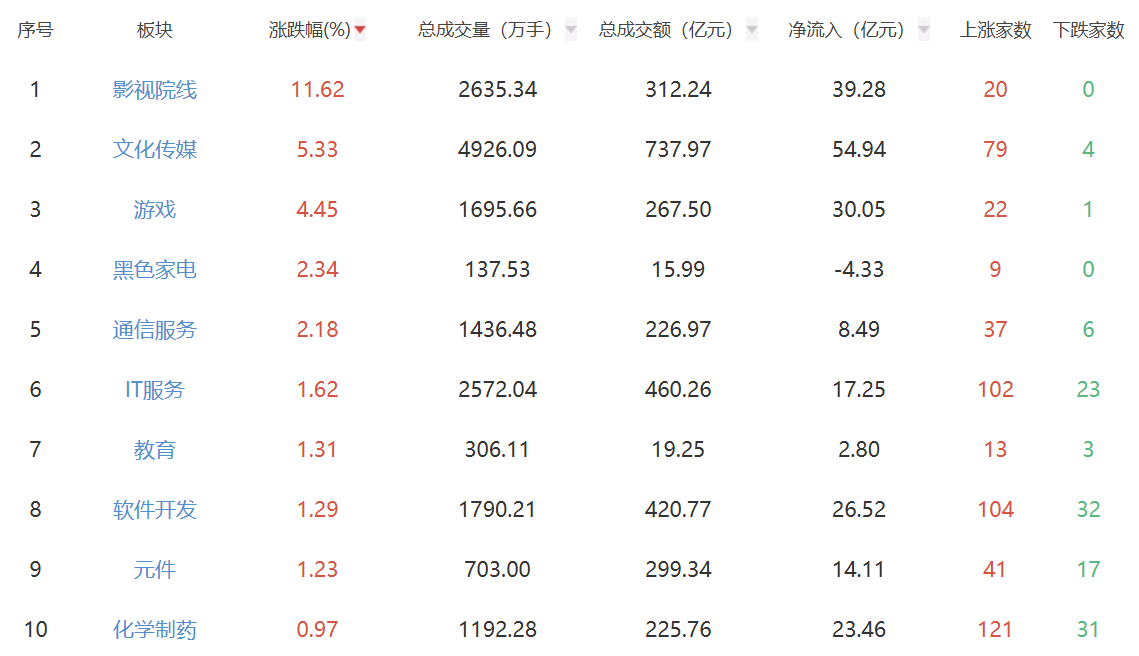
Core Viewpoint - The A-share market experienced slight declines in major indices, with the Shanghai Composite Index down by 0.02% and the Shenzhen Component Index also down by 0.02%, indicating a period of market consolidation [1] Market Performance - The Shanghai Composite Index closed at 4122.34 points, while the Shenzhen Component Index closed at 14206.26 points, and the ChiNext Index at 3328.02 points, reflecting minor fluctuations in the market [1] - The market saw a mixed performance across various sectors, with the film and television, cultural media, and gaming sectors showing notable gains, while the airport and shipping, precious metals, and liquor sectors faced declines [1] Sector Performance - The film and television sector led the gains with an increase of 11.62%, achieving a total transaction volume of 2,635.34 million hands and a transaction value of 312.24 billion [2] - The cultural media sector rose by 5.33%, with a transaction volume of 4,926.09 million hands and a transaction value of 737.97 billion, alongside a net inflow of 54.94 billion [2] - The gaming sector increased by 4.45%, with a transaction volume of 1,695.66 million hands and a transaction value of 267.50 billion, also showing a net inflow of 30.05 billion [2] - Conversely, the airport and shipping sector declined by 1.78%, with a transaction volume of 559.19 million hands and a transaction value of 31.54 billion, experiencing a net outflow of 2.87 billion [2] - The precious metals sector fell by 1.76%, with a transaction volume of 640.47 million hands and a transaction value of 154.58 billion, resulting in a net outflow of 5.08 billion [2] - The liquor sector decreased by 1.46%, with a transaction volume of 157.08 million hands and a transaction value of 99.39 billion, also facing a net outflow of 9.89 billion [2]
贺利氏贵金属:以循环共生重塑产业未来
Zhong Guo Hua Gong Bao· 2026-02-10 03:32
Core Viewpoint - The year 2026 is a critical period for China's manufacturing industry to advance towards high-end, intelligent, and green development, with companies like Heraeus Precious Metals transitioning from "scale expansion" to "quality and efficiency breakthroughs" [1] Group 1: Industry Trends and Strategies - The focus on high-quality development aims to break the cycle of "involution" in the industry, emphasizing the importance of technological innovation, model transformation, and circular economy [1] - Heraeus plans to lead in technology while seeking breakthroughs in the value reconstruction of the industrial chain [1] Group 2: Company Achievements and Innovations - In 2025, Heraeus Precious Metals China opened its analysis and testing center, providing high-standard precious metal testing services [2] - The company achieved localized mass production of a load-type iridium catalyst optimized for PEM electrolysis, significantly reducing iridium usage by 50%-90% and lowering production costs [2] - The establishment of the Hydrogen Innovation Center in Shanghai aims to promote breakthroughs and industrial applications in hydrogen energy technology [2] - Heraeus Precious Metals was recognized as one of the top 100 manufacturing enterprises in Nanjing for 2025 [2] Group 3: Innovation and Market Positioning - Innovation extends beyond technology and products to encompass organizational efficiency and business model restructuring [3] - Heraeus introduced a new generation of high-performance leak boards to meet the urgent demands of the domestic high-end semiconductor industry [3] - The registration of Heraeus platinum and palladium as a brand at the Guangzhou Futures Exchange marks a milestone, expected to enhance the competitiveness of domestic precious metal companies [3] - The company aims to contribute to the high-quality development of the domestic precious metals industry by providing a full lifecycle of products and services [3]
大宗商品:图说大宗:宏观情绪与基本面共振,金银铜波动加剧
2026-02-10 03:24
图说大宗 证券研究报告 2026.02.08 图说大宗:宏观情绪与基本面共振,金 银铜波动加剧 SAC 执证编号:S0080513070006 SFC CE Ref:BBU524 chaohui.guo@cicc.com.cn 郭朝辉 分析员 王炙鹿 分析员 陈雷 分析员 SAC 执证编号:S0080523030003 zhilu.wang@cicc.com.cn SAC 执证编号:S0080524020004 lei.chen@cicc.com.cn 宏观回顾:国内内需仍偏弱,沃什难撼扩表 国内方面,1 月中采制造业 PMI 环比下降 0.8ppt 至 49.3%,低于市场预期(Reuters 预测中值 50.0%;1 月非制造业商务活动指数环比下降 0.8ppt 至 49.4%;综合 PMI 环比下降 0.9 个百分点至 49.8%,皆再度回到收缩区间。中金宏观组认为,季节性因素或对数据扰动较大,但除了季节性以外, 需求仍然弱于供给,两者缺口进一步扩大。结构上,消费品制造业和小型企业回落较多。制造业整体受 大宗商品价格上涨影响,原材料购进价格上升,但向下游传导能力仍受制于需求。建筑业受天气和季节 性因素影 ...
国际黄金价格波动背后有何深意
Xin Hua Wang· 2026-02-10 03:17
Core Viewpoint - The international gold market has experienced significant volatility in early 2026, with prices reaching a historical peak of over $5,600 per ounce before dropping more than 20% in a short period, currently stabilizing above $5,000 per ounce. This reflects a reassessment of the global monetary system and geopolitical situation, positioning gold as a strategic reserve against long-term uncertainties rather than merely an investment asset or temporary safe haven [1]. Group 1: Factors Influencing Gold Prices - Historical data indicates that gold price fluctuations have long been influenced by factors such as safe-haven demand, U.S. dollar credit, and real interest rates, with the weight of these factors varying significantly across different historical periods [2]. - In the 1970s, inflation and oil crises drove gold prices, while from the 1980s to the early 2000s, economic growth and a strong dollar led to a prolonged period of low gold prices due to increased opportunity costs of holding gold [2]. - The current gold price uptrend is characterized by a structural shift, where the influence of real interest rates is diminishing, and the dual drivers of safe-haven attributes and credit reassessment are emerging [2]. Group 2: New Dynamics in Gold Pricing - In 2026, a phenomenon of "strong dollar" and "strong gold" coexists, indicating a reduced correlation between the two, suggesting that gold is seeking a new dynamic equilibrium under multiple influencing factors [3]. - Analysts believe that as long as global macroeconomic uncertainties persist, gold prices will maintain solid support, leading to a "defensive growth" investment strategy [3]. - Goldman Sachs has raised its gold price forecast for the end of 2026, attributing this to diversified demand from the private sector and emerging markets, which is hedging against policy risks [3]. Group 3: Central Bank Influence on Gold Prices - A significant factor supporting the current gold price is the shift in the role of global central banks, which have transitioned from net sellers to net buyers of gold, with purchases expected to remain high at around 755 tons in 2026 [4]. - This trend reflects a strategic reassessment of reserve asset security amid current geopolitical contexts, with increased gold reserves becoming a defensive measure [4]. - A survey by the World Gold Council indicates that most central banks plan to increase or maintain their gold reserves in the coming year, reaffirming gold's strategic value as a physical asset with no counterparty risk [5]. Group 4: Broader Economic Implications - The high international gold prices in 2026 are seen as a reflection of the transformation in the global economic governance system, with predictions that gold's premium effect will not quickly dissipate until a new stable geopolitical landscape is established [5]. - The current trends indicate a shift in gold's role from a mere financial investment tool to a strategic cornerstone for national economic security, continuing to serve as a hedge against uncertainties [5].