石化

Search documents
对二甲苯:短期不追高, PTA:单边震荡市,不追高, MEG:供需格局改善,空单减持,多 MEG 空 PX
Guo Tai Jun An Qi Huo· 2025-11-27 02:57
Report Summary 1. Investment Ratings - PX: Short-term, avoid chasing high prices [1] - PTA: In a unilateral volatile market, avoid chasing high prices [1] - MEG: Supply-demand pattern improves, reduce short positions, go long MEG and short PX [1] 2. Core Views - PX: Close long positions, go long MEG and short PX, pay attention to calendar spread reverse arbitrage positions [6] - PTA: At a high valuation level, close long positions, go long MEG and short PTA for hedging [6] - MEG: At a low price level, supply is expected to shrink, the supply-demand balance sheet improves, close short positions and reverse arbitrage, go long MEG and short PX for hedging [6] 3. Summary by Relevant Catalogs Market Dynamics - PX: Naphtha prices fell at the end of the session. On November 26, PX prices rose, with a January Asian spot deal at $828. The PX-naphtha spread is widening. Downstream polyester demand is normal, with the overall operating rate of Chinese polyester fibers at 91.30% as of November 20, and the weaving industry's operating rate dropping from 88% to 87% [3][4] - MEG: On November 15, several units of Huajin Aramco's project achieved mechanical completion. An Anhui 300,000-ton/year syngas-to-ethylene glycol unit is restarting and expected to produce normally this weekend [4][5] - Polyester: An Indonesian company plans to build a 720,000-ton/year polyester bottle chip plant. On November 26, the sales of Jiangsu and Zhejiang polyester yarns and direct-spun polyester staple fibers declined [5] Trend Intensity - PX trend intensity: -1 - PTA trend intensity: -1 - MEG trend intensity: 0 [6] Price and Spread Data | Futures | PX | PTA | MEG | PF | SC | | --- | --- | --- | --- | --- | --- | | Yesterday's closing price | 6774 | 4684 | 3896 | 6264 | 445 | | Change | 56 | 28 | 23 | 30 | -3.6 | | Change rate | 0.83% | 0.60% | 0.59% | 0.48% | -0.80% | | Month spread | PX1 - 5 | PTA1 - 5 | MEG1 - 5 | PF12 - 1 | SC11 - 12 | | Yesterday's closing price | -30 | -44 | -73 | -116 | 1.2 | | Previous day's closing price | -34 | -50 | -88 | -60 | 0.7 | | Change | 4 | 6 | 15 | -56 | 0.5 | | Spot | PX CFR China ($/ton) | PTA East China (yuan/ton) | MEG spot | Naphtha MOPJ | Dated Brent ($/barrel) | | Yesterday's price | 829 | 4647 | 3910 | 557.62 | 63.55 | | Previous day's price | 825.67 | 4635 | 3918 | 560.88 | 62.84 | | Change | 3.33 | 12 | -8 | -3.25 | 0.71 | | Spot processing fee | PX - naphtha spread | PTA processing fee | Short fiber processing fee | Bottle chip processing fee | MOPJ naphtha - Dubai crude spread | | Yesterday's price | 261.8 | 195.49 | 203.75 | 57.31 | -4.34 | | Previous day's price | 259.7 | 174.59 | 209.88 | 67.53 | -4.34 | | Change | 2.09 | 20.9 | -6.12 | -10.22 | 0 | [2]
林武在东营调研时强调 持续促进经济结构优化升级 坚定不移推动绿色低碳高质量发展
Da Zhong Ri Bao· 2025-11-27 01:09
Group 1 - The core message emphasizes the need to implement the spirit of the 20th Central Committee and Xi Jinping's important speech, focusing on strengthening the real economy and promoting green, low-carbon, and high-quality development [1][2] - The company aims to enhance the petrochemical industry by reducing oil consumption, increasing chemical production, and extending the supply chain to improve quality and efficiency [1] - There is a focus on carbon capture, utilization, and storage technology to improve resource utilization efficiency and reduce carbon emissions, contributing to national energy security and green transformation [1] Group 2 - The company is encouraged to leverage its leading role in the wind power equipment industry to support the development of a new energy system in the province [2] - The development of the East Dongying Zero Carbon Industrial Park is highlighted, with an emphasis on accelerating construction and expanding the industrial cluster [2] - The importance of ecological protection and restoration in the Yellow River Delta is stressed, aligning with Xi Jinping's ecological civilization thought [2]
天风证券:政策与周期共振 石化行业迎来结构性机遇
智通财经网· 2025-11-26 07:51
Core Viewpoint - The petrochemical industry is at a significant turning point driven by policies aimed at "controlling growth and reducing inventory" [1][2] Group 1: Policy Implications - The "controlling growth" strategy is central to the long-term improvement of the industry, as outlined in the "Petrochemical and Chemical Industry Stabilization Growth Work Plan," which emphasizes scientific regulation of major project construction and strict control of new refining capacity [2] - The "reducing inventory" approach focuses on addressing current contradictions, with safety, environmental protection, and energy efficiency being key policy drivers [2] Group 2: Industry Cycle and Capacity - The industry is nearing the end of its production cycle, with significant slowdowns in capacity growth expected by 2026 for most products [1][4] - Despite high operating rates, the industry has not experienced severe oversupply, with average capacity growth for various petrochemical products exceeding 10% per year from 2019 to 2025 [3] Group 3: Future Outlook - By 2026, the production growth rate of most petrochemical products is expected to decline significantly, leading to improved capacity utilization in sectors like PX, polyester filament, methanol, and acetic acid [4] - The industry is anticipated to transition from localized recovery to comprehensive improvement between 2027 and 2028, supported by high entry barriers and reduced new capacity growth [4] Group 4: Profitability and Investment Recommendations - The PX industry chain is projected to provide significant profit elasticity for refining companies in 2026, driven by supply-demand imbalances and external factors such as sanctions and refinery attacks affecting oil exports [5] - Recommended stocks include Hengli Petrochemical, Rongsheng Petrochemical, Hengyi Petrochemical, Dongfang Shenghong, and Sinopec, with a suggestion to pay attention to Huajin Co [5]



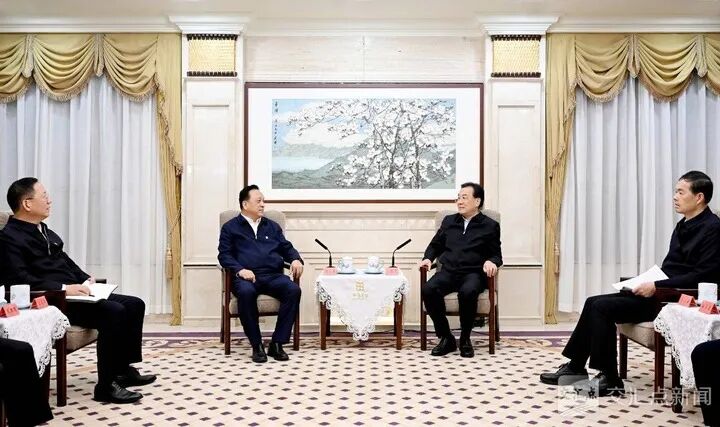
江苏省委书记信长星、省长刘小涛会见中国石化董事长侯启军
Xin Lang Cai Jing· 2025-11-26 04:36
11月24日,江苏省委书记信长星、省长刘小涛在南京会见中国石化集团董事长侯启军。信长星说,能源 保供、产业创新、安全生产等工作,都离不开石化产业的提质升级,需要中国石化继续给予支持。希望 双方围绕推动能源体系和石化产业转型升级深化合作,培育更多新的增长点,共同服务全国发展大局。 侯启军表示,中国石化将坚决扛牢保障国家能源安全政治责任,充分发挥全产业链优势,拓展与江苏的 全方位合作,积极布局更多先进技术和优质项目,促进产业智能化、绿色化、融合化发展,助力江苏高 质量发展继续走在前列。 ...
扬子石化聚烯烃新品生产目标提前完成
Zhong Guo Hua Gong Bao· 2025-11-26 02:31
Core Insights - Yangzi Petrochemical has exceeded its annual production target for eight new grades of polyolefins by the end of October, achieving this ahead of schedule [1] Group 1: New Product Development - The company established a leadership group for new product development, led by company executives, to approve annual development and marketing plans, and to address any bottlenecks in the production and sales process [1] - A project team focused on production, sales, research, and application was formed to enhance the efficiency of new product development and improve customer satisfaction [1] Group 2: Production Stability and Cost Management - To ensure stable production of new polyolefin products, the company conducted thorough inspections of production lines designated for new products and carefully planned the transition process [1] - During trial production, strict operational procedures were followed to monitor the dynamic performance of the production units, ensuring product quality and minimizing transitional materials to reduce production costs [1] Group 3: Sales and Customization Strategy - The company implemented a new sales model that integrates customized development, quantitative production, targeted sales, and specialized services, allowing for rapid industrial production and sales [1] - This approach enables the company to tailor new polyolefin products to meet individual customer needs effectively [1]
ICIS:石化企业亟须整合重组
Zhong Guo Hua Gong Bao· 2025-11-26 02:25
Group 1: Industry Overview - The petrochemical industry in Asia is facing overcapacity and weak demand, leading to declining profit margins and operational losses [1][3] - Companies are compelled to consider restructuring and consolidation as a necessary response to current challenges [1][3] Group 2: Company Actions - South Korean companies have agreed to reduce naphtha cracker capacity by up to 25%, with ongoing negotiations for business restructuring [1] - HD Hyundai Chemical and Lotte Chemical are finalizing plans to integrate their naphtha cracker operations into a joint venture to cut ethylene production [1] - Some companies, like Lotte Chemical, are planning to transition from basic chemicals to specialty chemicals [1] Group 3: Market Predictions - The global petrochemical market is not expected to recover in the short term, necessitating difficult decisions and adjustments in scale by companies [1] - The International Monetary Fund (IMF) forecasts a decline in economic growth rates for G20 countries, which may further impact demand for petrochemical products [2] Group 4: Challenges and Risks - Trade barriers, including U.S. tariffs and geopolitical tensions, are contributing to uncertainty in the market, affecting exports from countries like India [2] - The ongoing expansion of global petrochemical capacity from 2025 to 2026 is not favorable for companies, as demand remains weak in most economies [3] - Companies are urged to shut down outdated assets and rationalize operations before any potential recovery in demand can occur [3]
浙江:推动现货交易平台交易增量持续增长,聚焦钢材、塑料、橡胶等优势品种拓展业务范围
Sou Hu Cai Jing· 2025-11-26 01:56
Core Viewpoint - The Zhejiang Provincial Government has issued a plan to establish an integrated off-market trading platform for bulk commodities, aiming to enhance resource allocation and trading efficiency in the region [1] Group 1: Trading Platform Development - The plan includes the construction of a spot trading platform, which will be developed in phases based on the integration of existing platforms like the Zhejiang International Oil and Gas Trading Center [1] - The platform will operate under a unified leadership, structure, accounts, operations, standards, and team [1] Group 2: Trading Volume and Product Focus - There is an emphasis on increasing trading volume on the spot trading platform, particularly focusing on refined oil and chemical bulk commodities [1] - The platform will also expand its business scope to include steel, plastics, and rubber, which are identified as advantageous products [1] Group 3: Encouragement for Industry Leaders - Leading enterprises in the petrochemical sector are encouraged to establish sales zones on the spot trading platform [1] - The plan includes exploring cooperation on national reserve iron ore rotation business, subject to approval from relevant national authorities [1] Group 4: Integration with Futures Market - The initiative aims to explore integrated development between spot and futures markets [1] - The establishment of a basis quotation area on the spot trading platform is proposed, along with the introduction of real-time market data from futures exchanges [1] - There is a focus on expanding the coverage and scale of delivery warehouses for key trading varieties in collaboration with futures exchanges [1]
浙江:推动现货交易平台交易增量持续增长
Zheng Quan Shi Bao Wang· 2025-11-26 00:33
Core Viewpoint - The Zhejiang Provincial Government has issued a plan to enhance the integration of spot and futures markets for bulk commodities, aiming to establish a resource allocation hub for these commodities [1] Group 1: Market Development - The plan emphasizes the continuous growth of trading volume on spot trading platforms [1] - It aims to consolidate trading segments centered around refined oil and chemical bulk commodities [1] - The initiative includes regular online trading activities [1] Group 2: Business Expansion - The focus will be on expanding business scope in advantageous varieties such as steel, plastics, and rubber [1] - Leading enterprises in the petrochemical sector are encouraged to establish sales zones on spot trading platforms [1] - The plan also explores the potential for cooperation in the rotation of national reserves of iron ore, subject to approval from relevant national authorities [1]
我国加快建设现代化产业体系
Yang Shi Xin Wen· 2025-11-26 00:27
今年以来,我国现代化产业体系建设跑出"加速度"、不断焕发"新活力"。传统产业高端化、智能化转型 成效显著,超过八成的钢铁企业建成智能集控中心,一半以上的煤炭产能实现数字化开采,纺织行业重 点企业的关键工序数控化率超过了60%。 就在不久前,代表我国制造业最高水准的首批领航级智能工厂培育名单正式对外公布。这份涵盖了钢 铁、石化、消费品和装备制造等多个领域的名单,将率先探索全球敏捷定制等特色制造新模式。 广袤大地,中国产业新动能处处涌动着蓬勃生机。 长三角的工业互联网平台上,每分钟2万组数据在数字孪生系统实时流动调度,平均8秒就有一台冰箱下 线奔向全国各地。 同一时刻,珠三角的灯塔工厂里,订制一辆汽车有十万种个性化选装方案、一百多个颜色实时切换。 东部沿海的保税园区,跨境数据高速奔涌,仅一秒钟就能完成一单核验通关,让中国制造沿着数字导航 快速通达全球。 习近平总书记始终高度重视以实体经济为支撑的现代化产业体系建设,多次深入工厂车间、走进生产一 线,围绕现代化产业体系建设作出一系列重要指示。他强调,要打造自主可控、安全可靠、竞争力强的 现代化产业体系;加快构建具有智能化、绿色化、融合化特征和符合完整性、先进性、安全 ...
信长星刘小涛会见中国石化董事长侯启军
Xin Hua Ri Bao· 2025-11-25 12:37
Core Points - The meeting between Jiangsu provincial leaders and the chairman of Sinopec emphasizes the importance of collaboration in energy supply and the petrochemical industry transformation [1][3] - Jiangsu is focusing on implementing the strategic deployment from the 20th Central Committee regarding the construction of a new energy system [3] - Sinopec is committed to enhancing its cooperation with Jiangsu, leveraging its full industry chain advantages to support high-quality development in the province [3] Group 1 - Jiangsu provincial leaders expressed gratitude to Sinopec for its contributions to the province's development [3] - The provincial government is planning to enhance energy supply, industrial innovation, and safety production, which are crucial for the petrochemical industry's upgrade [3] - Sinopec aims to promote intelligent, green, and integrated development through advanced technologies and quality projects [3] Group 2 - The meeting included discussions on deepening cooperation to cultivate new growth points in the energy system and petrochemical industry [3] - Sinopec's chairman highlighted the company's political responsibility in ensuring national energy security [3] - The meeting was attended by key provincial leaders and Sinopec's vice president, indicating a high-level commitment to collaboration [3]