
银行理财

Search documents
银行理财周度跟踪(2025.8.11-2025.8.17):资管年会谋篇市场新生态,债市波动引理财净值回调-20250820
HWABAO SECURITIES· 2025-08-20 08:18
Investment Rating - The report does not explicitly provide an investment rating for the industry. Core Insights - The 2025 Asset Management Annual Conference highlighted the need for a competitive restructuring in the asset management sector, focusing on multi-asset and multi-strategy investment approaches [3][11]. - The report indicates a general decline in the annualized returns of cash management products and fixed-income products, reflecting market volatility and changing investor sentiment [5][16][18]. - The report emphasizes the importance of enhancing research capabilities and service quality in the asset management industry to adapt to market changes and investor needs [12][13]. Regulatory and Industry Dynamics - The 2025 Asset Management Annual Conference took place on August 16, focusing on the theme of "Breaking the Deadlock and Restructuring - Rebuilding Competitiveness in Asset Management" [3][11]. - Key executives from various financial institutions shared insights on the future of multi-asset investment strategies and the importance of AI infrastructure in driving growth [11][12]. Peer Innovation Dynamics - The report discusses the launch of the "日鑫悦益" product system by浦银理财, which includes strategic upgrades across four main product lines to enhance functionality and investment strategies [4][14]. - 招银理财 introduced the SMARP index, aimed at optimizing asset allocation and dynamic risk management across various asset classes [15]. Yield Performance - For the week of August 11-17, 2025, cash management products recorded an annualized yield of 1.31%, down 3 basis points from the previous week, while money market funds yielded 1.20%, down 1 basis point [5][16][20]. - The report notes a general decline in annualized yields for fixed-income products across different maturities, influenced by market factors such as U.S.-China tariff concerns and consumer loan policies [18][19]. Net Value Tracking - The report indicates that the net value ratio of bank wealth management products rose to 1.52%, an increase of 0.65 percentage points week-on-week, reflecting a widening credit spread [6][24][26]. - The widening credit spread is noted to be at historical low levels since September 2024, suggesting limited value for investors [26].
乘股市回暖东风 含权类理财产品销售升温
Zhong Guo Zheng Quan Bao· 2025-08-19 20:17
Core Viewpoint - The recent surge in demand for equity-linked wealth management products is driven by favorable policies and market conditions, with many products achieving annualized returns exceeding 4% in the past month [1][2]. Group 1: Product Performance - Several equity-linked wealth management products have shown strong performance, with one product achieving an annualized return of 5.39% year-to-date and 4.28% in the last month, while another reached 4.83% year-to-date and 6.59% in the last month [2]. - The popularity of these products is reflected in their rapid sales, with some banks releasing around 1 billion yuan worth of products daily, which sell out within minutes [1]. Group 2: Market Trends - The banking sector is increasingly focusing on equity-linked products as a response to the "asset shortage" environment, viewing them as a key opportunity to enhance product scale [1][4]. - Following the recovery of the A-share market, many investors are opting for equity-linked products to participate in stock market gains, leading to a significant increase in the issuance of such products by banks [4][5]. Group 3: Investor Behavior - Investors are shifting from low-yield fixed-income products to equity-linked products due to declining returns on traditional investments, with some expressing dissatisfaction with the low yields of money market funds and fixed-income products [3][6]. - Bank wealth management professionals are advising clients to consider equity-linked products for higher returns, especially for those with a certain risk tolerance [3][6]. Group 4: Strategic Adjustments - Banks are enhancing their investment capabilities in equity-linked products, with a focus on diversifying their product offerings to meet varying risk appetites among investors [5][6]. - The low interest rate environment is prompting banks to reduce reliance on traditional fixed-income products and to capture structural opportunities in the equity market [4][5].

股债“跷跷板”再现,约一成理财产品近一周收益告负
2 1 Shi Ji Jing Ji Bao Dao· 2025-08-19 10:39
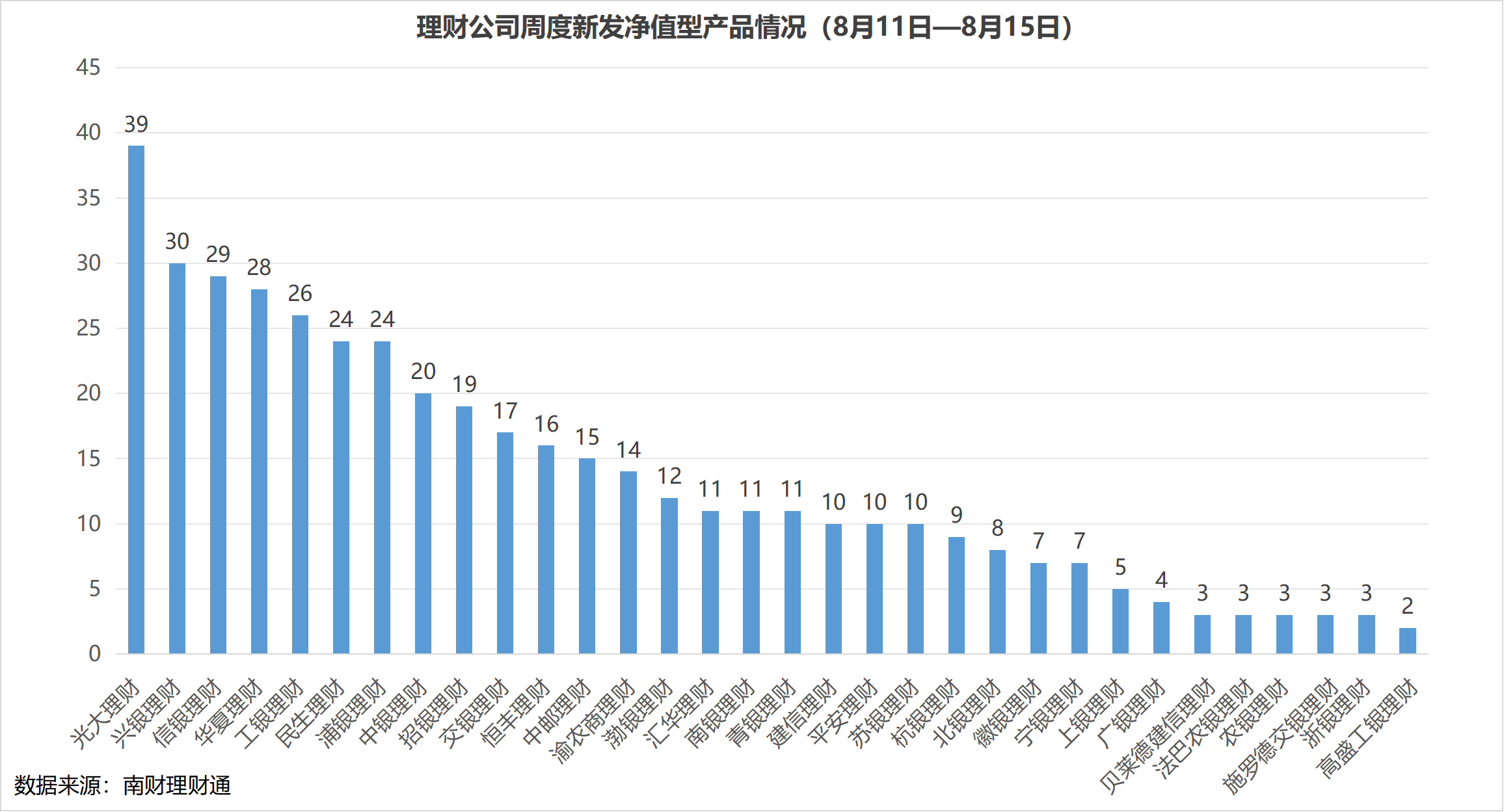
Market Overview - The bond market experienced an unexpected correction last week, with an overall balanced and loose funding environment. The weighted average of DR007 on August 15 was 1.48%, and the yield on 10-year government bonds closed at 1.75% [2] - In the stock market, major A-share indices surged, with the ChiNext Index, STAR 50 Index, and Shenzhen Component Index recording weekly gains of 8.58%, 5.53%, and 4.55% respectively. The communication, electronics, and non-bank financial sectors led the gains [2] Product Performance - The number of underperforming products remains low, with 25,210 public wealth management products in existence as of August 17, 2025. Among these, 141 products had a cumulative net value below 1, resulting in a comprehensive break-even rate of 0.56% for bank wealth management [3] - The break-even rates for equity and mixed wealth management products were 35.71% and 4.8% respectively, while fixed income public wealth management products had a break-even rate of 0.28% [3] - Fixed income products with 1-2 year and over 3-year terms had slightly higher break-even rates of 0.71% and 0.57% respectively [3] New Product Issuance - A total of 433 wealth management products were issued by 32 wealth management companies from August 11 to August 15, with joint-stock bank wealth management companies leading in issuance. Everbright Wealth issued 39 products, followed by Xinyin Wealth with 30 and Xinyin Wealth with 29 [4] - The newly issued products were primarily R2 (medium-low risk), closed-end net value type, and fixed income public products, with only 4 mixed products issued, accounting for 1.8%. No new equity or financial derivative products were launched [7] Product Pricing and Strategy - Product pricing saw a decline in most terms, except for 3-6 month and over 3-year products, which experienced a rebound. The pricing for 1-2 year and 2-3 year products fell below 2.80%, while products with a term of less than 1 month dropped below 2% [7] - Notably, Xinyin Wealth launched a fixed income enhancement product with a minimum holding period of 90 days and an innovative investment strategy that combines debt assets with quantitative volatility strategies [9] Yield Performance - Fixed income wealth management yields declined, with an average net value growth rate of 0.0511% over the past week. Mixed and equity products had average net value growth rates of 0.2075% and 1.354% respectively [10] - Among fixed income products, those with over 3-year terms had the highest average net value growth rate of 0.0794%, while products with a term of less than 1 month had the lowest at 0.0363% [10] Industry Trends - The scale of bank wealth management saw an unexpected increase of approximately 2 trillion yuan in July, reaching 32.67 trillion yuan, driven by the maturity of high-interest deposits and the relative attractiveness of wealth management products [16] - The growth in non-bank deposits significantly contributed to the increase in wealth management scale, with cash management and short-term fixed income products being the primary beneficiaries [16] - In August, the wealth management scale is expected to exceed 33 trillion yuan, with an annual target of 33.5 trillion yuan [16] - Last week, 16 new ESG-themed wealth management products were launched, indicating a rapid expansion of thematic wealth management offerings [17]

周报 | 股债“跷跷板”再现,约一成理财产品近一周收益告负
2 1 Shi Ji Jing Ji Bao Dao· 2025-08-19 10:25
Market Overview - The bond market experienced an unexpected correction last week, with an overall balanced and loose funding environment. The weighted average of DR007 on August 15 was 1.48%, and the yield on 10-year government bonds closed at 1.75% [2] - In the stock market, major A-share indices surged, with the ChiNext Index, STAR 50 Index, and Shenzhen Component Index recording weekly gains of 8.58%, 5.53%, and 4.55% respectively. The communication, electronics, and non-bank financial sectors led the gains [2] Product Performance - The number of underperforming products remains low, with 25,210 public wealth management products in existence as of August 17, 2025. Among these, 141 products had a cumulative net value below 1, resulting in a comprehensive break-even rate of 0.56% for bank wealth management. The break-even rates for equity and mixed wealth management products were 35.71% and 4.8%, respectively, while fixed income products had a break-even rate of 0.28% [3] - The break-even rates for fixed income products of various maturities remained low, with 1-2 year and over 3-year products slightly higher at 0.71% and 0.57% respectively [3] New Product Issuance - A total of 433 wealth management products were issued by 32 wealth management companies from August 11 to August 15, with joint-stock banks leading in issuance. Everbright Wealth issued 39 products, followed by Xinyin Wealth with 30 and Xinyin Wealth with 29 [4] - The newly issued products were primarily R2 (medium-low risk), closed-end net value type, and fixed income public products, with only 4 mixed products issued, accounting for 1.8%. No new equity or financial derivative products were launched [4] - Pricing trends showed a decline in most product maturities, with 1-2 year and 2-3 year products dropping below 2.80%, while products with maturities over 3 years saw a significant rebound to 2.55% [4] Investment Strategies - Notably, Xinyin Wealth launched a fixed income enhancement product named "Fengli Xindong Ruixiang 3M Holding Period Target Red 3 (Jixing Version)", which is a "fixed income+" product with a risk level of three and a minimum holding period of 90 days. The product's performance benchmark is based on a combination of various indices and deposit rates [5] Yield Performance - Fixed income wealth management yields declined, with an average net value growth rate of 0.0511% over the past week. Mixed and equity products had average net value growth rates of 0.2075% and 1.354%, respectively. Among fixed income products, those with maturities over 3 years had the highest average net value growth rate of 0.0794% [6] - The average annualized yield for cash public wealth management products in RMB, USD, and AUD was 1.338%, 3.924%, and 2.87%, respectively [6] - The proportion of negative yield products increased, primarily due to fixed income products, with 9.94% of RMB public wealth management products experiencing negative returns last week [6][7] Industry Trends - The scale of bank wealth management grew unexpectedly by approximately 2 trillion RMB to 32.67 trillion RMB by the end of July 2025, driven by the maturity of high-interest deposits and the relative attractiveness of wealth management products compared to deposit rates [8] - In August, the wealth management scale is expected to exceed 33 trillion RMB, with an annual target of 33.5 trillion RMB [8] - Last week, 16 new ESG-themed wealth management products were launched, indicating a rapid expansion of thematic wealth management offerings [9]
理财公司下沉掘金 地方银行转向代销
Bei Jing Shang Bao· 2025-08-18 16:19
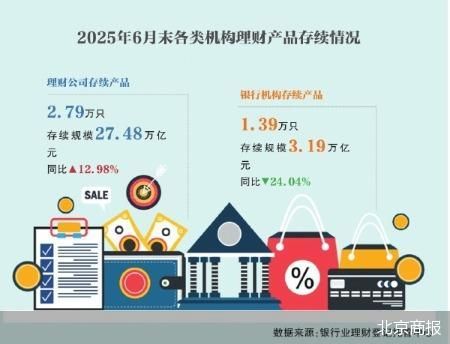
Core Viewpoint - The competition in the wealth management distribution market is intensifying as various financial institutions, including rural commercial banks, are expanding their partnerships with wealth management companies to capture the growing demand in lower-tier markets [1][3][4]. Group 1: Market Dynamics - Wealth management companies are increasingly targeting lower-tier cities as larger banks' sales channels become saturated [3][4]. - As of June, the total scale of wealth management products from wealth management companies reached 27.48 trillion yuan, accounting for nearly 90% of the market, while bank institutions held only 3.19 trillion yuan [1][6]. - The shift from self-operated to distribution models among small and medium-sized banks is becoming evident, driven by regulatory pressures to clear existing wealth management business by the end of 2026 [1][6][7]. Group 2: Strategic Partnerships - Wealth management companies are forming partnerships with local banks to enhance their distribution capabilities, moving towards a "distribution + empowerment" model [1][8]. - Recent agreements include partnerships between Agricultural Bank of China Wealth Management and Dongguan Rural Commercial Bank, as well as North Bank Wealth Management with Qujiang Rural Commercial Bank [3][4]. - In Shaanxi, multiple local financial institutions are collaborating with Bo Yin Wealth Management to expand their distribution efforts [4]. Group 3: Competitive Landscape - The wealth management industry is experiencing intensified competition, prompting companies to seek market share in less saturated areas [5][7]. - The regulatory environment is pushing small and medium-sized banks to transition from self-managed wealth management to distribution partnerships, creating opportunities for wealth management companies [5][6]. - The demand for diversified wealth management products is increasing among consumers in lower-tier markets, driven by rising income levels and urbanization [4][5]. Group 4: Future Outlook - The future collaboration between wealth management companies and local banks is expected to focus on product co-creation and digital tools to enhance sales and customer service capabilities [8][10]. - Wealth management companies need to provide comprehensive support to local banks, including training and marketing assistance, to ensure successful partnerships [10][11]. - The upcoming implementation of the "Commercial Bank Agency Sales Business Management Measures" will raise the bar for collaboration, increasing compliance costs and operational challenges for small banks [11].
博时基金市场异动陪伴8月18日:A股三大指数延续强势表现,创业板指涨2.84%
Xin Lang Ji Jin· 2025-08-18 08:11
♨博时基金市场异动陪伴 MACD金叉信号形成,这些股涨势不错! ‼ 今日A股三大指数继续走强,沪指上涨至近十年高点,创业板涨超2.8%。一方面,地缘风险缓和与外 部流动性宽松降低资金避险需求。美俄元首会晤推进安全谈判,叠加美联储9月降息概率升至九成以 上,推动全球资金转向新兴市场及成长板块。另一方面,增量资金持续入场成为间接助力。银行理财等 资金出现转向股市迹象,两融余额、两市成交额均重返2万亿量级,融资买入占比也触达10.5%,杠杆 资金对科技、券商等高弹性板块形成较强支撑。政策托底与新动能显现增强市场信心,AI算力、科技 自主可控等主线业绩兑现预期强化,与流动性宽松环境形成正向循环。 ‼ 央行二季度货政报告释放"稳物价、重结构"的审慎信号。其中,物价目标权重提升,将"促进物价合 理回升"列为政策重要考量,结合PPI低基数及"反内卷"政策对大宗商品价格的托底作用,年内PPI同比 触底回升可期。报告删除"降准降息"表述,强调"落实落细存量政策",货币政策维持"量宽价稳",重心 或转向存量工具效能释放而非增量宽松。尽管7月经济数据部分指标回落,但后续政策重点或在于中长 期效能与物价回升的协同性,而非短期过度刺激 ...

浦银理财李桦:坚守稳健定位,以多元配置服务实体与百姓财富
2 1 Shi Ji Jing Ji Bao Dao· 2025-08-18 06:47
Group 1 - The core viewpoint of the article highlights the development and positioning of the asset management industry, particularly focusing on the role of bank wealth management in providing stable, low-volatility investment options that aim for absolute returns [1][2]. - As of mid-August, the asset management scale of浦银理财 reached 1.45 trillion, having served 13 million clients, with all products this year achieving positive returns [1]. - The current market volatility is seen as a norm, leading to the belief that multi-asset allocation capabilities will become a core competitive advantage for asset management institutions [1]. Group 2 - The positioning of bank wealth management is defined as relatively low volatility and stable, with a focus on absolute returns, catering to the demand for low-volatility asset allocation [2]. - The asset management industry's mission remains to serve the real economy and preserve and increase the value of people's wealth, especially in the context of accelerating green transformation and deepening industrial upgrades [2].
年化收益超20%,科技牛带动,科技类理财收益率明显上行
Hua Xia Shi Bao· 2025-08-14 10:29
Core Viewpoint - The technology sector has seen a significant rise in stock prices, leading to substantial returns for bank wealth management products that have invested in technology assets [2][3]. Group 1: Performance of Technology Wealth Management Products - As of August 13, among 49 wealth management products with "technology" in their names, the highest yield since inception exceeded 20%, with 10 products yielding over 10% and 24 products yielding over 5% [2]. - The "全鑫权益" product from ICBC Wealth Management achieved an annualized yield of 20.3% over the past month and 10.97% over the past year as of August 14 [3]. - The "招银理财招卓专精特新" product has a cumulative yield of 13.55% since its inception, with a one-year volatility of 32.17% as of August 14 [3]. Group 2: Market Trends and Product Offerings - The technology sector has been bolstered by supportive policies, prompting wealth management firms to increase the creation and investment in technology-themed products [5]. - As of August 14, there are 49 existing products with "technology" in their names and 34 with "科创" (innovation) in their names, indicating a growing focus on technology investments [5]. - Most of the 83 existing products are fixed-income products, with a focus on investing in assets related to technological innovation while controlling risks [5]. Group 3: Investment Strategies and Risk Considerations - Wealth management products are increasingly focusing on ESG-compliant technology-related assets and high-grade bonds to mitigate credit risk [6]. - Investment managers emphasize that products with equity components tend to have higher net value volatility compared to pure fixed-income products, requiring investors to have a certain level of investment discipline and timing ability [4][6]. - Investors are advised to prioritize products with transparent underlying asset investments and strategies, focusing on high-credit-rated technology bonds or those clearly investing in leading technology firms [6].

股市走强,黄金失宠
和讯· 2025-08-14 09:30
Core Viewpoint - The article discusses the declining interest in gold investments amid a strong stock market performance, highlighting a significant reduction in gold ETF sizes and prices due to easing global trade tensions and shifting investor sentiment towards riskier assets [5][6][11]. Summary by Sections Gold ETF Performance - As of August 12, seven gold ETFs in China have seen a reduction of approximately 6.9 billion yuan in size over the past month, with notable declines in major ETFs such as Huaan and E Fund [4][5][11]. Market Sentiment and Price Trends - The COMEX gold futures contract fell below $3,400 per ounce, marking a significant drop of nearly 2.5% on August 11, the largest decline since May [5][12]. - The London spot gold price also decreased, closing at $3,348.02 per ounce on August 12, down 1.4% from its August high [5][12]. Investor Behavior - Investors are reallocating funds from gold to equities, driven by rising stock markets in China and the U.S., with the Shanghai Composite Index up approximately 4.8% in July [6][12][14]. - Despite the recent downturn, some financial institutions are increasing their allocations to "gold+" products, which include a minimum of 5% gold in their asset mix [7][15]. Long-term Outlook for Gold - Analysts from UBS and Goldman Sachs maintain a bullish long-term outlook for gold prices, projecting targets of $3,500 to $4,000 per ounce by 2026, supported by ongoing central bank demand and potential geopolitical tensions [7][18][20]. - The World Gold Council reports that a significant majority of central banks plan to increase or maintain their gold reserves, indicating a stable demand outlook [19]. Challenges for Retail Investors - Ordinary investors face challenges in gold investment, including decision-making, timing, and holding strategies, which could be mitigated by professional management through "gold+" products [8][16].

“资金洞察”系列报告(三):居民跑步入市了吗?
Western Securities· 2025-08-14 04:35
Group 1 - High-net-worth investors are actively entering the market, with significant inflows from private equity, leveraged funds, and speculative trading [1][11][14] - Private equity has seen a notable increase in institutional account openings, while individual account growth remains limited [14] - Leveraged funds have averaged daily inflows of 5.5 billion since July, with the current financing balance exceeding 2 trillion, a record high since 2015 [14][16] - Speculative trading has become active, with net inflows ranking just below the levels seen in 2015 [14][16] Group 2 - Resident funds have not significantly entered the market through public funds, with limited expansion in actively managed equity fund issuance and net subscriptions [2][18] - The issuance of actively managed equity funds remains at historical lows since the market shift in September 2022 [18] - Passive index funds are experiencing outflows, contrasting with the previous market conditions where funds flowed into equity ETFs [19][21] Group 3 - Retail investor participation is low, with current engagement levels not matching those of previous bull markets [3][27] - Retail fund inflows are limited, significantly weaker than the previous market conditions in September 2022 and February 2023 [27] - Recent data indicates a marginal decline in the balance of bank-to-securities transfers, suggesting that retail investors have not significantly entered the market [27][28] Group 4 - There is a growing trend of residents seeking higher returns through bank wealth management products due to excess savings and declining deposit rates [4][12][33] - The one-year fixed deposit rate has fallen below 1%, and the yield on popular wealth management products is only 1.05%, prompting a shift towards wealth management and fixed-income funds [4][33][34] - The combination of abundant funds and a scarcity of attractive assets is expected to accelerate the flow of resident funds into wealth management products, indirectly entering the equity market [4][12][34] Group 5 - Recent data shows a net outflow of 8.591 billion from foreign investments, particularly in financial, non-essential consumer goods, and industrial sectors [37][38] - Speculative trading saw a net inflow of 4.831 billion, primarily into the pharmaceutical, electronics, and machinery sectors [43][46] - Leveraged funds recorded a net inflow of 31.563 billion, focusing on electronics, machinery, and pharmaceuticals [48][53]