新能源

Search documents
【锋行链盟】科创板IPO全流程解析
Sou Hu Cai Jing· 2026-02-16 16:10
Core Viewpoint - The article outlines the comprehensive process of the IPO on the Sci-Tech Innovation Board (科创板), detailing the strict adherence to regulations set by the China Securities Regulatory Commission (CSRC) and the Shanghai Stock Exchange (SSE) throughout the entire IPO cycle [1]. Pre-IPO Preparation Phase - Companies must conduct self-assessments and strategic decisions, requiring collaboration with four core intermediaries [3] - Initial due diligence and issue rectification are essential steps before moving forward [3]. Counseling and Filing Phase - After signing a counseling agreement with the sponsor, companies must submit counseling materials to the local CSRC, initiating a counseling period typically lasting at least three months [3]. - The counseling process includes training on listing rules, corporate governance, and information disclosure requirements [5]. Application and Acceptance Phase - Companies must prepare application materials in accordance with the Sci-Tech Board's focus on "hard technology" across six key sectors [4]. - The selection of intermediary institutions is crucial, including sponsors, accounting firms, law firms, and asset appraisal agencies [4]. SSE Review Phase - The SSE employs an "inquiry-based review" process, involving multiple rounds of inquiries to uncover risks, requiring truthful responses from companies and intermediaries [6]. CSRC Registration Phase - Following SSE approval, application materials are submitted to the CSRC for registration review [9]. - The CSRC focuses on compliance with legal requirements and the accuracy of information disclosure during its review [12]. Issuance and Listing Phase - After receiving registration approval, companies conduct pre-roadshows and determine the issuance price range through market-based inquiries [15]. - The distribution of shares includes a minimum of 70% allocated to qualified institutional investors and a maximum of 30% to public investors [15]. Post-Listing Continuous Supervision Phase - Companies must adhere to ongoing regulatory requirements, including regular disclosures and maintaining corporate governance standards [14]. - The Sci-Tech Board has a stricter delisting system, with conditions triggering delisting procedures [15].

欧盟内讧升级!法国要对中国加税30%,德国却喊话:要向中国学习
Sou Hu Cai Jing· 2026-02-16 12:19
2026年初的欧洲政坛弥漫着不同寻常的紧张气氛。 2月11日,法国政府智库"高等战略与规划委员会"发布了一份引发轩然大波的研究报告。该份报告直指 中国工业体系拥有"欧洲难以复制的优势",其能源与用地成本比欧洲低30%至40%,高度一体化的产业 链和规模经济形成系统性竞争优势,甚至提出建议,主张对中国商品全面加税30%。这份被媒体解读 为"新广场协议"雏形的报告 与之相对,这德国总理默茨同日强调"反对狭隘保护主义""向中国学习"的演讲形成尖锐对立,将欧盟内 部关于中国政策的矛盾彻底公开化。 截止2025 年11 月, 中国与欧盟货物贸易进出口额为691.9亿美元 经济安全与市场开放的路线之争 目前法国推动的"欧洲优先"战略正在具体化为三项关键的措施:即将于下月公布的《工业加速法案》规 定了产品中"欧洲含量"的最低比例;针对关键领域外国投资的新限制条款,要求共享技术、雇佣当地工 人并与欧洲企业建立合资企业;以及对华贸易的"精准限制"清单。 这些政策背后是冰冷的数据——欧盟55%的制造业面临着来自中国的竞争消压力,其中德国受影响程度 达70%,法国则为36%。中国电动车在欧洲市场份额从5年前的3%飙升到了18%,直 ...
2025港股IPO年度全景复盘
Sou Hu Cai Jing· 2026-02-16 10:09
Core Insights - The strong resurgence of Hong Kong IPOs in 2025 is a central theme for the global capital markets, with nearly HKD 300 billion raised, reclaiming the top position in global IPO fundraising [2][7] - The Hong Kong IPO market has experienced a significant increase in both quantity and quality, with new listings up nearly 70% year-on-year and fundraising doubling compared to the previous year [2][3] Market Dynamics - The traditional dominance of internet and financial real estate sectors has been disrupted, with hard technology, advanced manufacturing, and biomedicine emerging as the three main pillars supporting the market [3][4] - Key sectors such as new energy, semiconductors, smart vehicles, and high-end equipment are now prominently represented in the Hong Kong market, enhancing its manufacturing base [3][4] Notable IPOs - Significant companies that went public in 2025 include: - CATL (宁德时代), raising approximately HKD 41 billion with a market cap of about HKD 920 billion and a PE ratio of around 18x [3] - Hengrui Medicine (恒瑞医药), a leader in innovative drugs, with a market cap of approximately HKD 320 billion and a PE of about 32x [3] - Sanhua Intelligent Control (三花智控), with a market cap of around HKD 180 billion and a PE of about 24x [3] - Haitian Flavoring and Food (海天味业), with a market cap of approximately HKD 420 billion and a PE of about 30x [3] - Chery Automobile (奇瑞汽车), with a market cap of around HKD 190 billion and a PE of about 12x [4] A+H Listing Trend - 2025 marked a significant year for A+H dual listings, with leading companies opting for this model to enhance global liquidity and valuation recovery [5][6] - The A+H model has become a standard for industry giants, reinforcing Hong Kong's position as the preferred overseas listing location for Chinese enterprises [6] Future Outlook - The recovery of the Hong Kong IPO market is seen as a result of multiple cyclical factors, including improved global liquidity, long-term valuation recovery, and the increasing demand for high-quality assets from mainland China [6][7] - Moving forward, the focus of the Hong Kong IPO market is expected to shift from quantity expansion to quality prioritization, with a stronger emphasis on industry logic over speculative trading [6][7]
怎么看全球产业格局之变
Sou Hu Cai Jing· 2026-02-16 03:16
Core Insights - The global industrial landscape is undergoing a systematic restructuring driven by unilateralism and protectionism, particularly from the U.S., leading countries to reassess and localize their industrial strategies to mitigate external risks [2][3]. Group 1: Characteristics of Industrial Restructuring - The restructuring is characterized by a shift from global integration to regionalization and a "1+N" multi-point layout, as countries seek to diversify production bases to enhance supply chain resilience. For instance, China's share of U.S. imports decreased from 21.6% in 2017 to 13.4% in 2024, while Mexico and Vietnam saw increases [3]. - The industrial value creation is transitioning from traditional manufacturing to service-oriented and green industries, with high-value services becoming integral to the industrial value chain. China's exports of new energy vehicles, lithium batteries, and photovoltaic products surged from 284.4 billion yuan in 2020 to 1.28 trillion yuan by 2025, a 3.5-fold increase [4]. - The technological innovation landscape is shifting from a unipolar to a multipolar model, with the U.S. leading in AI and high-end semiconductors, while the EU excels in green technology. This has led to a complex competitive environment where countries must invest heavily in independent R&D due to increasing technological barriers [7][12]. Group 2: Organizational and Regulatory Changes - The role of state intervention in industrial organization is becoming more pronounced, with countries employing strategic policies to influence industrial layouts. The U.S. and EU are using subsidies and regulations to shape their industrial ecosystems, leading to a competitive model centered around "chain master" enterprises [8][13]. - The weakening of traditional multilateral frameworks like the WTO is giving rise to a proliferation of regional trade agreements, which often include specific provisions for critical sectors like semiconductors and renewable energy, embedding values and standards into trade rules [8][13]. Group 3: Implications for China - To adapt to these profound changes, China must enhance its resilience and competitiveness by establishing itself as an indispensable hub in the global supply chain, leveraging its vast domestic market to attract high-end production factors [14]. - The focus should be on developing new productive forces and optimizing industrial structures, particularly by integrating productive services into the entire value chain to increase added value and expanding green exports [14][15]. - Strengthening technological advantages through foundational and original innovations is crucial, particularly in key areas like chip design, to overcome technological barriers and establish leadership in international standards [15][16].

晶采观察丨年味“科技范”!新质生产力焕新中国年
Yang Guang Wang· 2026-02-16 01:03
Core Viewpoint - The integration of technology into traditional practices is reshaping the Chinese New Year experience, highlighting the emergence of new productive forces that enhance both production and daily life [1][2][3] Group 1: Technological Integration - The use of AI-generated Spring Festival couplets reflects a shift towards technology-driven traditions, moving away from handwritten practices [1] - Consumers are increasingly purchasing high-tech items such as smart cleaning robots and AI cooking machines, indicating a trend towards high-end manufacturing and intelligent algorithms [2] - The proliferation of new energy vehicles and advanced communication networks (5G/6G) is transforming family reunions and travel experiences during the holiday [2] Group 2: Policy Support and Economic Impact - The Chinese government is actively supporting sectors like artificial intelligence, new energy, and high-end manufacturing through policies and subsidies, facilitating the adoption of advanced technologies in everyday life [1][2] - A total of 2.05 billion yuan has been allocated for the "Happy New Year" special event, which includes consumer vouchers and subsidies to stimulate spending during the holiday [1] - The combination of policy support and technological advancements is making high-tech products more affordable and accessible to the general public [2] Group 3: Cultural Transformation - The new year celebrations are characterized by a shift towards greener, smarter, and more humanized experiences, moving away from high-energy consumption and inefficiency [3] - The integration of technology into traditional customs enhances emotional connections and makes cultural practices more vibrant and engaging [3]
一场开在沙漠里的早班会
Xin Lang Cai Jing· 2026-02-15 15:55
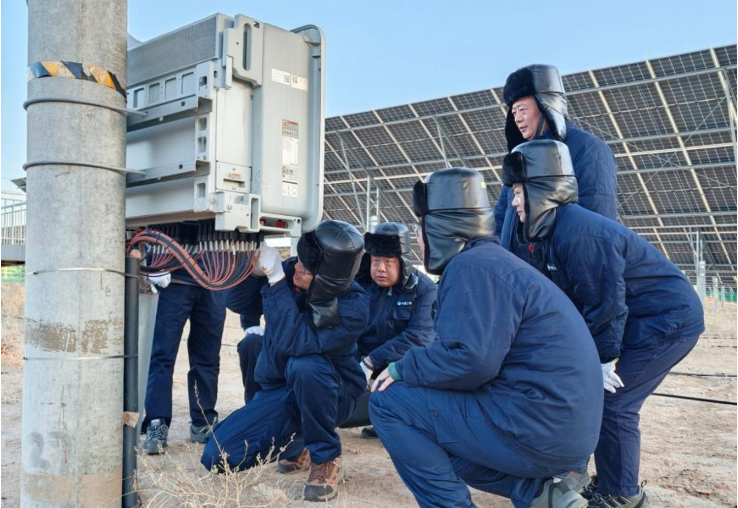
Core Viewpoint - The article highlights the proactive measures taken by the Three Gorges Group at the Kubuchi Desert photovoltaic power station to ensure operational safety and energy supply during the Chinese New Year, emphasizing the implementation of a "separation of operations and maintenance" model to enhance efficiency and skill development among staff [1][4][9]. Group 1: Operational Efficiency - The early morning meeting at the photovoltaic power station focused on troubleshooting a low insulation resistance alarm from an inverter, demonstrating a hands-on approach to skill enhancement and fault resolution [3][4]. - The "separation of operations and maintenance" model was initiated at the Kubuchi Desert photovoltaic power station, allowing dedicated teams to focus on monitoring and fault management, thereby improving operational efficiency [7][9]. - The maintenance team successfully completed fault checks on 304 box transformers within a week, showcasing the effectiveness of the new operational model [9]. Group 2: Employee Engagement and Training - Employees showed enthusiasm for learning and skill development, with new hires actively seeking hands-on experience in troubleshooting [3][4]. - The practical training session transformed the early meeting into an immersive training environment, enhancing team collaboration and knowledge sharing [4][9]. - The new operational model has led to increased employee motivation and higher work efficiency, contributing to a robust operational support system for energy supply during peak demand periods [9]. Group 3: Renewable Energy Contribution - The Kubuchi Desert photovoltaic power station, in conjunction with energy storage systems, is effectively contributing to regional energy supply and supporting low-carbon transition efforts [11]. - The integration of "light-storage interaction" models is enhancing the stability of green energy supply, further solidifying the role of renewable energy in the region [11].
习近平:当前经济工作的重点任务
财联社· 2026-02-15 07:13
Core Viewpoint - The article emphasizes the importance of focusing on key tasks for economic work in 2026, highlighting the need to strengthen domestic demand and build a robust domestic market while promoting consumption and investment [1]. Group 1: Economic Strategy - The article outlines the need to implement actions to boost consumption, including urban and rural income increase plans and optimizing the supply of quality goods and services [1]. - It stresses the importance of stabilizing investment and increasing the scale of central budget investments, while optimizing the use of local government special bonds [1]. Group 2: Innovation and Reform - The article advocates for innovation-driven growth, emphasizing the role of technology in industrial upgrades and the establishment of international technology innovation centers in key regions [2]. - It calls for reforms to enhance market vitality, including the establishment of a unified national market and the promotion of private sector development [2]. Group 3: International Cooperation - The article highlights the need for open international cooperation, promoting trade and investment integration, and expanding service sector openness [3]. - It encourages the development of digital and green trade, as well as the signing of more regional and bilateral trade agreements [3]. Group 4: Sustainable Development - The article stresses the importance of green transformation, advocating for carbon reduction and pollution control while enhancing green development momentum [4]. - It outlines plans for energy system construction and solid waste management to support environmental sustainability [4]. Group 5: Social Welfare - The article emphasizes prioritizing people's livelihoods, focusing on employment stability and improving access to education and healthcare [5]. - It highlights the need for policies to support vulnerable groups, including the elderly and those in flexible employment [5]. Group 6: Risk Management - The article discusses the importance of risk management in key areas, particularly in stabilizing the real estate market and addressing local government debt risks [6]. - It advocates for measures to optimize debt restructuring and mitigate financing platform risks [6].

快充、超充、换电、加氢,高速路服务区实现多元补能
Xin Jing Bao· 2026-02-15 04:37
Core Insights - The article highlights the transformation of highway service areas in China, focusing on the integration of diverse energy supply options and enhanced customer experiences during the Spring Festival travel period [1][2][11]. Group 1: Energy Supply Innovations - The Beijing Majia Bridge service area features the first hydrogen refueling station on a highway in Beijing, with two 35 MPa hydrogen dispensers capable of serving around 100 cold chain transport vehicles [3]. - The Wangqingtuo service area is the first in the Beijing-Tianjin-Hebei region to operate entirely on green energy, utilizing photovoltaic systems for zero-carbon operations and offering over 50 charging points [6]. - The Hubei Jingzhou East service area is recognized as the first comprehensive energy supply station in the country, equipped with mobile charging robots during peak holiday periods and real-time display screens for fuel and charging queue information [11]. Group 2: Enhanced Customer Experience - The Beijing Baige service area has upgraded its charging facilities to accommodate super-fast charging batteries, significantly reducing charging wait times and enhancing the overall travel experience [2]. - The Tianjin Sicuandian service area features a NIO battery swap station, allowing drivers to change batteries in about three minutes without leaving their vehicles, thus improving convenience during long trips [5]. - The Hebei Xu Shui service area has been redesigned to reflect Song Dynasty architecture, creating a unique atmosphere that combines cultural elements with modern amenities, including a variety of food options and a marketplace feel [9]. Group 3: Cultural and Recreational Aspects - The Tianjin Wangqingtuo service area offers a "Driver's Home" with amenities such as sofas, washing machines, and showers, catering to long-distance drivers and enhancing their comfort [6]. - The Hebei Yongqing service area incorporates a garden-style park and local food offerings, providing a relaxing environment for travelers [7]. - The Hubei Jingzhou East service area combines traditional architectural styles with modern commercial facilities, creating a shopping and dining experience akin to a small mall [11].
27国要对华加税30%?法国打响第一枪,美财长一句话定义中美关系
Sou Hu Cai Jing· 2026-02-15 03:42
Group 1 - France has proposed a 30% tariff on Chinese goods to address the significant trade deficit with China, suggesting that the EU should either impose these tariffs or allow the euro to depreciate by 20% to 30% against the yuan [1][3][21] - The report indicates that 55% of manufacturing output in the EU is facing direct competition from China, with Germany at 70% and France at 36%, highlighting the pressure on European industries from Chinese manufacturing [7][10] - The proposal reflects a shift in Europe’s stance from free trade to protectionism, as the continent struggles to compete with China's manufacturing capabilities, which are often 30%-40% cheaper [8][10] Group 2 - The report serves as a political maneuver by France to unify EU member states against China, but it may face resistance from countries like Germany and Hungary, which have strong economic ties with China [10][12] - The U.S. has shifted its strategy from aggressive trade wars to a more pragmatic approach, recognizing that tariffs have not effectively reduced the trade deficit with China, which reached $361 billion in 2025 [14][16] - The U.S. is now focusing on domestic manufacturing and reducing risks in key sectors while maintaining trade relations in other areas, indicating a strategic pivot rather than a complete decoupling from China [20][22]
拟对华加税30%,法国欲打第一枪,中方点名警告后,德风向先变了
Sou Hu Cai Jing· 2026-02-15 03:29
Core Viewpoint - France has proposed to the EU to impose approximately 30% tariffs on Chinese goods, driven by concerns over competition from China and the US, as highlighted by President Macron's earlier warnings about Europe's economic vulnerability [1][3]. Group 1: France's Proposal and Economic Context - The proposal for increased tariffs is rooted in France's competitive anxiety, as Europe faces sluggish economic growth and declining manufacturing competitiveness [1]. - An internal EU report indicates that Europe lags significantly behind China and the US in investments in emerging fields such as green technology, artificial intelligence, and quantum computing [1]. - France advocates for a "Europe First" strategy, emphasizing trade protection and industrial support policies, particularly in sectors like renewable energy, automotive, and photovoltaics, where Chinese manufacturing poses a significant challenge [1]. Group 2: Germany's Position and Economic Implications - Germany's cautious stance on the proposed tariffs is influenced by its heavy reliance on exports and close trade ties with China, making it wary of potential negative impacts on its manufacturing sector [3][4]. - German Chancellor Merz highlighted the stark economic growth disparities, noting that China's average annual growth rate over the past 20 years is around 8%, compared to 1% for the EU, urging for reforms to improve internal efficiency and reduce regulatory barriers [3][4]. - Germany's focus is on enhancing its competitiveness rather than imposing trade barriers, reflecting a pragmatic approach to the challenges posed by external competition [4]. Group 3: Future Policy Directions and Global Impact - The future policy direction of the EU will depend on internal coordination among member states, with potential outcomes ranging from increased trade protection to a focus on internal reforms and efficiency improvements [6]. - The choices made by Europe will have significant implications for the global economic landscape, affecting global supply chains and trade systems, given the substantial trade volume and industrial connections between China and the EU [6]. - A confrontational stance could lead to adverse effects for both parties, emphasizing the need for cooperation alongside competition [6].