
航空航天

Search documents
钢研高纳(300034.SZ):公司ODS合金主要应用于航空航天领域
Ge Long Hui· 2026-01-26 12:46
Group 1 - The core viewpoint of the article is that the company Steel Research High-Tech (300034.SZ) has indicated that its ODS alloy is primarily used in the aerospace sector [1] Group 2 - The company engages in the production of ODS alloys, which are specialized materials with applications in high-performance industries [1] - The aerospace industry is highlighted as a key market for the company's products, suggesting a focus on advanced technology and innovation [1]

汽车行业周报:人形机器人+航空航天双轮驱动,旋转变压器迎广阔新兴市场
Huaxin Securities· 2026-01-26 12:24
Investment Rating - The report maintains a "Buy" rating for the automotive industry, particularly focusing on humanoid robots and aerospace sectors [2][10]. Core Insights - The humanoid robot market is expected to significantly drive the demand for rotary transformers, with a projected market size of 6.15 billion yuan by 2030 and 47.1 billion yuan by 2035, reflecting a CAGR of 85.9% from 2026 to 2035 [4][27]. - The aerospace sector is also experiencing growth, with satellite launches increasing rapidly, leading to a forecasted rotary transformer market size of 700 million yuan by 2030 and 1.8 billion yuan by 2035, with a CAGR of 22.7% from 2026 to 2035 [5][30]. Summary by Sections 1. Humanoid Robots and Aerospace Driving Rotary Transformer Market - Rotary transformers are well-suited for humanoid robots due to their strong shock resistance and durability, making them ideal for complex operational environments [4][24]. - The market for rotary transformers in humanoid robots is expected to surpass traditional markets, as they replace encoders in robotic joints [27]. 2. Market Performance of Humanoid Robots - The humanoid robot sector is anticipated to see a substantial increase in market size, driven by the need for high reliability and longevity in robotic joints [4][27]. - The report highlights the importance of rotary transformers in enhancing the performance of humanoid robots, particularly in their joints and dexterous hands [27]. 3. Market Performance of Aerospace Sector - The report notes a significant increase in satellite launches, with SpaceX planning to launch 42,000 satellites by 2033, which will boost the demand for rotary transformers in satellite attitude and orbit control systems [5][30]. - The rotary transformer market in the aerospace sector is projected to grow steadily, with increasing applications in satellite systems [30]. 4. Industry Data Tracking - The global rotary transformer market is expected to grow from approximately 4.445 billion yuan in 2024 to 11.851 billion yuan by 2031, with a CAGR of 15.3% from 2025 to 2031 [33]. - The automotive sector's rotary transformer market is projected to grow from 1.334 billion yuan in 2024 to 3.555 billion yuan by 2031 [33]. 5. Company Announcements - The report emphasizes the rapid growth of domestic companies like Yingshuo Technology, which has captured a significant market share in the rotary transformer sector, particularly in the new energy vehicle market [44][61]. - Yingshuo Technology's revenue has shown a CAGR of 176.6% from 2020 to 2022, with a strong focus on the new energy vehicle sector [44][55].


三维通信:共同投资设立合伙企业 投资于智能制造、航空航天、新能源等高新技术行业的非上市股权
Xin Lang Cai Jing· 2026-01-26 12:00
转自:智通财经 【三维通信:共同投资设立合伙企业 投资于智能制造、航空航天、新能源等高新技术行业的非上市股 权】智通财经1月26日电,三维通信(002115.SZ)公告称,公司与杭州九智投资管理有限公司等共5位合 伙人签署合伙协议,共同投资杭州渠智股权投资合伙企业(有限合伙),公司作为有限合伙人认缴出资 2,500万元。合伙基金可投资于智能制造、航空航天、新能源等高新技术行业的非上市股权,并可以通 过投资或受让资产管理产品份额或合伙企业的有限合伙份额间接投资非上市股权标的。 ...

神剑股份:公司高端装备制造领域包括航空航天及轨道交通两方面业务
Zheng Quan Ri Bao Wang· 2026-01-26 11:45
证券日报网讯1月26日,神剑股份(002361)在互动平台回答投资者提问时表示,公司高端装备制造领 域包括航空航天及轨道交通两方面业务。根据公司2024年年度报告,高端装备制造业务占公司营业收入 10.92%。 ...

马斯克:自动驾驶、机器人、天基能源助特斯拉与SpaceX领跑
Sou Hu Cai Jing· 2026-01-26 07:49
Core Insights - Elon Musk believes that Tesla and SpaceX will ultimately surpass their competitors due to advancements in autonomous driving, robotics, and space-based energy, which will fundamentally reshape economic scales [1]. Group 1: Tesla - Tesla's market value has reportedly exceeded the combined total of all other automotive manufacturers, driven by its autonomous driving technology [5]. - The potential impact of Tesla's humanoid robot, Optimus, is significant, with Musk suggesting that its mass production could elevate global GDP by an order of magnitude [5]. Group 2: SpaceX - SpaceX's valuation has surpassed the total of the six largest defense companies in the U.S., indicating its substantial economic potential [3]. - Musk asserts that the economic value of the space-based industry will eventually exceed the total value of the Earth’s economy, with space energy being approximately 100,000 times more abundant than what Earth can provide [3].



C919生产开门红,“今年有望每15天内造一架”
Guan Cha Zhe Wang· 2026-01-26 07:35
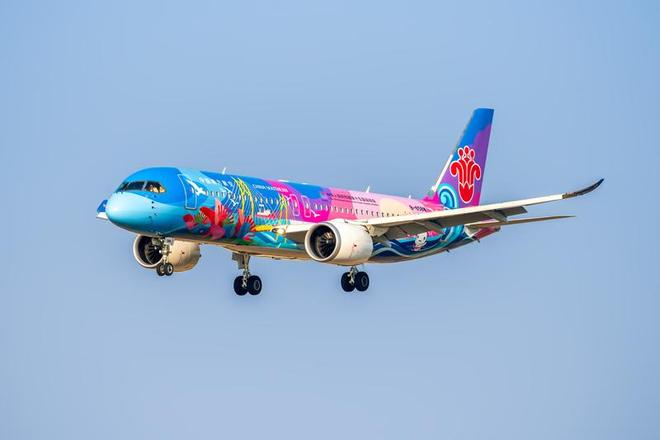
Core Viewpoint - The commercial operation of China's C919 aircraft is steadily progressing, with production and delivery accelerating, aiming for a target of at least 28 deliveries in 2026, with a production rate of one aircraft every 10 to 15 days expected [1][4][5]. Production and Delivery - In 2025, COMAC delivered a total of approximately 15 C919 aircraft, including 6 to Air China, 4 to China Eastern Airlines, and 5 to China Southern Airlines, marking an increase from 12 deliveries in 2024 but falling short of the initial target of 75 [2][5]. - The supply chain issues that hindered production in the previous year are gradually improving, with 8 of the 15 aircraft delivered in November and December [2][5]. - The company anticipates that the supply chain situation will continue to improve in the new year, with two C919 aircraft already completed and entering the delivery process at the start of 2026 [4][5]. Engine Supply and Political Factors - The reliance on Western-made LEAP-1C engines poses a challenge for COMAC, as political factors can disrupt the procurement process, although the company is working closely with CFM International to ensure a steady supply [5][6][7]. - Analysts suggest that while the political interference in engine supply is unavoidable, strengthening cooperation with CFM International is the most feasible way for COMAC to increase production in the short term [7]. Market Position and Future Prospects - The C919 has already transported over 4 million passengers since its domestic operation began in May 2023, and the order backlog continues to grow, with major airlines planning to purchase at least 100 aircraft each by 2031 [10]. - The current share of domestically produced aircraft in China's civil aviation fleet has increased from 1.3% in 2019 to 4.7% [10]. - COMAC is actively pursuing international airworthiness certification for the C919, which is crucial for competing with Boeing and Airbus [10][11].
ETF今日收评 | 黄金股相关ETF涨超8%,卫星ETF跌超8%
Sou Hu Cai Jing· 2026-01-26 07:31
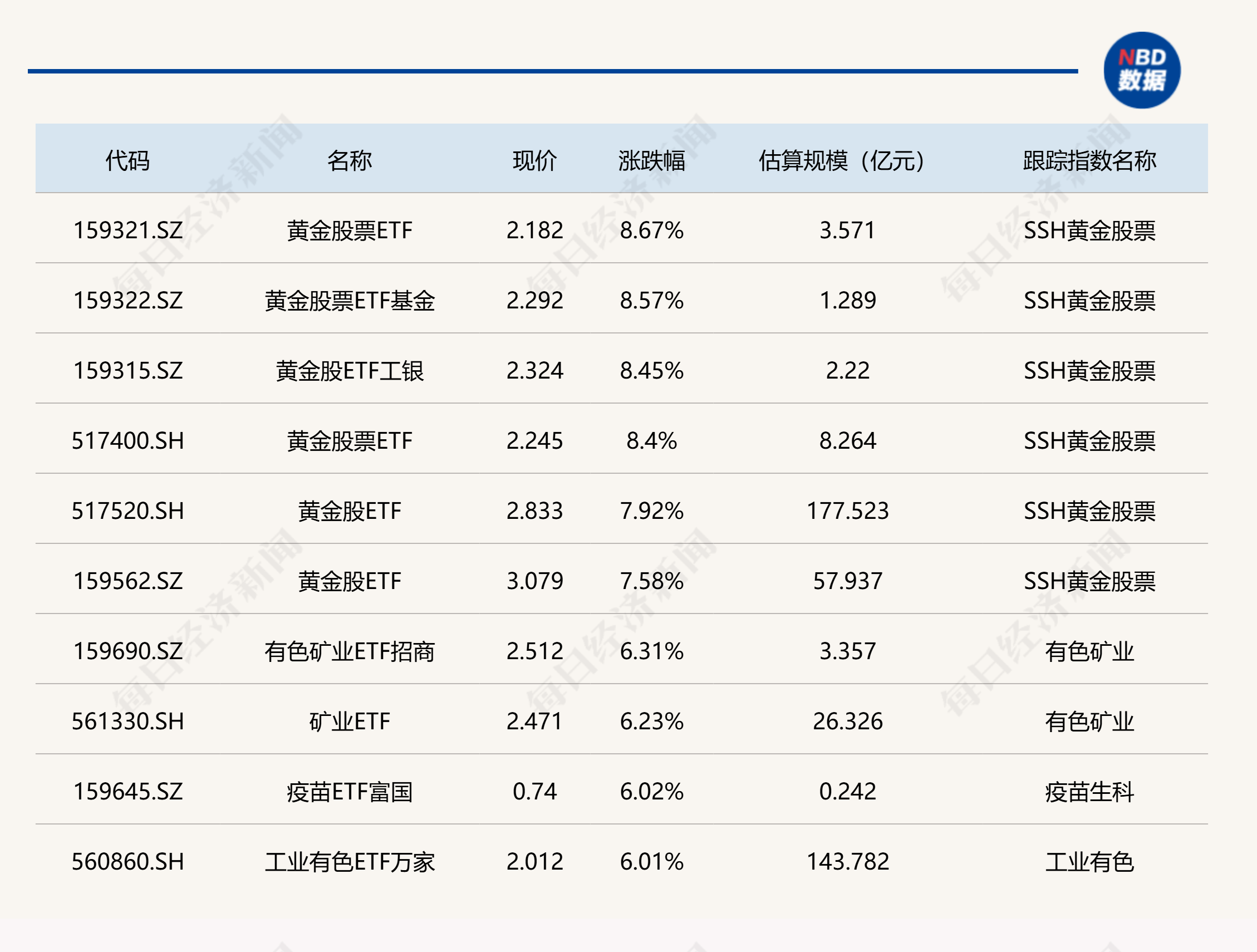
Market Overview - The market experienced fluctuations throughout the day, with significant divergence between large and small indices. The non-ferrous metals sector led the gains, particularly in precious metals, while oil and gas concepts also showed strength. The chemical sector saw a rebound, whereas commercial aerospace and semiconductor equipment sectors faced notable declines [1]. ETF Performance - Several gold-related ETFs saw increases exceeding 8%, indicating strong investor interest in gold stocks [1]. - Specific ETF prices include: - 159321.SZ Gold Stock ETF at 2.182 - 159322.SZ Gold Stock ETF Fund at 2.292 - 159315.SZ Gold Stock ETF ICBC at 2.324 - 517400.SH Gold Stock ETF at 2.245 - 517520.SH Gold Stock ETF at 2.833 - 159562.SZ Gold Stock ETF at 3.079 - 159690.SZ Non-ferrous Mining ETF at 2.512 - 561330.SH Mining ETF at 2.471 - 159645.SZ Vaccine ETF at 0.74 [2]. Gold Market Insights - On January 26, international spot and futures gold prices surpassed $5000 per ounce, marking a historic high. Analysts suggest that factors such as expectations of Federal Reserve interest rate cuts, instability in the US dollar, midterm elections in the US, and geopolitical uncertainties could drive further increases in gold prices [3]. Satellite Sector Analysis - The satellite ETF sector experienced declines, with the following notable drops: - 563230.SH Satellite ETF down 8.16% - 159218.SZ Satellite Industry ETF down 7.97% - 512630.SH Satellite ETF GF down 7.91% - 563790.SH Satellite ETF Penghua down 7.46% - 159283.SZ General Aviation ETF down 6.84% - 159206.SZ Satellite ETF down 6.71% [4][5]. - A brokerage firm indicated that during the 14th Five-Year Plan period, commercial aerospace is expected to become a key driver of new productive forces and high-quality technological development in China. The number of satellite launches is anticipated to accelerate by 2026, with private commercial rocket companies expected to play a significant role alongside state-owned enterprises, supporting high-frequency launch demands. Investment opportunities in China's satellite internet industry chain are viewed positively for 2026 [5].
太空新基建有望带来万亿级市场爆发期,航空航天ETF(159227)单日“吸金”近2亿
Xin Lang Cai Jing· 2026-01-26 03:25
Core Viewpoint - The aerospace industry is experiencing significant volatility, with major stocks declining sharply, while the market anticipates a substantial growth phase driven by advancements in commercial space technology and infrastructure by 2035 [1][2]. Group 1: Stock Performance - The CN5082 aerospace industry index has seen significant declines, with stocks like Yaguang Technology down 13.41%, China Satellite down 10.00%, and Hangfa Technology down 9.60% [1]. - The Aerospace ETF (159227) is currently priced at 1.48 yuan, with a trading volume of 4.85 billion yuan and a turnover rate of 15.23% [1]. Group 2: Market Activity - The Aerospace ETF has recorded a net inflow of 1.92 billion yuan, indicating active market participation [1]. - The average daily trading volume for the Aerospace ETF over the past month is 7.06 billion yuan, reflecting strong investor interest [1]. Group 3: Industry Outlook - The 2026 Beijing International Commercial Aerospace Forum highlighted that the global space economy is expected to reach 1.8 trillion USD by 2035, driven by new infrastructure developments [1]. - According to Western Securities, the domestic commercial aerospace sector is entering a critical phase of policy support and technology validation from 2024 to 2025, with 2026 potentially marking the start of a commercialized cycle [1]. - The successful recovery and reflight validation of rockets like the "Zhuque-3" are anticipated to shift the sector from a thematic market to a mainline market [1]. Group 4: ETF Composition - The Aerospace ETF closely tracks the CN5082 index, covering key segments such as aerospace equipment, satellite navigation, and new materials, with commercial aerospace concepts accounting for 70% of its weight [2]. - Major holdings in the ETF include industry leaders like Aerospace Development, China Satellite, and AVIC [2].
航亚科技
2026-01-26 02:50
Summary of the Conference Call on Hangya Technology Company Overview - **Company**: Hangya Technology - **Industry**: Aerospace components, specifically focusing on aviation engines and gas turbines - **Core Business**: Two main segments - aviation engine components and orthopedic implants, with a strong emphasis on aviation engine parts [9][10] Key Points and Arguments Market Demand - **Aviation Engine Demand**: Global demand for aviation engines is surging due to increased passenger turnover and the need for aircraft maintenance. The global passenger turnover is projected to reach 93 trillion in 2024, an 11% year-on-year increase, with a seat occupancy rate at a historical high of 85% [2][3] - **Aircraft Replacement**: It is estimated that 80% of the current commercial aircraft will need replacement within the next 20 years due to aging fleets, with the average age of commercial aircraft currently at 14.8 years [2][17] - **Maintenance Market Growth**: The demand for aircraft maintenance is rising, driven by older aircraft and increased maintenance costs due to engine-related groundings [3][4] Company Positioning - **Technological Edge**: Hangya Technology has a high technical barrier in precision forging of blades, gaining recognition from international clients. The company is accelerating its entry into overseas supply chains, capitalizing on the tight supply chain situation [2][6] - **Client Base**: The company has established long-term agreements with major clients like Safran and Rolls-Royce, securing a significant share of the market for compressor blades [10][34] Financial Performance - **Revenue Growth**: The company has shown consistent revenue growth from 2018 to 2024, with a recovery in overseas revenue share post-pandemic. The projected net profit for 2026 and 2027 is estimated at 202 million and 290 million, respectively, with a valuation of 33 times earnings [11][38] - **Order Backlog**: As of mid-2025, GE's aviation business had an order backlog of $12.38 billion, reflecting a 157% increase from the previous year, indicating strong demand in the aviation sector [4][5] Supply Chain Challenges - **Supply Chain Bottlenecks**: The global supply chain for aviation components is under strain, particularly for parts produced in Europe, affecting delivery capabilities [6][20] - **Material Costs**: Fluctuations in raw material prices, particularly for titanium and high-temperature alloys, pose risks to profitability [38] Competitive Landscape - **Market Position**: Hangya Technology is positioned in the midstream of the aerospace supply chain, focusing on precision forging and machining of components, which are critical for engine performance [14][15] - **Industry Competitors**: The company competes with other firms in the precision forging sector, such as AVIC Heavy Machinery and Parker Hannifin, but distinguishes itself through its unique technology and client relationships [15][38] Risks - **Client Concentration**: A high concentration of revenue from a few key clients (e.g., Safran and Rolls-Royce) presents risks related to geopolitical factors and market dynamics [38] - **Talent Retention**: The potential loss of technical talent and increasing market competition are additional risks that could impact future growth [38] Additional Important Information - **Technological Development**: The company is advancing its capabilities in precision machining and has received various international certifications for its processes [36][37] - **Future Outlook**: The company is optimistic about its growth trajectory, particularly in the maintenance and repair market, as well as its ability to capture more market share in the gas turbine sector [16][38] This summary encapsulates the key insights from the conference call regarding Hangya Technology's market position, financial outlook, and the challenges it faces in the aerospace industry.


激浊扬清,周观军工行业第154期:大国之翼,东方风来
Changjiang Securities· 2026-01-26 02:35
Investment Rating - The report maintains a "Positive" investment rating for the aerospace and defense industry [4] Core Insights - The domestic commercial aircraft market in China is projected to reach approximately 10 trillion yuan over the next 20 years, with an expected demand of over 400 aircraft per year by 2029 [15][18] - The C919 aircraft family has expanded with the introduction of the C919-600 highland variant, which is designed for high-altitude operations, marking a significant step in China's civil aviation equipment development [14] - The report highlights the trend towards self-sufficiency in domestic commercial aircraft engines, indicating a potential to break the existing monopoly in the market [41] Summary by Sections Section 1: C919 Aircraft Development - The C919-600 highland variant has been publicly unveiled, designed specifically for high-altitude routes, enhancing adaptability for challenging environments [14] - The C919 family now includes basic, extended, and highland variants, with a steady progression towards a comprehensive product matrix [14] Section 2: Market Demand and Projections - The domestic commercial aircraft market is expected to be 2.5 times larger than the current military aircraft market, with a forecasted demand of 9,856 aircraft and a market size of 103.53 billion yuan over the next 20 years [15][17] - By 2029, the demand for new commercial aircraft in China's civil aviation fleet is projected to exceed 400 units annually, with specific annual requirements outlined for the years 2025 to 2029 [18][19] Section 3: Engine Market Dynamics - The global commercial aircraft engine market is anticipated to exceed 13 trillion yuan over the next 20 years, with China's market expected to surpass 2.9 trillion yuan [43][45] - The report indicates a significant mismatch in supply and demand for commercial aircraft engines globally, with a strong push for domestic development of aviation power systems [52][59] Section 4: Commercial Aerospace Developments - Blue Arrow Aerospace's IPO status has changed to "under inquiry," indicating a rapid acceleration in the commercial space sector [71] - The report outlines plans for multiple rocket launches in 2026, with a focus on both near-Earth and deep-space exploration, highlighting the increasing activity in China's commercial space industry [77][86] Section 5: Satellite Manufacturing and Launch Capabilities - The report notes that domestic satellite manufacturing capacity is robust, with several companies capable of producing hundreds of satellites annually, which is expected to drive down costs [99][100] - The establishment of new liquid rocket launch facilities at the Hainan commercial launch site is set to enhance China's capabilities in commercial space launches [108]
