
啤酒

Search documents
一周内三家企业冲刺港股上市 豫企扬帆香江秀出自信范儿
He Nan Ri Bao· 2026-01-18 23:45
Group 1 - The pace of Henan enterprises planning to list in Hong Kong has significantly accelerated, with three companies advancing their listing processes within a week, marking an unusual frequency in the history of Henan's capital market [1] - Muyuan Foods has successfully passed the Hong Kong Stock Exchange listing hearing, positioning itself as the world's largest pig farming enterprise, while Hanwei Technology and Jinxing Beer have also announced their plans to list in Hong Kong [1] - Other Henan enterprises, such as Real Bio, Banu Hotpot, and United Information Technology, are also actively preparing for their Hong Kong listings, contributing to a growing trend of Henan companies seeking to enter the capital market [1] Group 2 - The recent surge in Hong Kong listings is driven by a resonance of policies, market conditions, and corporate needs, with the Henan government introducing a high-quality development action plan for the private economy and establishing a "green channel" for companies seeking to list [2] - Listing in Hong Kong not only injects capital into enterprises but also encourages them to enhance governance structures and management standards according to international norms, creating a dual empowerment effect in capital markets [2] - The concentration of Henan enterprises planning to list reflects the province's deeper integration into domestic and international dual circulation, showcasing a transformation of key variables into significant increments for high-quality development [2]


豫企扬帆香江秀出自信范儿
Sou Hu Cai Jing· 2026-01-18 23:14
Group 1 - The pace of Henan enterprises planning to list in Hong Kong has significantly accelerated, with three companies advancing their listing processes within a week, which is rare in the history of Henan's capital market [1] - Muyuan Foods, the world's largest pig farming company, has successfully passed the Hong Kong Stock Exchange listing hearing, moving closer to its listing [1] - Hanwei Technology announced its plan to list in Hong Kong, aiming to leverage the platform for international expansion [1] - Jinxing Beer submitted its main board listing application to the Hong Kong Stock Exchange, marking the beginning of local beer companies' engagement with international capital markets [1] Group 2 - The recent wave of listings is driven by a synergy of policies, market conditions, and corporate needs, with the Henan government promoting high-quality development of the private economy and establishing a "green channel" for companies seeking to list [1] - Listing in Hong Kong not only injects capital into enterprises but also encourages them to improve governance structures and management standards according to international norms [2] - Leading companies are utilizing A-shares for high valuation financing while expanding international capital channels through Hong Kong listings, creating a dual empowerment effect in the capital market [2] - The recent surge in Henan enterprises planning to list reflects the province's deeper integration into domestic and international dual circulation, showcasing a transformation of key variables into significant growth for high-quality development [2]
【转|太平洋食饮-26年度策略】底部向阳,寻找结构性亮点
远峰电子· 2026-01-18 11:38
Overall Sector Review - The food and beverage sector significantly underperformed the market, with a year-to-date decline of -0.62%, lagging behind the Shanghai Composite Index by 15.0 percentage points [2] - The sector experienced a deep correction after an initial rebound driven by expectations of consumption recovery and supportive policies, but the actual recovery rate was lower than anticipated, leading to a consensus on weak domestic demand [2] Subsector Performance - The snack sector outperformed with a year-to-date increase of 28.88%, driven by channel expansion and a revenue growth rate of 30.97% in the first three quarters [4] - Soft drinks also showed resilience with a 10.11% stock price increase, benefiting from strong travel demand and low-cost, high-frequency consumption [4] - The restaurant chain sector saw a rebound with gains of approximately 10.34% and 10.29% for pre-processed and baked goods, respectively [4] - The liquor sector, particularly high-end liquor, faced challenges with weaker sales and declining prices, while beer performance was supported but affected by high-end market constraints [4] Investment Insights - The sector is under pressure from deflationary trends and a weak recovery, with consumer confidence remaining low, indicating a shift to a "new normal" of low growth [8] - High-end consumption has shown slight recovery due to stock market wealth effects, but sustainability remains a concern [9] - The food and beverage sector's valuation is at historical lows, with a current PE (TTM) of 21.9X, indicating potential investment opportunities in undervalued segments [12] Fund Holdings - As of Q3 2025, the food and beverage sector's fund holdings decreased to 6.38%, nearing levels seen in 2016, with the liquor segment comprising 5.52% of this [14] - Fund holdings in the liquor sector increased for certain subsectors, including white liquor and seasoning products, while others saw declines [16] Long-term Trends - The liquor industry is undergoing its longest adjustment period since 2003, with significant price corrections and a potential bottoming out of valuations [21] - The white liquor sector has underperformed the market with a year-to-date return of -4.87%, reflecting weak demand and a divergence from broader market trends [24] - The third quarter of 2025 saw a significant decline in revenue and net profit for the white liquor sector, indicating a deep adjustment phase [27] Pricing Dynamics - The white liquor market is experiencing a general decline in prices, particularly in high-end segments, while lower price segments show resilience [29] - The average price of high-end products like Moutai has dropped significantly, while mid-range and lower-range products have maintained stability or slight increases [31] Investment Recommendations - The white liquor sector is advised to focus on inventory reduction and demand recovery, with a preference for leading brands that can maintain pricing power and product stability [32]







河南父子卖啤酒 ,一年分红超3亿
Sou Hu Cai Jing· 2026-01-18 07:00
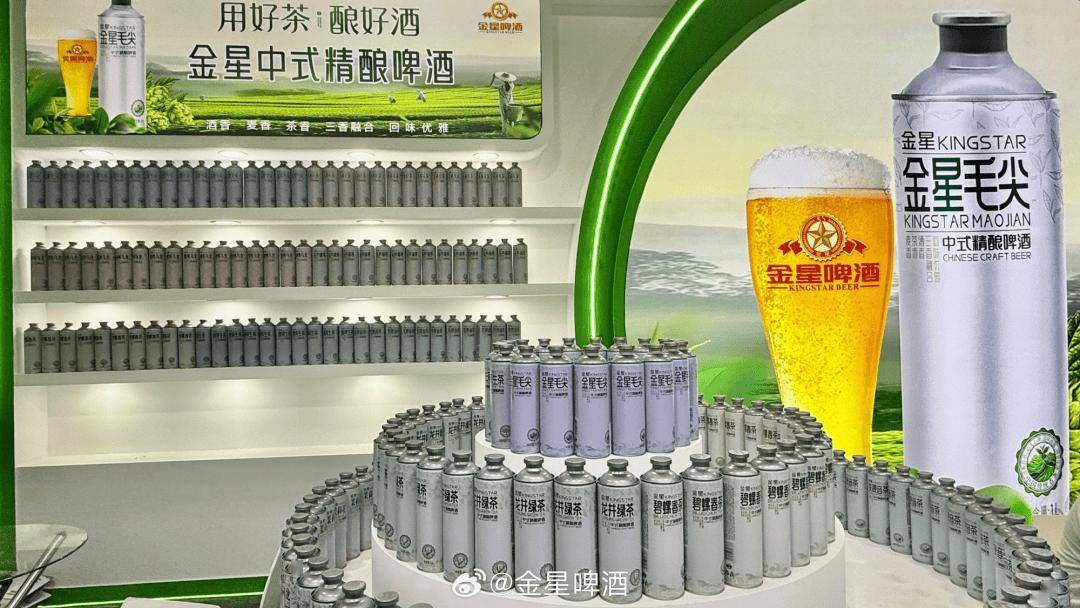
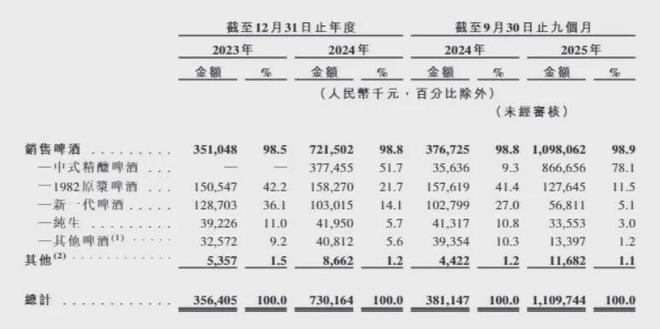
Core Viewpoint - The rapid growth of Henan Jinxing Brewery, driven by its innovative product "Jinxing Maojian," has positioned the company for an upcoming IPO, highlighting the shift in consumer preferences towards female-targeted beverages [2][4][12]. Financial Performance - Jinxing Brewery's revenue surged from 356 million yuan in 2023 to 730 million yuan in 2024, with a further increase to 1.11 billion yuan in the first nine months of 2025, marking a year-on-year growth rate of 191.34% compared to 2024 [2][6]. - The net profit skyrocketed from 12.2 million yuan in 2023 to 125 million yuan in 2024, reaching 305 million yuan in the first nine months of 2025, achieving a 24-fold increase over two years [7][6]. Product Development - The introduction of the "Jinxing Maojian" tea beer in August 2024 marked a significant turning point, with sales reaching 6 tons on the first day and exceeding 100 million cans (approximately 100,000 tons) within ten months [2][4]. - The company has expanded its product line to include 166 SKUs, with 50 being Chinese craft beers, contributing over 70% of revenue in the first nine months of 2025 [5][7]. Market Position - As of September 30, 2025, Jinxing Brewery has become the third-largest craft beer company in China and the largest flavored craft beer producer, holding a market share of 14.6% [2][12]. - The company has successfully tapped into the female consumer market, with over 50% of its core consumer base aged 18-35 being female, and this percentage increased to over 60% with the introduction of new flavors [2][4]. Strategic Initiatives - The company plans to utilize the funds raised from the IPO to upgrade production facilities, acquire capacity, and strengthen its national distribution network, particularly through partnerships with major e-commerce platforms [12][13]. - Jinxing Brewery aims to continue developing new products, including rice wine and non-alcoholic tea beer, while upgrading existing flavors to meet evolving consumer preferences [13].
豫企赴港上市潮起!一周3家企业冲刺港交所,还有多家在推进
Sou Hu Cai Jing· 2026-01-17 13:07
Group 1 - The core viewpoint of the article highlights the increasing trend of Henan enterprises pursuing listings in Hong Kong, with companies like Muyuan Foods, Hanwei Technology, and Jinxing Beer announcing their latest progress in just one week [1][2][3] - The listing activities are driven by multiple factors including financing for expansion, brand upgrades, and governance optimization, marking a significant integration of the Central Plains economy with global capital [1][2] - Hanwei Technology plans to issue H-shares not exceeding 15% of its total share capital post-issue, with funds directed towards R&D, mergers and acquisitions, and production expansion [2][4] Group 2 - Jinxing Beer aims to become the "first Chinese craft beer" by enhancing production capacity, global sales channels, and brand marketing through its upcoming IPO [3][4] - The appeal of the Hong Kong stock market is bolstered by supportive policies, market advantages, and the development needs of enterprises, creating a conducive environment for listings [4][5] - The China Securities Regulatory Commission has introduced measures to facilitate the listing of mainland enterprises in Hong Kong, including streamlining the approval process and reducing costs [5][6] Group 3 - The global pig farming industry presents significant growth opportunities, and Muyuan Foods intends to leverage its technological advantages and cost control to capture overseas market potential [6] - The differentiation in listing paths for Henan enterprises reflects their specific development needs, with A-shares being more suitable for domestic-focused companies and Hong Kong listings appealing to those with international expansion plans [7][8] - The dual listing strategy ("A+H") allows leading enterprises to achieve high valuations in A-shares while expanding their international capital channels through Hong Kong [7][8]

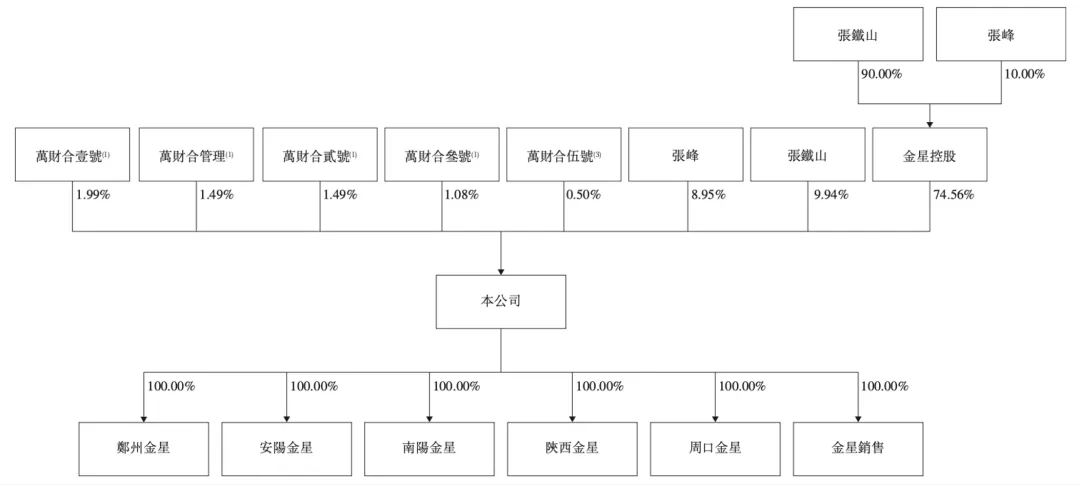
金星啤酒闯港交所:父子绝对控股,2025分红2.29亿,茶啤赛道拥挤
Sou Hu Cai Jing· 2026-01-16 16:15
Core Viewpoint - Henan Jinxing Beer Co., Ltd. is attempting to break free from its regional brand status by pursuing an IPO on the Hong Kong Stock Exchange, aiming to enhance production capacity, global sales, marketing, and product innovation [3][4]. Group 1: Company Background and IPO Plans - Jinxing Beer, originally founded in 1983 as Dongfeng Brewery, has undergone significant transformations, including privatization and restructuring, culminating in its current status as a joint-stock company with 93.45% ownership by the founding family [3][4]. - The company has faced multiple setbacks in its IPO journey, with previous attempts in 2003 and 2011 failing due to ownership issues and financial challenges [4]. - The current IPO plan is seen as a critical step for Jinxing Beer to escape its regional brand limitations and is set against the backdrop of its 40th anniversary [4]. Group 2: Financial Performance and Challenges - Jinxing Beer declared a substantial dividend of 229 million yuan prior to its IPO, exceeding its net profit for 2024, raising concerns about cash flow and financial sustainability [4][5]. - The company has a history of underpaying employee social security and housing funds, accumulating over 20 million yuan in unpaid contributions, which could pose compliance risks [4][5]. Group 3: Market Position and Product Strategy - Jinxing Beer has carved out a niche in the "Chinese craft beer" segment by incorporating local tea flavors, leading to significant revenue growth from 356 million yuan in 2023 to 1.11 billion yuan in the first three quarters of 2025 [6][7]. - The company's traditional beer products have seen a decline in revenue share, with the "Chinese craft beer" category accounting for 78.1% of sales in 2025, highlighting a reliance on a single product line [6][7]. Group 4: Competitive Landscape - Jinxing Beer holds approximately 40% market share in Henan and has expanded its distribution network to cover 29 provinces, but faces increasing competition from national giants who are consolidating regional brands [8][9]. - The company’s supply chain is characterized by high supplier concentration, with over 30% of procurement from the top five suppliers, which poses potential risks [8]. - The tea beer category is becoming a competitive focal point, with major players like China Resources and Budweiser entering the market, making Jinxing Beer’s national expansion challenging [9].
一家冲刺港股,一家破产重整,精酿啤酒冰火两重天?
Sou Hu Cai Jing· 2026-01-16 12:16
Core Viewpoint - The contrasting fates of Henan Jinxing Brewery and Shandong Taishan Brewery highlight the competitive dynamics within China's craft beer industry, with Jinxing poised for an IPO while Taishan faces bankruptcy restructuring [1][10]. Company Overview - Jinxing Brewery, founded in 1982, initially struggled but became a market leader in Henan by 1993 under the leadership of Zhang Tieshan [2]. - Taishan Brewery, once a strong player in the market, is now undergoing bankruptcy restructuring due to severe financial distress [7][9]. Financial Performance - Jinxing Brewery reported a revenue increase of 191.34% to 1.11 billion yuan and a net profit surge of 1095.84% to 305 million yuan in the first nine months of 2025 [7]. - Taishan Brewery's total assets were approximately 622 million yuan, with liabilities reaching 663 million yuan, resulting in a debt ratio of 106.63% [9]. Market Dynamics - The craft beer market in China has surpassed 80 billion yuan and is projected to reach 160 billion yuan by 2026, becoming the only segment in the beer industry experiencing growth [10]. - The industry is witnessing a "three-legged" competitive landscape, with traditional giants leveraging channel advantages, retail companies disrupting with low-price strategies, and independent brands focusing on innovation [10]. Strategic Insights - Taishan Brewery's challenges stem from aggressive expansion driven by performance pressure, neglecting the cash flow and supply chain demands of the craft beer sector [10]. - Jinxing Brewery's success is attributed to its alignment with consumer trends through product innovation and channel adaptation, emphasizing the importance of balancing innovation with stability in a competitive market [10]. Industry Implications - The contrasting situations of Jinxing and Taishan serve as a warning to industry players: in a billion-yuan market, balancing innovation with prudent management and accurately addressing consumer needs is crucial for survival [10][11].
「港股IPO观察」净利率从3%飙至27%!金星啤酒IPO亮出“暴利底牌”:中式精酿高定价能否抵御巨头围剿
Hua Xia Shi Bao· 2026-01-16 11:49
Core Viewpoint - Henan Jinxing Beer Co., Ltd. is embarking on an IPO journey in Hong Kong, aiming to enhance corporate governance, transparency, and secure capital for long-term product development and channel expansion [2][5]. Company Overview - Founded in 1982, Jinxing Beer has evolved from traditional beer to a focus on "Chinese craft beer," launching its first craft beer, Jinxing Maojian, in August 2024, which significantly boosted its performance [3][4]. - In 2023, the company reported revenues of 356 million yuan and a net profit of 12.2 million yuan, but by 2024, revenues surged to 730 million yuan, a 104.9% increase, with net profit reaching 125 million yuan, a 928% increase [3][4]. Financial Performance - For the first three quarters of 2025, Jinxing Beer achieved revenues of 1.11 billion yuan, a 191.2% increase year-on-year, and a net profit of 305 million yuan, a 1095.8% increase [3][4]. - The company has become the eighth largest in China's beer industry and the fifth largest domestic beer company, with a retail sales compound annual growth rate (CAGR) of 23.7% from 2022 to 2024 [4]. Product Pricing and Profitability - Jinxing Beer’s craft beer is priced significantly higher than traditional beers, with craft beer retail prices around 20 yuan per can (1L), compared to traditional beers priced between 2.5 yuan per can (330ml) and 6 yuan per bottle (500ml) [4]. - The gross margin has improved, with figures of 27.3%, 37.8%, and 47% for 2023, 2024, and the first three quarters of 2025, respectively, while net margins reached 3.4%, 17.2%, and 27.5% [4]. Market Position and Competition - Jinxing Beer faces increasing competition from major players like China Resources Beer and Yanjing Beer, which are expanding their craft beer offerings [6][9]. - The company relies heavily on distributors for sales, with 94.8% of its revenue coming from this channel, and has a network covering 29 provinces in China [7]. Strategic Outlook - The IPO is seen as a strategic move to strengthen Jinxing Beer’s market position amid intensifying competition, allowing for enhanced funding for innovation and brand development [5][9]. - The company aims to maintain its focus on Chinese craft beer while navigating the challenges posed by larger competitors and evolving market dynamics [8][9].
金星啤酒冲刺港股:中式精酿贡献近八成收入,去年分红超3亿元
Cai Jing Wang· 2026-01-16 10:39
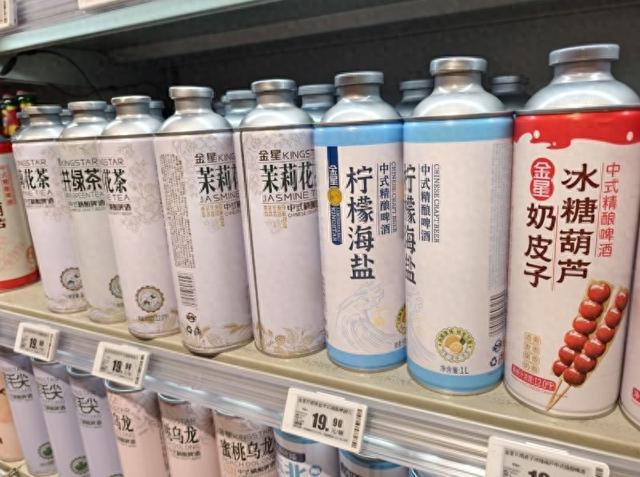
Core Viewpoint - Jin Xing Beer is accelerating its capitalization process by applying for a listing on the Hong Kong Stock Exchange, aiming to become the first "Chinese craft beer" stock in Hong Kong [1] Company Overview - Founded in 1982, Jin Xing Beer has established 15 production bases across 9 provinces in China, with an annual production capacity of 2 million tons [1] - The company’s main products include various series of Chinese craft beer, including "Jin Xing Mao Jian," which combines tea with brewing techniques, and has expanded to flavors like jasmine tea and sugar orange [1] Financial Performance - Jin Xing Beer reported revenues of 356 million RMB, 730 million RMB, and 1.11 billion RMB for the years 2023, 2024, and the first three quarters of 2025, respectively [2][3] - The profit and total comprehensive income for the same periods were 12.2 million RMB, 125 million RMB, and 305 million RMB, with gross margins increasing from 27.3% to 47.0% [2] Product Contribution - In 2024, the revenue from Chinese craft beer reached 377 million RMB, accounting for 51.7% of total revenue, which increased to 867 million RMB and 78.1% in the first nine months of 2025 [4] - Other product categories, such as the 1982 original beer and new generation beer, saw significant revenue declines of 19.0% and 44.7%, respectively [4] Dividend Policy - Prior to its IPO, Jin Xing Beer has implemented substantial dividends, distributing a total of 329 million RMB to shareholders, exceeding its net profit for the first nine months of 2025 [4] Ownership Structure - The company exhibits a family-controlled ownership structure, with the founder and his son controlling 93.45% of the shares [4] Industry Growth - The craft beer market in China is in an expansion phase, with a compound annual growth rate (CAGR) of 38.4% from 2019 to 2024, projected to reach a market size of 182.1 billion RMB by 2029 [5] - The flavored craft beer segment is expected to grow from 11.1 billion RMB in 2024 to 66 billion RMB by 2029, with a CAGR of 42.8% [5] Fundraising Purpose - Jin Xing Beer plans to use the proceeds from its IPO to enhance production capacity, strengthen sales networks, marketing activities, product innovation, and improve digital capabilities [6]
金星啤酒赴港IPO:过度依赖单一品类及分销渠道 递表前分红2.29亿元全部进了实控人父子口袋
Xin Lang Cai Jing· 2026-01-16 10:12
Core Viewpoint - Henan Jinxing Beer Co., Ltd. has submitted its main board listing application to the Hong Kong Stock Exchange, showcasing explosive growth in revenue and net profit driven by the "Chinese craft beer" concept, but faces significant risks from over-reliance on a single product category, family governance issues, and increasing industry competition [1][8] Business Structure Risks: Over-reliance on Chinese Craft Beer and Channel Imbalance - The company's revenue growth is heavily dependent on the "Chinese craft beer" single category, with the "Jinxing Maojian" tea beer series contributing 78.1% of revenue in the first three quarters of 2025, while traditional beer products dropped to 16.6% [2][9] - Over 94% of revenue relies on distributors, with only 4.1% from direct sales, and 61.5% of distributors concentrated in Central China, leading to potential issues like price chaos and inventory mismanagement [2][9] Financial and Governance Concerns: Aggressive Dividends and Social Security Arrears - The company implemented large dividends before the IPO, totaling 229 million yuan, which accounted for 182.6% of the 2024 net profit, while simultaneously facing three years of social security and provident fund arrears exceeding 21.9 million yuan [3][10] - High concentration of ownership, with family members holding 100% of shares, raises governance risks, as the management team is predominantly family members, potentially sidelining minority shareholders [3][10] Industry Competition Pressure: Encroachment by Giants and Lack of Standards - The Chinese craft beer sector is growing rapidly but has low barriers to entry, with major companies like China Resources and Tsingtao launching similar products, and competitors using aggressive pricing strategies [4][11] - The absence of national standards for craft beer allows for easy imitation of the company's "flavor craft" concept, risking the erosion of its first-mover advantage [4][11] Sustainability Challenges: Seasonal Fluctuations and Valuation Disputes - The company's sales exhibit significant seasonality, with a notable decline after October, necessitating production cuts, despite attempts to introduce winter specialty drinks [5][12] - The overall valuation of the Hong Kong beer sector is low (P/E ratio of 15-18 times), and if the company cannot be categorized as "new consumption," its financing scale may fall short of expectations [5][12] Conclusion - The IPO attempt by Jinxing Beer represents a typical case of traditional regional breweries leveraging product innovation for breakthrough, but transitioning from a "viral hit" to a "sustainable enterprise" requires overcoming challenges in product diversification, governance modernization, and building competitive barriers [6][13]